<span>Monthly Archives</span><h1>July 2019</h1>
    Uncategorized

    Visiting Lascaux II

    July 24, 2019

    unnamed-5

    [author’s photo]

    In my last post I promised to note the lighting arrangements in Lascaux II. Well, I went to inspect them today, and, as it happens, I was not disappointed.

    The tour began with a couple of gloomy exhibition spaces. But already it was clear that the cave’s original replica (indeed, ‘original replica’) was to be a more earthy, some might say chthonic, experience. And whereas the guide at Lascaux IV was armed with a slick laser pointer, our guide at Lascaux II used a battered flashlight. This says plenty about the difference between the two experiences. And yet, there was more.

    Before we entered the artificial painted grotto, our guide disappeared on some pretext. We were left alone for maybe three, four minutes. He returned with an actual flaming torch. This delighted young, old, and me, alike. So we ventured onwards.

    Once inside the Hall of the Bulls, the flame was all we had to go on, as our guide stoked up the air of mystery and illuminated bovine form after bovine form.

    But having established we were ‘not afraid of the dark’, he extinguished the torch, and brought up the house lights. It was still not as bright as Lascaux IV. The ochre yellows were not as cheerful. The rock appeared more abrasive. The art somehow looked more monumental. Were we at closer quarters with the art? It seemed that way. The passage through the Diverticule axial was certainly more narrow, more dramatic.

    To compare Lascaux II and Lascaux IV will prove interesting. I’m glad I made the hike, (one mile uphill in 37 degree heat). I climbed a bit further to take a peek at the entrance to the real Lascaux. You can just about make out the steps. Barbed wire, sight-blocking hedges, and private property notices, seem like a strange afterlife for the most famous cave in the world.

    prehistoric art

    Visiting Lascaux IV

    July 23, 2019

    28216220888_0570729f2c_b

    “Lascaux IV”by Alexandre Dolique is licensed under CC BY-NC-ND 2.0


    As I looked up at an 18 metre painted ceiling known as the Diverticule axial, I was, for the first time not merely intrigued by prehistoric art, but moved by it. The weird thing is, I was not in a prehistoric cave. I was in a two-year old replica.

    Today I visited Lascaux IV. While a mere 200 scientists get permission to visit the original each year, Lascaux IV is a resource for the rest of us. It is extensive, atmospheric, and I’m told accurate to within a 16thof a millimetre. Really!?

    It would be hard to conceive of a more exhaustive visitor centre. Our tour lasted for more than an hour; the guide was knowledgeable and personable; the replica caverns were stunning; there was no shortage of museological add ons (films, sound effects, multi-media theatre, 3D cinema, VR lab, interactive gallery of ‘primitive’ modern art, and a temporary exhibition space, gift shops for both grown ups and children.)

    The Vézère Valley is baking today: 40 degrees according to my phone. But I found it really instructive to be told to think of the region as having once been more akin to Lapland or Greenland. Today it is forested. Then it was tundra. Once we were nomads. Now we are tourists.

    Many on the tour are driving round the region seeing more caves, including those where you can see original artwork. I on the other hand will be visiting two more caves here at Lascaux: the first replica (Lascaux II) and an undecorated neighbour, Grand Roc. I must remind myself: it’s all about the replicas. I will try not to well up again, at either.

    By the way, the image is from the Atelier section of the visit. Photography underground is prohibited, which is in itself interesting. But this was the passage which gets compared to the Sistine Chapel. It’s more cheerful than Michelangelo, at least the colours are brighter. I look forward to comparing the lighting at Lascaux II.

    prehistoric art

    The faux pas of primitivism

    July 16, 2019

    14474428405_5f5969f519_b

    “Lascaux 170”by Ma Boîte à Image is licensed under CC BY-NC-SA 2.0

    In post war France, prehistoric art got people talking. At least it got intellectuals talking, but this being France we can imagine that the zone of interest was widespread. The basis for this post, about primitivism in the years following the Second World War, is an important paper by Douglas Smith called Beyond the Cave.

    While many in France thought they’d found the origins of humanity, three figures called into question the simplicity of that conclusion: Georges Bataille, Maurice Blanchot and René Char. Smith quotes poet Char on the dubious quest for orgins: “Cette espérance de retour est la pire perversion de la culture occidentale, sa plus folle aberration.” (This hope of going back is the worst perversion of western culture, its maddest aberration.) But all three writers complicate the notion of origins. They assert, in various ways, with critical subtlety, that the works at Lascaux are both origins and originary non-origins. Bear with it.

    Smith concludes that Lascaux was indeed an ‘impossible origin’, given the efforts of the parties who wanted to find the descendants of the modernist White Cube in the Hall of the Bulls. This was the general idea behind the second wave of primitivism in French culture in the 1940s and 1950s. In the first wave, modern artists looked to exotic cultures for the origins of modernism. But now, figures like artist Jean Dubuffet, photographer Brassaï, and architect Le Corbusier were taking inspiration from the indigenous primitivism of prehistoric art, as if the first artists were already modern without realising it.

    Writer, politician and former Resistance fighter, Andre Malraux claimed that the caves at Montignac were used as an arms cache for his comrades in arms. Lascaux was thought to be a place of anachronistic goodness. This was to ascribe a spurious innocence to prehistoric art, in the face of the guilt which humanity shares in the wake of Auschwitz and Hiroshima.

    tourism, Uncategorized

    How authentic is cave painting?

    July 11, 2019

    coke

    I have been reading a correspondence between Spanish academic José Díaz Cuyás and Dean MacCannell. MacCannell is a former soixante-huitard who lost faith in a 1960s style Revolution. But as he observes, some fifty years later: “‘The revolution’ and especially the romantic figure of the revolutionary is a myth that effectively disables the left today.”

    The public are not totally alienated consumers, as Marx suggests, but more like ‘readers’ (Cuyás) faced with supermarket shelves rather than books. There will be no uprising of organised workers, as in Russia in 1917. But there are still ways to fight climate change, to accommodate migrants and to one day depose the right wing populists who govern us.

    In 1976 MacGannell published The Tourist: A New Theory of the Leisure Class. In doing so he instituted an entire field of academic research, tourism studies. This too is a book about revolution. In a response to Cuyás, its author quotes a passage in which he imagines a totalizing revolution in which every habit of mind is rethought, every book rewritten, every city rebuilt. The end of capitalism is only half of this unthinkable scenario.

    “And yet,” writes MacGannell, “our laws have undergone total change and our cities have been rebuilt block by block. Our masterpieces are remade in each new genre.” So might I also add, our paleolithic  art has been thoroughly replicated, and  reinterpreted. In this light my history of the caves and their mediation could be a history of revolutions.

    And while we may bemoan our lost access to the caves, our passive alienation under capitalism, and our confinement within hyperreal simulacra, MacGannell argues it was ever thus: “No human group, not even the most primitive, has ever lived in anything resembling objective reality.” So if prehistoric art marks the very emergence of the symbolic order, access for its original audience was in a sense as indirect as ours.

    Perhaps MacGannell believes it naïve to want authenticity. He writes: “Without the symbolic, society does not exist”. It underpins science as well as art. It gives us language, law, face to face interaction with other subjective beings. And ironically, one presumes, without it we would be too primitive to ascribe any value to authenticity.

    The author of the tourist even refers to cave painting in his prescription for art: “When it is framed as a vital organ of the symbolic, from the first outline of an animal on the wall of a cave, down to the present day, for better and for worse, all art must engage its audience and continuously demand that its audience complete it.”

    Whether or not it be ‘art’, I intend to demonstrate that 20thand 21stcentury audiences have completed the works found in Franco-Cantabrian caves in a number of ways.

    heritage, paleolithic art

    Lascaux: an intangible monument

    July 4, 2019

    31904812727_491a2bde66_b

    I’ve been reading an essay by Rosemary J Coombe about world heritage in an age of neoliberal politics.

    Whereas a monolithic state may once have strived to preserve monumental artefacts and artworks of supposed universal appeal, we now have a web of agencies both within and outside of government that connect around artefacts that may not even be tangible.

    Efforts to preserve a rare language or a local cuisine are now validified, and the actors who lobby to give them listed status with UNESCO World Heritage Sites, are as likely to be from the community as from the corridors of bureaucratic power, or so it is hoped.

    Intangible cultural heritage even has an acronym (ICH) and ICH has comprised many of the efforts of a 21stcentury UNESCO, in a bid to redress the 19thcentury bias towards Western Europeans which ‘monumental heritage’ is said to represent.

    • But what about a monument which is 20,000 or even 40,000 years old? Is it possible to ‘inherit’ culture which predates written history?
    • If Lascaux is closed to the public, and virtualised in the form of digital reproductions and multiple nearby replicas, how tangible do the original caverns become?
    • And given the little we know about correlatives to the parietal art (which many believe included storytelling, music and/or dance), is Lascaux largely intangible? If so, do the caves represent lost ICH?

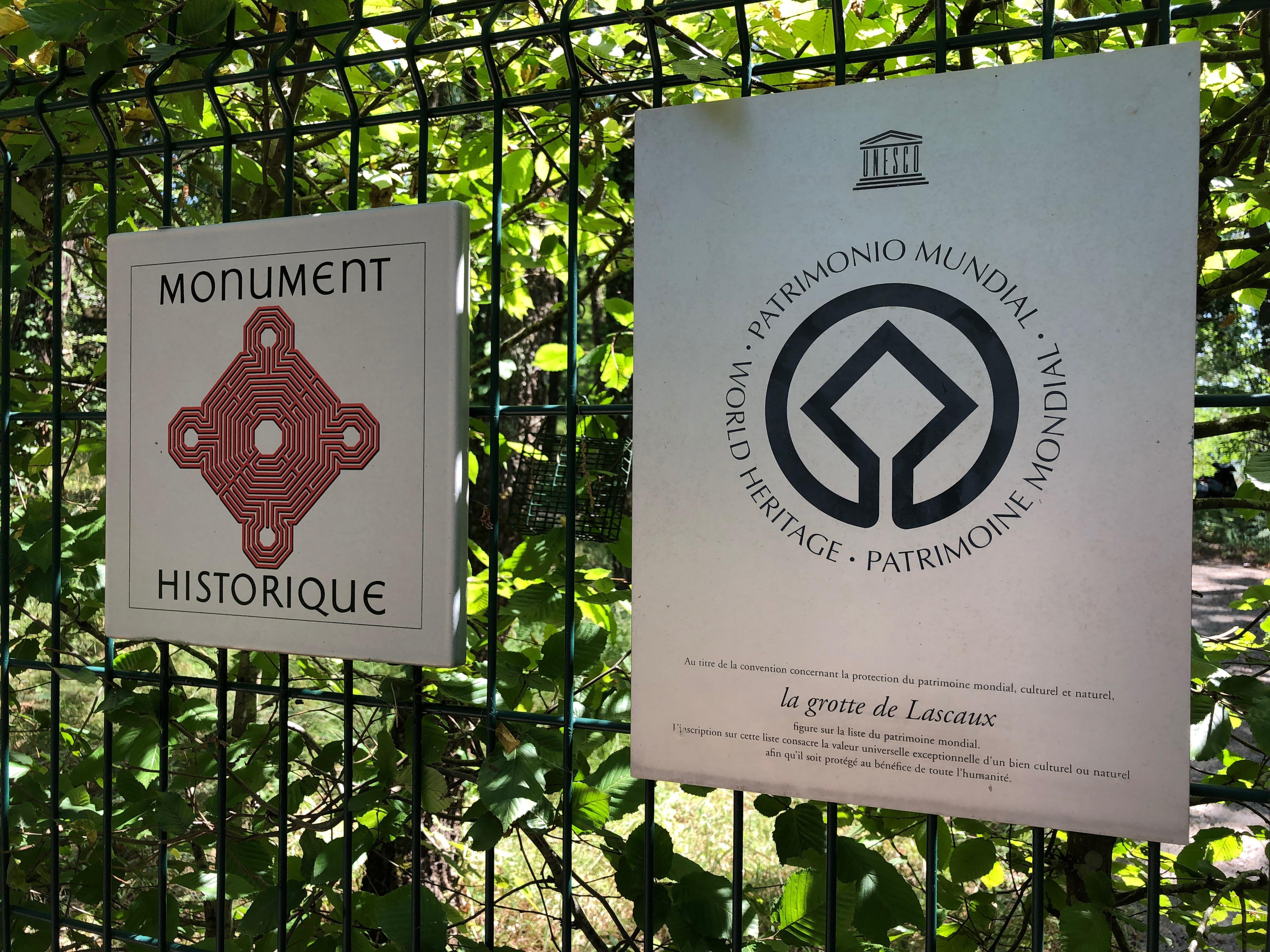
    Whatever the case, one cannot today conceive of Lascaux without UNESCO World Heritage Status. Even if it remains to be seen how the network of bureaucrats and heritage practitioners line up to support its preservation, presentation, and promotion around the world.

    The Minister for Culture may once have closed the caves to the public , but the arrangement in place to keep them closed is described by Coombe as an ‘assemblage’ of interests from the public-private, local-national-and-global joint ventures who compete and collaborate to manage the site at Montignac.