<span>Monthly Archives</span><h1>September 2020</h1>
    philosophy

    A history of madness

    September 28, 2020
    “UFO” by astraverkhau is licensed under CC BY-NC 2.0

    I remember reading Derrida take issue with Foucault. It was about madness, funnily, and the founder of deconstruction asked how it was possible to bear witness to insanity, The essay was ‘Cogito and the history of madness’, and while much flew over my head, I was struck by the humility with which Derrida showed to take on Foucault and critique his former teacher.

    It was a long time ago. I was 28, 29 years old. Derrida was at first utterly incomprehensible to me. Then eventually I got to grips with some of his thinking. It was on an MA course in critical theory at the University of Sussex and it gave me a lot of confidence, to engage with deconstruction.

    My former teacher was Professor Nicholas Royle. It was the first year he led his module on Derrida and much of the course formed the basis for his book on Derrida in the Routledge Critical Thinkers series. My cohort are all there, in the acknowledgements together. It was a very generous act by our former teacher. But if Derrida describes himself as a disciple of Foucault, that is surely what we were in a way and for a while: disciples.

    I should probably keep this quiet and any Derrida expert reading this could probably deconstruct this post in no time; but I’m no longer so convinced about what I learned about my strand of Derrida.

    My dissertation was on madness and much of it revolved around a phrase which appears in an interview from the collection Points; Derrida says “A madness must watch over thinking”. That is to say, we should not allow our decisions to unfold by reason alone because to do so would render our lives too mechanistic. That way danger lies and, yes, we should avoid an excess of reason.

    But to inform a decision with madness? I must now be honest; it seems a bad idea. Madness, to my mind, is choosing cigarette brands according to religion. Or believing you can tune into radio stations on your teeth. That sort of thing. It should not watch over thinking. Emotion should inevitably watch over thinking, but emotion is not madness and I no longer subscribe to the idea that madness and emotion are on a sliding scale.

    Madness is not an absence of reason or an excess of emotion. I think the mad have plenty of reasons for most of what they think or do. And I don’t believe they are any more passionate than those of us above ground. And yes, I do think one can bear witness. You can witness madness by observing the barefoot guy picking through the trash outside the shopping centre. You can observe it by reading Judge Schreber, or even Swedenborg.

    Swedenborg was in contact with aliens, apparently, while remaining one of Earth’s first rank philosophers. Derrida asks, with what I recall seemed like alarm at the time, in his essay Passions: an Oblique Offering, “How is a Swedenborg possible?”.  How indeed? This is a profound question, and it indicates that Derrida’s understanding of madness has its limits. As does mine or yours. But you would not want aliens to watch over thinking.
    contemporary art

    Walter and Zoniel, A Simple Act of Wonder (2020)

    September 3, 2020

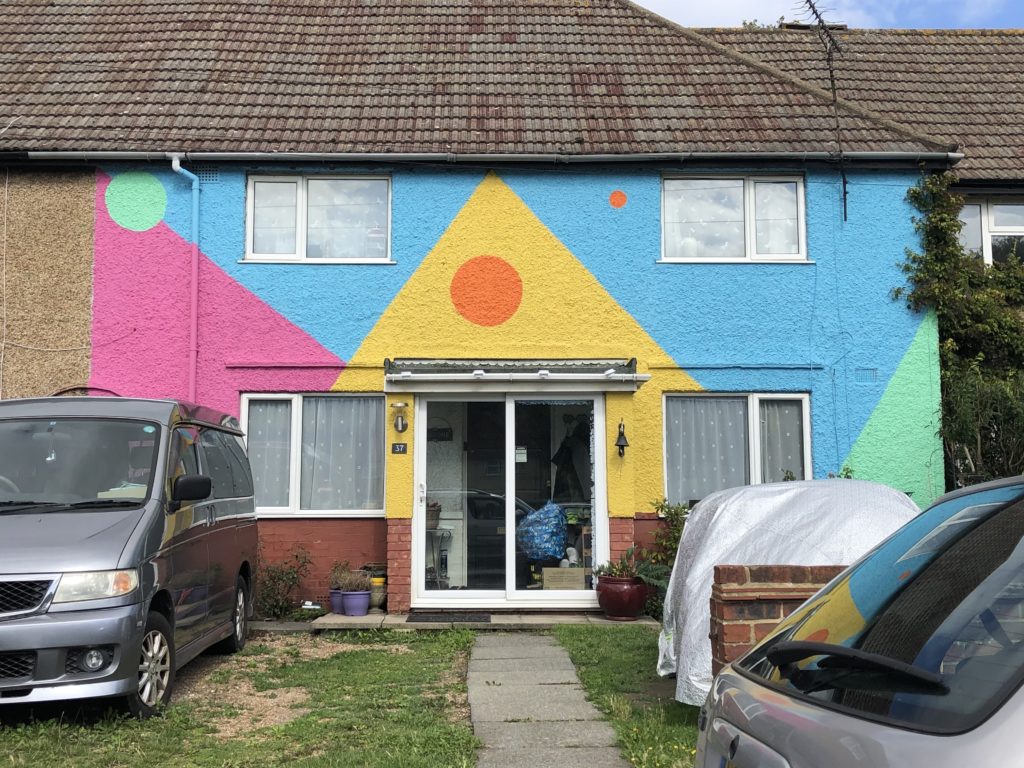
    Before I heard about this exhibition and community-based artwork, Moulescoombe was just a destination on the front of the 49 bus, a neighbourhood so different from the middle-class bubbles in which I’ve lived, I had never gone there. And yet go there, properly, we did, myself and co-writer/co-photographer, 9-year-old Aysha, who enjoyed spotting the newly painted murals from the passenger side of a car driven, too slowly, by me, around the unfamiliar suburban streets.

    I can only say we did experience a simple act of wonder to find bright geometric painting on the side of characteristically grey council housing. We found five such interventions, each resonating with the others, and each one a testament to the occupants, brave enough to foray into exhibiting contemporary art on the side of their traditional housing.

    By this wondrous act, artists Walter and Zoniel have brought Moulescoombe and adjacent neighbourhood Bevendean into dialogue with city centre gallery Fabrica; in this central hub, the murals now relate to an immersive installation, all bright carpets and stretched plastic tape, which echo the loud colours and geometric forms deployed around the two estates on the edge of town. It was hoped that many Brighton residents, especially those who are often excluded from contemporary art spaces, might come and explore this show. But a global pandemic has meant that the gallery is closed to the general public.

    Our family got access (a blogging perk) and we got to enjoy the space as light streamed into the colours here, on one of the last days of summer 2020. Liz Whitehead from Fabrica recounted the genesis of the project: the time the artists had spent on the two estates, the fact that a few of the houses will retain their new appearance, and also the origins of the show title; ‘A Simple Act of Wonder’ emerged from a conversation between the artists and a resident who apparently exclaimed “That’s it! That should be the title!”

    Simple art, perhaps, but for people who are clearly never simple. A good few from these neighbourhoods have got to grips with a disruptive new artwork. And as for me, I got to navigate a new local environment, quite different to my usual haunts. And I got to share the wonder of Aysha; my daughter wrote, unaided, a review of the show at Fabrica. (She also took the photos for this post.)

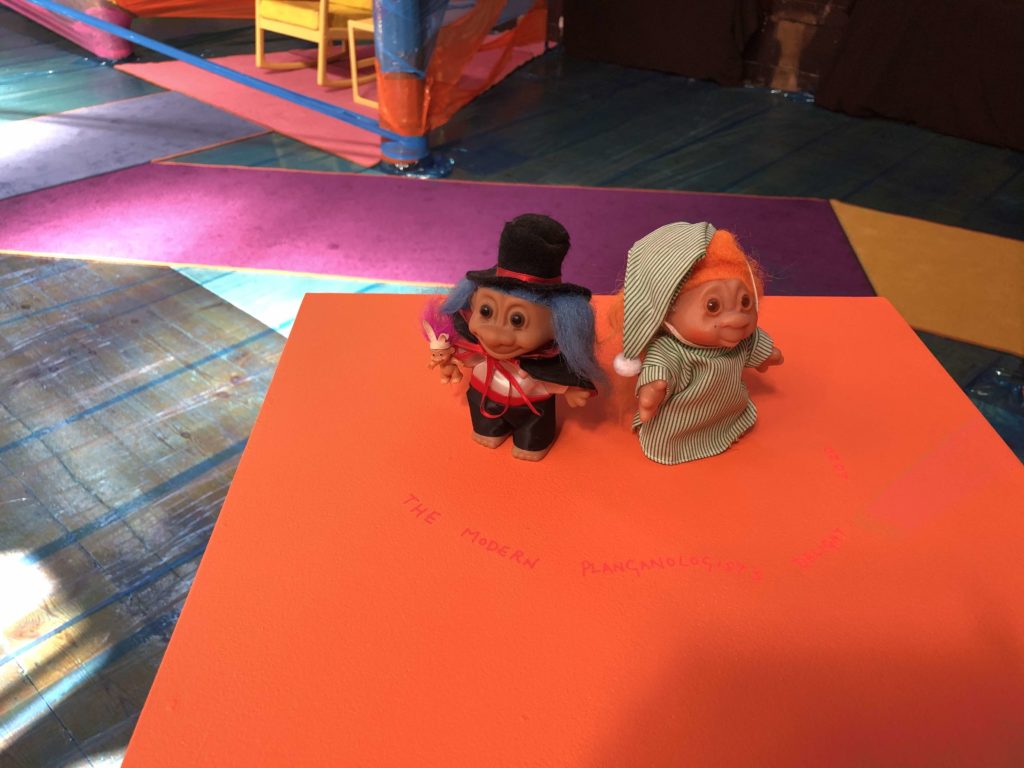
    “Me, Mark and Mummy went to this really amazing art exhibition. There were so many colours there. Later in this review I will show you some pictures of it. It was so colourful it made me want to run and jump around. We were told to take our shoes off before we went in, because there were so many different kinds of textures on the floor that they wanted us to feel them and it was really fun. The artists’ names were Walter and Zoniel. It was in town in Brighton. Some of the colours were red, orange, yellow, green, blue purple pink and grey.

    Here are some photos:

    “In the picture you can see at the end there are some photos of stuff like cats, dogs and people doing stuff.”

    “There you can see that there were little things like toys.”

    A Simple Act of Wonder runs until, at least, the 10 September 2020 in various sites in Moulescoombe and Bevendean. A map trail can be found on the Fabrica website where you can also explore the gallery show, virtually,