Can an artist activate items in a museum collection, or do those items activate the artist in turn?
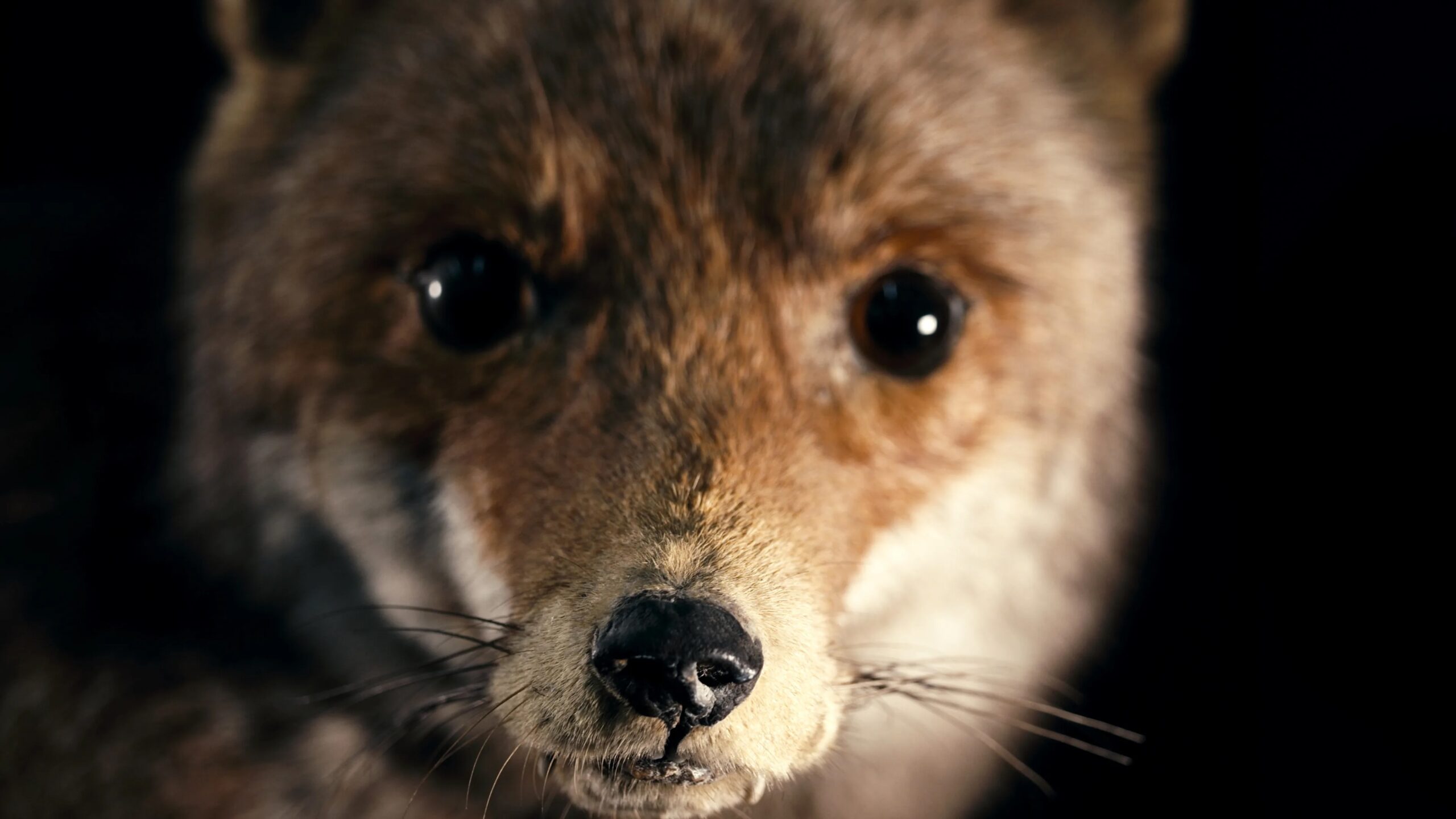
At the Amelia Scott Civic Centre in Tunbridge Wells, a rook, a fox, a kingfisher, a crystalline rock and a dinosaur bone have all triggered a new work by David Blandy. Each of these artefacts has been removed from a vitrine, filmed in a studio, and given a thought-provoking script and VO. In this way, you might say, they have also given the artist a voice, certainly a vision.
Taxidermy animals have an unusual status. They retain a preserved appearance, but they are dead. They let you get really close as a result, and they have those glassy eyes, which you will never look into in the wild. As they rotate, up close, against a cosmically-black background, in a black box viewing space here at the Amelia, they are, dare I say it, even a little bit comic. But are we not the funny ones for having once gutted these beautiful creatures and sewn stuffing into their feathers and fur?
There’s quite a lot of talk these days about objects having agency, stones having consciousness, rooms having memories and so forth. But if talking immobile, unbreathing, non-reproductive entities as having being, then a museum is a great place to test that. (A film such as Night at the Museum is an exaggerated narrative sure, but it does illustrate an imaginative truth for theories about artefacts and their souls.)
Blandy might be pulling in allusions to the Canterbury Tales, that local epic, and this genteel town’s grazing lands in common ownership, as if the rook, the fox, the kingfisher, the rock and the bone have travelled here though space and time to carry one of the artist’s stories of post-apocalyptic recuperation. Except that this story could not have been told in this place without a very living collection of natural history and prehistory.
Shared commons, shared pasture, shared nature and, as the film puts it, ‘common knowledge’ and ‘common wealth’ are the ideas we need right now, as the climate collapses and the chickens of private ownership are coming home to roost.
Museums like the Amelia, with their impulse to share collections with then widest possible audience, are an enduring part of that ideal dynamic. I think that might be true to the extent that in this case a museum has operated as a medium for several characters, animal and mineral, to call out for an artist to tell their tale.
Commons illustrates how the holdings of a museum have a certain grip on the institution, and any artists invited to work with them, in turn.
David Blandy’s work can be seen at the Amelia Scott in Tunbridge Wells until 11 January 2026.