Browsing Tag: installation

    drawing

    Emma Stibbon: Melting Ice | Rising Tides

    May 29, 2024
    Emma Stibbon, Sea II (2012) (detail)

    Her ink froze. Emma Stibbon was on the deck of the Antigua, a barquentine sailing boat forging a course into the arctic waters above Svalbad, Norway. The waters were rough as well as cold, and the artist was alleviating sea sickness by staying out on deck and drawing. Some works from this endeavour contain tiny spines of colour where the ice flakes have shaped the marks she was making in her sketchbook.

    Melting Ice | Rising Tides is a show resulting from a) field trips to both arctic regions and b) time spent looking at the coast of East Sussex. It is hard to imagine a more coherent yet far reaching exhibition. It has purpose: to bring home the effects of global warming. And equal weight is given to the plight of Greenland, say, and the erosion of the Seven Sisters, not far from the gallery. And it has consistency: water colour and ink washes build to create a prevailing mood of monochrome coolness, where blue, green and lilac tints add nuance to the overall picture.

    These drawings are better seen than photographed. They are beautiful: how sublime are the pale bergs upon the dark sees! How complex and enthralling is the foam atop a wave! In each of these drawings one feels the dramatic attempt of hand and eye to encompass extremes of nature and express the magnitude of the climate emergency. There are no human figures anywhere, yet our carbon footprint is everywhere in these stark and treacherous vistas.

    Along with acrylic, watercolour and ink, there are plenty of innovative materials. Stibbon uses cliff chalk and sea salt in her preparations in a gesture that blends her works with their subject. On the crest of waves, there is delicate tracery left by evaporated water; she uses seawater in some of the works. Elsewhere aluminium powder gives her ice floes additional texture and grit. The labels in this exhibition repay cross referencing with the works. This must be the poetry of fact.

    Such poetry, hardly to be expected from what is ostensibly a vast observational drawing exercise, is everywhere: breaking waves captured with impossible detail and care are mesmerising; coast guard cottages on clifftops which will eventually collapse are overwhelmingly lonely; the discovery of a local landmark in Seaford called Hope Gap results in a vertiginous study of a set of steps plunging down into a roiling sea. 

    At the heart of the show is a full scale recreation of a cliff fall, complete with chalk boulders, rocks and rubble, plus and an eight metre wide drawing of a Sussex cliff. In any other context this site specific monument would be the show stopper. Indeed, it is perfect the way that Stibbon has brought the local downland shoreline, so often celebrated here at Towner, into the white cube environment. The immensity of her subject and her theme both perhaps call for it.

    But scaled right down to a modestly-sized blackened intaglio print, Stibbon is at her intense best: capturing a chaotic wave-scape which is of course completely ephemeral. Sea II (2012) is just one example of the artist’s ability to pause time. If only our species could do the same, these impending disasters may not all come to pass.

    Emma Stibbon: Melting Ice | Rising Tides can be seen at Towner, Eastbourne, until 15 September 2024.
    sound art

    Laurie Anderson, Lou Reed Drones (2016)

    May 17, 2016

    anderson

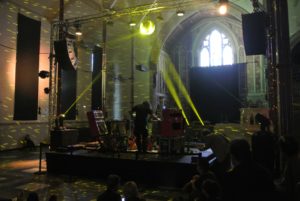
    Saint Mark’s chapel in Kemptown has been throbbing for five days straight. That is what you get from this piece, a relentless pulse of skuzzy, kilowatt-heavy hum which envelops you.

    Where’s the band? You might ask, if you are keen on music of this persuasion. Well, they’ve left behind some eight unmanned guitars leaning on a similar number of vintage amps.

    Rather than a performer, we have a soundman, who is putting in these marathon stretches in which he orchestrates the oscillations. ‘Here come the waves,’ as Lou Reed himself once sang.

    Yes, this is the much anticipated installation piece by artist and musician Laurie Anderson in which several of her late husband’s guitars are set to feedback in deafening harmony.

    It’s a warm bath, which may explain why the crowd in here are dwelling for long minutes at a time. They sit on risers. They lie on the stone floor. One guy in shades has hands clasped in prayer.

    But the stained glass cannot compete with the lighting rig and the spots of light which flit around the room like a murmuration of fireflies. Yes, there is a glitter ball. It hangs in the air like a quoted lyric.

    This attempt to raise the dead, within the safe confines of an Anglican chapel, feels like a partial success. Lou Reed is surely working his caustic, sonic way into the heart of the assembled crowd.

    We have dry ice instead of incense, to remind us that rock rituals have frequently been about the mysteries of faith and the incarnation of rebel angels.

    To complain that this gig-like event is not Art, would be churlishness turned up to eleven on the volume dial. The categories hardly matter, because Reed deserves this encore.

    Lou Reed Drones had its UK premier between May 13 and 17 as part of the Brighton Festival 2016, guest curated by Laurie Anderson.

    film art

    João Maria Gusmão + Pedro Paiva, Glossolalia [Good Morning] (2014)

    February 12, 2015

    GP-Parrot-8_500_327_80_s_c1

    “There’s a metaphor in there somewhere,” says Guardian critic Adrian Searle, as he contemplates this film. criticismism would like to pick up on those words: parrot fashion, naturally.

    But that is what Glossolalia makes me think of: art criticism, mimicry and even plagiarism. To look at reviews for this pair of Portuguese artists certain phrases do the rounds.

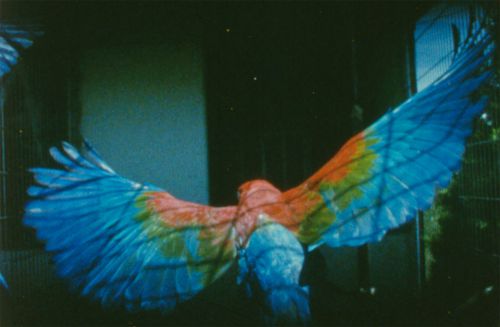
    Pataphysics, haunting, the limits of reason, the uncanny, slow-mo; the observations loop in and out of various publications. They make this show appear like a dazzling macaw stuck in a cage.

    And yet precise words might not matter. Perhaps the babble alone should hold our attention.  Glossolalia does after all cite the religious phenomena of speaking in tongues.

    In which case, it is the rhythm to which we should attend. Searle has a rhythm in which adjectives pile up and sentences spill over, which is of course fine. It’s nothing if not distinctive.

    However, the rhythm of this film Gusmão + Paiva is a magisterial throb, with a silent pounding effect as the caged bird takes flight. No, there is no sound. We take on trust, this parrot’s gift of speech.

    There is always something out of control about the tongue of a psittacine. Whether overwhelmed or underwhelmed the same could be said of an art writer. We feel compelled to speak.

    In many cases, what comes out is a reconfigured press release, or a half remembered curator’s talk, or even that notorious form of glossolalia known as International Art Speak.

    One might also parrot other critics. Interview magazine reveals that the artists film at 3,000 frames per second to give a weirdly crisp result when slowed down to 24. Now I’ve revealed it too.

    Seeing is believing, even if hearing cannot be. Our title suggests that if we could hear this pretty boy, he would bid us Good Morning. The bright feathers speak. The image is a vocal one.

    João Maria Gusmão + Pedro Paiva: Papagaia can be seen at Camden Arts Centre until 29 March 2015. Meanwhile, here’s a topical story about a parrot.