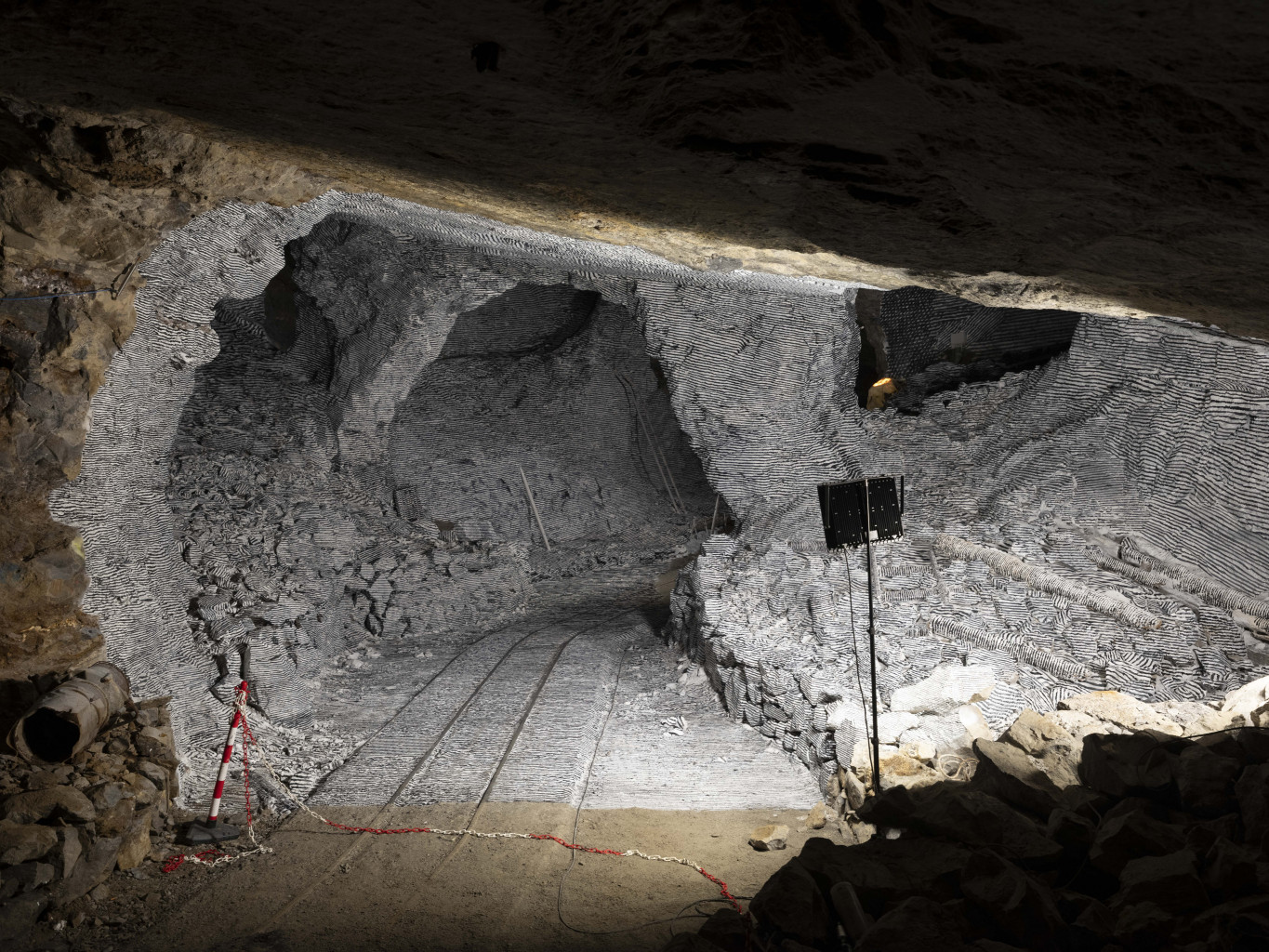
The Orobie Biennial, to be found in the Bergamo Alps of Northern Italy, draws together and curates a rolling programme of many peaks. Exhibitions, installations, interventions are all set among some of Europe’s most scenic mountains. Interesting venues for visual art, in this region better known for hiking, have included a deep chamber in a disused iron and fluorite mine used now for tourism and the aging of local cheeses.
It was here that German artist Julius von Bismarck staged a piece of site specific painting that disrupted the entrance to two or three tunnels by a repetitive pattern of uniform, tight black lines which follow the contours of the walls but which create a remarkable illusion of flatness.
Stand back and, as the corresponding photographic artwork reveals, it could be an art historical etching. Walk inside and, working on viewers like some prehistoric abstract parietal work, it must heighten awareness of one’s body, as well as an effect of proximity to the Underworld.
Given this blog’s interest in what gets called ‘cave art’ and how that relates to contemporary, immersive art environments I was keen to read about this work. But seeing as not much commentary has found its way online yet, I thought it would be useful to interview Julius, virtually, from his studio in Berlin, and he was kind enough to give up his time..
MS: Dürer, Friedrich, Klee and Cezanne have all been cited as influences for this series, but Landscape Painting (Mine) (2025) made me immediately think of parietal works from prehistory. What are the points of difference and similarity with ‘cave art’ and this rare sub-genre of that, which we might call ‘mine art’?
JvB: Yeah, I think that’s a coincidence. Even if cave painting wasn’t a thing, I would have done the mine painting or drawing or etching. The fact that cave painting exists and not just once but over the whole planet and done by different humans in different ages is of course a very interesting layer of the work, as it opens up the question as to what would cave painting be today? Caves were not the only places where humans started to paint or draw what they’d seen (which of course is a very important step in human evolution.) It’s probable they did it somewhere else but it washed away, everywhere except for caves. So the cave basically is the data safe which, by accident, humans have used — without planning — to make these drawings that lived thousands and thousands of years later. It’s a kind of a random archive of human development.
Some years ago, when humans came to picture their surroundings, they created a medium. They created a language, right? One dog barks to another dog; one wolf sings to another wolf; a stag is bellowing to show off his power: language has existed between many different animals, including humans but it was something that only existed in the moment, when it was spoken by our prehistoric ancestors. However, the drawing is an important step in making this medium of communication last, which is a completely new quality of human power in some way. I think it’s really interesting to find out why humans were able to have such a massive effect on their hosting planet or on the biosphere that made them.
Landscape Painting, is a series of projects: The first one I did in Mexico, then I went on to do it in different natural environments, different cultural zones, collaborating with different humans. It’s an ongoing project that I will keep on doing, and the whole project is what you’d call media critique or an experimental media archaeology. I’m trying to find out what it means to depict the world and what change that makes in the world.
My theory is this: if you draw a mountain you will change that mountain. By depicting something you change what you depict. For example, recently you can see it very easily with influencers; influencers can take a selfie on a mountain peak in some National Park and next year there’s thousands of influencers queuing up to recreate the same shot. Thus the act of depiction influences the subject being depicted. Maybe even those early depictions of some bison in a cave painting might give us not only the idea that these bison existed in that time, but also a retroactive effect on the bison, because maybe one day we’ll come up with the idea of remaking the local species from some DNA that we find in the cave. Inspired by that cave painting we’ll bring it back to life!
MS: What specifically entailed you to make work underground
JvB: My Landscape Paintings are always historically inspired because I’m trying to look back and forward at the same time, trying to make sense of what’s happening visually. And yes, many artists before me depicted quarries and mines. It’s a typical sujet of landscape painting, and of etchings that were printed and circulated worldwide in newspapers and books or sold as individual prints. I’m talking about the time before photography was invented, when printing was one of the primary visual mediums through which we understood the world, especially in colonial timeframes.
For example ships were being sent to the other side of the world but these places weren’t known through photos and videos — we encountered these ‘foreign’ lands through etchings and paintings. This work attempts to reimagine that world because mines, caves and quarries were so often the scenes depicted. Humans were fascinated with the power of what they could do. Making a mine is akin to moving a mountain. So it’s an early visual effect corresponding to ways that humans came to affect the surface of the earth
MS: The work raises fascinating questions about perspective and immersion. At Orobie it was presumably in 360 degrees. On screen, it is in two dimensions. Like a cave painting it follows the relief of the subterranean wall, but when photographed it collapses into 2D, looking uncannily like an engraving. Would you prefer it to be seen in reproduction? Are perspectival engravings the first immersive art experiences or is that too simplistic?
JvB: With media tech you can make magic happen, you get that with Van Gogh Live and similar experiences which I find all very interesting. But often they are used in very uninteresting ways: mainly to create a simple ‘wow!’ effect, although admittedly that can sometimes be very nice. Even a selfie-media show can be interesting because you start to question your senses in a way you haven’t done before.
In this case I didn’t expect the landscape painting to feel so intense in person, because I thought it needed the step of being two-dimensionalised again. When you first look at it, it reads one way; but if you look at it for longer it shifts into something else and this transformation is what I’m interested in. When you go into the cave, you obviously know you’re in a cave and you know you’re looking at a drawing, so I didn’t anticipate the effect to be that strong. But standing in there it ‘s as if your brain keeps insisting “Drawing, drawing drawing drawing!” though you know you are inside the cave.
So far my Landscape Paintings have always been very temporary because they’re outdoors and I knew the effect would be short-lived. As soon as it rained or snowed, or there was wind or sun, everything deteriorates. I’m working with organic paint which is not the most durable and will simply wash away. But the cave is the opposite case, because you still have these many-thousand-year-old cave paintings done with paint that would not have lasted long outside. For me permanence was never essential but it’s a nice additional layer and one can only wait to see what happens.
Also the way people encounter the work is not really under my control. The mine is accessible: people come on tours, they wear helmets, it’s almost like a historical site you visit, which is a strange context for an artwork. And I don’t know if this will become a selfie spot or something that people find intrusive. Perhaps they’ll think the cave would be more beautiful without those ugly lines, which is also a completely valid response.
MS: What was your process and what were the physical challenges in making this work? Dark underground spaces can play tricks on the mind after all. Were you aware of any self-conscious heroism coming into play as you entered the mountainside and altered the rock face? As you made this piece what was your awareness of hardship and bodily risk?
JvB: I get this question a lot. Wildfires and hurricanes and Antarctic regions are places not normally known for their comfort. But I don’t experience going there as a heroic challenge. In fact, the idea of “conquering” the world, being a hero by getting to places that are hard to get to feels like an anachronism. People climb mountains to reach the summit. I enjoy that too, as a hobby. But I do it because the view is amazing, and it’s nice to have a personal challenge. I love it because I get to go through totally different climate zones, walking up a mountain. It’s similar with going into a forest fire; it’s intensely compelling because these environments contain so much interesting information you can’t access otherwise.
The attitude of, ’Oh yeah, I’ve been in this deepest cave or mine in the world!’ is really not what motivates me at all .Historically, that may have played a role for many, but if you go back to Humboldt [nineteenth century German geographer, naturalist and explorer] and read his diaries you also see that he didn’t go to these places in order to conquer them but it was predominantly for scientific research. Later on mountaineering became more about proving you could get somewhere, less about gathering any information
As for working in the mine: It wasn’t comfortable at all. It was 10 degrees and super wet in there, which meant the paint wouldn’t dry. lt was warm outside but inside it still felt like winter and we were not allowed to make a fire because nowadays people are concerned about fatal levels of carbon monoxide. (Even though people became what they are by going into caves and making fires; now we’re forbidden to make fires in caves). Anyways, it was cold and wet and the team that I worked with are the real heroes. Those thousands and thousands of lines could only be painted in a team effort.
MS: But I think certain feelings are inescapable. Exploring caves is adventurous.
JvB: Of course, since Jules Verne wrote Journey to the Centre of the Earth, that’s baked into us. Going into a mountain or going underground always carries a little bit of that feeling. When I was a teenager I spent quite a lot of time in the subway system in Berlin searching for secret tunnels. There was this big tunnel system beneath the Wall [the Berlin Wall, 1961 -1989] that had been sealed off to prevent people from escaping via subterranean passages.
It was an adventure going underground, like a secret underground world, and, of course, that fascination, and that romanticism along with it, comes from Verne.
MS: Finally, it seems to me that prehistoric parietal works (aka cave paintings) translate quite badly into two dimensions. They lack the illusion of depth whereas your piece creates the illusion of flatness. Technically how did you achieve this? Was there much experimentation with camera and equipment and were you surprised at any point by the results or lack of?
JvB: Thanks for that question, normally people never ask me that and I put a lot of effort into it so, yeah, it was a challenge. I don’t know how many photos I took, maybe hundreds. But in the end I used probably 50 of them and stitched them together. I took a flash system with several flash units that would bring enough light into the cave, to get a high quality of photo. The thing is, I wanted it to look like a drawing and a drawing has no blurry parts. With an etching, either its black or white; there’s no grey and for that you need very high image quality to not have grainy or blurry parts. That’s a big challenge in such a dark place, so we needed to use flashlights like studio lighting. Those lights make it possible to capture the surface sharply and at high resolution.
MS: Then there was the moment of truth. What was that like?
JvB: Just a lot of excitement because only at the very end it all came together. That was a stressful moment because I tend to use up all the time available and we had to hurry, since we allowed ourselves three days for the shoot and post production. I would spend all day in there taking photos trying to be concentrated, being super nervous because I loved how it looked. Translating that into a photograph was so difficult and it was something I really needed to do myself. Normally I am a team player but I have never met someone who would do that as precisely as I want it to be.
Julius von Bismarck, Landscape Painting (Mine), 2025, could be seen June to September in Dossena, at The Orobie Biennial – Thinking Like a Mountain, GAMeC, Bergamo, 2025.