Browsing Tag: politics

    Uncategorized

    Matthew Collings at Handel Street Projects

    October 13, 2025

    On my way to Handel Street Projects, the bus passed Abbey Road. There were about two dozen tourists by the iconic crossing, staging photographs and re-enactments. A negotiation between drivers and pedestrians takes place all day here. It’s a scene of celebration of visual culture, which set the tone for me as I travelled to The Matthew Collings Holistic Art Experience, due to open that evening (on a visit I made on September 19). Having ascertained I wasn’t from the Telegraph or the Mail, the curator, Fedja Klikovac, and eponymous artist, Collings, were generous enough to make a little time for me to poke around a few hours before the PV.

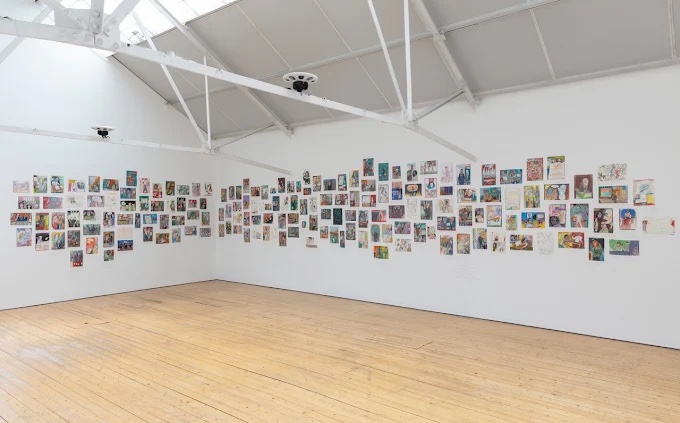
    At the Marylebone gallery, I was led up an innocuous flight of stairs into a large gallery with four grey walls on which imagination and memory bring alive some 300 iconic scenes, with a cast of pop cultural figures, art historical figures and political actors posed for dreamlike snapshots from the pencil of Matthew Collings. These images fill the space, and look for any period of time and you will even see a Beatle or two. There are more characters than the cover of Sgt Pepper and the theatricality is just as vivid. Pop colours abound, but political messages, rather than cryptic ones are as black and white as they need to be in our times.

    The artist sat in one corner of the room, writing lengthy expository captions directly on the gallery wall. Collings was happy to break soon and to chat with me about all of this. I had never met him, but he was little different from his online self-presentation. Spectacle frames heavy enough to be serious when paired with Karl Marx-like beard. And, in a recent unfortunate development, a patch on one eye to combat the discomfort of Bell’s palsy. The artist was as welcoming as you hope him to be; not only does he keep some rarified imaginative company – with some very great artists and some very evil world leaders – he has a common touch.

    Let me just expand. There is a genocide in Gaza. There are fascists controlling the narratives on race in the UK. Trump is as mad as he is stupid. Contemporary artists are silent on issues which might hurt their careers. As a result there is no mainstream visibility for the ammoral billionaires and their hired friends in UK and American politics. In art we struggle with an absence of any cri-de-coeur masterpieces; there is no Picasso, Goya or Velasquez equal to the task of protest. The spirit of Philip Guston, who Collings tells me was perhaps our last great artistic social critic, has been confined by celebratory curators and museum people to the 20th century, with no notion of a KKK at work in America today.

    Collings is obsessed with the art world and manages to be an outsider and an insider at the same time. In past decades he edited an art magazine, presented art television, made abstract paintings with his partner Emma Biggs (which he might still be doing). When I ask about such entanglement with what he decries as a right-wing capitalist racket, he compares art world people to family, because you can’t choose them, and you might hate them, but you are part of them.

    With an ease of creating likenesses, a surreal gift for unlikely encounters, a sense of urgency that never lacks a sense of humour, Collings depicts an imaginary dynamics by which the famous dead, living celebs from art, music & literature, plus fiend-like political figures battle it out. The artist has described the exhibition as a portrayal of the content of his head, no more, no less. But if so, it is a landscape that feels both funny and familiar, not least because so many of these drawings have previously appeared on Instagram.

    But if I was expecting to get a sense of déjà vu from this exhibition, that was confounded. because each drawing here looks more richly and artfully executed in real life and the effect of hundreds of these across the entire gallery space is really overwhelming. I stepped into the space and uttered a word I had not anticipated from a crop of IG posts, “Wow!”

    I noted in the visitor book that Collings really has art world ‘surrounded’. I was not 100 percent sure who it was who ever was said to have said that they had America ‘surrounded’. Help me out in the comments if you know. But for me the phrase is a mad, ominous, messianic promise. Was it Timothy Leary or one of the Zippies? Either way it is an episode from twentieth century history of the ilk to be found in these historical drawings. These trenchant works, in this 360 degree space, have the capacity to turn heads and, I hope, change minds.

    The Matthew Collings Holistic Art Experience can be experienced at Handel Street Projects, London, until 24 October 2025.

    contemporary art, Uncategorized

    Interview: Paul Watson

    May 16, 2024
    Bacchanalia Beneath the Wind Turbines, Paul Watson, 2019

    An artist and I stand on the summit of Whitehawk Hill, atop the hidden remains of a neolithic encampment. He is dressed in black, and smokes actual cigarettes, as I might have expected. Beyond that I’ve little idea how this meeting, with one of Folklore Twitter’s dark luminaries is about to play out.

    The setting, a prehistoric site we both chose, is disappointingly nondescript. I had hoped it will channel some chthonic energy into the piece you are about to read. But for the time being, myself, and this leading online goth and Brighton-based artist, contemplate a mobile phone mast. He seems to love it!

    “I don’t believe in magic” he tells me later in the East Brighton cafe to which we repair. But, dimly, I had thought of Paul Watson as a serious occultist, with a suitably esoteric vision. His last published body of work comprises of shadowy charcoal figure drawings of gloomy naked models. These subjects looks so close to the relic-littered soil of old Albion. His drawings reference myth, pagan spirits, and a spirit of utter dejection which is very 2024. (Watson has an abiding interest in the English civil war).

    To further characterise his drawing, I would say that his figures are very inward. In charcoal, their bodies are pale or grimy, never warm or especially inviting. Whereas classical life drawing conveys a sense of anatomical fidelity, Watson seems to dispense with flesh in favour of bone. His men are stony or grave rather than vigorous; his women perhaps dented rather than curvaceous.

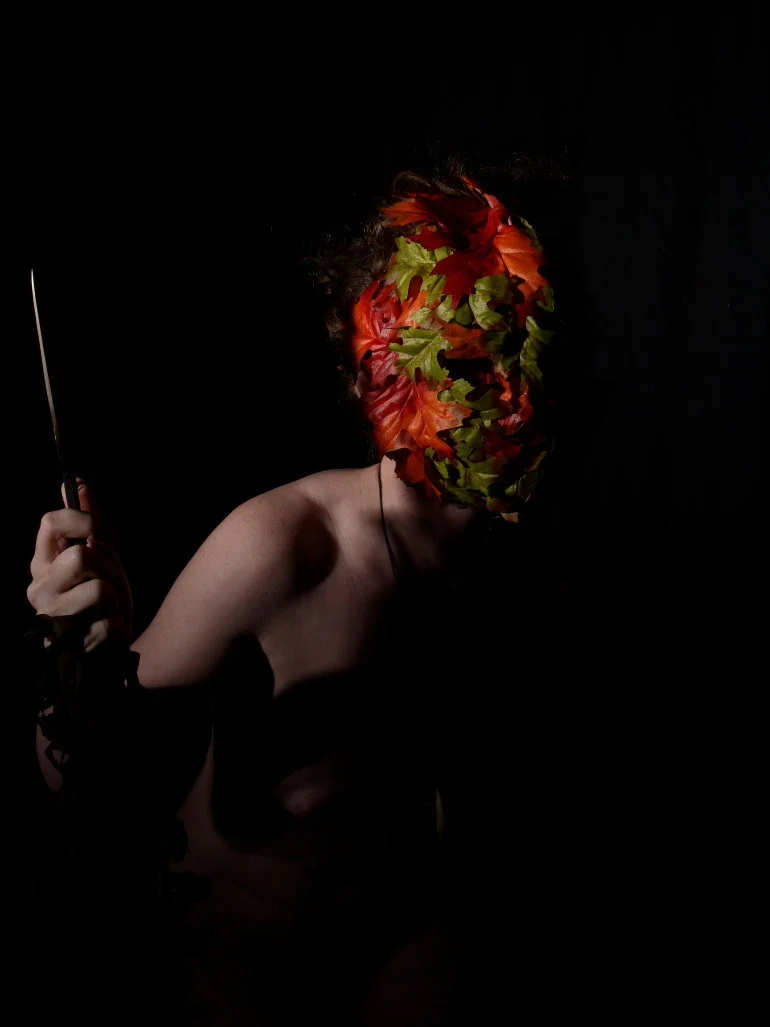
    Their environment can change; it is a background of midnight black in that series, a featureless sepia desert in the latest. Sanguine pencils, rather than charcoal, give his figures renaissance pedigree, quite at odds with the mood of fin de siècle Viennese expressionism. His photography, in which he shifts gears again, is stark and notable for the models’ otherworldly masks; and Watson makes these himself.

    Masks lend his sitters an air of atavistic power. It will amaze you, for instance, how a muzzle of ivy or an eye mask of oak leaves can imbue a stranger with great mystery and potency. You wouldn’t want to meet many of these photographic subjects on a dark night, and yet in their world it is always night.

    There is a vital intrigue here, because in person Watson is approachable, open and upbeat. For all the obscurity of the pagan rituals he seems to evoke, he offers complete transparency of means. He makes books, because these are more accessible (“People are in this country are far more comfortable buying books, than buying artwork. They know what to do with books.”).

    He also runs a detailed commentary on his practice at lazaruscorporation.co.uk. He is upfront about his paper, his pencils, and his process. If he is searching for a life model, you will read about it. Even his thoughts about blogging are right there, on the blog. He will also, endearingly, wear his musical influences on his artistic sleeve, having stayed true to a few bands from the 80s which I, for one, have been trying to forget. Perhaps unfairly.

    On the one hand he still inhabits an eldritch isle. His book England’s Dark Dreaming assumes the guise of a semi-mystical pamphlet. Watson took inspiration from ‘samizdat’ publications dating to the English civil war. “I started that after the Brexit vote,” he tells me, “and it was very much a cry of rage at the growing right wing presence in England”. Watson quotes the words of ‘landscape punk’ David Southwell, who claims that ‘reenchantment is resistance’. Watson concurs, aiming “not to view the world purely in materialistic terms and to use whatever is available to find wonder in the world.” Such wonder, he seems to say, will always elude the price tags of late capitalism. 

    On the other hand, he is unafraid of the light of day. “I don’t see any paradox,” he says, “between an enchanted world and a demystified process.” Watson might be horrified were I to present him as angst-ridden as, say, Ian Curtis. “I’m not interested in building on that whole artist myth of tortured genius,” he says. “I like demystifying the whole thing. I don’t think it takes away from the finished piece. I think it adds to it this whole thing.”

    How else, in the age of deep fakery, can you be verifiably real? Of his masks, for example, he says: “It was definitely not AI. It was crafted with glue and petals and wood – whatever I was using.”

    And here is the total artistic programme. When Watson is not coding software in his day job, he is working, as if from command-lines, series by series, on an attempt to create a vehicle or a lens to allow us all to imagine the unimaginable: namely the end of capitalism. Watson’s latest works are influenced by an unpublished, unfinished work of the late Mark Fisher, the theorist who is best known for saying the end of the world is easier to imagine than a working ideological alternative to the current Neo-liberal worldview. 

    Watson picks up: “I think that is true. It is very difficult to imagine something different from capitalism, so what I’ve been trying to do with Acid Renaissance [the most recent series – see above – which in fairness is warmer and lighter] is to break the imaginative chains by going into the mythic again and then start to imagine this future England almost like a social anarchist state”.

    In these sepia scenes of Leonardoesque cartoon we are confronted by details that Watson must hope we can take forward into that unimaginable future; here a laptop, there a wheelchair, in one, even and especially, wind turbines. Despite some deep historical references, Watson is clear he would like to effect change in the present. “I’m not interested in going back to the past, “ he says. “I’m interested in going to a post-industrial future”. Yet it is no pastoral idyll which the artist has in mind. “I’m fairly healthy but there are many people who rely on electricity and having the infrastructure of hospitals and things like that. So I very much don’t like these back-to-the-land fantasies. I think they’re fascist, because you’re essentially saying: we can kill off this part of the population. So I think you’ve got to imagine this post-industrial future which still does have things like electricity and healthcare”. 

    If that sounds difficult to imagine, perhaps it will indeed take a truly widespread, far reaching renaissance of an acid nature for us to collectively hallucinate what Mark Fisher’s idea of impossibility might actually look like on this planet of ours. In the meantime, we have Watson’s coming book.

    Whatever the future, there is something which the artist believes is essential to human expression. “I think there’s something very fundamental about creating images of the human body,” he says. He compels my attention with an image in England Dark Dreaming in which one of his mythic, future-past characters is making handprints on a cave wall. In this common palaeolithic act the body is implicated in “the very earliest form of art.” 

    Having spent six yeas of a research degree trying to put the term ‘cave art’ into question, I am not sure. But whatever the case it was grand to stand alongside such a thoughtful and committed contemporary artist on the site of an encampment dating back 5,500 years and look across our city by the sea.

    As Spring sunlight played on the water and the South Downs offered Brighton’s denizens their protection, we imagined being able to look across to the summit of Chanctonbury Ring by night and to see a bonfire. This mental journey back in time felt easy in the present company. Or was it a journey into the future? Reaching for my smartphone I took my own photo of the phone mast and we hiked back down the hillside.

    For more information on this artist, and to read his generous writings and/or view prints and books for purchase, visit Lazarus Corporation.

    Ritual, Part IV, Paul Watson, 2017
    Oak Leaf Mask, Paul Watson, 2014
    Whitehawk encampment, author’s photo

    books, Uncategorized

    Book review: White Sight, Nicholas Mirzoeff

    April 6, 2023

    Nineteenth century civic statues are so boring. Colourless, elevated, obscure, pompous, they have, for a very long time, eluded questioning. To topple one of these monuments, to go so far as to dump one into the sea, is to make the whatever bronze idol, appear to us fresh, and in disgrace. If there is such a thing as mere symbolism, this is not it. Reading White Sight by Nicholas Mirzoeff, the debasement of a statue is a noisy tear in the very fabric of society: a good thing, because the society we live in is racializing and racist on so many levels.

    After Black Lives Matter, we should no longer support the infrastructure of dull, sober, weathered, white men like Colston. Their grotesque pasts – and it’s a past shared by all westerners – are commemorated globally from South Africa to the Americas, in the UK and around Europe. When statues fall, they become visible. As they become visible, we see the involvement of their subjects in colonisation, slavery and rape. Mirzoeff likens it to a power cut; one does not see electricity but without it we are at a loss. Same with racism.

    Vision is the key element here. The statues are potent because they are largely invisible. If we can accept that objects have agency, specifically works of art, these do. They look at us. They look down on us. They embody the form of ‘white sight’ which is eponymous to this revelatory book. Mirzoeff describes white sight as the Operating System of white supremacy. The concrete and bronze network of slave traders, plantation owners, racist prime ministers legitimise a global system of discrimination in which, at the sharp end, Black people are murdered by white police.

    How has this OS come to exist? It has arisen because in the history of race relations, white people have assumed positions of surveillance: those above deck on slave ships, as overseers on plantations. White artists have ordered the world as such that it appears to funnel its contents into a static waiting eye, and the resulting authority and omniscience, assisted by the invention of perspective is not so different from that of today’s drone pilot. The area below the camera on a reaper drone, which fans out like a Florentine cityscape, is known as a kill box.

    The machinery for this lethal viewpoint was developed in the renaissance and Mirzoeff cites a subgenre of worldmaking landscape paintings in which Italian artists depict a heavily perspectival ‘ideal city’. Most notable is his reproduction of a Utopian vision by Francesco di Giorgio Martini, (c.1490 -1500). This empty colonnaded scene, in which paving leads the eye down to the waterside at Livorno, directs our attention to two distant islands: Capraia appears dead ahead as a navigational aid for ships heading to newfound lands; the other island is Gorgona, once said to be the home of the Gorgon, a mythical being of terrifying repute whose gaze would turn you into a statue. Connecting the Gorgon to Colston is a mindblowing detail.

    It is alarming to realise from the pages of this book, how deep and longstanding are the forces of colonialism. Mirzoeff has a rare ability to join dots in this way. In 2020, he was able to observe a number of the so-called Trump caravans on the streets of his neighbourhood on Long Island. He saw, ‘long lines of F-150 trucks, SUVs, and other cars taking over the roadways’. These menacing, slow moving motorcades appeared in defiance of the pandemic shutdowns and in support of the then president. In this instance the author connects several more indications of prevalent white sight: the ‘fossil-fuel intensive vehicles’, the ‘summer of climate-change driven wildfires’, and the destinations chosen (more memorials, yes, but also a Trump-endorsed pizzeria), all combine to ‘reinforce white reality’. Facts are stranger and stronger than fiction. With great acuity, Mirzoeff’s book unpicks the weave of the existing social fabric.

    White Sight ranges across many spheres of contemporary discourse, from mass extinction to modernist poetry, Islamophobia, covid masks, the Suffragettes and prehistoric archaeology. Personally I was captivated and yet devastated by his conclusions. This presumed great civilisation which I benefit from, is rotten to the core. And still the rhetoric continues. UK Home Secretary Suella Braverman’s language is nothing new. Queen Elizabeth I claimed in the late sixteenth century that the country was being overrun by “blackamoors”. Sad.

    White sight is a collective way of seeing, not a biological inevitability. My outtake from this comprehensive counter-surveillance operation, is that white sight is that mode of perception which allows humans to intrumentalise one another and the planet. Racialisation, capitalism, and the eco crisis are all one.

    Decolonising your viewpoint is a huge challenge for white people everywhere, to realise they (and I include myself) have become white over the years thanks to conditioning and self-interest. Only then will those deathly civic statues become interesting, intolerable, unmissable targets for all humanity.

    White Sight by Nicholas Mirzoeff (2023) The MIT Press, 339 pages. Available from all good bookshops.

    contemporary art

    Interview: Sahej Rahal

    July 30, 2016

    sahal

    The artist appears to have a simple and urgent proposition: to render the past absurd is to neutralise the rhetoric of the political right.

    Without a golden age to hark about, no one can promise to make America, the UK, or India ‘great again’. And we can instead progress to a state of internationalism, equal rights, economic parity and perpetual peace.

    Rahal lives in Mumbai, but he points out that the whole planet is “kind of a scary place to be working, globally”. He is, however, welcome in the North West, where for the duration of the 2016 Liverpool Biennial, his sculpture and film is being shown across three sites.

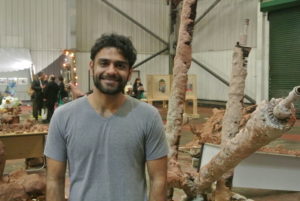
    We met at Cains Brewery, a cavernous space for art enjoying a good year. It is however scruffy, and Rahal’s work looks in keeping with the general state of repair. It is the first thing a visitor sees: nuggets of clay arranged on trestle-like tables; bits of scaffold, locally sourced, covered in clay; and black-box monitors which appear to emerge from the mess on which figurines breathe or practice with lightsabers.

    “I’m a huge nerd and I obviously have all these Star Wars references”, the artist cheerfully informs me. But like many contemporary sculptors, he aims both high and low, looking to Jorge Luis Borges for ”vast metaphysical narratives”, and for that writer’s concern with “creating this itinerary of our culture”.

    In short, this itinerary is dystopian. The artefacts presented appear fresh from some archaeological dig. But what kind of half-formed world do they conjure up? A: it is a world run by idiots in which technology has failed us and we have forgotten basic craft skills. And that seems to me the worst of all possible worlds.

    “I like the fact that these characters, or these objects of clay could somehow become like harbingers of something, you know?” Rahul tells me as we contemplate his pottery-based triage stations which all appear to somehow breathe in the light of the moving image work.

    He also says: “I’m more interested in putting them together to form meaning… from these absurd things, which are beyond reason in a certain way. In that meaning-making ritual that people perform, how do we create allegiances? How do we create bonds across space-time?”

    An interest in travel and time travel chimes in well with the 2016 Biennial, which is a nebulous animal in which Monuments from the Future is one of six official themes. You may find, as I did, that as you come across Rahal’s work more than once, you build a picture of what might be becoming. 

    It is a picture of a primitive time around the corner. Rahal expresses concern about right wing  governments that have followed the Arab Spring, the rise of presidential candidate Donald Trump, and the hate-filled effect of Brexit here in the UK.

    If politics is performative, the artist has another highly political aspect to his practice. Rahul stages improvised, ritualistic performances which offer only “fleeting, fragmented glimpses” of a narrative, and which change gear according to pop cultural requests from his viewers.

    “Even I don’t have a bead on [these],” he tells me. “Essentially, what’s interesting for me is that I’m also a viewer as well.” One supposes that in these powerless times, we are all to a degree little more than viewers, even as we march, occupy, tweet or blog.

    But perhaps in the light of our political horizons, we’ll do well to maintain any civilisation at all.

    Despite everything, Rahal is making the most of circumstances: “Earthenware has so much meaning to our origins so I’m drawn to that, but saying that it’s also so much fun to just dive into clay and get mud all over me.”

    As well he might, since in Summer 2016 we are all up to the neck in it.

    Liverpool Biennial runs until October 16 2016. I reviewed it for Culture24 here. See artist’s website for more images.

    contemporary art, installation

    Ai Weiwei, Straight (2008-12)

    October 1, 2015

    straight

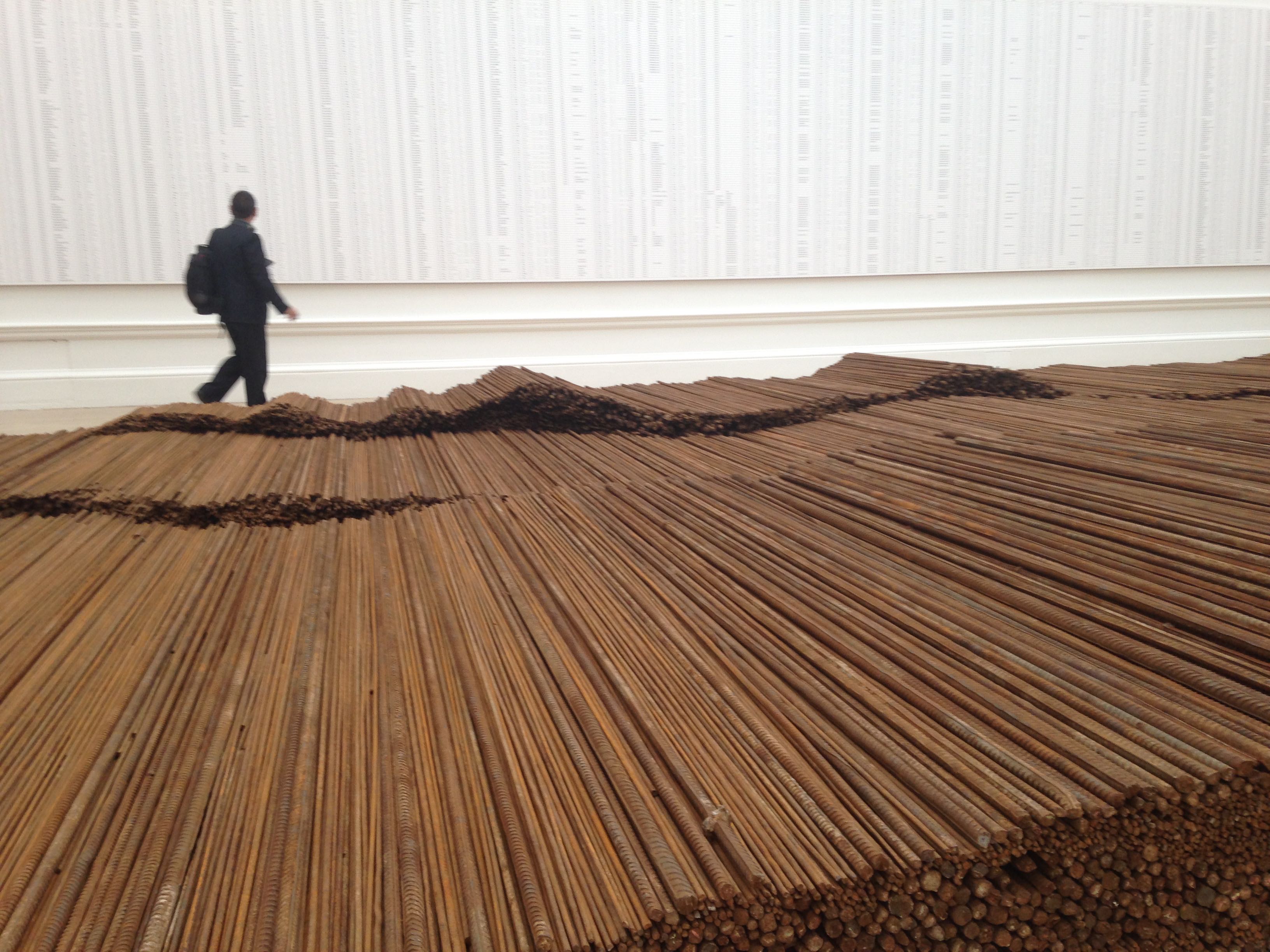
    There are two epicentres under consideration in this monumental installation at the Royal Academy right now. One was in Wenchuan County in Sechuan; the other is the government in Beijing.

    The first meant a quake that destroyed 20 schools. The second has monitored the ongoing work of China’s best known artist and kept him at arm’s length with bureaucracy and doublespeak.

    Ai contends that given their location on a seismic faultline, the schools should have been better built. This piece is a memorial, which lays square blame with corrupt officials and construction firms.

    There is even something unpatriotic about substandard architecture. This, after all, is a nation most famed for a wall stretching more than 20,000km. It inspires a memorable short story by Kafka.

    For the Great Wall, says the Czech writer (although how would he know?): “An unremitting sense of personal responsibility in the builders were indispensable prerequisites for the work”.

    But you can see, from 200 tonnes of straightened rebar, the materials in Sechuan were not equal to the task. And as you can see from the accompanying film, the steel bars failed as a structure.

    Now another wall was put up to protect the guilty. Ai’s team struggled to get information on the missing and the dead. “What if you’re an American spy?” asks a drudge on the end of the phone.

    Until the major earthquake, Ai appears to have been something of a favoured son and a successful architect in his own right. As you know, he collaborated on the main stadium for the Beijing Olympics.

    But it’s commonly thought that it is his unambiguous art of protest, and not his tax affairs, which led to his detention without trial for 80 days in 2011. The authorities have said little.

    Kafka again, in character as a native of the old empire, “We Chinese possess certain folk and political institutions that are unique in their clarity, others again unique in their obscurity.”

    Clarity: Ai has crossed the line. Obscurity: we cannot tell you what line or where. Both qualities pursued the artist even to the point of his visa complications in getting to London for his show.

    It is of course counterproductive. The repression gives additional power to the work. As if the walls filled with a list of 5,000 victims’ names, a list of serene despair, were not power enough.

    Ai Weiwei at the Royal Academy can be seen until 13 December 2015. You can find my review for Culture24 here. The Kafka story mentioned is of course The Great Wall of China, to be found in the Complete Short Stories of Franz Kafka, Vintage, 1999.