Here is my claim code: TG8BTEVHUMAE. Let’s see if this works
art blog since 2009
From the 20th century onwards, the beauty of much art is it has no need for the eye of a beholder. Conceptual works, in theory, place as much importance on the idea as the finished visual object. And while lots can be said about the dozen pieces below, the kernel of each is a thought of no more than 140 characters.
This is not to assume that simple ideas are the best. But it is possible that in a time of information overload, and web-based attention spans, they are the ones that travel best. If these artworks translate into tweets, it is only a sign of their power.
By now you should be convinced, some of the most important works of modern and contemporary art lose little from a lot of distillation. They might even work as tweets, albeit ones with plenty more to say.
More details on the 12 artworks can be found in Conceptual Art, by Tony Godfrey (published by Phaidon), which contains hundreds more like them all discussed in considerably more depth.
A 24-hour recording of ambient city noise is, on the face of it, boring. Few people will ever sit through all of the 1999 Giorgio Sadotti piece currently on show at Milton Keynes Gallery.
Behind the soundtrack, however, is an amazing story. Sadotti flew from London to New York, stayed overnight, and came home the next day without speaking to anyone. And that has the makings of an urban legend.
Now simply by hearing about the artwork, you can experience it. It can be easily shared, at no cost, between friends, over a drink. Never mind the lengthy audio documentation. The anecdote, surely, is just as much the artwork, as the tapes from across the Atlantic.
You may wonder how it was possible, logistically, to do such a thing. In its invisible way, the piece is as remarkable as a tromp l’oeil ceiling or an ornate manuscript. It must have been solitary, dogged work to produce.
The next question is what he might have said. The title implies withheld judgement or perhaps a kept secret. It draws attention to what Sadotti was thinking and the recording offers no clue. This gives the piece an essential and age old mystique.
In an attempt to demystify Went To America Didn’t Say A Word, I went to my local shop for a pint of milk and maintained a strict silence. Here is the documentation. You won’t find it in a gallery: Went To The Cornershop Didn’t Say A Word.wma
The The Things Is (For 3) is at Milton Keynes Gallery until 12 September
Canary Wharf underground station offers the best and the worst opportunity an artist could hope for.
“There are 45 million people who will travel through that station per annum, which is extraordinary. There’s no gallery in the world which could even boast a fraction of that kind of potential audience,” says John Gerrard.
“But of course, it’s not a receptive audience. It’s a hurrying, blind audience in a way.”
Gerrard is responsible for a vast projection on the far wall of atrium, which requires nothing if not patience. The computer generated simulation unfolds in real time, day by day, with a narrative scheduled to last for 30 years.
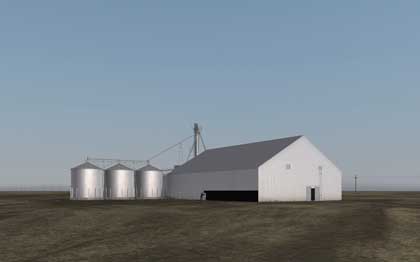
Oil Stick Work (Angelo Martinez/Richfield, Kansas) is set in a Kansas landscape dominated by a grain silo. Dawn breaks about noon British Summer Time and the scene fades to darkness at around 2am.
Between those times, a lone figure sets to work painting the building black. He paints one square metre each day with an artist’s crayon. By the time he completes his task, in 2038, US oil supplies are projected to run dry.
Art on the Underground will be showing the astonishing time based work for 12 months, and Gerrard hopes that in that time a “fraction” of the audience will notice the work’s progression.
The tempo of his art is a far cry from the pace of nearby life. The Jubilee Line station serves some of the world’s busiest banks. “I think the banking context is a very good foil for the work, for the slow build of the work,” says the Irish artist.
He also expresses amazement at the latest forms of (high frequency and algorithmic) trading. “It’s almost become quite anarchic what’s happening in those environments,” he says.
“You’ve got people basically spending billions to gain in microseconds on somebody else in terms of speculation.”
The central theme in Oil Stick Work, intensive farming, is clearly not unrelated. In the 1930s, oil-powered agriculture caused catastrophe when the prairies succumbed to the worst dust storms ever seen in America.
Today the same landscapes are dominated by ominous and anonymous buildings such as the grain silo above or the grow finish units used to farm and slaughter pigs. People are few and far between, but with one notable exception.
Angelo Martinez is the name of a New York builder who auditioned as a stand-in for a worker who told Gerrard to stop taking photos of one of the installations in Kansas. Now with virtually remodelled features, the artist says it “really is a portrait of him.”
The unreal localities which inspired Oil Stick Work are well suited to 3D simulations. “I’m slightly on my own with the medium which is curious,” notes the artist.
“There is an established arena of game art which is in existence, but this particular kind of static approach, which I think has a lot of potential, I don’t think there’s anybody working like this at the moment.”
That medium, according to Gerrard, “was effectively born in a military context,” and for his next work his is taking the form back to its roots.
“The new work I’m doing at the moment is actually remaking a historical scene which is from the Iran-Iraq war, the first Iraq war from the 1980s, and in it there is a soldier figure…who is enacting a kind of impossible performance.”
This will be the first time the artist has used military training technology to recreate a military training exercise. “I’ll see how that goes. I mean, it’s a bit of a risk,” he says.
But despite the outward calm of a piece like Oil Stick Work, organised aggression is already very much a theme.
“Those grow finish units on the American landscape are in and of themselves a type of horror story of gargantuan proportions,” he suggests. “I don’t think there are many games that would reach that level of…what is it? You know, the implicit violence in those scenes.”
From Kansas to Canary Wharf, what you cannot see is what can shock the most.
Written for Culture24.
Here’s a round up of work for Culture24 in the last week or so. Feel free to peruse:

This installation is an open invitation to skeptics. The materials are literally rubbish. There is no apparent order to the display. If this work was collected up and put in a skip we would walk past without a second glance.
So Takahashi’s work can seem a byword for mischief. She takes the world’s least valuable things, waste paper, damaged clocks, unwanted tools, and turns them into ingredients of the world’s most valuable commodity, art.
But she works at it. We know the items have been selected with care because recurring themes emerge. Care has also been taken to spread them around in a balanced way. Some objects are fixed together or stood on end and the scene is not as chaotic as it first appears. It has aesthetic appeal.
Takahashi snatches victory from the jaws of defeat, or art from the realms of oblivion. We need a way to deal with rubbish, on an emotional level. Clockwork suggests we can indeed process it, along with death, decay and disorder. It should give rise to courage, not skepticism.
Why not read what other people had to say about Tamoko Takahashi? Here is a good profile of the artist by Andrew Graham-Dixon. Here is an intelligent review of a show from 1998 in Frieze. And here is a scathing attack on her 2005 show at Serpentine by Jonathan Jones in the Guardian.
Introspective Retrospective by Tomoko Takahashi is at De La Warr Pavilion until 12 September.