Exploring the sunken churches of Lalibela
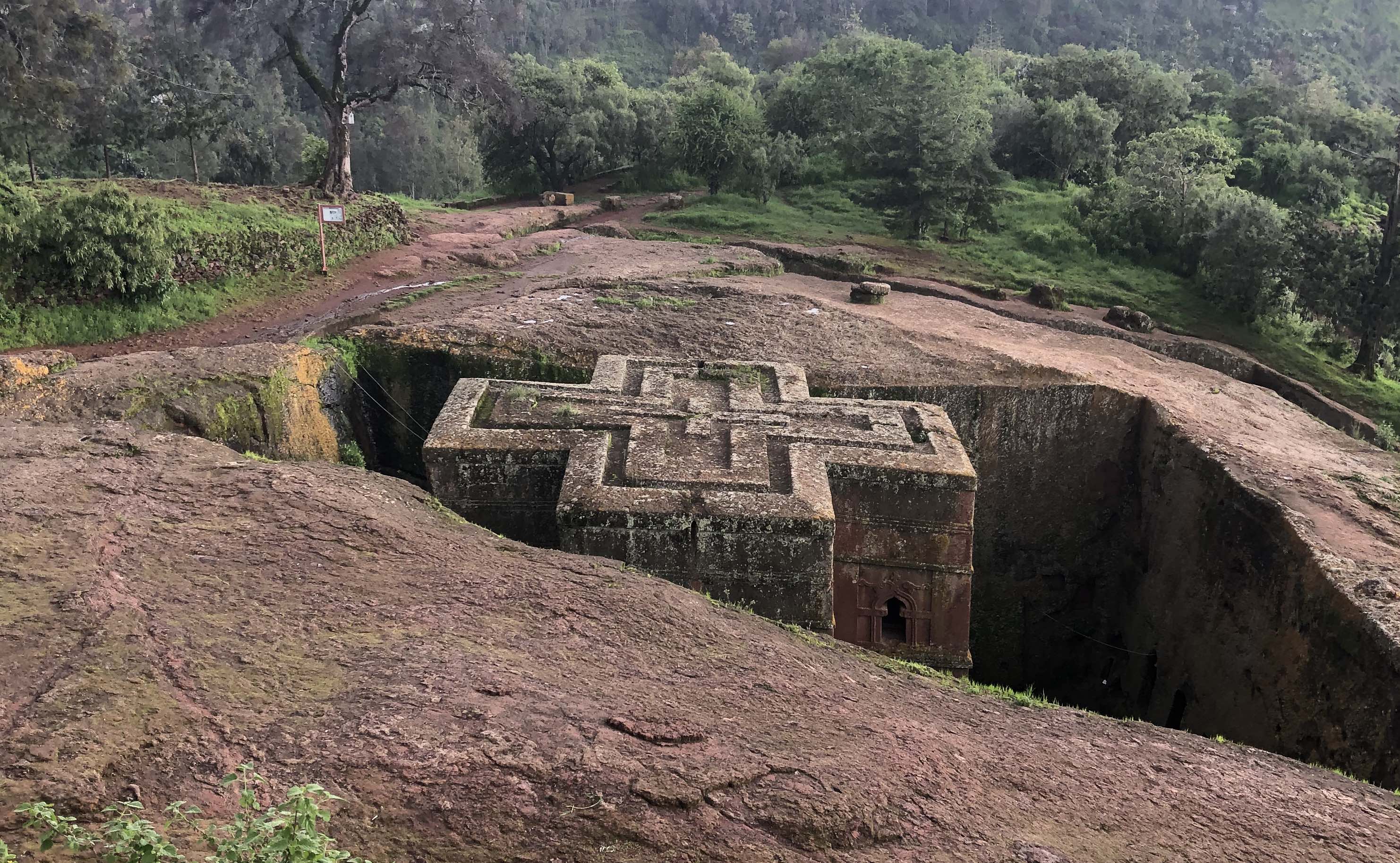
Lalibela is a troubled, troubling town in the Highlands of Ethiopia. It is under curfew and without power. Our 2022 trip was memorable, absolutely, a fantastic experience: memorable for the food, the scenery and eleven miraculous churches all hewn into rock; but we still get updates via text – disturbing messages about civil war, food shortages and even drone attacks. We can’t forget the churches. We can’t forget the locals.
In summer 2022, we sat on a terrace with views across the surrounding jungle valley. Over a drink or two, our guide told us how, just last year, these treetops echoed with the sound of gun battles, a scene of bitter fighting between the Ethiopian government and Northern militia forces. Indeed, still parked outside was a residual UN jeep, some material evidence of some stark facts. We have happy memories of our Airbnb as well. Our host chatted with us as we ate breakfast; he recommended places to eat, charged our phones and even procured us a litre of honey. Both locals have our numbers now, and they reach out to us from time to time. There is nothing we can do about visas, or debts, or the threat of displacement.
Those churches were the reason we came. To reach them we were to climb down steep red steps into man-made crevasses which brought us up against grave, square-cut facades or to small dark entry ways, hewn low in the rock. Before entering we removed shoes and padded in dusty socks around uneven floors, past priest holes like small caves and gloomy altars just a foot off the ground. A sparse interior might have a few worn rugs, a smoky candle here or there, or burnished paintings revealing devotional icons upon which we shone our phones to see ancient panels leaned with formality against walls of volcanic stone.
Most of the churches were dug down and into the rock face, but four are actual monoliths, meaning they are cut away from all sides. The most impressive edifice, Biete Giorgis or the House of Saint George, has a cruciform footprint. You can imagine jumping from the nearby plateau onto the roof. A tour of Bet Gabriel-Rufael, the House of the Archangel, meanwhile, took us through an unlit 35m tunnel. It was confined, totally dark, said to reflect a journey through hell. Prof D found the going v. hard, but owing to the difficulties of the terrain, these were surely the most fun ecclesiastical monuments which our daughter, little A, had ever known.
Fun was not the intention. These churches were planned, chipped, scraped and shovelled into existence during the dark ages, not widely considered one of history’s most laugh-a-minute eras. They were built in the late twelfth and early thirteenth centuries by a regional king who wanted to put his manor on the map as a new Jerusalem. Ethiopia, the home of Coptic Christianity, has done its own religious thing since the fourth century. I’ll gloss over the details, but these churches are older than most in Europe. It goes on here still, the worship, the services, the feast days. We navigated the trenches of eight or so churches, making our way around congregants from the town.
Some of the townsfolk, I saw too much of. These were the pair of teenage boys who, having engaged me in conversation, knew my name, my place of origin, and my indulgent attitude towards young people who want to ‘practice English’ so they can ‘study at university’. In fact, they had all the English they needed to try and sell me bracelets and souvenirs. That might sound harsh, but they tailed us for a full day and gave to the beginning of our stay, a quiet sense of menace, stoked I admit from my having seen ominous films like Straw Dogs (1971) and Deliverance (1972). D, who knows territory like this, told me to ignore them. This only seemed to hurt their feelings. That was the most difficult thing about travelling to Lalibela: the requirement to ignore impecunious local inhabitants.
Another difficulty was the permanent power cut. Lack of electricity meant that each time we stopped for food we would need to charge phones off generators. We ate to the sound of their constant chugging. After dusk we navigated the compound and our three-bed room with the help of a wind-up torch. We got early nights. We bathed in the morning with warm water brought to us in a bucket by our Airbnb host. And after breakfast I could enjoy the slow and careful preparation of a coffee or two. The strong Ethiopian brew meant that, when I left for the sightseeing, unlike my phone, I was 100% charged.
Our room had a balcony from which you could hear insects, birds and prayer calls. The view was largely tree canopies, simple dwellings, and blue skies. I found it meditative to sit there, while D and A recovered with siestas. The new Jerusalem, during this respite in fighting, was a much more peaceful place than one finds in the vicinity of the old Jerusalem right now. It is an eternal tragedy that the world’s most holy places seem to attract the most warlike aspects of human nature. Paranoia has dominion over the Earth.
Before we flew to Lalibela we tried to pass security at the airport in Addis Ababa. During this routine check I was pulled aside because they found a pair of binoculars in little A’s bag. It’s against on/off martial law, apparently, to bring binoculars into Ethiopia. We were heading in the direction of the conflict so, naturally, they thought that a small family on UK passports might be smuggling military equipment to the militia. Admittedly, I enjoyed the level of suspicion, given that nineteenth century poet Arthur Rimbaud took up gun-running in East Africa. But I don’t think he flew.
The binoculars were really innocuous: small, not too powerful, and fitted snugly in a purple case branded with the logo of one of the UK’s most respectable charities: the National Trust(!). But upon their discovery we were separated, and I was escorted, by armed official, back the way we had come through the departures hall and into a windowless back office. There was quite a bit of waiting – I wondered if would we miss our flight; there was also some questioning – I wondered if I would do jail time. But after I had signed a paper or two, the binoculars were confiscated and I was taken back to departures to rejoin D and A.
If you ever go to Lalibela, let me know. If our guide and our host are still in business, you’ll be looked after well. The churches I’m sure, will be open to visitors, for another millennia, at least, you would say.

No Comments