<h1>Archives</h1>
    Britpop

    The unbearable lightness of Britpop

    June 19, 2026

    I’m not calling for a cessation of all music and dancing until WWIII ends, but I am calling for a ban on Britpop. It just seemed a bit much to be bouncing around to unofficial national anthems at a time when our nation is aiding and abetting war crimes and an emboldened far right are torching migrant homes and campaigning for office in paramilitary uniform.

    That’s not to say that the clientele of this dayrave are actively racist. Most if not all persons of colour here were treated with total respect and gratitude, because most if not all were among those checking our bags and serving the free drinks. Nevertheless belting out the chorus to World in Motion by New Order (“In-ger-land!”) is for me problematic in the shadow of Gaza. 

    The DJ was good enough to apologise, in the name of football, to any “Irish, Welsh or Scots”, as if it was inconceivable there might be any other nationalities present. It’s not that refugees wouldn’t have been welcome here; as they should be welcome everywhere. Only it was doubtful they would be able to sing along to bands like Shed Seven.

    While it had some good tunes back in the day, Britpop is uniquely tone deaf for the quarterway point of the twentyfirst century. Unlike 1960s rock, 1970s punk, and 1980s indie, It was a genre free from revolt. A chart battle between blur and Oasis was the only point of social friction. The pop was for pop’s sake. The rock ’n’ roll, ditto. Those were feelgood times. These are not.

    The only political topic for this insular genre was the class system in Britain. That this system was regarded with something like affection is the inescapable conclusion: blur were to amp up their Essex roots in a bid for downward mobility, before running for parliament and hobnobbing with the Cotswold set; Oasis were to heavily trade on scally ways, even as (now-Irish) Noel co-opted the Union Jack; Pulp were to observe that the middle or upper classes will “never understand” what it means to be common.

    So here I was, a middle class, middle-aged man, with a group of middle-aged, middle class friends at an event so middle class it stole the Champagne from a well known Oasis title and called their merry bash Prosecco Supernova. And so it was that, as poor relations now to any Mancuinan rock ‘n’ roll stars, we fuelled our own midlife weekend afternoon rockstar fantasies with tasteful, budget alcohol.

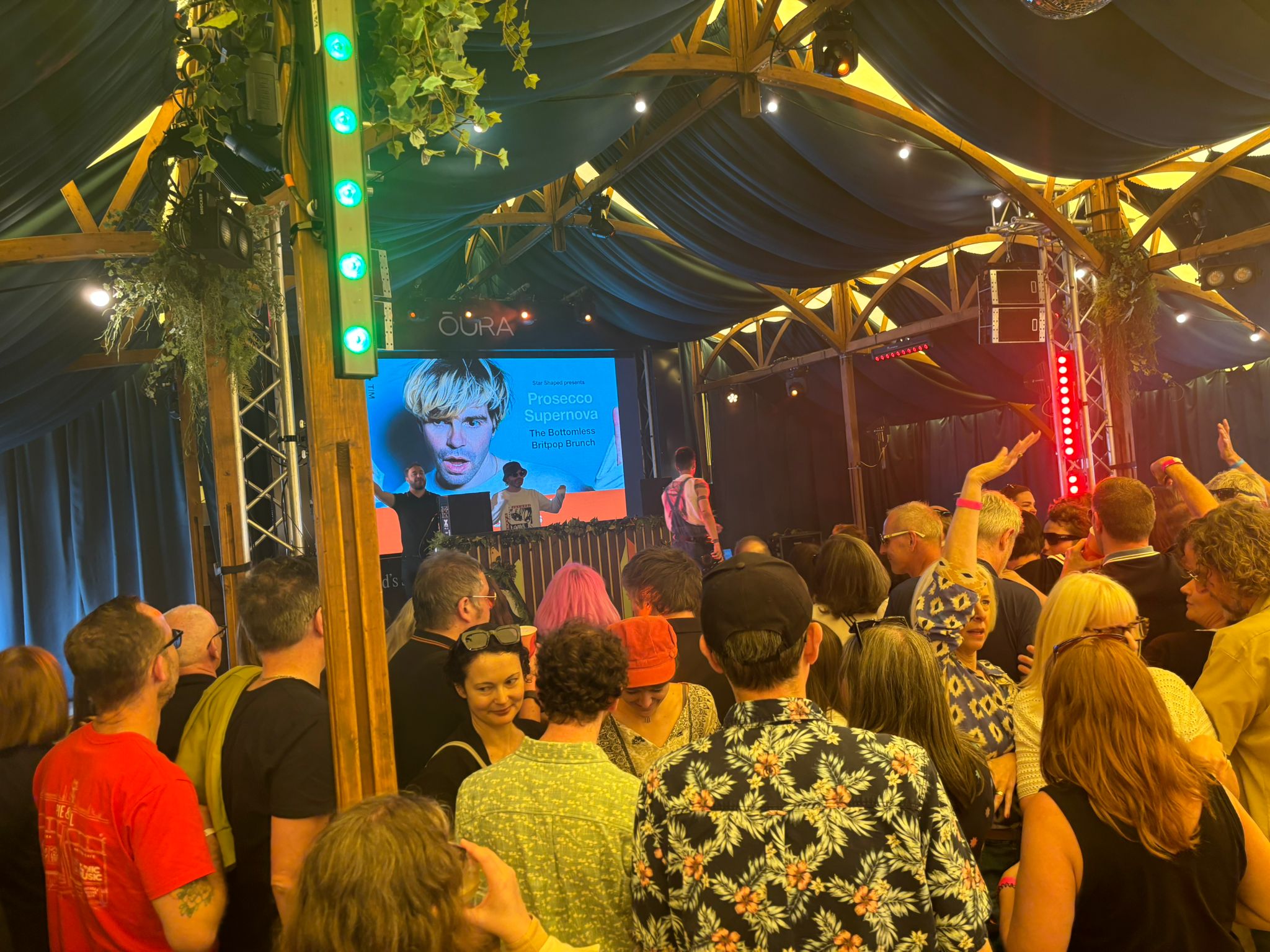
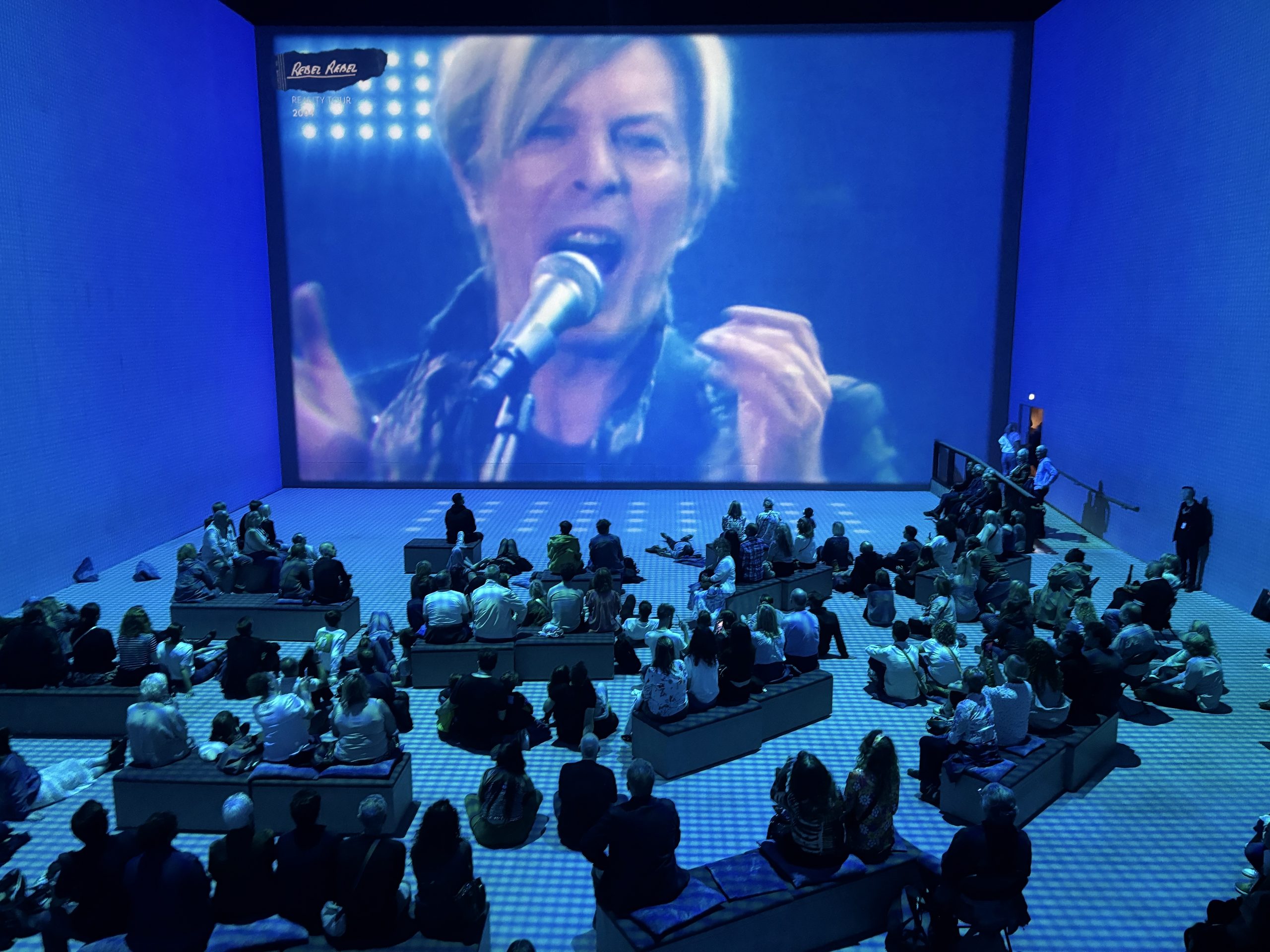
    As you might be able to work out from the photo I took, the ostensible DJs was Tim Burgess from the Charlatans.* I say ostensible because the setlist was so obvious it had to have been programmed for him. And it irked me that the Madchester scene was folded into Britpop, along with New Order, The Housemartins, The Smiths, and Teenage Fanclub. Will I be back in December to bathe in nostalgia with Bez from the Happy Mondays? Possibly not, but I hear he’s good for a selfie.

    We staggered out into the June sunlight, as naive and lightheaded as university freshers. I got the train home to Brighton, which is contender for the most pop city in the UK. I was a few hours late for the Carnival Agaisnt Fascism, where ex-Housemartin and Big Beat DJ Norman Cook aka Fat Boy Slim was spearheading sonic resistance to a delegation of thugs marching, rather than playing, ‘for England’.

    *I must point out Tim was not resposnible for either the football banter or the playing of World in Motion. That was a DJ from the organisers Star Shaped who certainly seemed to enjoy fronting tings. Good luck to him, yeah!

    Brighton, contemporary art

    Brighton in May: home is where the art is

    June 2, 2026

    I didn’t exhaust the possibilities for seeing art in this year’s Brighton Festival. But I was glad to have caught both the exhibitons here. If you saw either, let me know in the comments!

    Tender Exchange

    Hold a wooden heart and privately speak into it. Speak what is in your own flesh and blood heart. The wooden heart is anatomical in shape. Your own metaphorical heart impossible to locate. This exercise proves challenging. “It’s hard to say what’s really in your heart” I say to a project facilitator. “Yes, and it’s hard to know where to stop,” she replies, I take the trinket to a nearby tree and as I  stand below, in presumable communion with nature, I  commit a few words to a discrete inlaid microphone. Then I return the heart.

    The artist took it from me and placed it on a dock on a plinth where my innermost thoughts joined a sea of voices which echo from some dozen of these recording devices. I think my exact words were something-something-grateful, something-something-hoped for. As such, it was a generic, if ostensibly heartfelt, message. But on my way home I thought of many things I could have, should have, said to do justice to this quite twee but well-executed art work. Twee is not a dirty word, btw, if like me you grew up to the sound of 1980s tweepop.

    I moved around the ring listening to voices drift in and out of ear shot. Here was where prayers, wishes, confessions, confidences and secrets were exchanged and where the contents of your heart were offered up as tender in multiple senses. Currency for what I do not know. But to speak your innermost desires to an archive and hear them carried off by the breeze in this way was to feel like letting go. 

    Do my spoken feelings register with the universe or have I divested myself of them forever? Only time will tell. Tender Exchange now has knowledge of some of my intimate feelings, but reading news headlines later that day, I realised, we know very little about the human heart. 

    Tender Exchange was at Moulescoomb Place on May 16-17 2026. It was a Brighton Festival event by Becca Gill of Radical Ritual.

    Shadow Light: Songs My Brother Taught Me

    I had never seen a white cube as white as the Project Space at Phoenix looked during the recent show by Simon David Eden. And as the artist floated towards me, dressed in white, with a scarf you might wear to an ashram, he took on an inescapable aspect of celestial guardianship. 

    Shadow Light: Songs My Brother Taught Me is a show about suicide, both its acceptance and its  prevention. It pays tribute to the artist’s elder brother, who sadly took his life in 1976, at the age of 20. The musical siblings had played guitar together. And their old acoustic, painted white, strings all broken, lies in a hardshell case loosely wrapped in rusted chains; it’s as if the instrument has emerged in this hallowed space, Houdini-like by its own volition. 

    The life of this guitar extends to a suite of photographic prints, monochrome with the occasional dangerous red accent; the prints cluster upon all four walls accumulating ‘sold’ dots. If the public clearly wants them up on their walls, these serenely cubist studies (surely the eponymous songs inherited from Eden’s older brother) bear the weight of memory and silence. It’s a silence that not even the murmured conversations here can dispel.

    I too enjoy one of these low register chats with the artist. He tells me that the park outside (known in Brighton as The Level) was where his brother once worked as a groundsman. It’s a fact reflected in the two sculptural elements of the exhibition: as dried leaves, elm stumps, Sussex flint, which is as black and white as the prints, and a vicious looking saw blade. And because the artist’s late brother burnt his diaries, lyrics and notebooks, some ashy remains of bound paper are here in a readymade cage.

    Eden directs me to a poem on the wall in a quite priestly way and leaves me alone with it. In this poem the facts alone sing, in a concrete form text in which these lines stretch out and loosen as the white page behind them absorbs the pain like a healing hand pressed to a brow. I was moved, with a sadness hard to bear in close quarters. The artist did also say he felt his brother’s presence in the gallery. He has been brought back to us: a resonant gift for anyone who has known the loss of someone to suicide.

    Shadow Light: Songs My Brother Taught Me was at Phoenix Art Space between May 1 and 17 2026

    relational aesthetics, Uncategorized

    Pavillon Simone Weil, Thomas Hirschhorn (2026)

    May 20, 2026

    “It’s a bubble”, Thomas Hirschhorn confirms. I find him immersed in the Pavillon Sicli in Geneva, where he is resident twelve hours a day, seven days a week, for some 75 days. It’s only half of a surprise that this is a work of what he calls Présence et Production. And I don’t miss the chance to ask him about prehistoric caves. Does this monument to philosopher Simone Weil in some way reflects the subterranean origins of humanity’s image making?

    It does. Hirschhorn’s 2002 work Cavemanman was also an immersive piece of bricolage, being a rapidly made assemblages of cardboard, MDF and packing tape. I was able to further check with Hirschhorn that a previous statement on cave art wasn’t intended as a provocation. No he says, it wasn’t: those who painted prehistoric caves and those who come by later and add graffiti, or one supposes to make pavilions, are of equal value.

    But perhaps some lives are worth elevating. The current exhibition or current bubble is dedicated to the life and work of Simone Weil. And unlike a palaeolithic cave, the industrial space in the Les Acacias district is inundated with light and activity. By the look of its new facade, of placards and banners, this former factory, where fire extinguishers were made, is occupied by the workers. 

    On my only previous trip to Geneva, I found myself at a squat party that went on all night, but in Hirschhorn’s squat the locals are sleeping out a bright, warm and sunny day. I count half a dozen recumbent bodies. Others are moving back and forth with plates of free pasta. I queue for a free coffee. The spirit of welcome extended to an approach from the artist, who I recognise at once: imposing height, black rimmed spectacles, papers and paperback books in the breast pockets of dark shirt. He strikes up a conversation with handshake proffered.

    I am a bit star struck, but fandom is encouraged here. This all consuming relational art piece is a shrine and tribute to a philosopher who should perhaps be canonised. Frail, bookish Weil took a gruelling job in a factory and even took up arms in the Spanish Civil War. During WWII, she starved herself in solidarity with the Free French and wanted to parachute into her homeland to work as a nurse for the Resistance. But as a myopic and possibly anorexic young woman, she was to be little help in any of these ventures.

    After a short journey on this earth, the 34-year-old was outlived by several books of mystical and political writings. It is these which give the pavilion the feel a work in progress, of a notebook or set college text. Her words are all around us: spray painted onto drapes, etched on signage with biro, and printed then curated into a wildly complex mind map of inter-related themes that reflects a deep engagement with her ideas. In both English and French.

    My own introduction to her thought is a wartime audit of the spiritual health of the French nation, The Need for Roots (published posthumously in 1949). Hirschhorn tells me that for him Gravity and Grace  (published posthumously in 1947) is the best way in. Important texts are so much to conjure with, and even my first encounter with a sculpture by this artist (Drift Topography at the 2012 Liverpool Biennial), struck me for the inclusion of two dozen much thumbed books.

    Admittedly an art exhibition based on tracts of theory could be a dry affair. But this expo is more than a showcase for handwritten screeds or manifestos. Along with the local diners, sleepers and coffee drinkers, there are local collaborators who fill the space with edifying, enjoyable sideshows and participatory stalls, all of which reflect the life of Weil and offer continuity with previous works of relational art by this artist.

    For example, there was a kickboxing class. Weil was not tough, but she was committed enough to seek out combat given that, in Spain and in her native France, fascists were the enemy. The gasp of knee against training pad and the odd grunt of connection energise the atmosphere of Pavillon Sicli. A dojo, located by an entrance, would be a compelling introduction to any gallery.

    There was a stall offering Esperanto; that too appeared relfected Weil’s idealism. And up a timber-frame ramp there was a garment repair desk who are running a couple of repairs a day. At another upper level desk you could learn about a translation project. An artist called Roxanne tells me that in the new French translation of Demanding the Impossible by Peter Marshall (1991), there will be a new section on Weil. 

    I spent time in a phone box, listening to philosophical vox pops on a vintage handset. I spent time in a screening room, where the words of Simone Weil met with a collage of found footage. I passed much of an afternoon in the courtyard, watching street artists at work while others played football. There was also a bookshop, a library, a house newssheet, an evening talk from German philosopher Marcus Steinweg, and so on

    Hirschhorn has made a handful of previous pavilions or monuments along these lines. He took Gramsci to the Bronx, Bataille to Kassel, Deleuze to Avignon and Spinoza to Amsterdam. Local communities have embraced these visitations, in many cases helped to build and run these cerebral spaces, and they have done so not despite being working class but because they are working class. 

    Those with most to gain from radical theory need these new monuments. Hirschhorn offers us all a break from the tradition in which generals and statesmen look down on us from bronze heights (in work by this artist and others; see my previous posts here and here) The many sofas upholstered in gaffer tape invite the public to simply chill. The stalls and activities invite you to simply think. And the truth demonstrated by the sleepers who are dotted across Pavillon Simone Weil is this: at some point we all awake, and when you do so Weil will be there.

    Pavillon Simone Weil can be seen at Pavillon Sicli, Geneva, until June 16 2026.

    Uncategorized

    It’s 8:30. Do you know where your brains are?

    April 13, 2026

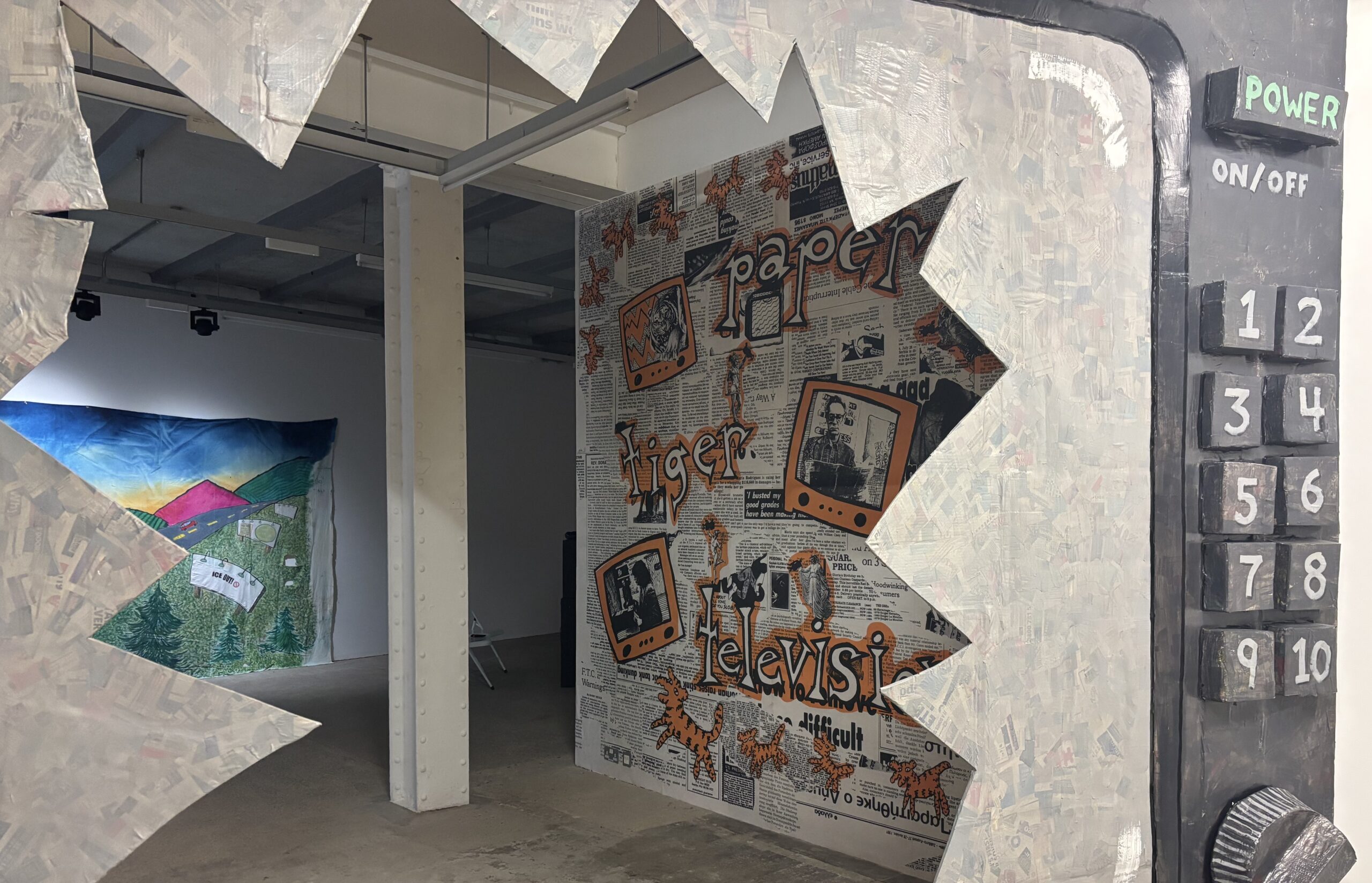
    Don’t know where my brains are now but last week they were at Goldsmiths CCA where I caught an archival exhibition dedicated to the output of Paper Tiger Television. Beginning in 1981, this collective (aka PTTV) has broadcast some 400 episodes of a public access show that was to turn its gaze back on the media explosion of which it was a part. Many of theire regular, live programmes began with the statement-question: It’s 8:30. Do you know where your brains are?; each would conclude, for maximum transparency, with a caption screen revealing the budget of the preceding show.

    So, a typical episode would feature an acerbic media theorist leafing through the pages, with actual print and analogue pages, of one of the twentieth century’s most iconic newsstand titles: sociologist Herb Schiller dissects the New York Times (The Steering Mechanism of the Ruling Classes (1981)); Artist Martha Rosler reads Vogue magazine (Wishing, Dreaming, Winning, Spending (1982)); author Murray Bookchin considers Time magazine (History as a Television Series (1982)). Some later shows have a documentary feel, like Standing with Palestine (2004, but tragically timeless).

    If you can make it to New Cross, you have the possibility of stepping into a basement set, through a theatrical arch cut and painted to look like the broken screen of a 1980s TV set. The 80s make a strong reappearance, with slime green video captions on shows with punk energy and, at times, a small audience who resemble a bored CBGBs band. Archival publications and handprinted video backdrops complete this mise-en-scène. And eight monitors, each with remotes, headphones, and chairs all serve up five films each.

    If you can’t make it to New Cross before the 19th April, there are 500 eps available to view on the PPTV website. It is a really awesome resource and a chance to experience Paper Tiger Television, on the small screen.  A diverting time awaits!

    Uncategorized

    The war strikes North London

    March 18, 2026

    The manufacture and sale of a fighter jet entails a complex and shady web; such planes have wide supply chains and reach the market in lots destined for different client states. But research bodies put an incriminating figure on the contribution of UK arms manufacturers towards Israel’s aerial war on Gaza; The Ploughshares Project and Campaign Against Arms Trade both set a figure of 15 or 16 percent, on components of the f-35i joint strike fighter supplied by factories here. F35s have been used in civilian harm events in Gaza.

    As a result of domestic manufacturers’ complicity with a genocide (described as such by the UN), many activists have targeted factories across Britain with symbolic and actual damage, which has resulted in the criminalisation of members of Palestine Action, deemed terrorists for a non-violent campaign of opposition to an Israeli war with bewilderingly international support from the UK, the US and various other western countries.

    While all this means I’m straying from my lane as an art blogger, it is mentioned as background to the rest of this post, which concerns vandalism and a campaign of harassment against galleries which have bravely carried anti-war messages in the UK’s cultural climate of self-censorship and silence. Several actors from the far right and pro-Israel lobby appear to have targeted three North London galleries in the last six months. These forced the closure of a show at two branches of The Bomb Factory and the third closures of a solo show at Handel Street Projects in Marylebone. 

    To be clear, I am perhaps conflating two diverse aggressors. Handel Street was targeted by, so it seems, zionists. The Bomb Factory provoked the ire of some individuals more broadly opposed to a progressive, woke and/or pro-Palestine agenda. Veteran satirist Peter Kennard was one of those provocative artists with a work about the tens of thousands of children killled in Gaza.

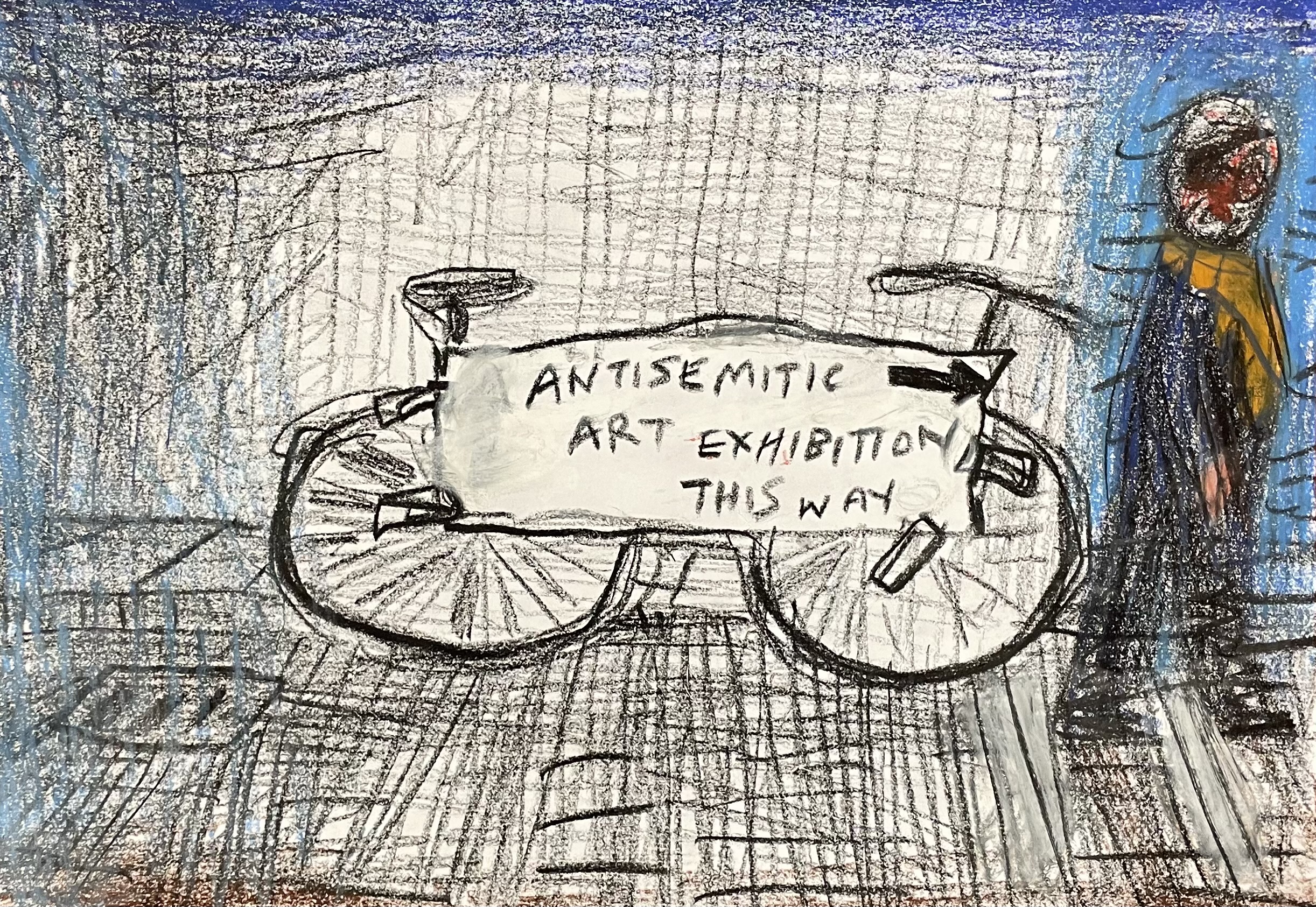
    Matthew Collings, meanwhile, has 21k followers on Instagram, who may be familiar with the rest of the story. Three less well-known art world figures, unimpressed by trenchant posts on IG, and prolific and critical drawings, about historical artists and contemporary politics, were to allegedly threaten artist, curator and building owner, all on the grounds of anti-semitism. Pictured above (in a work by Collings) is some contributory guerrilla signage which appeared nearby. While money is hardly the issue here, curator and gallery director Fedja Kilovac estimates that premature closure of a successful show cost him several thousands of pounds in lost sales.

    This was also the London art scene’s loss. Collings will take his integrity elsewhere, to Margate, imminently, and to prospective venues in Europe. I wrote about his amazing show before it closed, and so did Waldemar Januszczak who suggested it deserved to win the Turner Prize. He said so in The Sunday Times, a British paper of record. This is not the first time that zionists have exerted influence over UK galleries, but what events at Handel Street Projects suggest is that even a small show, however brilliant, can become a target.

    Meanwhile windows are smashed in further North London spaces. The Bomb Factory, in case its opponents hadn’t realised, is not manufacturing literal bombs. Attack an actual weapons factory in the UK, or express support for those who do, and you risk going to jail. These are such thorny times and feelings evidently run high, but the principle of artistic freedom calls for more respect. 

    It is linked to the principle of freedom for those living under siege and bombardment in wars that, even as Israel’s supporters cry self defence or anti-semitism, has now spread across the Middle East, killing families, destroying lives, flattening homes and erasing cultures. Since the F35 plays  such a nefarious role here, disentanglement by the UK would save civilian lives. Why not that?

    Matthew Collings: Drawings Against Genocide can be seen at Joseph Wales Studios, Margate, between 21st and 29th March 2026.

    early film

    Behold the bioscope

    March 4, 2026

    Like a steel tiffin box the size of a small packing case, the bioscope gleams in the fairy light ambience of an artisanal market in the centre of Delhi. On its polygonal front are circular portals the size of pickle jars with tin lids hanging on chain. Hurdy-gurdy handles sit atop, used to stir whatever it might contain. And a patient operative waits, patiently, confident in the appeal of his strange cargo. The night air is alive with swinging Indo-psychedelia. The track on his speaker was identified to me as ‘Yamma Yamma’ from the 1980 Bollywood movie Shaan. 

    I pay 50 rupees (about 40 pence in UK money) and take my seat. It’s a squat toy-like stool, that invites me to regress a little as I put my eye to the nearest porthole with irresistible curiosity. Inside glows and, somewhat upstage from my view-point is a scrolling frieze of images that now move for me, left to right, at unhurried speed. Each photograph or painting seems animated by the music, the magical light, and the stately procession of a spooling roll of thick paper which is tattered, spliced and sellotaped in a way that reflects the age of this technology.

    The device, a bioscope, was once used to provide some of India’s most rural villages with a proto-cinematic experience. Of course it calls for some suspension of disbelief. But even as a twenty-first century smartphone owner, whose life has no shortage of striking colourful images, there was a wow factor to this rudimentary display. The bioscope scroll, as fragile as a holy relic, is charged with the historic pleasures it must have given to many a screen-free household.

    There was no narrative for me to worry about, not even any clear sequence, and the only link between the images appeared to be that all of them are in some way representative of this epic land that is India. There were tigers. There were Hindu gods. There was a portrait of a beautiful actress, and next to her a cobra. The Taj Mahal was to roll across the golden stage, as was Q’tub Minar. I was also surprised to see a photo of the current Indian PM flanked by ministers. This updated bioscope is clearly adapted for our divisive, populist times.

    The presentation finished and I was moved to applaud the eccentric contraption. And to think it was devised for an audience who would value images on the strength of visual or thematic appeal, rather than those viewers of contemporary film and television who, like me, tend to watch for the sake of the story. As such the bioscope is a fine, and globally diverse, example of the filmic attractions that were to inspire western avant gardes from surrealists to expressionists via futurists. As such, it reminded me of Tom Gunning’s influential paper and the film theorist’s argument that cinema was once valued for pure visuality and self-conscious awareness of looking.*

    This location is one of the Indian capital’s less hectic spots, and it seems as if no family visit to New Delhi is complete without a couple of hours in this market, Dilli Haat. I haver been more than half a dozen times but, distracted by the shirts and the scarves, the paintings and the carvings, the spices and ceramics, plus the chai and the chilli flavoured momos, I had never noticed the bioscope before. Now I might never forget it.


    * Tom Gunning, The Cinema of Attraction[s]: Early Film, Its Spectator and the Avant-Garde (1986)

    contemporary art, Uncategorized

    The cave is basically the data safe: interview with Julius von Bismarck

    February 23, 2026
    A colour photo of an illuminated network of mine tunnels with a flash lamp in the foreground
    Julius von Bismarck, Landscape Painting (Mine), Installation view, Dossena Mines, 2025, as part of the project “The Orobie Biennial – Thinking Like a Mountain”. Photo: Nicola Gnesi Studio, Courtesy of GAMeC – Galleria d’Arte Moderna e Contemporanea di Bergamo and VG Bildkunst, Bonn 2025

    The Orobie Biennial, to be found in the Bergamo Alps of Northern Italy, draws together and curates a rolling programme of many peaks. Exhibitions, installations, interventions are all set among some of Europe’s most scenic mountains. Interesting venues for visual art, in this region better known for hiking, have included a deep chamber in a disused iron and fluorite mine used now for tourism and the aging of local cheeses.

    It was here that German artist Julius von Bismarck staged a piece of site specific painting that disrupted the entrance to two or three tunnels by a repetitive pattern of uniform, tight black lines which follow the contours of the walls but which create a remarkable illusion of flatness. 

    Stand back and, as the corresponding photographic artwork reveals, it could be an art historical etching. Walk inside and, working on viewers like some prehistoric abstract parietal work, it must heighten awareness of one’s body, as well as an effect of proximity to the Underworld.

    Given this blog’s interest in what gets called ‘cave art’ and how that relates to contemporary, immersive art environments I was keen to read about this work. But seeing as not much commentary has found its way online yet, I thought it would be useful to interview Julius, virtually, from his studio in Berlin, and he was kind enough to give up his time..

    MS: Dürer, Friedrich, Klee and Cezanne have all been cited as influences for this series, but Landscape Painting (Mine) (2025) made me immediately think of parietal works from prehistory. What are the points of difference and similarity with ‘cave art’ and this rare sub-genre of that, which we might call ‘mine art’?

    JvB: Yeah, I think that’s a coincidence. Even if cave painting wasn’t a thing, I would have done the mine painting or drawing or etching. The fact that cave painting exists and not just once but over the whole planet and done by different humans in different ages is of course a very interesting layer of the work, as it opens up the question as to what would cave painting be today? Caves were not the only places where humans started to paint or draw what they’d seen (which of course is a very important step in human evolution.) It’s probable they did it somewhere else but it washed away, everywhere except for caves. So the cave basically is the data safe which, by accident, humans have used — without planning — to make these drawings that lived thousands and thousands of years later. It’s a kind of a random archive of human development.

    Some years ago, when humans came to picture their surroundings, they created a medium. They created a language, right? One dog barks to another dog; one wolf sings to another wolf; a stag is bellowing to show off his power: language has existed between many different animals, including humans but it was  something that only existed in the moment, when it was spoken by our prehistoric ancestors. However, the drawing is an important step in making this medium of communication last, which is a completely new quality of human power in some way. I think it’s really interesting to find out why humans were able to have such a massive effect on their hosting planet or on the biosphere that made them.

    Landscape Painting, is a series of projects: The first one I did in Mexico, then I went on to do it in different natural environments, different cultural zones, collaborating with different humans. It’s an ongoing project that I will keep on doing, and the whole project is what you’d call media critique or an experimental media archaeology. I’m trying to find out what it means to depict the world and what change that makes in the world. 

    My theory is this: if you draw a mountain you will change that mountain. By depicting something you change what you depict. For example, recently you can see it very easily with influencers; influencers can take a selfie on a mountain peak in some National Park and next year there’s thousands of influencers queuing up to recreate the same shot. Thus the act of depiction influences the subject being depicted. Maybe even those early depictions of some bison in a cave painting might give us not only the idea that these bison existed in that time, but also a retroactive effect on the bison, because maybe one day we’ll come up with the idea of remaking the local species from some DNA that we find in the cave. Inspired by that cave painting we’ll bring it back to life! 

    MS: What specifically entailed you to make work underground

    JvB: My Landscape Paintings are always historically inspired because I’m trying to look back and forward at the same time, trying to make sense of what’s happening visually. And yes, many artists before me depicted quarries and mines. It’s a typical sujet of landscape painting, and of etchings that were printed and circulated worldwide in newspapers and books or sold as individual prints. I’m talking about the time before photography was invented, when printing was one of the primary visual mediums through which we understood the world, especially in colonial timeframes.

    For example ships were being sent to the other side of the world but these places weren’t known through photos and videos — we encountered these ‘foreign’ lands  through etchings and paintings. This work attempts to reimagine that world because mines, caves and quarries were so often the scenes depicted. Humans were fascinated with the power of what they could do. Making a mine is akin to moving a mountain. So it’s an early visual effect corresponding to ways that humans came to affect the surface of the earth

    MS: The work raises fascinating questions about perspective and immersion. At Orobie it was presumably in 360 degrees. On screen, it is in two dimensions. Like a cave painting it follows the relief of the subterranean wall, but when photographed it collapses into 2D, looking uncannily like an engraving. Would you prefer it to be seen in reproduction? Are perspectival engravings the first immersive art experiences or is that too simplistic?

    JvB: With media tech you can make magic happen, you get that with Van Gogh Live and  similar experiences which I find all very interesting. But often they are used in very uninteresting ways: mainly to create a simple ‘wow!’ effect, although admittedly that can sometimes be very nice. Even a selfie-media show can be interesting because you start to question your senses in a way you haven’t done before. 

    In this case I didn’t expect the landscape painting to feel so intense in person, because I thought it needed the step of being two-dimensionalised again. When you first look at it, it reads one way; but if you look at it for longer it shifts into something else and this transformation is what I’m interested in. When you go into the cave, you obviously know you’re in a cave and you know you’re looking at a drawing, so I didn’t anticipate the effect to be that strong. But standing in there it ‘s as if your brain keeps insisting “Drawing, drawing drawing drawing!” though you know you are inside the cave.

    So far my Landscape Paintings have always been very temporary because they’re outdoors and I knew the effect would be short-lived. As soon as it rained or snowed, or there was wind or sun, everything deteriorates. I’m working with organic paint which is not the most durable and will simply wash away. But the cave is the opposite case, because you still have these many-thousand-year-old cave paintings done with paint that would not have lasted long outside. For me permanence was never essential but it’s a nice additional layer and one can only wait to see what happens.

    Also the way people encounter the work is not really under my control. The mine is accessible: people come on tours, they wear helmets, it’s almost like a historical site you visit, which is a strange context for an artwork. And I don’t know if this will become a selfie spot or something that people find intrusive. Perhaps they’ll think the cave would be more beautiful without those ugly lines, which is also a completely valid response. 

    MS: What was your process and what were the physical challenges in making this work? Dark underground spaces can play tricks on the mind after all. Were you aware of any self-conscious heroism coming into play as you entered the mountainside and altered the rock face? As you made this piece what was your awareness of hardship and bodily risk?

    JvB: I get this question a lot. Wildfires and hurricanes and Antarctic regions are places not normally known for their comfort. But I don’t experience going there as a heroic challenge. In fact, the idea of “conquering” the world, being a hero by getting to places that are hard to get to feels like an anachronism. People climb mountains to reach the summit. I enjoy that too, as a hobby. But I do it because the view is amazing, and it’s nice to have a personal challenge. I love it because I get to go through totally different climate zones, walking up a mountain. It’s similar with going into a forest fire; it’s intensely compelling because these environments contain so much interesting information you can’t access otherwise. 

    The attitude of, ’Oh yeah, I’ve been in this deepest cave or mine in the world!’ is really not what motivates me at all .Historically, that may have played a role for many, but if you go back to Humboldt [nineteenth century German geographer, naturalist and explorer] and read his diaries you also see that he didn’t go to these places in order to conquer them but it was predominantly for scientific research. Later on mountaineering became more about proving you could get somewhere, less about gathering any information

    As for working in the mine:  It wasn’t comfortable at all. It was 10 degrees and super wet in there, which meant the paint wouldn’t dry. lt was warm outside but inside it still felt like winter and we were not allowed to make a fire because nowadays people are concerned about fatal levels of carbon monoxide. (Even though people became what they are by going into caves and making fires; now we’re forbidden to make fires in caves). Anyways, it was cold and wet and the team that I worked with are the real heroes. Those thousands and thousands of lines could only be painted in a team effort.

    MS: But I think certain feelings are inescapable. Exploring caves is adventurous. 

    JvB: Of course, since Jules Verne wrote Journey to the Centre of the Earth, that’s baked into us. Going into a mountain or going underground always carries a little bit of that feeling. When I was a teenager I spent quite a lot of time in the subway system in Berlin searching for secret tunnels. There was this big tunnel system beneath the Wall [the Berlin Wall, 1961 -1989] that had been sealed off to prevent people from escaping via subterranean passages.

    It was an adventure going underground, like a secret underground world, and, of course, that fascination, and that romanticism along with it, comes from Verne. 

    MS: Finally, it seems to me that prehistoric parietal works (aka cave paintings) translate quite badly into two dimensions. They lack the illusion of depth whereas your piece creates the illusion of flatness. Technically how did you achieve this? Was there much experimentation with camera and equipment and were you surprised at any point by the results or lack of?

    JvB: Thanks for that question, normally people never ask me that and I put a lot of effort into it so, yeah, it was a challenge. I don’t know how many photos I took, maybe hundreds. But in the end I used probably 50 of them and stitched them together. I took a flash system with several flash units that would bring enough light into the cave, to get a high quality of photo. The thing is, I wanted it to look like a drawing and a drawing has no blurry parts. With an etching, either its black or white; there’s no grey and for that you need very high image quality to not have grainy or blurry parts. That’s a big challenge in such a dark place, so we needed to use flashlights like studio lighting. Those lights make it possible to capture the surface sharply and at high resolution.

    MS: Then there was the moment of truth. What was that like?

    JvB: Just a lot of excitement because only at the very end it all came together. That was a stressful moment because I tend to use up all the time available and we had to hurry, since we allowed ourselves three days for the shoot and post production. I would spend all day in there taking photos trying to be concentrated, being super nervous because I loved how it looked. Translating that into a photograph was so difficult and it was something I really needed to do myself. Normally I am a team player but I have never met someone who would do that as precisely as I want it to be.

    Julius von Bismarck, Landscape Painting (Mine), 2025, could be seen June to September in Dossena, at The Orobie Biennial – Thinking Like a Mountain, GAMeC, Bergamo, 2025.

    immersive environments

    CAVE in the heart of Cov

    February 4, 2026

    All at once I was on the hard shoulder of a motorway. Police were cordoning off the scene of disturbance. Lorries thundered past. Rain hammered down. Paramedics were on the scene. And, for good measure, a large dog was barking at me. This was my introduction to CAVE, a simulation machine and teaching tool at Coventry University in the UK midlands.

    CAVE stands for Cave Automated Virtual Environments. I should admit were the topographical metaphor not telegraphed me by that acronym, I might have missed this particular immersive venue. But choosing to pay attention, I was fascinated by the potential and the resonance of this £1.5 million installation.

    Primarily used for nursing at the moment, CAVE occupies three adjacent walls in a large seminar room in the Richard Crossman building, in Cov’s city centre. Each of these ‘walls’ is actually a jumbo LED screen where the action is amplified by surround sound. Which meant that my motorway encounter took place as vividly in my periphery and my ear drums as It did in my immediate field of vision.

    What’s so useful about this is that paramedics can run through their paces in real world scenarios with some of the stresses and distractions they will come up against IRL. Their efforts can be tracked via a (non-virtual) digitally powered mannequin that tutors can put in position in the central floor area. 

    Or, in another hybrid scenario they can engage in role play with local mental health service users, who are among those most vulnerable to committing affray on the roads. Along with strokes or heart attacks, as a paramedic you might need to deal with emotions too.

    The objects and populace of CAVE scenarios like this motorway are CGI. I was delighted to see extensive illustrated menus of characters and objects in a scrolling grid; these elements could be slid into a vector plan of what appears on screen, to create new imagery for a cave where nothing is set in stone. I was shown one or two more of these critical environments including a deafening night club and a hazard-filled hospital ward.

    Perhaps even more impressive was the software that is used to train both physios and nurses. Loading a new application the room went black and on the far wall was a beating human heart, its beat all you could hear. I was handed 3D glasses, my guide wore tracker glasses; together we approached that livid, pulsating muscle and then entered the atrium and saw the major arteries from within. It was a trip.

    But CAVE has potential for fun too. I was later to be shown a scenario best described as an autopsy in a thunderstorm. This is one they pull out at Halloween for a group of brave students. They also run escape rooms in which participants escape from the back of the room and are rewarded by reaching the CAVE space.

    It did not escape me that while the room was dormant, the panoramic screensaver, running across some 15 metres of wall, featured mountains, sunrise and, wow, mist. CAVE may be highly utilitarian (or even on occasions highly entertaining), but it retains a little of the sublimity of German Romanticism, as seen from above this ‘sea of fog’.

    More serious though was the simulation of a new patient with sepsis. Here a highly interactive bedside setting allowed my guide to show how one might gather vitals and spoken testimony in order to reach a diagnosis. CAVE can also surround you with powerpoint presentations, run multiple choice quizzes with gameshow levels of interactivity.

    I was blown away by CAVE and it’s given me a lot of food for thought. I will not forget my session there, especially the journey into a literal heart in the literal darkness. Thank you Assistant Professor Sam Clark for showing me around.

    ***

    It’s over a year since I wrote this post on the National History Museum with a focus on a model whale and a replica sauropod skeleton. Well, last Wednesday I found myself face-to-skull with that skeleton, which has earned the affectionate child-friendly nickname Dippy.

    Dippy has been on tour, from the National History Museum in London to some of the UK’s regions and now Coventry, where Dippy is in the Herbert, which sounds like the plot line of a claymation animation with a trombone soundtrack. 

    She or he (I’m not sure about Dippy’s pronouns) shares an atrium space with a jacquard loom. The loom has close connections with this city whereas Dippy’s original bones are from Wyoming. And yet he/she/they certainly fit with the space in so far as this is a family friendly museum. 

    A 26m dinosaur will have brought many families through the door, but through those doors the Herbert was also offering a couple of exhibitions you might want to see while you’re here: a wonderfully staged show about the experience of Indian migrants in Britain and a smaller photo show dedicated to Team GB skateboarders at the 2024 Paris Olympics.

    And I learned something new. I learned that natural historians and skeleton custodians are not above a bit of osteopathy. Following research in the 1960s, Dippy had its neck raised; in the 1990s, its tail was raised. Prior to these postural corrections, the nation’s fave pet dino must have looked a bit depressive.

    Briefly scientists were to speculate that Dippy moved with low-slung lizard belly, legs shooting out to each side. It is probable that curators, researchers, museum directors, and technicans feel more confident manipulating a remnant made, not from organic material, but from plaster of Paris.

    Uncategorized

    Play it again and again: Rick’s Café in Casablanca

    January 12, 2026

    There is a city which seems only to be famous for the film named after it. Aside from an epic mosque, Casablanca has few other claims to fame.* But the claim to have inspired a movie which some still consider to be one of the greatest of all time is strong. The connection is set in stone by a commercial recreation of that film’s most pivotal location: in 2004 a plush bar known as Rick’s Cafe opened on the seafront. Here, a short red carpet, two elegant palm trees and as many spruce doormen now flank the entrance to a fictional dimension where it is forever 1942, the year of Casablanca’s US release.

    Many are the visual, sonic and gastronomic cues that situate the visitor in the space where one of the silver screen’s most famous couples fall victim to crossed stars and geopolitical manoeuvres. Bar owner Rick and his not-quite-ex Ilsa are played of course by Bogart and Bergman. In case you need a flavour of the chemistry between these two icons, the two can be found smoking and drinking their way through a loop on a large but discreet plasma TV, built into the wooden panels of the establishment’s upstairs gambling den.

    It was here that my wife and daughter ate apple pie (because what could be more American?) and a New York cheesecake (named after Rick/Bogart). I was the only person to destroy the illusion by asking for tequila, which, as far as I can recall, has no bearing on the narrative or the atmosphere which is so powerful in the Academy Award winning film. As we quietly imbibed our orders in the bar, feeling underdressed compared with the many diners, a party of five or six Chinese tourists also broke the fourth wall by crowding round the roulette table and photographing the framed promotional posters nearby.

    Prices were definitely present day, but I made a foray through the restaurant and found that the balconies, balustrades, and riad-shaped floorplan all offered transport to the universe of Rick’s ‘original’ bar, even if that bar itself was largely an invention of a set designer. And meanwhile waiters in white linen, and fez hats, low lighting and soft cutlery clinking, along with a generally quiet dressy clientele, went some way to recapture the glamour of golden age Hollywood. On some level we were all extras in an immersive performance.

    There was a grand piano in the courtyard, same make, model and vintage as that used by a supporting character played by Arthur ‘Dooley’ Wiison: the Sam whose repertoire included “As Time Goes By”, a song he was famously asked to play “again” (even if that most famous of lines is a conflation of dialogue spoken by Ilsa and not a direct lift from the script).**

    Rick’s Cafe in Casablanca is not a pure replica and not peopled by replicants. Instead it is a hybrid recreation which blends many details from the filmset with a carefully constructed ambience that perpetuates an image of a city in which tourists can feel less like tourists for a moment and more like, well, members of a transient demimonde each of us engaged in our dubious activities in the shadow of war. At time of writing this wartime context was given added and unwanted spice by the vaunted threat of US imperial ambitions. In January 2026, Rick’s Bar could plan to open a franchise in Caracas.

    I would go so far as to say that this commercial dining establishment is — after celluloid, VHS and MP4, Original Motion Picture Soundtrack, and a paperback copy of the script — really a whole new format for Casablanca (1942 – ongoing), bearing a relation to the film akin to an experiential night at Secret Cinema or a visit to the theme park that is Shakespeare’s Globe on London’s South Bank. Bruno Latour argues that the aura of an artwork can ‘migrate’, by appearing in new versions… like this one you can walk right into. Aura might not, as Walter Benjamin was to warn on the eve of Bogie’s war, diminish in the age of mechanical reproduction, it might just migrate and accumulate. In this way Rick’s Bar does as much for distributors Warner Bros. Pictures Inc. as it does for the Moroccan National Tourist Office.

    Two people who I know would have loved to visit Rick’s Bar are my maternal grandmother and a husband we knew merely as Tom. Indeed along with a memory of the film, which I saw on video during the late 90s, my visit triggered a childhood recollection in which this rum couple dressed in matching trench coats and fedoras in an attempt to look like Humphrey Bogart in Casablanca. Spoiler: they looked nothing like him, and on our way out of the house, this Tom was so embarrassed by a last minute wardrobe mandate that a row ensued. I honestly don’t know how often they ever went out to cosplay like this together. But I guess that Casablanca was such a powerful imaginative property for them that it lent itself to tribute and pastiche over and over again. Not to mention the repetition of many famous lines, which we now all own.

    A filmic world, anchored in a lesser known city, has now given everyone the chance to participate in a shared nostalgia trip: I can report it is a trip-within-a-trip for anyone lucky enough to visit said city after seeing said film.

    * Funnily enough, my hometown has both a strong 1940s movie connection in Brighton Rock (1948) and a secondary attraction in Brighton Royal Pavilion which was built to look like a mosque.

    ** Incidentally the evening we dropped in to Rick’s cafe, there were a couple of musicians installed next to this venerable machine and traditional Moroccan music was the fare. Perhaps these days, when the in-house pianist, strikes up the tune many people are waiting to hear, the simulation gets too intense.

    contemporary art

    Congratulations Nnena Kalu!

    December 10, 2025

    Protests around the Turner Prize, even if they have run out of steam in recent years, will have been put to bed last night, as the Prize went to Nnena Kalu. No one can really object to it. It is an event so cheering, it is strange to recall that this is the event that has been picketed by Stuckists, decried by Culture Ministers and jeered at by tabloids

    Art world insiders and the interested public alike have thrilled to Kalu’s work on display at Cartwright Hall in Bradford, where the Prize exhibition was held this year. The complexity is all in its form and colour. The ideas are not in the conceptual scaffolding or the artist’s written statement. Her show bypasses that.

    But caution is needed. Kalu’s learning disability is not a fetish or a fad. And in a year when identity politics came to the fore, since all the contenders could claim marginality, the winning artist had nothing verbal to say about her own position vis-à-vis neurodivergence, race, gender or sexuality.

    However, it bears repeating that Kalu is the first artist from a supported studio to win the prize. Kalu is the first such artist to even get near the shortlist. Having come to the jury’s attention, her energy must have swept them away.

    And so this is the year that an unvocal artist with no formal training, but an unquestionable talent and a universalising aesthetic took the biggest prize in UK art. There’s plenty to say about that, inevitably, but none of it cause for protest. 

    I previously wrote about the artist’s inclusion in the shortlist for Disability Arts Online and you can read it here.