We visit the original Parthenon, in Athens
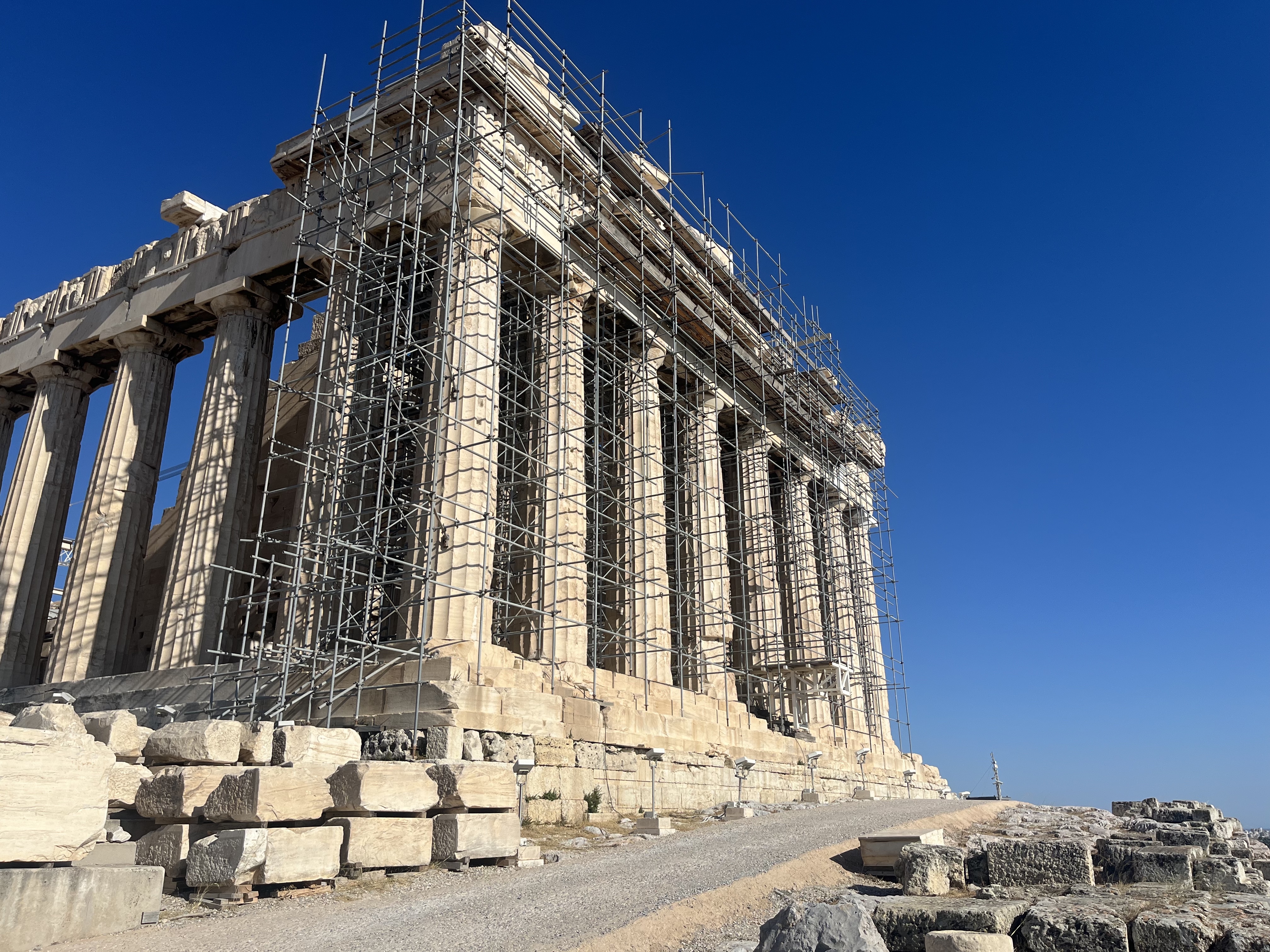
There is scaffolding across the near elevation of the Parthenon and it looks like the most famous monument in Greece has been subsumed by a glitchy photoshop layer. Think of an unhinged graphic designer working on the sleeve of a minimal techno album. In other words, although far too hot for the builders right now, the Acropolis has been enhanced by the patina of restoration work on its centrepiece. Civilisation evolved here; a data driven grid reflects where we’ve got to.
Both old and new are grand in this place. The vast temple – which appears so frequently in tourist literature on Greece; which graces thousands of illustrations of myth; that you’ll find in scores of architecture source books, plus countless cartoons about philosophy, not to mention a deluge of souvenir fridge magnets – is somehow a fresh sight to me. And, from the audio guide, I learn how: the stone base is convex and the pillars lean into one another and these subliminal engineering tweaks, no matter how subtle, are what give the Parthenon its spring and glaring white energy.
I overhear an American tourist boast about a copy in Nashville. And although tiny models of the Parthenon occupy snow domes the world over, the world’s less well-known replica is full scale and lives in a park in the Deep South. Some might say it’s better than the original since it houses a recreation of a 42ft statue of the presiding deity, Athena, and casts of the marbles which once adorned the pediment here. Greece has thus far failed to retrieve the marbles from the British Museum and the first statue of Athena is lost. So my provocative vote goes to Nashville and the year of the Tennessee Centennial Exposition, 1897, for best example of this building from the fifth century BC.
Those marbles really are a sticking point, mind you, and I’m glad that the guidance notes which we came across in Athens do not mince words. The marbles are ‘loot’, Lord Elgin had a piratical ‘crew’, and the transport of 75m of exquisite ancient sculpture to London in 1801 is unambiguous theft, not to mention collusion with the Ottoman government of the day. So if you’ve fallen for the line that the so-called Elgin Marbles are safer in Holborn, please visit the Acropolis Museum. It is truly world class. Since the plunder Greek archaeologists have found more than enough remaining items on the famous hilltop to fill an extensive, imaginative, beautifully curated twenty-first century museum.
When you enter this venue, you can look down from the forecourt to see a complex of ruins; the ground floor seems cantilevered over a hamlet’s worth of ancient residences You can explore this scene from a crisscross of gantries, shaded by the ground floor of the Museum overhead. Greeks are obviously fantastic custodians. The dig site boasts a museum within a museum, a sequence of glass chambers in which you can browse ancient chattels and ornaments; a panel in the floor, sealed with toughened glass, allows you to gaze down upon existing mosaics and even, here and there, walk across them.
Somehow the upper floors manage to emphasise the artistic quality of the recovered exhibits; many have been stolen; many have not. The new building could be a contemporary art space. The British Museum, by contrast, still has neo-classical bank vibes and reflects our national fetish for classicism in its presentation of Greek relics. Here in the Acropolis Museum, one better appreciates the aesthetic values of the time as seen on the statues and friezes, with less emphasis on idealised physiques and classical history, more on creative expression, vitality and colour (One hears that the classical world was once awash with colour paint; here you can still see the bright flecks.)
Our hosts didn’t get everything right at the Acropolis. They were, for example, reluctant to give Prof D credit for a mobility impairment and let her use the disability elevator from the foot of the Attica hill top to a vantage point from where she could get a proper look at the monument we had paid to come and see. Without this facility she would have been unable to climb any of the baking steps never mind reach the summit.
It was also curious to see a young couple strike a ballroom dance pose together for a photo of the far end of the Parthenon. One of the guards told them off quite ‘strictly’. Those guards may think they are guarding civilisation, dignity, and civic pride. But this is also the land of Dionysus, Eros, Pan, many, many satyrs, and the philosopher Diogenes who was to openly masturbate in the Agora just to make a point. Much worse behaviour than recreating Strictly Come Athens. Anyhow the scene gave me a chuckle, not least because the male dance partner was already looking a bit embarrassed long before the guard blew her whistle and a hundred tourists turned to look their way.
So there we were. Scaffolding at one end to provide structural maintenance and valuable protection. Gesture policing at the other end to provide compliance with brand guidelines. And a world class repository for the many priceless artefacts which were created to stock this iconic archaeological site. No photos in the museum either. The entirety really was well looked after.
By way of an epilogue, we visited Athens at the peak of the 2024 Greek wildfires. Aided by strong winds, the fires were eating up the surrounding forests at speeds of up to 15kmh. The evening we stepped off the plane, the air smelled like a barbecue. We then sat in the Airbnb watching BBC World and contemplating the potential prospect of evacuation given that suburbs were already burning. The next day, unpeturbed, we passed our time in a tourist bubble. The acropolis, which is after all a stone mountain and the highest point in Athens was probably also the safest location. But from up there, by the evening on day two, there was no sign of fire. And day by day the risk dissipated.
Thank the gods (and the EU Civil Protection Mechanism which triggered the arrival of firefighters and equipment from eight European countries) for saving the Greek capital on this occasion.

No Comments