Infection proliferates in a Bucharest park
I have been bitten by the replica bug and I seem to have written about many: copies of Leonardo’s Last Supper in Switzerland; the part reconstruction of the Devil’s Quoits in Oxfordshire; the plaster bones of a diplodocus skeleton in London; the Nashville Parthenon; the monumental scale 1:1 rendering of the Emperor Constantine in Rome. I find these reproductions compelling. They display an impetus of their own making. And the transcendental energy (and funds) which the various originals suck up from their localities and custodians goes far beyond use value. Its pure regeneration.
Lascaux, for example, has such infernal power it has spawned three official copies: Lascaux II, Lascaux III, and Lascaux IV. These issues from the depths of a French hillside are the only visible, or viable, and tangible evidence of the wonders within. But they have duly drawn the life out of the original grotto.
Does not touring a replica cave with your family and other excited tourists led by an entertaining guide sound a more lively experience than that enjoyed by a grey-haired expert? If the expert is permitted to visit at all, it must be for a gloomy solo visit of no more than 30 minutes per day. Lascaux is afraid of the light.
Which brings me to the central caprice of this particular ramble, namely, vampirism. What I here propose is that each case of replication, reproduction, reconstruction or recreation results from an unknowable moment of unconscious infection: a vampiric bite to the archaeological imaginary. Include the virtual fly-throughs, on which I am currently working, and one might say that six new versions of Lascaux stalk the earth.
I got thinking this way during a recent trip to Bucharest. I was there for a conference of art critics, who it is often said can feed off the blood of artists for an entire career. Anyway, I went rogue one afternoon and strolled through the autumn sunshine to Carol Park. Entering this French-style public garden, a grand vista stretched away to the south of the city. Paved walkways led to a vertiginous metallic sculpture that was beseeching the blue sky. On a terrace were stone inscriptions, floral wreaths, a fire in an amphora. But I note that given one or two ideological changes, the authorities have had to exhume numerous corpses here as Romania transitioned to and from a state of Communist rule.
Upon climbing to the terrace, I was able to reflect solemnly on the dancing flame of the eternal torch and to double take at the sight of a guard who, being so utterly still and lifeless, I took for a while to be himself an uncanny replica. I was set straight by a local curator later on. More due diligence revealed the full name of Carol Park to be Carol I Park, as if somewhere, this very landscape has its own reiteration. Is there a Carol II Park dedicated to King Carol II? I almost expect so.
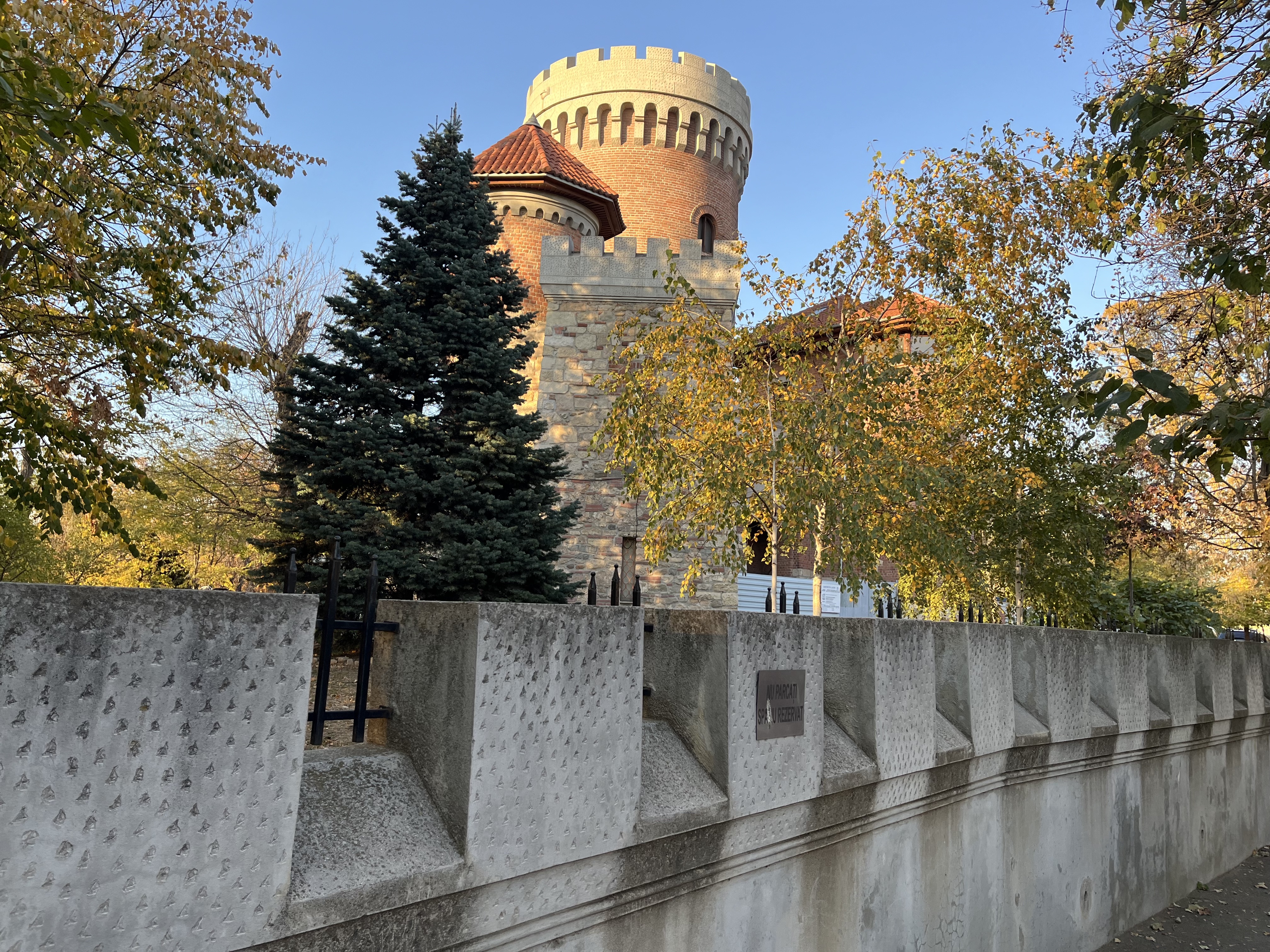
So there I was, thinking about commemoration and looking for a further structure I had come to see: the HQ of the National Office for the Cult of Heroes. This curious building, with a mysterious function, was retired behind hoardings together with a frustrating wealth of municipal foliage. It was found in guidebooks and on touristy websites with an even more appealing moniker, Dracula’s Castle. And while it has never seen active service as a fortification for the undead, it does comprise ancient stones, ornamental battlements, that crenellated tower, steep roofs and a distinctly Byzantine mien.
But it is a smaller model of another castle. Indeed it bears the fang marks of a clifftop castle above the Valley of the Arge; Poenari Citadel, to the North of Bucharest, was the lair of Transylvania’s original bad man, Vlad the Impaler. We’ll have to make do. Historic evidence for the life of Dracula is thin on the ground, sadly for the Romanian tourist board.*
I came away from Carol Park with several mental images: policemen picnicking on a bench; mothers with pushchairs who looked only too pleased to be out and about; a middle-aged man launching a remote control speedboat. But thanks to the sunshine, perhaps, I did not see a single vampire. Count Dracula is too busy these days, working as a tribute act. Nor did I see Nosferatu in any filmic guise, or any of the cast of Hotel Transylvania, or Count Duckula, or the Count from Sesame Street. But the unique art object here, the abstract monument which might have lent itself to art criticism, was centred atop a mausoleum. I took in the scene, merely shivered, and decided it best to rejoin my colleagues.
* In Bran, Transylvania, my brother and I visited a third castle, which is said to best fit Bram Stoker’s description of Dracula’s crib. All three castles are well infected with the logic of spontaneous imitation, which I believe we always post-rationalise.

5 Comments
Your account of your visit to Carol Park is highly evocative, entertaining and thought-provoking at the same time. A very enjoyable and informative read. Thank you!
You could rewrite Walter Benjamin’s mechanical reproduction essay.
Speaking from near Cardiff
Hope you’ve reached now. Thanks for the updates!
Many people have been chipping away at it. Isn’t it the most cited art history work of the twentieth century. Would be aiming quite high!