A brief encounter with Marcel Duchamp’s Large Glass
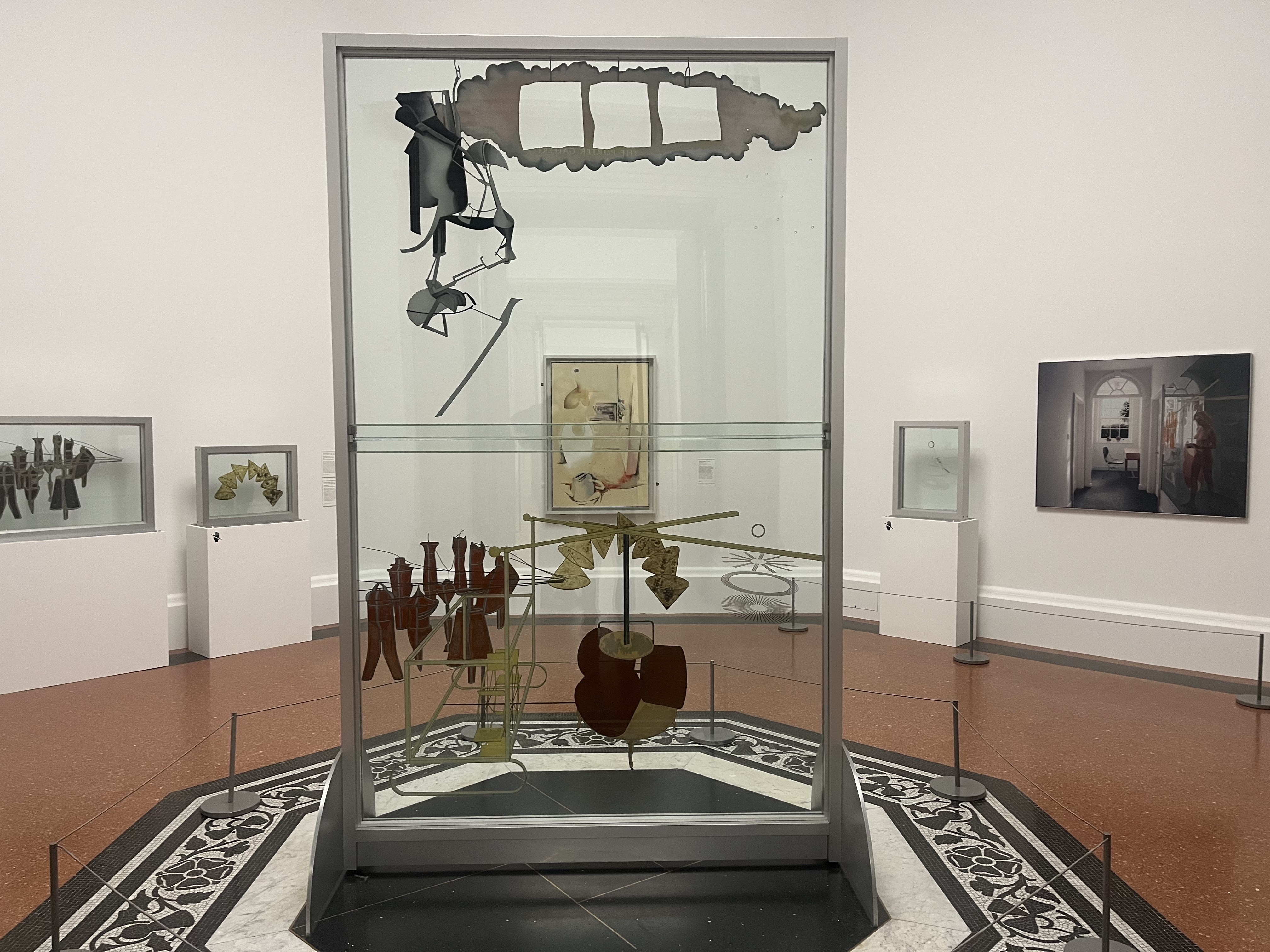
Like a freestanding, double-glazed patio door demo unit, the twentieth century’s most enigmatic work of art is propped vertically on its functional base, inviting showroom visitors to peer through the vitrine or merely to admire the joins and the casing.
This particular glass sample does have a few imperfections; trapped inside the layers, for no explicable reason, is a wealth of intriguing diagrammatic tracery: a wiry, hard-to-read, set up that defies easy description. But elements you might still call cogwheels, and attenuated rotors, plus dressmaker dummies do seem present.
There is no clear purpose to this incomplete Heath Robinsonesque arrangement, but one perhaps hinted at by the object’s official designation. Because this is, of course, The Bride Stripped Bare by her Bachelors, Even. The title fogs up the view; and this here version of the Large Glass, as it is AKA, is also a replica, further muddying the waters in Room 18, where I’m photographing the work, by Marcel Duchamp, at Tate Britain.
Our national claim on this enigmatic piece which was to pre-occupy the French artist for much of his working life, stems from a connection to Pop artist Richard Hamilton. Hamilton was to enthusiastically correspond with Duchamp and so the reconstruction was made with the full approval of the author. It is an enhancement of the open ended suggestiveness of a work which escapes the limits of the Philadelphia Museum of Art.
It can be unsettling to dwell for long on the uncanny doubling effect that accompanies a reproduction of an icon. But words must be said about the spread of what remains: a pure, obsessive artistic idea. Duchamp worked on The Large Glass for decades
Duchamp was to accompany his magnum opus with an extensive archive of notes: the so-called Green Box (and the subequent Green Book) was an extensive publication full of riddling captions and confusing blueprints. Conceived as an edition of 200, and yet since Duchamp was quite indifferent to commercial success. One concludes that such propagation, and indeed replication of box-subject, all played happily into his desires for then future existence of the Large Glass.
He signed Hamilton’s work; Tate is calling this, paradoxically, an original replica. Whatever is written about the earlier version, this reproduction (1965-6/1985) is a provocation to begin all over again with the commentary.
The collaboration has given birth to a twin piece; you could not write a critical profile of either identical sibling, without referring to their sister or brother. Replication has therefore expanded the scope of the Large Glass, irrevocably changing the first work, giving it a new and imaginatively productive context. Handwritten letters in another glass case here align the professional output of both artists, as if this puzzle held the key to the accessible charms of British Pop art.
And, by dint of the necessity of any replica, this one bestows a new appearance on the original. Having not been to Philadeplhia I leave it to others to compare and contrast. But I was struck when I recently visited Tate that this piece, which lived in my mind in brown cubist monochrome, does have colours. It also has polish – none of the dust which can often accrue in an archive. It further offers a degree of surprise. What is it doing here in Pimlico along with the Turners? What was I doing?
Duchamp’s major work gives me very little. It is resolutely unaesthetic. For a study of heterosexual relationships it is utterly dry and devoid of romance, but it is not without humour: withering irony in this case. It is the irony of an attachment to the hearts and flowers, and to an act of union which is, physiologically speaking, as mechanical as an engine piston. It is the irony of the grand caprice of many of our lives, that of popping the big question, from within an economic system which otherwise dictates the affairs of men and women.
The bride seen in this window is perpetually denuded by the attention of half a dozen suitors. She is the one for sale. Duchamp’s piece is hardly a sales tool for marriage, but it does appeal to sell the availability of this one woman to allcomers. Hamilton’s piece is a promotional stand for all that. The pages written about both are further collateral to the deal, returning me to this showroom prop.
I was inspired to visit this work by Hamilton/Duchamp by a biography of the latter written by Calvin Tomkins. I recommend it to you, because it outlines a personality every bit as remarkable as this problem work.

3 Comments
I knew nothing about the subject before reading this. Now I am really intrigued.
Great writing.
“Like a freestanding, double-glazed patio door demo unit, the twentieth century’s most enigmatic work of art” I love how you call it as it first appears, Mark, it is bold. Don’t you think though that the apparent crudeness of 20th century art, when we think of how much time went into it (which you mention) compared with the ease of creating imagery in the 21st century – particularly now AI can assist- is why we give it special attention. It is like we are looking back at ancestors from the prehistoric age rather than a hundred years ago or less (fewer?). With your take on Duchamp’s cynical attitude to marriage (or perception of it thus) I though how anti-romance most writers and artists of the 20th century were- Hemingway, Burroughs, the Pop artists… this seems to be forgotten by those who look at the talented romantics who were not, for the most part, the major artists of the twentieth century– Kerouac (I love him but still), Fitzgerald (ditto), Led Zeppelin (just saw a documentary about them so they came to mind but Leonard Cohen or Neil Young or Joni Mitchell – “soured romantics” we have to say, at least, were so much better)… in other words we look at the 20th century now (I feel) as a more romantic decade but I feel actually the greatest artists were not romantic, or at least were disillusioned romantics (who else? Camus, Didion, Marquez – from what I have read- Burroughs, obviously- Sartre… the list goes on. Anyway, that’s a way of saying, you got me thinking. : )
Thank you Jay. I think you’re right, the 20th century we grew up in is ancient history. I’m not sure Duchamp is making some kind of anti-valentines card here, but he does seem to have been preoccupied with a certain systematic, structural, aspect of romantic love. Quite a world away from the likes of a Kerouac or Joni Mitchell. He was rather, in the words of 80s popsters Five Star, a ‘system addict’: https://www.youtube.com/watch?v=wsA7rdZelLc