On a contemporary experience of a prehistoric mystery
I did not expect a pop quiz at 7.15 in the morning. The quizmaster was behind the wheel of a taxi. The contestant (me) was in the back seat, looking out at the grey dawn-lit Wiltshire countryside. It took me about half an hour, and several educated guesses to get from Salisbury to Stonehenge.
“He was a member of the best selling three-piece rock band in the 1980s.” I don’t know. “He once sent a message in a bottle.’ Sting!
“He was Britain’s most successful filmmaker of the 1990s.” Erm… “He was once married to Madonna.” Guy Ritchie!
“Do you watch Would I Lie To You?” I’ve seen it. “He grew up round here.” David Mitchell!
And so the time passed and I learned that the lead singer of The Police and the director of Lock, Stock and Two Smoking Barrels both have mansions visible from the A360. I learned that one half of Mitchell and Webb is Salisbury’s favourite son. I also learned that, for strategic wartime regions, those fetishised fighter planes known as Spitfires were manufactured in this part of the world. Oh so much to take in! And I had only ventured out this way for a visit to a well known stone circle.
I was dropped by the security gate outside the visitor centre run by English Heritage. There were already a number of cars parked up for the head of PR, plus an in-house prehistorian, plus the marketing manager, and then three photographic artists, whose show (within the canopied galleries of indoor museum space) was the impetus for my first visit to Stonehenge. A convoy of job titles is soon rolling across the grounds. It’s a much shorter car journey and there are no more nuggets of low cultural trivia. I get out of one of then vehicles and it is there.
It.
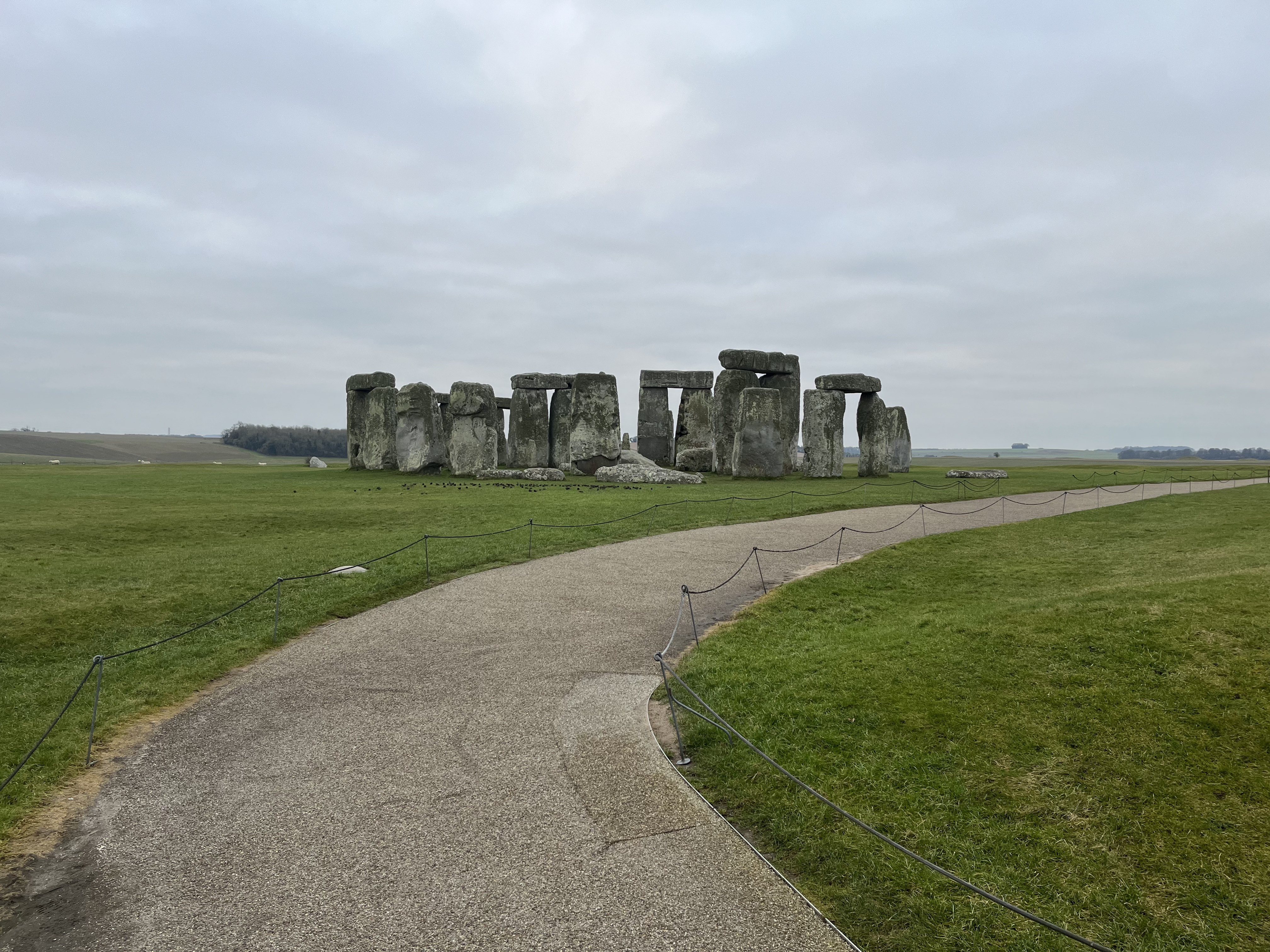
It looks, if I may say so, quite dinky from the approach path. Not quite as wide as you might think. Taller than you would imagine. And impossible to take in at a glance. Thanks to a circle within the circle, there is no definitive vista. Sarsen stones and the Blue stones set off differing rhythms and much of the ring has collapsed. The muddy earth has begun to reclaim several of the recumbent pillars. Encircling the visitor, this impossible architecture is as square and block-like as it is round.
Rooks flutter on the heights. Lichen spreads beautifully across stone surface. I seek primordial energy, but reaching for a nearby pillar I am reminded not to touch.
In the absence of wind and rain, it feels like a welcoming place. In the absence of sun, it maintains a sombre grandeur. But any sense data is drowned out by a voice in my head, which tells me I am at the UNESCO World Heritage Site of Stonehenge, Europe’s heaviest stone circle, and subject of many History Channel documentaries, together with a top notch 2022 exhibition at the British Museum that really served as my introduction.
I am in both an outdoor museum and the scene of solstice revels. I am plugged in to the extensive work of archaeologists and simultaneously a know-nothing here. My keen awareness is that this is the most important prehistoric site in the UK.
Meandering round the stones, trying not to bump into others, I find myself in a parodic dance with – who else? – but the monument’s comms team. Who would be able to come to Stonehenge without acute awareness of where they stand, where they walk, how long they gaze? And how, I come to wonder, can the young artists mentioned, and the curators who have been working with them, ever hope to express anything of this mute monolithic presence, of this untranslatable amassing of sandstone and igneous rock, of an incontrovertible enigma that will not go away.
Reflecting on this visit I found that my impressions were of a landmark at once very familiar and also uncanny: for that very reason. I felt like I had been here in a dream. That may be why I wanted so much to touch the stone: for the purposes of a quite unscientific authentification. Given the efforts made to assemble this spectacular creation (stones from Wales etc), my own rapid response (asking AI to confirm the backstory, booting up an online dictionary, googling synonyms for speechless), poured out here for a distracted readership, feels so helplessly glib that I can be sure the mystery is shut off from me forever.
But I did feel a certain degree of dramatic affirmation of my ongoing interest in prehistory, and its representations. I felt that at 8am on a wednesday would be my best chance to see it afresh. The mercurial cloud of restless starlings and the ominous rooks perched atop 7m tall stones gave me somehow much more than any previous reading or viewing. It was a relief to finally get this close to Stonehenge, but it remained mediated.
The experience was framed by the resident birdlife, by surrounding plains, by muddy footprints, a rope cordon and by the accretion of lichen in many shades. It was the home of Guy Ritchie and Sting. Far easier to talk about all of this, than the stubborn enigma brought into focus by a kaleidoscope of contemporary culture.

2 Comments
That visit sounds positively presidential! Any Spinal Tap questions or ones about, yer man, Deller? Was the traffic noise from the nearby junction/roundabout/A-road significant?
Thanks Micheál. Ooops, I overdid the motorcade stuff!
Deller and Spinal Tap were featured in the well curated exhibition in the visitor centre. And yes, the traffic was visible, and audible. Good point.