Taking the plunge in immersive shows at both The Barbican and Tate Modern
On the 23rd July I visited two shows in London which promised an immersive gallery experience. In their evocation of early years and final moments, neither disappointed.
UNLIMITED SCREENTIME
In William Golding’s 1954 novel Lord of the Flies, an island of marooned British schoolboys soon descends into chaos. In Ricochets, Francis Alÿs’s 2024 show at the Barbican, children at play in an array of global locations may be seen to embody the best of human nature not the worst.
Ricochets takes as its theme children’s games, rather than immature attempts at self-governance. At play, whether in Switzerland or in Afghanistan, children express joy, imagination, fair play and innocence. One should add to the list ‘vulnerability’ at times of conflict, but I will return to that.
Some of the games were new to me. Most were merely in new locations. It’s been a while, but of course I too have eagerly played tag, hop scotch, and conkers. I have improvised a go-kart, had a snowball fight and raced along with a stick and a hoop. Hard to believe I know.
But I have not danced barefoot on a dusty roadside. I have not played laser tag with a shard of broken mirror. I have not taken part in an elaborate game of mime football, at risk of getting shot. My chances of reaching adulthood physically unharmed were always very good compared with the subjects of some of the films collected here.
So I was surprised and yet not surprised to find that laughter and exuberant high pitched shouts can ring out from some of the worst trouble spots on Earth. The faces of our western kids do not have a monopoly on smiles. In the sometime absence of healthcare, education, and even food, children worldwide still have access to free time and creativity.
Alÿs has bedecked the Barbican’s gallery with some two or three dozen screens. It is ironic that many of the younger visitors to this show, of which there were many at the time of my visit, will get all the screen time they want for an hour or two, while their parents sanction the exposure as artistic nourishment.
It may be that the smartphone has supplanted the possession of any compendium of children’s games. I had a book once, with 101 activities to try with my younger brother, and I thought of games like ‘rock, paper, scissors’ or marbles as throwbacks to the time of Victorian Britain. But I couldn’t be more wrong.
Marbles dates back to prehistoric times for example. Rock, paper, scissors is embraced by our contemporaries in many corners of the world. Interpretation on site makes the point that while civilisations rise and fall, the games children play endure, perhaps thanks to their very marginality.
The Barbican has pressed the immersive button here to market a show which on paper sounds – I’ll be honest – quite boring.
Actually it’s hugely rich. Not just because, as one circumnavigates the third-floor space, the films accumulate to imbue the low-lit space into a pulsating essence of play, a hub for all these games worldwide.
Alÿs augments this 360-degree, darkened cinematic spectacle with small jewel-like paintings on backlit canvas which immortalise various dusty roads the artist has come across in his many investigative travels,. Tiny figures and cherished ludic props are an utter charm.
These travels, to places as remote as Mosul or Juarez, might seem fraught with risk were it not for the blithe and cheerful ubiquitous presence of the most vulnerable in society. In Ukraine, the kids dress in battle fatigues and flag down passing cars in search of Russians. It must be awful to experience territorial invasion; it must be irresistible to feel as if the whole thing is a quite serious game.
It was interesting that not one of the films had been made in Gaza. Alÿs has previously made work about the Israeli occupation of Palestine and one imagines that the planning for this show was too well advanced by this time last year to have responded to events subsequent to October7th 2023.
Or perhaps there was time. Time, but no appetite? How could the artist have presented the lighter side of a conflict filled with so many images and reports of countless children who have had limbs amputated without anaesthetic, been wounded and orphaned, had severe burns across the whole body or been targeted by IDF snipers; shot expertly in the head.
The harmlessness of children’s games is a major takeout of this exhibition, as are the risks which players take. The boys playing soccer without a ball on a street in Mosul are, unbelievably, risking death at the hands of the Islamic State. They are scattered by a gunshot at the end of their game.
While the films in ‘Ricochets’ are for the most part joyful, two more elements underpin them with mystical seriousness. I have already mentioned the elegiac paintings, there are also modestly sized animations which build on their mystery and emerge from the darkness of the mezzanine level.
By this point I was well ahead in a game that most art loving grown ups will recognise. That of pacing oneself around a gallery, studying whatever documentation one finds, and doing what it takes to release the dopamine which an art fix can provide.
THE DYING OF THE LIGHT
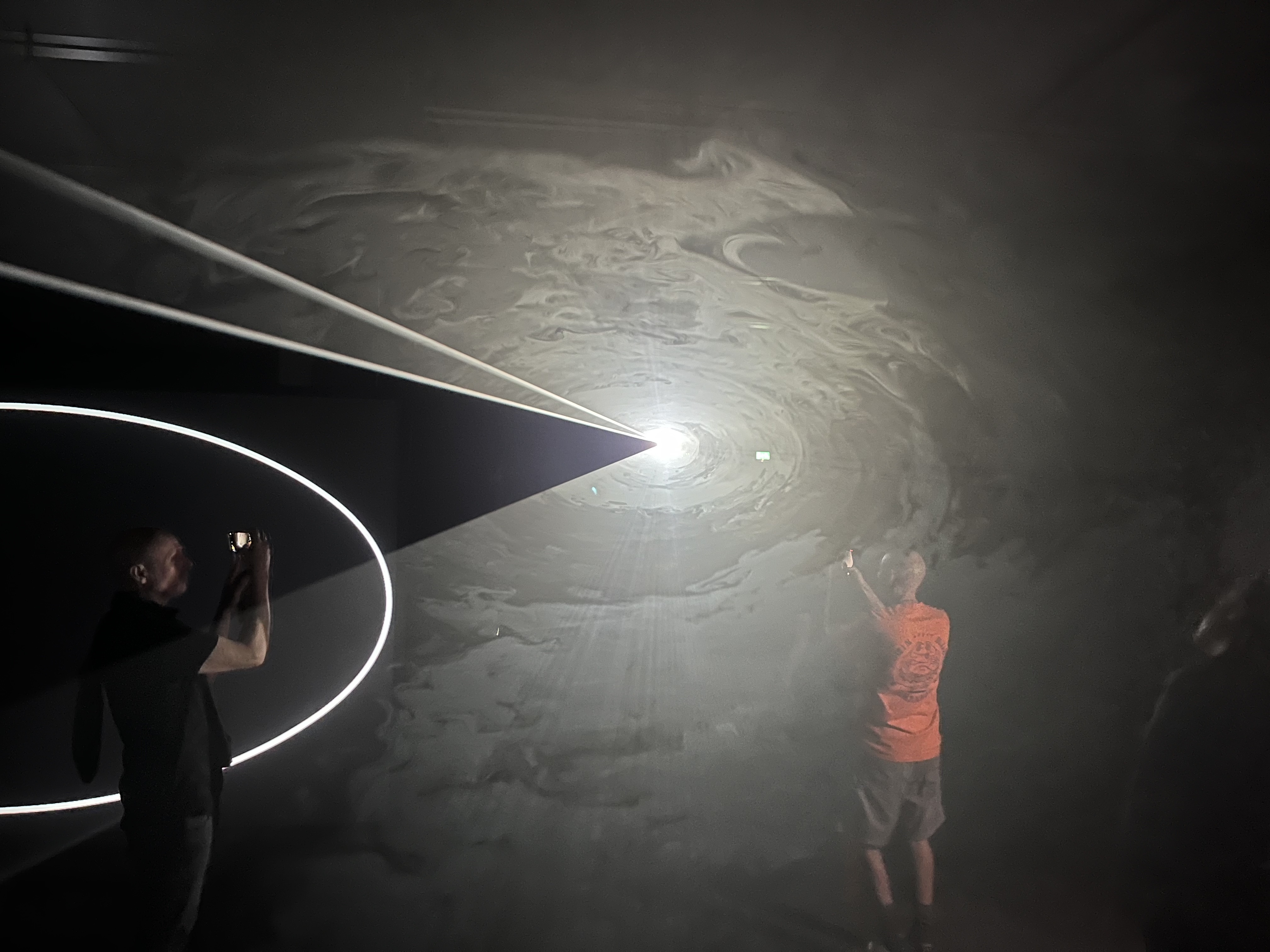
Being akin to a near death experience, Solid Light had me craving a lit cigarette; and as a reconstruction of an artwork first shown in the 1970s New York loft scene, it had me craving to be a full chain smoker, surrounded by nicotine addicts. There we all would be, staring up and down these funnels of light and contemplating the meaning of the all-powerful pinpoints of light.
I don’t know how else to interpret these works at Tate Modern, other than metaphors for the soul’s passage. And I don’t know anyone who wouldn’t agree that, as a spiritual journey, death would be more likely to come to me or you wreathed in tobacco smoke, rather than the artificial mist used to recreate the atmosphere of a downtown art studio. It was a sanitised mist which we are assured by the gallery notes is nontoxic.
But I still can’t deny the power of these installations. Expanding light envelopes the viewer in a sharply defined cone. The don’t-worry-it’s-safe air pollution swirls like a sci-fi film special effect. Cloudy little puffs stream around the illuminated space and billow around in waves that seem all but sentient. This close to an imagined death there is an unveiling of previously invisible energies.
This is a bijou exhibition which Tate may hope reaches the heights of popularity achieved by their best-known recent excursion into immersive art. I am talking about Yayoi Kusama’s Infinity Mirror Rooms which, for the longest time, was the delight of families, selfie takers and people who like to be transported by art. Antony McCall Smith’s own ‘response’ is not only a mirror for what we think of when we think of death. Unlike the Kusama, it is also an adventure in finitude.
In the darkness of this modest space on the fourth floor of the Blavtatnik Building, there are really only two ways out. One is through the pinprick of light, the eye of a needle, and out into a blinding vision of the Pearly Gates, to mix metaphors and impose a culturally Christian reading. The other is by following a lit green Exit sign: another concession to our latter day culture of health and safety.
But for all that, I salute the young couple who, canoodling on the gallery floor, were sharing their vision of the end of the line. They seemed caught in this imperious beam, enveloped by a happy memory which flew in the face of material realities. The prime mover in this show is a projector which, once the smoke clears, will be found to offer nothing more than a bright white full stop.
‘Ricochets’ is at Barbican until 1 September 2024. ‘Solid Light’ is at Tate Modern until 27 April 2025.

No Comments