An encounter with the Emperor Constantine in Rome
Last month, Prof D and I visited Rome. Despite the obstacles presented by baking sun and frequent stops for street food, I was on a mission to see a piece of living history at the Museum of the Capitoline.
A bus coughed us up before the Altare della Patria. It was completed in 1935. You might imagine it to be one more local element of the ancient world. But the steps, as wide as the bleachers of a stadium, and the portico, which fronts a temple to the fatherland rather than to a mythic god, is a monument to a nineteenth century king, Victor Emmanuel II, who unified Italy in 1861. An image of both empire and kingdom served Italy badly, and Mussolini well. The fascist dictator held his rallies here in the 20s and 30s.
Glossing over that far right set dressing for a moment, we found an adjacent set of steps to the Musei Capitoline. We were braced to pay €30 each to get in, but after a quick exchange with a staff member I discovered that the main object of my interest could be viewed, free of charge, in a garden behind the museum.
This well paved green space, an adjunct to the Villa Cafferelli, occupies the site of a former place of worship: the Temple of Jupiter Optimus Maximus. But I was not here to bask in the presence of Jupiter even if our sightseeing focus was no more ‘real’ than this piece of divine representation.
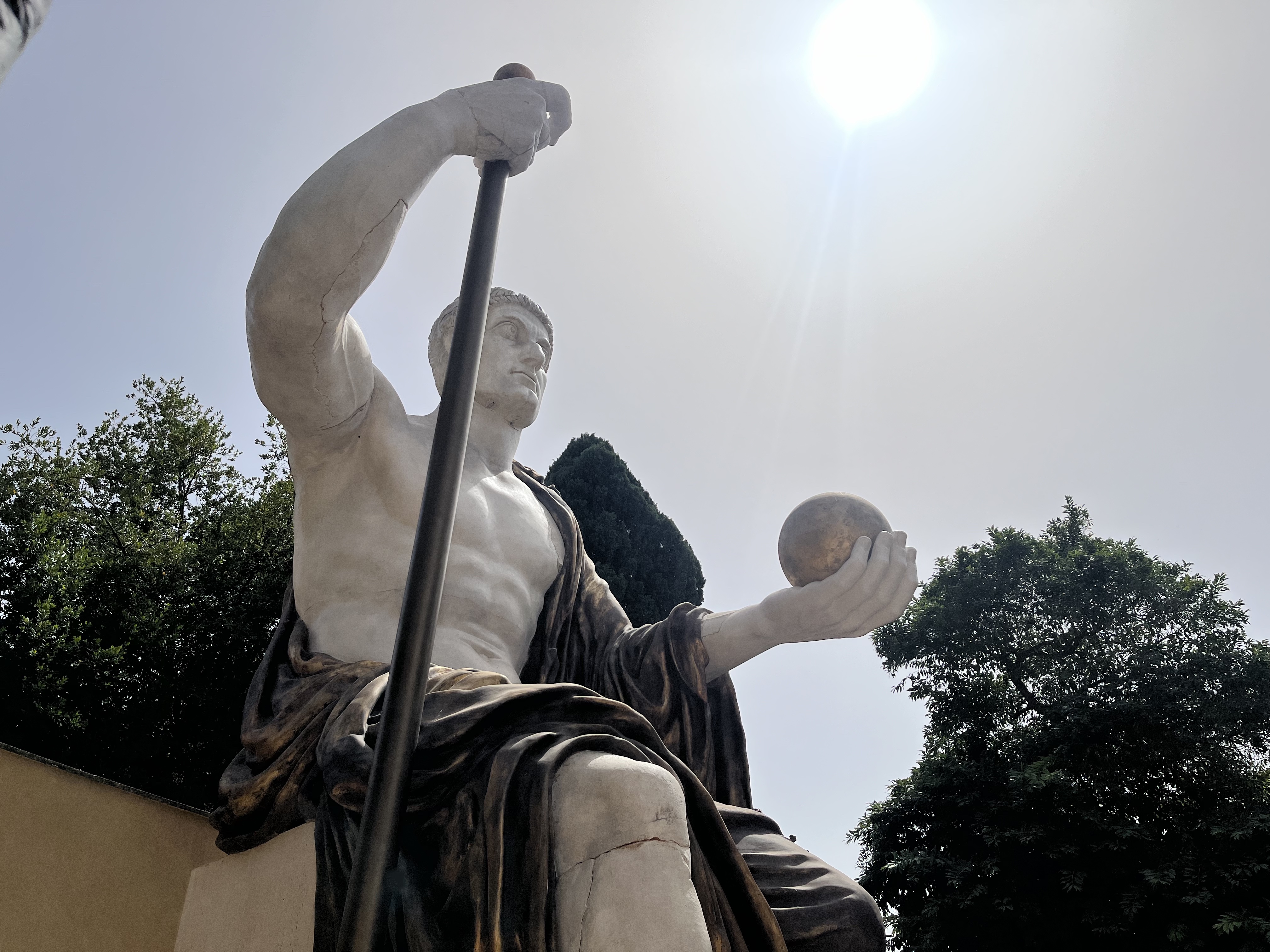
As we approached an archway in the tall garden wall, we could see the household deity. But it was no supernatural entity, rather a third century emperor of Rome. He was not disguised as a bull or a swan, but took the form of a 42-foot replica statue.
This was an ‘off the scale’ representation of the Emperor Constantine, whose notable achievements included the official recognition of Christianity and the relocation of his vast empire’s HQ to the city which for so many years bore his name, Constantinople. Given the forthcoming reach and influence of the Roman Catholic Church, Jupiter must still be spinning on his cloud at this turn of events.
This imposing statue has had various iterations. In its first form, in around about the fifth century BC, when it first emerges from the annals, it was the God of the heavens, rather than the ruler of ancient Rome, who wore the crown here.
In 69BC the statue got its first remake. Still dedicated to the lofty boss of the ancient world, it now took the seated form we see today: bare torso and, waist down, a cloak.
In 80 AD, after a fire, the drapery was to inspire a hybridized successor fashioned in marble and, perhaps, bronze. As an art historian I need to describe this mixed media sculptures as an acrolith. And given that present idol is comprised of polystyrene resin, plaster powder, bronze powder, and stucco, the Colossus of Constantine remains very much a composite.
Between 80 AD and 2024, there is an interim detail of note. Between 217 and 222 AD our rendering of the God of Thunder was struck by lightning. At which point the Romans felt okay to abandon their presiding deities and ascribe all of that power and pomp to their current leader Constantine, though perhaps that changing of the guard was a bit more ‘top down’.
By the twenty-first century, not much was left of this repurposed monument. A head, a foot, fragmentary museum holdings rather than expressions of imperial power. But time, museum time, is surely nonlinear and on the day we visited in 2024, the glory of Rome had cycled round and restored one of its most visible outward forms, in the representation of one of its most illustrious emperors.
Tall as he is, Constantine is all the more imperial for the fact that he is seated. We enter his presence as petitioners on foot, stepping into a cool walled garden which can barely contain him. Despite lightweight materials, and the educated technical guesswork which has led to his full three-dimensional reconstruction, this man has presence.
Who would have thought that a fairly academic exercise, involving the study of two-dimensional photographs, literary and epigraphic sources, and the comparisons with other seated statues from the era, could yield such awesome, immediate results?
His fierce gaze is upturned to the left, as if in recollection of something once seen by that pair of monstrous carved eyeballs. His unsmiling mouth is set with calm authority; a squared off masculinity extends from his jaw to the definition of his torso. (It is literally and metaphorically chiselled.) The haircut, it has to be said, is a bit Mark Zuckerberg, who was reportedly inspired, style-wise at least, by the fringes of the Caesars of yore.
His props are are those of a profane ruler aspiring to the sacred. His right arm is lightly crooked around the head of a sceptre. His left arm comes towards us with an orb in his upturned palm. Both these accoutrements offer a regal mien, which appears to modern eyes in contrast to the loose and quite relaxed cloak which protects Constantine’s modesty. The plinth supporting his seat, is out of sight. A full sculptural throne, although the emperor’s appearance hints at it, would surely have been de trop!
The original sculpture was in Parian marble and, it is thought, gilded bronze. In the reconstruction, cloak, sceptre and orb all take on a similar glitter, which gives the work a mixed media look which is surprisingly contemporary.
For me there is a point of comparison between the Colossus of Constantine and Gazing Ball (Farnese Hercules), a 2013 work by art star Jeff Koons. The Gazing Ball series was to bring together plaster sculptures or a range of figures (by no means all classical) with electric blue, glass spheres all of which are the size of a football.
Hercules, while nude, wears the armature of rippling muscle. Less than a quarter of the height of Constantine, he still stands more than 10ft. And while the plasterwork is chalky and as glaringly white as any monument in Rome, his titular orb is reflective offering a portrait in a convex mirror to gallery visitors who may encounter this, or any of these works from the 2010s.
I’d wager that Koons himself, if he was to see this reproduction, might give up on emulating classicism. It is simply too epic, too full of historic meaning and even in his status as replica, Constantine reigns from the great beyond. Yes, he is artificial, but his third century representation as a serene, all-powerful 42 ft seated god was hardly anchored in reality in the first place. The emperor’s latest incarnation is still filled with the spirit of ancient Rome, a spirit which cannot be said to have ever left us.
The ‘Colosso di Costantino’ is free to view at Villa Caffarelli until the end of 2025.

No Comments