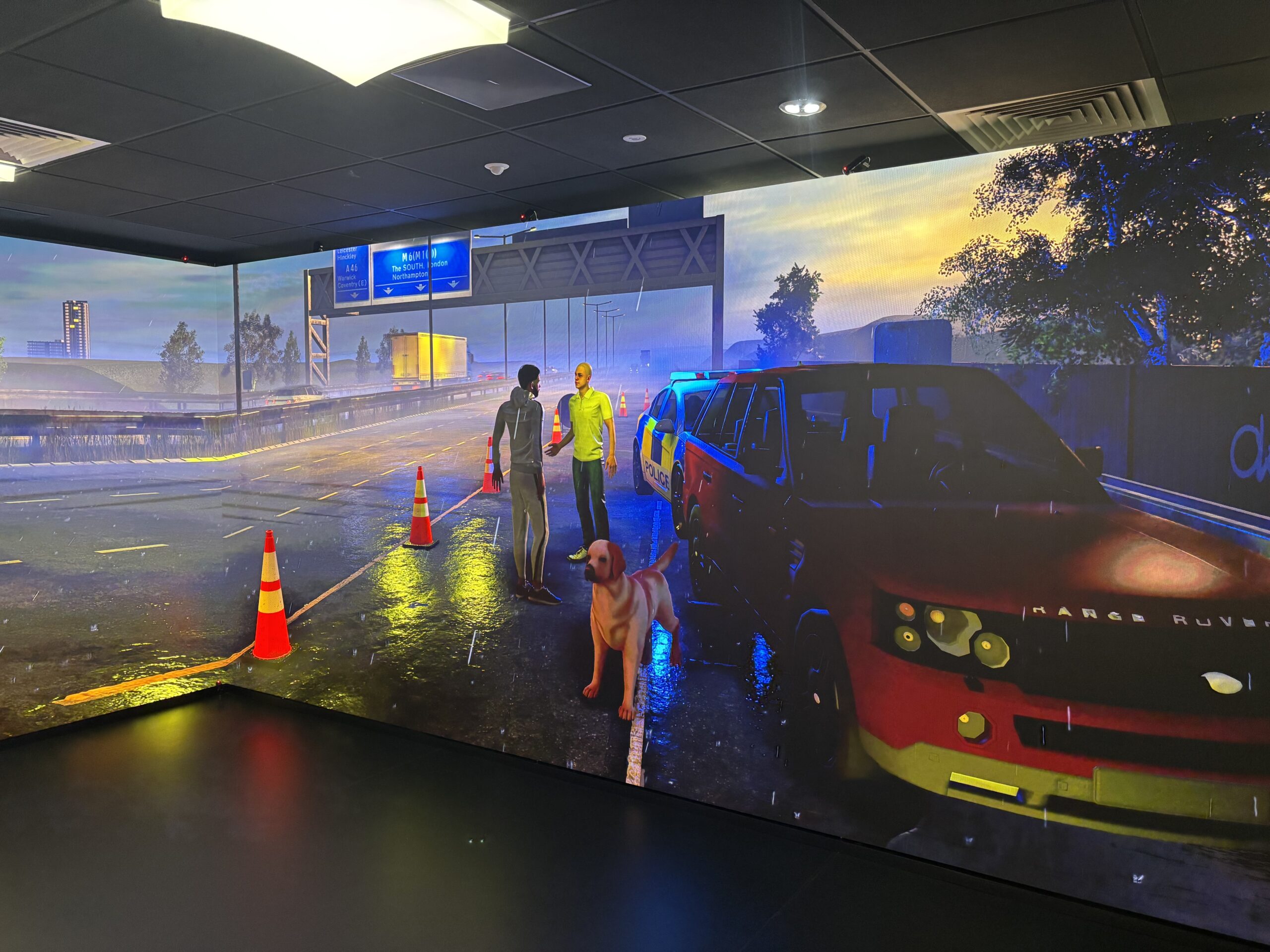
All at once I was on the hard shoulder of a motorway. Police were cordoning off the scene of disturbance. Lorries thundered past. Rain hammered down. Paramedics were on the scene. And, for good measure, a large dog was barking at me. This was my introduction to CAVE, a simulation machine and teaching tool at Coventry University in the UK midlands.
CAVE stands for Cave Automated Virtual Environments. I should admit were the topographical metaphor not telegraphed me by that acronym, I might have missed this particular immersive venue. But choosing to pay attention, I was fascinated by the potential and the resonance of this £1.5 million installation.
Primarily used for nursing at the moment, CAVE occupies three adjacent walls in a large seminar room in the Richard Crossman building, in Cov’s city centre. Each of these ‘walls’ is actually a jumbo LED screen where the action is amplified by surround sound. Which meant that my motorway encounter took place as vividly in my periphery and my ear drums as It did in my immediate field of vision.
What’s so useful about this is that paramedics can run through their paces in real world scenarios with some of the stresses and distractions they will come up against IRL. Their efforts can be tracked via a (non-virtual) digitally powered mannequin that tutors can put in position in the central floor area.
Or, in another hybrid scenario they can engage in role play with local mental health service users, who are among those most vulnerable to committing affray on the roads. Along with strokes or heart attacks, as a paramedic you might need to deal with emotions too.
The objects and populace of CAVE scenarios like this motorway are CGI. I was delighted to see extensive illustrated menus of characters and objects in a scrolling grid; these elements could be slid into a vector plan of what appears on screen, to create new imagery for a cave where nothing is set in stone. I was shown one or two more of these critical environments including a deafening night club and a hazard-filled hospital ward.
Perhaps even more impressive was the software that is used to train both physios and nurses. Loading a new application the room went black and on the far wall was a beating human heart, its beat all you could hear. I was handed 3D glasses, my guide wore tracker glasses; together we approached that livid, pulsating muscle and then entered the atrium and saw the major arteries from within. It was a trip.
But CAVE has potential for fun too. I was later to be shown a scenario best described as an autopsy in a thunderstorm. This is one they pull out at Halloween for a group of brave students. They also run escape rooms in which participants escape from the back of the room and are rewarded by reaching the CAVE space.
It did not escape me that while the room was dormant, the panoramic screensaver, running across some 15 metres of wall, featured mountains, sunrise and, wow, mist. CAVE may be highly utilitarian (or even on occasions highly entertaining), but it retains a little of the sublimity of German Romanticism, as seen from above this ‘sea of fog’.
More serious though was the simulation of a new patient with sepsis. Here a highly interactive bedside setting allowed my guide to show how one might gather vitals and spoken testimony in order to reach a diagnosis. CAVE can also surround you with powerpoint presentations, run multiple choice quizzes with gameshow levels of interactivity.
I was blown away by CAVE and it’s given me a lot of food for thought. I will not forget my session there, especially the journey into a literal heart in the literal darkness. Thank you Assistant Professor Sam Clark for showing me around.
***
It’s over a year since I wrote this post on the National History Museum with a focus on a model whale and a replica sauropod skeleton. Well, last Wednesday I found myself face-to-skull with that skeleton, which has earned the affectionate child-friendly nickname Dippy.
Dippy has been on tour, from the National History Museum in London to some of the UK’s regions and now Coventry, where Dippy is in the Herbert, which sounds like the plot line of a claymation animation with a trombone soundtrack.
She or he (I’m not sure about Dippy’s pronouns) shares an atrium space with a jacquard loom. The loom has close connections with this city whereas Dippy’s original bones are from Wyoming. And yet he/she/they certainly fit with the space in so far as this is a family friendly museum.
A 26m dinosaur will have brought many families through the door, but through those doors the Herbert was also offering a couple of exhibitions you might want to see while you’re here: a wonderfully staged show about the experience of Indian migrants in Britain and a smaller photo show dedicated to Team GB skateboarders at the 2024 Paris Olympics.
And I learned something new. I learned that natural historians and skeleton custodians are not above a bit of osteopathy. Following research in the 1960s, Dippy had its neck raised; in the 1990s, its tail was raised. Prior to these postural corrections, the nation’s fave pet dino must have looked a bit depressive.
Briefly scientists were to speculate that Dippy moved with low-slung lizard belly, legs shooting out to each side. It is probable that curators, researchers, museum directors, and technicans feel more confident manipulating a remnant made, not from organic material, but from plaster of Paris.

No Comments