Discovering an ancestral home in in Banff
“Is there a doctor on board the plane?”
Okay, they didn’t in actual fact ask this, as we cruised 40,000 foot above Greenland. But they might have done. They might have put out a call for a doctor, and then what?
The scene was set for unprecedented hubris. En route to my first academic conference, I had passed my PhD viva days prior. In a matter of weeks I would be, officially, a doctor.
But would I be a doctor-on-board-this-plane?”
It’s an old gag: the Doctor of Philosophy who makes themselves known to cabin crew only to struggle when their knowledge of Etruscan pottery from the 5th century BCE is annihilated in the face of a life and death scenario.
But I was so high on my unexpected academic achievement, I might have tried to be a medical expert. Like a schoolboy, unable to resist shooting up my hand, and turning out to be a total imposter.
The flight passed off without incident however. I watched the latest Indiana Jones movie on the grounds that it was related to my research, but it failed to deliver. Not a good omen..
I landed in Calgary and took a bus to Banff. Getting dark, but I was experiencing the novelty of a North American highway, the sight of the SUVs and trucks with long-nosed cabs and the way that surroundings loomed and the general Twin Peaks ambience of the hotel. It was like entering a make-believe world.
I was also pleased that my roommate, Don, seemed chill, polite and sane: this was surely a very good start.
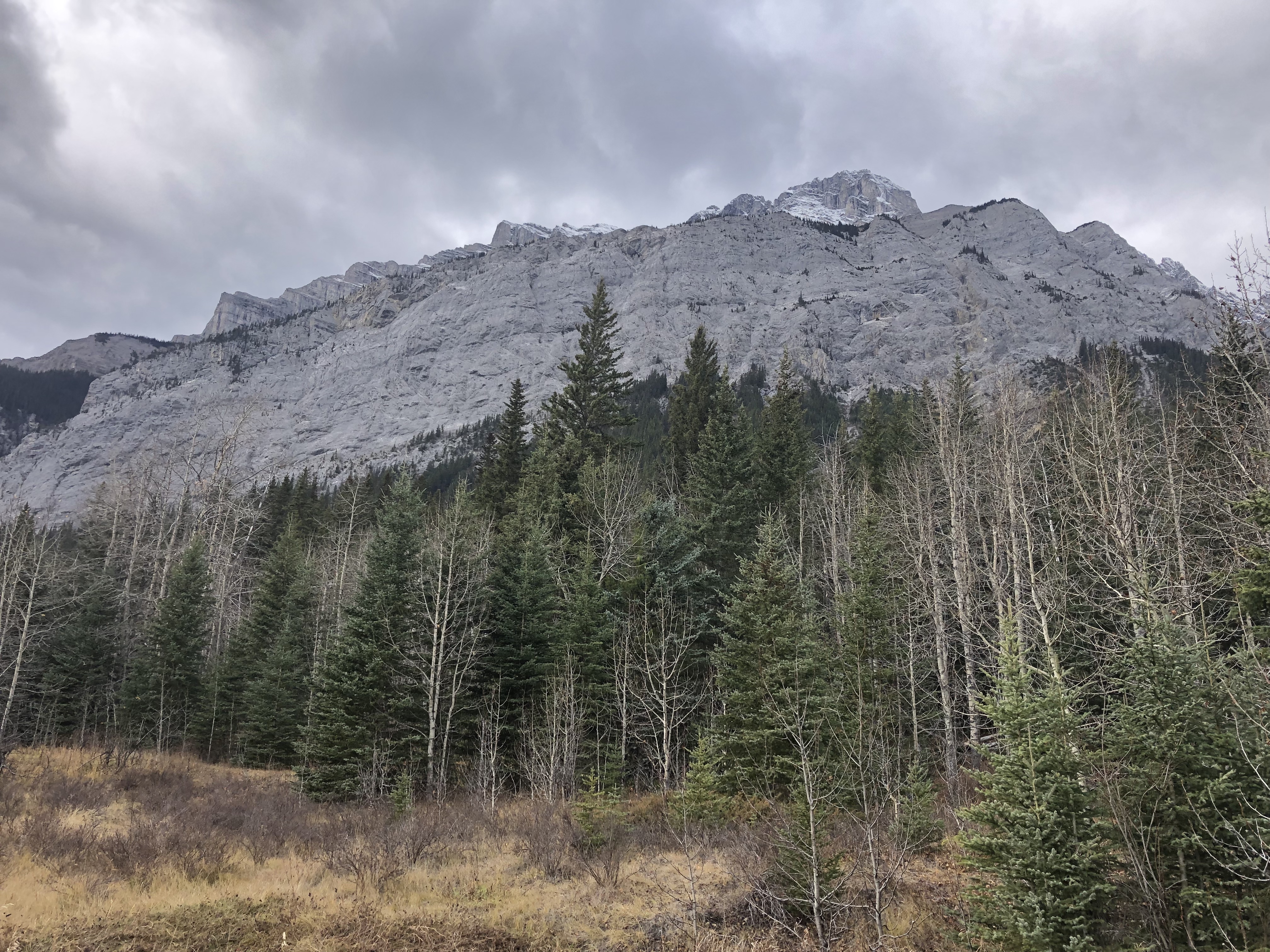
Next morning, after sleeping for 12 hours, I persuaded Don to visit the town’s famous cave with me. The Rockies, which enclosed us with peaks as high as 3,600m, were resplendent in manes of fog, caps of snow. The Bow River was a tumultuous cascade of noisily white water. So beautiful.
The cave was small but perfectly formed for bathing; at least that had happened once upon a time. Sulphur bubbled up from the sandy bottom of a deep warm pool.
We paid eight Canadian dollars to get in and, perhaps in order to get his money’s worth, Don overlooked the DO NOT TOUCH sign and trailed his fingers in the sulphuric waters. And succumbing to peer pressure, my oldest character flaw, I did the same.
We were soon to discover, from a helpful guide that contamination from human skin threatened the existence of an endangered species of snail which existed in no other spot upon God’s green earth. She pointed out a few of these unsuspecting snails, dark, tiny, and in slimy residence upon rafts of algae.
I was not so much an imposter at this point, as an outlaw.
Getting away with intrusions like this would soon become my primary objective as, in the course of three long days, I listened to a series of highly intelligent people expounding upon areas of vast expertise with great seriousness and understanding of the academic game.
My own slot was a Damoclean sword. I was the last speaker on one of the last panels on the final day. As the hour approached I found it harder and harder to believe I actually had a PhD. I was a snail-killing lightweight.
The conference opened with a reception where I put two of my most reliable skills to good use: eating canapés and drinking beers. But it was dawning on me, as certain introductions were made, and dedications were stated, that this was not just an academic affair, it was a chance for Canadians to meet other Canadians.
Having flown from the UK, representing a university few here might even know. I was to be sure an outlier of extreme unlikelihood. I’m not complaining. It was amazing to be here. But as each of the speakers celebrated one another and paid tribute to various tribes of First Nations peoples upon whose land we were conferencing, I felt surreally out of place.
I wanted to belong, who doesn’t? Especially when, as things got weird, a First Nations elder took the mic and led us on a guided meditation by which the assembled art historians could become buffalo walking into a vividly visualised storm.
Pablo Russell, the name of this guru, was surely one of the most inspirational speakers I have ever witnessed at work.
The UK timezone slipped away from me and I was slowly getting used to Banff time. Perhaps that was a step in the direction of belonging: falling asleep in sync with West Canada and waking up, refreshed, without needing to wonder, on Day 2, where the hell I was.
Don presented in the morning. A good panel, it was full of cool people doing cool projects. Co-panelists included a woman who had built a solar powered shed/archive, located on a frozen lake, for accumulating data from grass roots art projects nearby. There was also an an artist using climate data to make generative artworks formatted for social media. My roommate slotted in well, with his comparison of internet based platforms for visual art.*
By the time lunch came around I was familiar with a convention which found that the chair of every session would kick things off by apologizing to various tribes of First Nations people and thanking them for our continued presence on hereditary land. I can understand the need for this convention, but a rogue inner voice was nevertheless reassuring me that I had nothing to do with this particular form of colonization.
Packed lunch at hand, I sat on a coach and we drove into the National Park. I was here to take part in a ‘Walking Lab’ excursion to the site of a local derelict mine.
Let’s see, I thought, what these bastard settlers got up to here in this beautiful wilderness. I was quick to learn the term extractivism, and I now look forward to applying it frequently to all manner of nefarious practices.
Walking Lab entailed dousing for minerals and water with copper pendulums and listening to a pirate FM station broadcast from a backpack belonging to one of the organisers. There were artistic performances by Leah Decter (self-acknowledged white settler) and Alana Bartol (an indigenous artist working with local plants).
At one point, I even became a participant in Decter’s mysterious performance and found myself literally tied to a piece of coal. But I ignored the symbolism. Regular reminders of the toxicity of this site amongst the ruins of a local power station, failed to prick my conscience. This was still someone else’s issue, or so I thought.
I attended every session I could in this two-day conference and was blown away by the standard of these delegates, blown away by their focus, poise, scholarly rigour and areas of fascinating research. Even the PhD candidates were intimidating in their professionalism. How could I ever pull this off?
That night there was the small matter of karaoke. I didn’t exactly jump at the opportunity, but there was really no other nightlife.
Armed with a can or two of local pale ale, I followed Don into one of the Banff Arts Centre artist studios where an energetic young woman was belting out a very terrific performance of Dancing in the Dark.
“I wanna change my clothes, my hair, my face”, she sang, and I couldn’t agree more.
Don was brave. Before long he was performing Space Oddity with all the poise of a young David Bowie exploring movement in one of his early mime-influenced persona. In this way Don conducted an actual countdown to Major Tom’s lift off and the room went beserk.
My room mate had achieved a measure of celebrity; I would clearly have to dust off my own tonsils and take part in this, this, this what? This gathering, this cult, this party, this ritual. Or Was it a social practice artwork?
I chose The Whole of the Moon by The Waterboys, and it triggered something for me.
Maybe the Celtic feel of the band brought up some ancestral memory; maybe it was the sentimental effect of the beer; maybe it was sharing a mic and a stage with representatives of the First Nations. Or sharing a stage with impressive academic speakers.
Whatever the case, karaoke, billed here as a ‘subversive methodology for making change’, WORKED when I made a glaringly obvious connection…
While planning this trip, my old man told me with a modicum of pride that as part of an Irish diaspora, my own grandfather had for a time lived here in Banff. As far as I know, he was not an invited guest of any First Nations tribe and were he to have used a gramophone or even an electric light, I was thereby fully implicated in the toxic legacy of the power station I had visited earlier that day.
Saturday was upon us, with no time to assimilate this bombshell, and I was due to present around 5pm. I had reread and rehearsed my paper, as if it contained the lyrics to a karaoke track. I had come alive to its limitations, its contradictions and its possible inaccuracies. I was in a word, worried.
There were six of us. We had 15 minites each. Subjects included tourism in Mammoth Cave, early flash photography with magnesium powder, the extractivist tendencies of photo film production, early experiments in stereoscopy including toy viewmaster viewing devices, a Life magazine feature on unborn children, and cave inspired NFTs. All fascinating. My own paper was on the first colour photographs of Lascaux in France.
Throughout my talk I encountered a few problems: 1) I was low on confidence, but hyped on adrenalin; 2) I tried to make eye contact with audience members as if it was a wedding speech; 3) I began to panic at the thought I had somehow missed out a whole page (I hadn’t); 4)I felt as if I tried to cover too much ground and that in places I was telling the audience stuff they already knew.
But I know for a fact that my paper also had some undeniable strengths: 1) my shirt was nicely ironed; 2) I kept to my time limit; 3) I had a swell picture of a bison 4) with my English accent I may also have had novelty value.
For most of the Q&A that followed, I sat under the lights and tried not to look like someone waking from a dream in which they have just sat an exam in the nude. The audience seemed more interested, rightly so, by my co-presenters. I was out in the cold, cold mountain air.
But Don, as heroic to me as Indiana Jones at that moment, brought me into the post-panel conversation with the final question of the day, and praise be, I was suddenly able to field it, and then, even deal with a follow up question. I have nightmares about Q&As.
After our chair, Sophie, wrapped up the session and two or three people even approached to thank me for an interesting talk. Let me tell you, that made my 8,000 mile round trip feel marginally less insane.
I said goodbye to Don at 6am the next morning and, after a bit more sleep, I headed into town to buy a souvenir or two. I would like to say that, this being grizzly country, I found a t-shirt with the legend “I Survived a Mauling”. That or a native American dream catcher, modified for very fragile professional dreams.
I got mentally prepared to head home and the journey was as smooth as the delivery of an assistant professor with several hundred citations.
No doctors were required on that plane either.
*Any artists reading this, who would like a ‘museum quality’ archive online, get in touch and I’ll connect you to Don Goodes. Meanwhile arts professionals of all descriptions are invited to take part in his survey. Please take part if you can!

No Comments