A review of contraband art by Palestinian artists trapped in Gaza
Pomegranate seeds have been split by thumbnail to squirt a blood-like dye across the page. Coarse paper bags, once packaging stomach medicine, have been overlaid with sketches. Drawings fill ruled school books, all issued by UNRWA (the United Nations Relief and Works Agency). Colour is minmimal. Images are sketchy. These features do not seem to be conceptual decisions; perhaps they instead arise from stark limits to making work under bombardment in a country that is being wiped off the map.
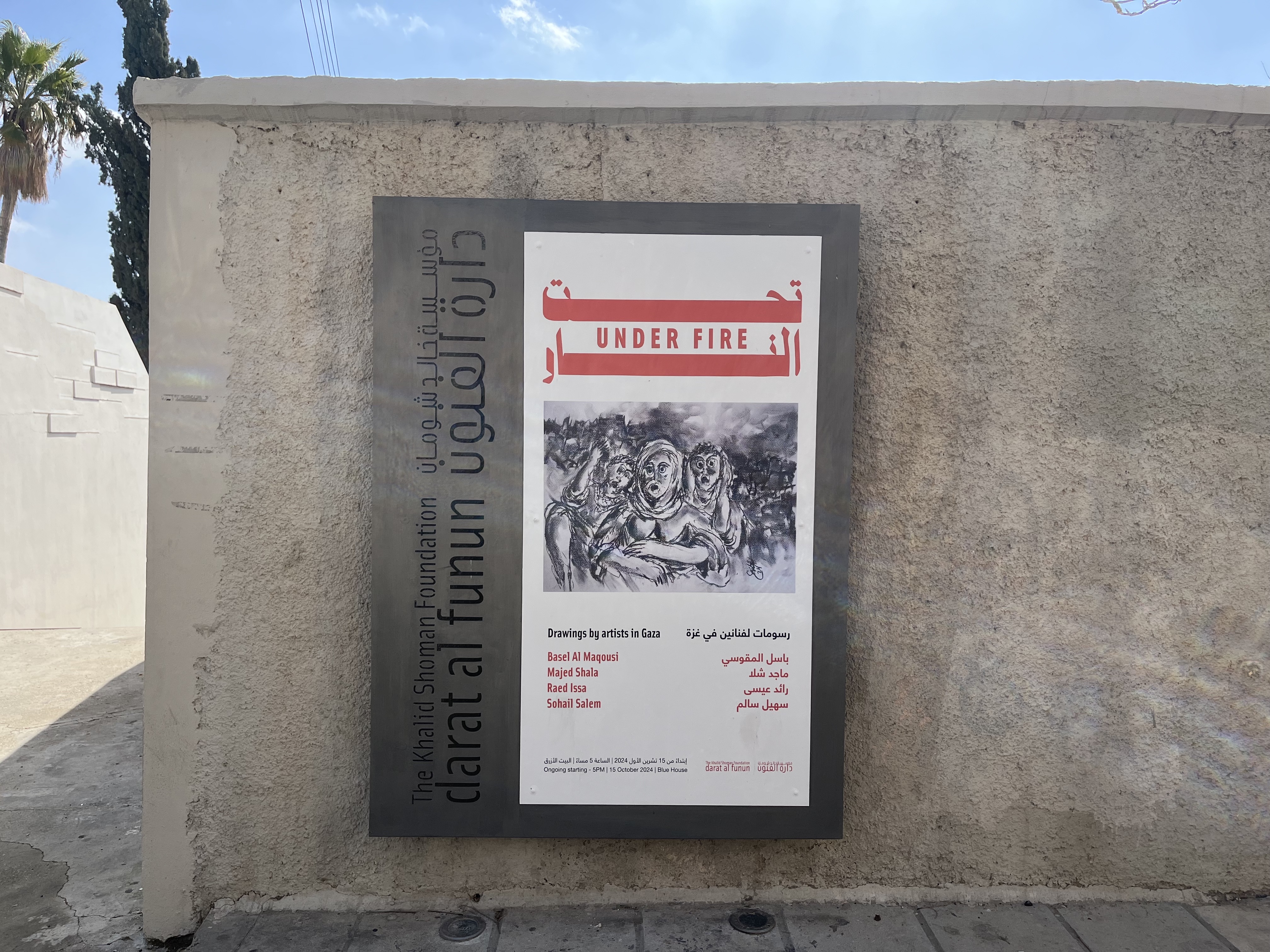
Under Fire is a recent group show we saw at Darat al Funun in Amman, Jordan. It brought together four artists who (still) live in Palestine, which is really not that far away. These materials are hardly conceptual tools; they are rather the limited means by which desperate souls continue to work. Drawing no longer qualifies as a ‘practice’ for Basil al Maqousi, or Majed Shala, for Raed Issa or Sohail Salem. Drawing, to any artist who has lost home, studio and decades of artwork, is a lifeline and a last resort.
The angular forms of camp tents provide a sharp, anxious, repetitive motif for Basil Al Maqousi. Fifteen of his expressionistic scenes hang in a crowded grid which leaves the viewer no exit from a sea of temporary shelters. You could suffocate in the choppy waves of ridgepoles and canvas. Close ups of inhabitants reveal a dense frontline of anguished faces. Women queue, hold heads in hands, stare at us with eyes that have seen too much.
Using ballpoint pens in red, blue and black, Sohail Salem has worked up the pages of his exercise books, with indeterminate shading and detail that is no less intense. At times, in exhaustive compositions where the faces of individual subjects appear to dissolve, the atmosphere is claustrophobic. And yet he also draws surviving flowers, cacti, and palm trees: moments of relative peace in camps more isolating than those of Maqousi.
A sense emerges from the show that, as a response to genocide, drawing has moved to occupy a different space from the video and/or photography captured by smartphones. The artist’s hand offers a better response to emotions like fury, grief, and despair. The works in Under Fire are not generally graphic or explicit. Civilian murders are absent; a blindfolded prisoner and tank which find their way onto a page of Salem’s notebook is a rarity. It appears is as if atrocities, in Gaza, as they appear daily on social media, cannot be added to in pen and paper by artists living on the front line.
Raed Issa sets out to preserve life and portray his compatriots at rest and in reflective mood. His images of head-scarved women or men seated for discussion emerge with gentle shading from washes of makeshift paint or the blue and orange branding on the side of relief agency sacking. The artist’s work is warm, sad, but also insistent – you might say resilient. Portrait follows portrait. We get time with each sitter, enough to get to know these subjects with all their pain and the jeopardy of their future.
Majed Shala, whose entire life’s work now lies under rubble, has returned to drawing as a way to escape, or so it seems. In a largely monochrome show he offers a limited amount of colour. Where his colleagues find desolation he has turned his attention to ongoing village scenes and the resilient vegetation in this region. Those who wish for artists to trade in aesthetics will understand Shala’s work at once, as he has plucked beauty from the maw of annihilation.
While this show deals in the back-to-basic form of figurative drawing from life, it is knowingly put together. The works are notably uncommodified, usually untitled and presented in minimal black frames. There are explanatory notes, which just state the facts. A vitrine showcases Sohail Salem’s ruled pages. A smartphone film shows Raed Issa at work. And a bright red poster introducing you to the two room gallery space rests on an easel. The artists’ economy of form and subject matter is matched by the curator’s economy of means.
In addition to this delicately-handled drawing show, Darat al Funun was, at the time of our visit, showcasing work of many other artists, who still make big, mixed-media, and oblique work. They include Lebanese artist Joe Namy, a Brazilian analogue film artist represented by the character Ж, plus a group show of contemporary works, all of which address the situation in Palestine. If to be a conceptual artist is to enjoy near total freedom, to be an artist in Palestine appears to entail compulsion to make work regardless of the situation. And yet perhaps it entails some freedom too: the freedom to pick up a pencil.
This will have to serve, Under Fire suggests, until we have freedom for all.
Under Fire closed on March 31 2025. Prof D, Little A and I visited in February.

No Comments