How the exploration of prehistoric painted caves can also make great telly
Archaeology is the most daring of sciences; what other discipline could have inspired Indiana Jones or Lara Croft? Action-heroism accompanies the transmission of finds from dig site to public sphere, and this is also an intrinsic aspect of any second-hand representations of cave ‘art’.
The content below was originally paywalled.
(Altamira was authenticated by a hardy catholic cleric. Lascaux was shot in colour by an intrepid photojournalist. Chauvet was visited by a small camera crew and a director not averse to play up the challenges of filming in 3D. It will be in the book!)
BBC television presenter Steve Backshall on the other hand appears at first to be primarily a hero, and only secondarily a naturalist or a conservationist. In fact, he disavows titles like anthropologist or archaeologist, although he’s hardly ignorant of those fields either.
In Episode 6 of his new series Expedition he goes in search of cave painting in a near impassable mountain range in Indonesian Borneo.
The dangers are real: they share the river with salt water crocodiles, they share the cave with poisonous centipedes, and they share their blood with leeches. For nine long days they trek around a jungle and a limestone karst labyrinth where a broken ankle would result in death. They are beyond the range of mountain rescue, and it seems their satellite trackers have packed up. The camera operator slips and cuts his shin to the bone; any infection would be fatal here.
Their nine day expedition, with no apparent guarantee of success (other than what you might anticipate via the redemptive magic of television) and descents into one or two caves where they find no ‘art’. Their ultimate goal is a cave that, nine days ago, was a mere rumour.
Backshall is eventually visited by self-conscious heroism, more a-frighted by the supernatural than the snakes and spiders we usually see him toy with. “It’s very different, a very different cave,” he says, in grave tones, “it feels darker, more foreboding, more sinister in here”.
Perhaps, so it seems, it is impossible to avoid any pleasure in the spooktacular once you get to see parietal works first hand.
The crew are soon filling their boots with footage of hand prints some 40,000 years old. And on camera, madly enough, a UK media personality is the first to discover several significant parietal works on the regional frontline of prehistoric studies.
He laughs breathlessly, a little too breathlessly; there are nerves in the face of this ancient graffiti which the camera lights will not dispel.
Backshall’s finds are authenticated at once by Dr Prindi Setiawan, who is both the foremost expert on Indonesia’s prehistoric caves and the presenter’s wingman here. “Keep your eyes open!” says the presenter, as the team spreads out in the sinister environment. “Anything that looks like… art, give Pindi a shout”.
There is this unscripted beat before the word ‘art’, which is revealing. It seems ’art’ is hardly the mot juste, even to somewhat rough-hewn explorers.
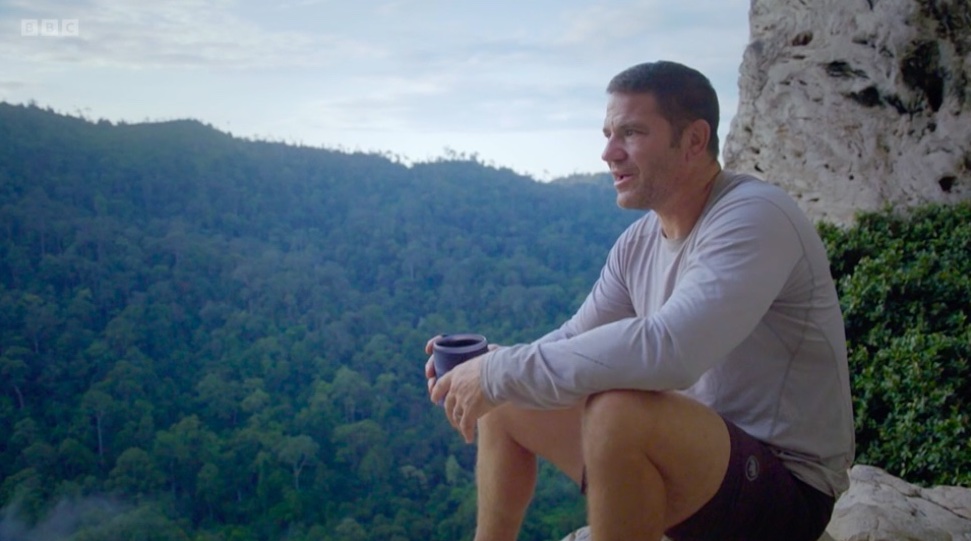
Backshall’s occasional soliloquys are disarming, merely a few modest insights, on a limestone perch, with coffee mug in hand. Never mind the nerves we might have witnessed in the cave. For him, upon reflection it’s what anyone would have done.
His most interesting observation is that an engraving of a bull would not have been recorded from life, but from memory. I would argue, conversely, that this televisual document that reaches its audience in living rooms across the UK, is a subsequent transplant with its own creativity and blindness.
Whoever undertakes an expedition like this for whoever may be his/her/their client will bring home their biases along with their documents. It happens time and again.
But it is rare to witness the discovery of parietal works, rarer still to find a moment like this slotted into the story arc of cookie cutter BBC documentary. In 45 minutes of easygoing television we hence learn that very ancient caves make great exploration-fodder, a source of only mild wonder, and, ultimately, reassuring TV.
I’d recommend Expedition to anyone with iPlayer, but let these words be preparation, and be aware of the risks. Would love to hear from anyone else who’s managed to see Steve Backshall in action!

No Comments