Reproductions proliferate to seal a twenty-first century artist’s reputation
Noah Davis dropped out of college and completed his art education by studying works in books; he worked in the bookshop at MOCA in L.A. It was here he learned from the canon of commercial publishing. He hoovered up reproductions of a fine constellation of painters, that he would openly come to namecheck, both modern and contemporary.*
In order to find his own themes, he turned to photography. Formerly, while a student, in 1975 his mother roamed the Southside of Chicago with a 35mm camera. He was to raid her archive. Then he found various other snapshots of everyday life in black America in flea markets. Davis painted life, in works all the more vivid and alive for being indirect. Somehow.
Painterly influences and snapshot subjects are both on display at the Barbican right now, where a touring retrospective is establishing Davis as a true great with at least one major achievement to his name: as much as any other artist, he normalises the representation of African Americans in art: swimming, making music, crossing the street; drug and crime free; taking a break from civil rights marches. Black lives, matter of fact.
Davis died sadly young. In 2015, at the age of 32 cancer claimed him just four years after he lost his father to the same illness. Who knows what else he might have achieved? The portrait here of Keven Davis is breath-catching: in Painting for my Dad (2011), a casually dressed but worn down subject, holding a storm lantern by his side, looks towards into a starry abyss which stretches out below. Co-curator Eleanor Nairne praises the capture here of ‘imminent grief’. That is true, and I’d add that mortality appears both mysterious and yet so tangible. Such an eloquent painting.
This is a show in which art itself is equally ineffable and concrete. It is not clear how, for example, after an association with artist Dan Flavin, a strip light can accrue great market value. Davis pulls back the curtain on that magic trick by acquiring his own tubes of fluorescent lighting and calling it Imitation of Dan Flavin (2013). He does the same for Jeff Koons, On Kawara, Brancusi, Fred Sandback, Barnett Newman, Christo & Jean Claude, Robert Smithson, Donald Judd and Marcel Duchamp. And the cumulative effect is to complicate the facsimile works that resulted.
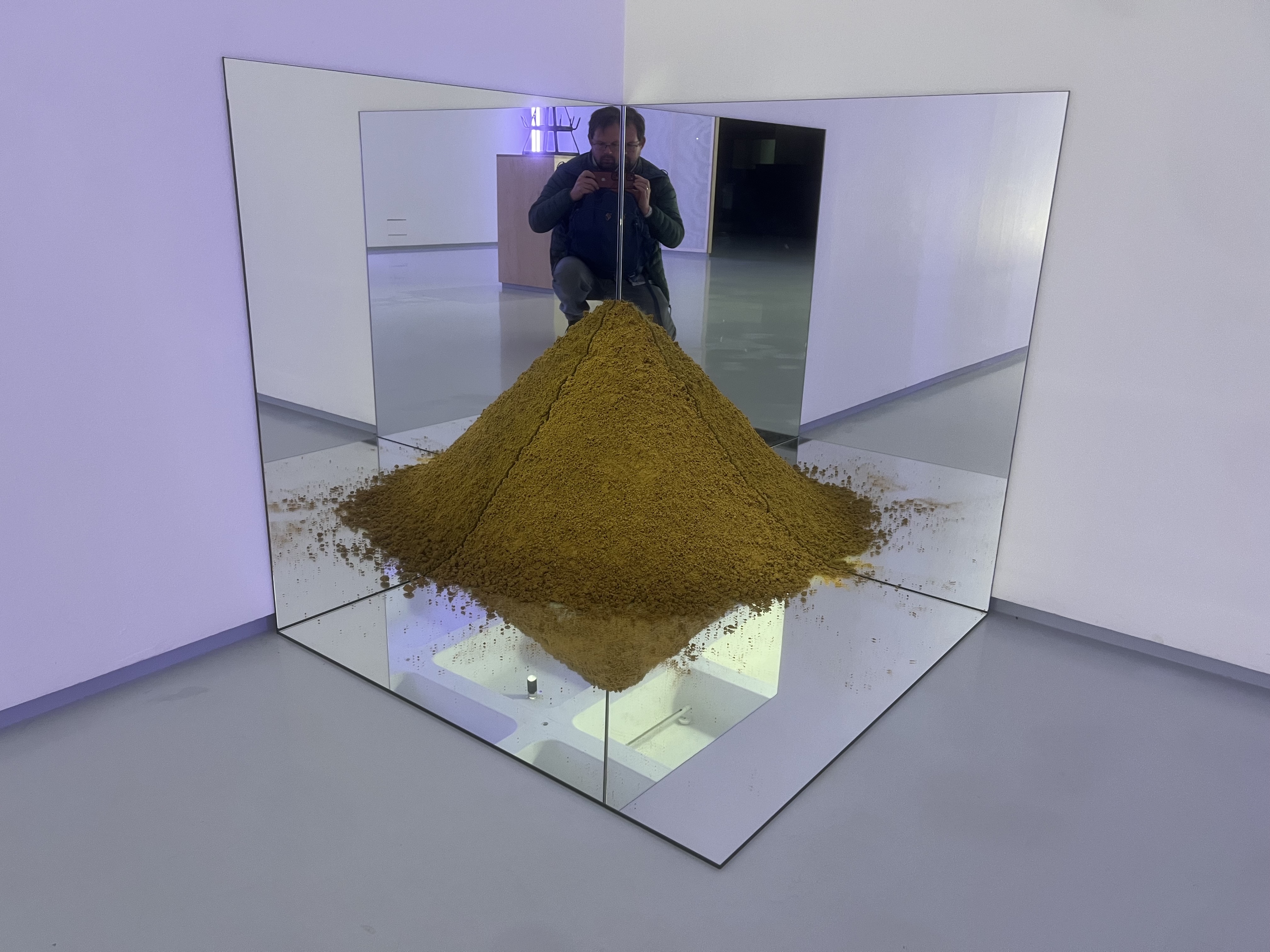
You’d have to still be some kind of conjurer to stage this series of reproductions with the brio that Davis shows. On the evidence of a capsule display at the Barbican, his neon works are still urban, cool, and conceptual. His version of an early piece by Koons, a glass case containing an upright green Hoover, still commands a rush of consumer desire. His Imitation of Robert Smithson (2013), assembled in the corner of the gallery out of mirrors and sand still reflects and in this way deflects the critical gaze.
The exhibits in Davis’s Imitation of Wealth series give clarity to their ideas, while questioning their materiality. ‘Imitation of Wealth’ was the inaugural exhibition of an ambitious community project by which the artist was to found a museum in the Los Angeles neighbourhood Arlington Heights. It was named the Underground Museum (2014) and was intended by the artist “to provide inner-city neighbourhoods with free access to world-class art.”
As an American museum that was free to enter, containing works that would openly rip off the art market, conceived and operated as a non-profit resource for a primarily black audience, the UM was a bold, subversive, counterpoint to the way the art world is usually run. It was founded with money bequeathed to the artist, by Keven Davis, for the use of the wider community.
It was a refurb rather than a white cube. Four adjacent buildings were found between 3006 and 3012 West Washington Boulevard (3506-12) and the dividing walls knocked through. It boasted a library, (books from the home of Davis and his wife Karon), a bar, a screening area, and a purple-themed garden – apparently an homage to Prince.
By the time a publisher began to supply the library and MOCA began to loan bona fide artworks, these developments were not charitable gestures and more like the enrichment of a sound and already workable idea. The bookseller from MOCA had become the director of a reading room, gallery and civic institution with perhaps even more imaginative clout than his former workplace.
In recognition that something special was afoot, MOCA was to restage the exhibition ‘Imitation of Wealth’ in 2015. On this occasion the pirate artworks were to cross the threshold of one of the very institutions which stood to otherwise prop up the value of the originals. This was both additional complication and conjurer’s flourish on behalf of Davis, his wife, and, presumably by this point, a team of collaborators. The landmark show opened on August 29 to clarity and mystery; the artist Noah Davis was to pass on the same day.
You might say the recognition by MOCA closed a circle, or even a cycle of reproduction. Beginning with the colour prints in the museum bookstore, Davis was soon to build a democratic archive of amateur photographs. He faked the holdings of his own museum, and then loaned them back to the mainstream. Davis was, always, representing the art world, even as he represented quotidian black lives. He gave life to an entire community and he preserved those lives in paint, ensuring some degree of immortality for the way that he did so.
*For the record, we are talking about Francis Bacon, Balthus, Georg Baselitz, Francesco Clemente, Giorgio de Chirico, Peter Doig, Marlene Dumas, Lucian Freud, Paul Klee, R. B. Kitaj, Édouard Manet, Kerry James Marshall, Noah Purifoy, Neo Rauch, Odilon Redon, Daniel Richter, Christian Schad, Eugen Schönebeck, Henry Taylor, Luc Tuymans. At least Davis was talking about them.

No Comments