Browsing Tag: Brighton

    Uncategorized

    “I’m not sure yet.”

    June 12, 2024


    This is an artwork I heard about, and in truth there was nothing to see. Jon Carritt and Dan Palmer, two artists who share work space had erased themselves from an Open Studio weekend at Phoenix Art Space, Brighton. They had plastered over their studio door.

    A few indications remained that there was once a work space here: a smoke alarm above the soon-dry plaster facade, names and a numbered indication on the weekend floorpan, or a recent memory which a visitor might have had that surely… there was a door here!?

    I’ll quickly gloss over the pop cultural suggestions which hidden realms evoke. From The Secret Garden to Harry Potter, via Narnia and Doctor Who, any suggestion that an entrance is hidden is sure to set the imagination racing.

    However, Carritt and Palmer are conceptual artists and having visited their studio I can report it is  very minimal, with a few books, a dusty speaker, and a couple of tidy desks. If an art-loving Harry Potter fan had had the means (magical or otherwise) to break through this wall during Open Studios, they would have been sorely disappointed.

    Phoenix studios on Grand Parade were replete with c.120 additional artists who were more or less happy to exhibit some of their output and welcome you to their domains. It was all part of a busy time in Brighton, in that merriest of monks: May.

    This time of year ushers in our annual Open House season. Some 180 domestic venues across these environs offer you the chance to inspect other people’s kitchens, gardens and artwork. All this, as England’s biggest arts festival and its growing Fringe casts a jubilant shadow across town.

    Carritt and Palmer had inevitably delivered a modest affirmation of the untrammelled spirit of play and creativity that can take over during a festival or a biennial. But it was also a negation of some aspects of this energetic celebration. 

    Brighton Open House Festival is, after all, a professionally organised event which allows 100s of local artists to monetise their practice, if only for a month now (and three weekends at Christmas).

    With a light touch and a hard edge, Carritt and Palmer build on their contributions from previous years: a plinth to block the entrance, video footage their studio on the locked door, a waiting ticket dispenser, a bouquet of flowers – with apologetic note. This year their studio was ‘colonised’ by Phoenix neighbour, painter Mike Stoakes. 

    I asked Carritt for a bit of explanation of all this, specifically I wanted to know whether last year’s building work had a title. He said: “If we considered it today as an artwork, we might refer to it as ‘disappearing studio’, or ‘plastered-over studio door’, but I’m not sure yet.”

    That doubt, in a civic context where art and culture are promoted so aggressively, and blindly at times, is doubtless important. I wish I’d seen the artwork, if that it be, and I’m also glad, in a sense, that I didn’t.

    contemporary art, Uncategorized

    Interview: Paul Watson

    May 16, 2024
    Bacchanalia Beneath the Wind Turbines, Paul Watson, 2019

    An artist and I stand on the summit of Whitehawk Hill, atop the hidden remains of a neolithic encampment. He is dressed in black, and smokes actual cigarettes, as I might have expected. Beyond that I’ve little idea how this meeting, with one of Folklore Twitter’s dark luminaries is about to play out.

    The setting, a prehistoric site we both chose, is disappointingly nondescript. I had hoped it will channel some chthonic energy into the piece you are about to read. But for the time being, myself, and this leading online goth and Brighton-based artist, contemplate a mobile phone mast. He seems to love it!

    “I don’t believe in magic” he tells me later in the East Brighton cafe to which we repair. But, dimly, I had thought of Paul Watson as a serious occultist, with a suitably esoteric vision. His last published body of work comprises of shadowy charcoal figure drawings of gloomy naked models. These subjects looks so close to the relic-littered soil of old Albion. His drawings reference myth, pagan spirits, and a spirit of utter dejection which is very 2024. (Watson has an abiding interest in the English civil war).

    To further characterise his drawing, I would say that his figures are very inward. In charcoal, their bodies are pale or grimy, never warm or especially inviting. Whereas classical life drawing conveys a sense of anatomical fidelity, Watson seems to dispense with flesh in favour of bone. His men are stony or grave rather than vigorous; his women perhaps dented rather than curvaceous.

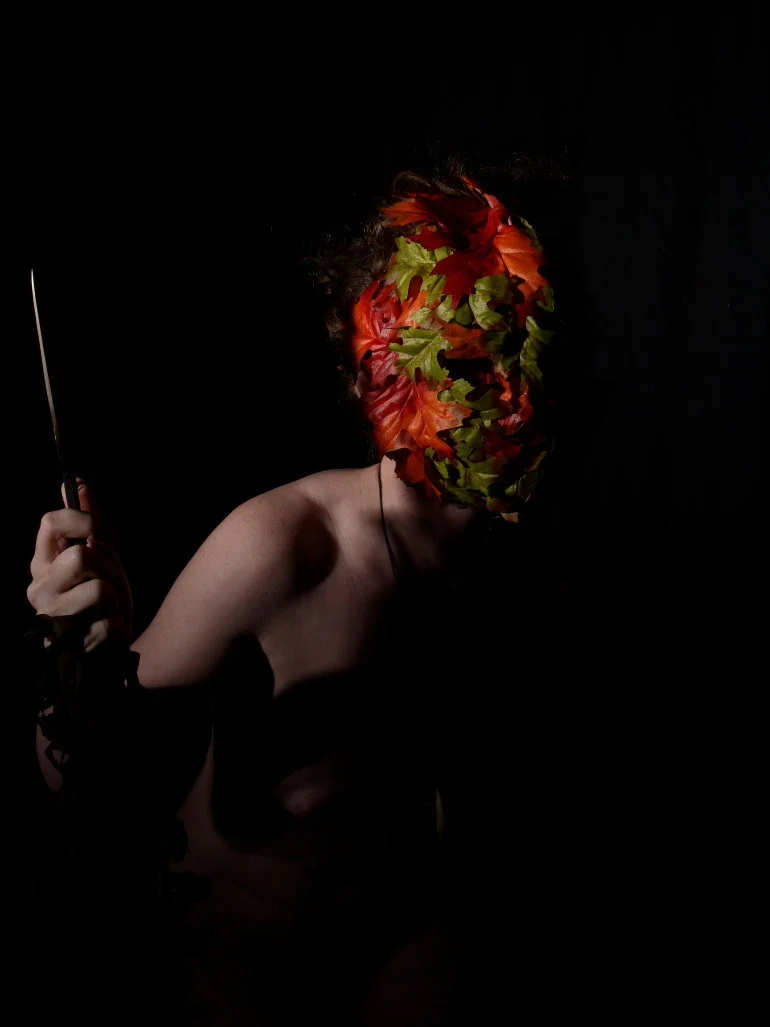
    Their environment can change; it is a background of midnight black in that series, a featureless sepia desert in the latest. Sanguine pencils, rather than charcoal, give his figures renaissance pedigree, quite at odds with the mood of fin de siècle Viennese expressionism. His photography, in which he shifts gears again, is stark and notable for the models’ otherworldly masks; and Watson makes these himself.

    Masks lend his sitters an air of atavistic power. It will amaze you, for instance, how a muzzle of ivy or an eye mask of oak leaves can imbue a stranger with great mystery and potency. You wouldn’t want to meet many of these photographic subjects on a dark night, and yet in their world it is always night.

    There is a vital intrigue here, because in person Watson is approachable, open and upbeat. For all the obscurity of the pagan rituals he seems to evoke, he offers complete transparency of means. He makes books, because these are more accessible (“People are in this country are far more comfortable buying books, than buying artwork. They know what to do with books.”).

    He also runs a detailed commentary on his practice at lazaruscorporation.co.uk. He is upfront about his paper, his pencils, and his process. If he is searching for a life model, you will read about it. Even his thoughts about blogging are right there, on the blog. He will also, endearingly, wear his musical influences on his artistic sleeve, having stayed true to a few bands from the 80s which I, for one, have been trying to forget. Perhaps unfairly.

    On the one hand he still inhabits an eldritch isle. His book England’s Dark Dreaming assumes the guise of a semi-mystical pamphlet. Watson took inspiration from ‘samizdat’ publications dating to the English civil war. “I started that after the Brexit vote,” he tells me, “and it was very much a cry of rage at the growing right wing presence in England”. Watson quotes the words of ‘landscape punk’ David Southwell, who claims that ‘reenchantment is resistance’. Watson concurs, aiming “not to view the world purely in materialistic terms and to use whatever is available to find wonder in the world.” Such wonder, he seems to say, will always elude the price tags of late capitalism. 

    On the other hand, he is unafraid of the light of day. “I don’t see any paradox,” he says, “between an enchanted world and a demystified process.” Watson might be horrified were I to present him as angst-ridden as, say, Ian Curtis. “I’m not interested in building on that whole artist myth of tortured genius,” he says. “I like demystifying the whole thing. I don’t think it takes away from the finished piece. I think it adds to it this whole thing.”

    How else, in the age of deep fakery, can you be verifiably real? Of his masks, for example, he says: “It was definitely not AI. It was crafted with glue and petals and wood – whatever I was using.”

    And here is the total artistic programme. When Watson is not coding software in his day job, he is working, as if from command-lines, series by series, on an attempt to create a vehicle or a lens to allow us all to imagine the unimaginable: namely the end of capitalism. Watson’s latest works are influenced by an unpublished, unfinished work of the late Mark Fisher, the theorist who is best known for saying the end of the world is easier to imagine than a working ideological alternative to the current Neo-liberal worldview. 

    Watson picks up: “I think that is true. It is very difficult to imagine something different from capitalism, so what I’ve been trying to do with Acid Renaissance [the most recent series – see above – which in fairness is warmer and lighter] is to break the imaginative chains by going into the mythic again and then start to imagine this future England almost like a social anarchist state”.

    In these sepia scenes of Leonardoesque cartoon we are confronted by details that Watson must hope we can take forward into that unimaginable future; here a laptop, there a wheelchair, in one, even and especially, wind turbines. Despite some deep historical references, Watson is clear he would like to effect change in the present. “I’m not interested in going back to the past, “ he says. “I’m interested in going to a post-industrial future”. Yet it is no pastoral idyll which the artist has in mind. “I’m fairly healthy but there are many people who rely on electricity and having the infrastructure of hospitals and things like that. So I very much don’t like these back-to-the-land fantasies. I think they’re fascist, because you’re essentially saying: we can kill off this part of the population. So I think you’ve got to imagine this post-industrial future which still does have things like electricity and healthcare”. 

    If that sounds difficult to imagine, perhaps it will indeed take a truly widespread, far reaching renaissance of an acid nature for us to collectively hallucinate what Mark Fisher’s idea of impossibility might actually look like on this planet of ours. In the meantime, we have Watson’s coming book.

    Whatever the future, there is something which the artist believes is essential to human expression. “I think there’s something very fundamental about creating images of the human body,” he says. He compels my attention with an image in England Dark Dreaming in which one of his mythic, future-past characters is making handprints on a cave wall. In this common palaeolithic act the body is implicated in “the very earliest form of art.” 

    Having spent six yeas of a research degree trying to put the term ‘cave art’ into question, I am not sure. But whatever the case it was grand to stand alongside such a thoughtful and committed contemporary artist on the site of an encampment dating back 5,500 years and look across our city by the sea.

    As Spring sunlight played on the water and the South Downs offered Brighton’s denizens their protection, we imagined being able to look across to the summit of Chanctonbury Ring by night and to see a bonfire. This mental journey back in time felt easy in the present company. Or was it a journey into the future? Reaching for my smartphone I took my own photo of the phone mast and we hiked back down the hillside.

    For more information on this artist, and to read his generous writings and/or view prints and books for purchase, visit Lazarus Corporation.

    Ritual, Part IV, Paul Watson, 2017
    Oak Leaf Mask, Paul Watson, 2014
    Whitehawk encampment, author’s photo

    contemporary art

    Walter and Zoniel, A Simple Act of Wonder (2020)

    September 3, 2020

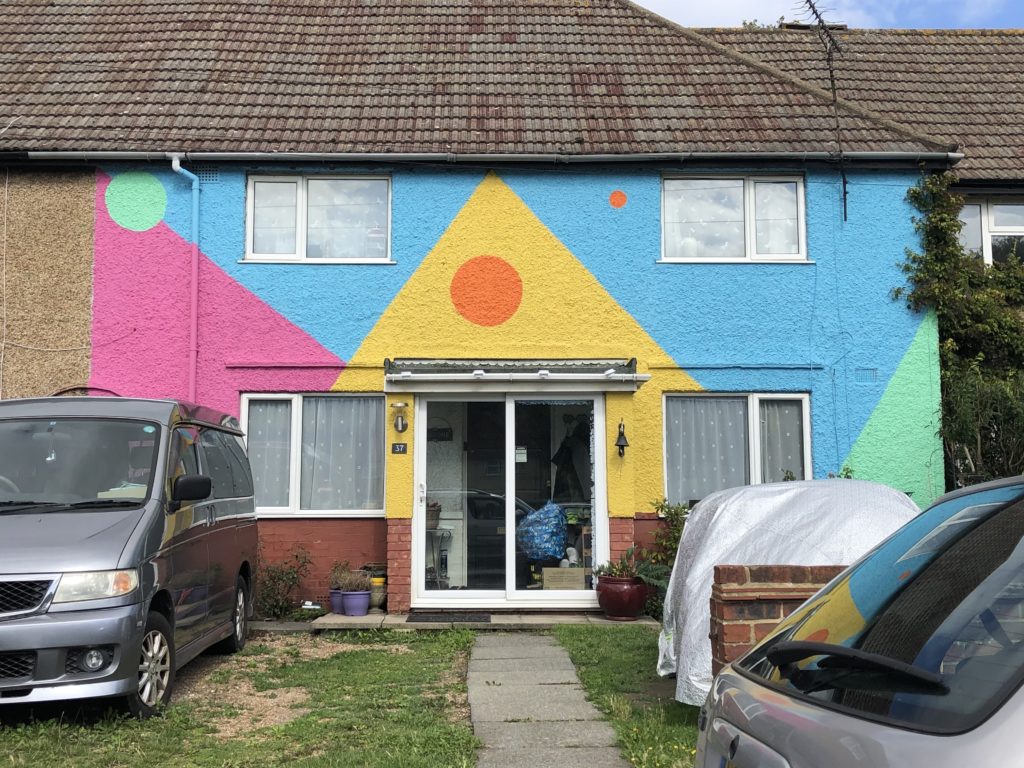
    Before I heard about this exhibition and community-based artwork, Moulescoombe was just a destination on the front of the 49 bus, a neighbourhood so different from the middle-class bubbles in which I’ve lived, I had never gone there. And yet go there, properly, we did, myself and co-writer/co-photographer, 9-year-old Aysha, who enjoyed spotting the newly painted murals from the passenger side of a car driven, too slowly, by me, around the unfamiliar suburban streets.

    I can only say we did experience a simple act of wonder to find bright geometric painting on the side of characteristically grey council housing. We found five such interventions, each resonating with the others, and each one a testament to the occupants, brave enough to foray into exhibiting contemporary art on the side of their traditional housing.

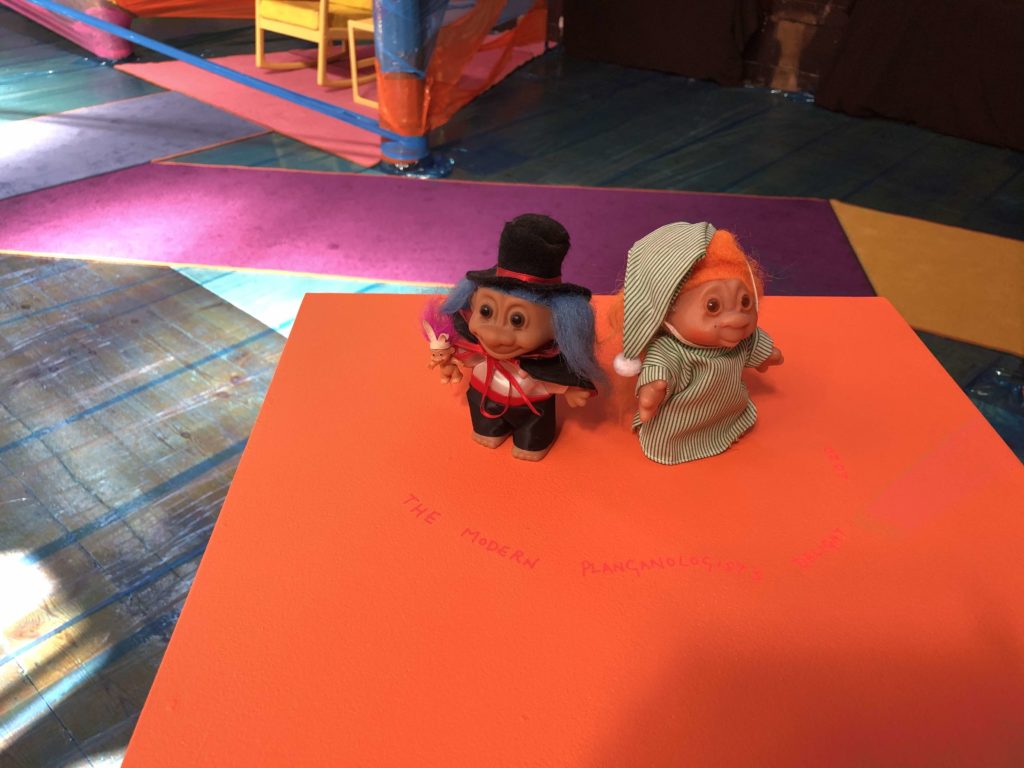
    By this wondrous act, artists Walter and Zoniel have brought Moulescoombe and adjacent neighbourhood Bevendean into dialogue with city centre gallery Fabrica; in this central hub, the murals now relate to an immersive installation, all bright carpets and stretched plastic tape, which echo the loud colours and geometric forms deployed around the two estates on the edge of town. It was hoped that many Brighton residents, especially those who are often excluded from contemporary art spaces, might come and explore this show. But a global pandemic has meant that the gallery is closed to the general public.

    Our family got access (a blogging perk) and we got to enjoy the space as light streamed into the colours here, on one of the last days of summer 2020. Liz Whitehead from Fabrica recounted the genesis of the project: the time the artists had spent on the two estates, the fact that a few of the houses will retain their new appearance, and also the origins of the show title; ‘A Simple Act of Wonder’ emerged from a conversation between the artists and a resident who apparently exclaimed “That’s it! That should be the title!”

    Simple art, perhaps, but for people who are clearly never simple. A good few from these neighbourhoods have got to grips with a disruptive new artwork. And as for me, I got to navigate a new local environment, quite different to my usual haunts. And I got to share the wonder of Aysha; my daughter wrote, unaided, a review of the show at Fabrica. (She also took the photos for this post.)

    “Me, Mark and Mummy went to this really amazing art exhibition. There were so many colours there. Later in this review I will show you some pictures of it. It was so colourful it made me want to run and jump around. We were told to take our shoes off before we went in, because there were so many different kinds of textures on the floor that they wanted us to feel them and it was really fun. The artists’ names were Walter and Zoniel. It was in town in Brighton. Some of the colours were red, orange, yellow, green, blue purple pink and grey.

    Here are some photos:

    “In the picture you can see at the end there are some photos of stuff like cats, dogs and people doing stuff.”

    “There you can see that there were little things like toys.”

    A Simple Act of Wonder runs until, at least, the 10 September 2020 in various sites in Moulescoombe and Bevendean. A map trail can be found on the Fabrica website where you can also explore the gallery show, virtually,

    tourism, Uncategorized

    Be a rambler

    July 31, 2020

    In the late 90s, Diesel ran an ad campaign promoting tourism. It was the age of cultural missions in advertising, and the fashion brand encouraged you to “Be a tourist”. Diesel’s target audience were taking gap years and backpacking in the Far East with a dog eared copy of Alex Garland’s 1996 novel The Beach. They were self-avowed travellers not just sight seers. But hey, the ads were too funny.

    20 years later, we are still falling over ourselves to eschew tourism. But why? For my PhD I’ve been reading a bit about tourism and discovered the theory that tourism is the quintessential human condition, for post-industrial westerners. Dean MacCannell, who founded the discipline of tourism studies, has argued that we assert our modernity by gazing on evidence of the past. We do this because we cannot allow ourselves to identify with our oft tyrannical ancestors.

    Ironically, travel (not tourism) is one aspect of our premodern past. Tourism evolved from travel, and not vice versa. With roots in the 16th century notion one could complete one’s classical education with a Grand Tour of classical Europe. The world’s first travel package, from Thomas Cook as it happens, was a chartered train to a rally in support of temperance. Why would you want to go back to either of those travel propositions.

    So I was stopped in my tracks, in my hometown, on the beach, where I was neither tourist nor traveller by the exhortation on the side of BTN Bike Share hire bikes. You can read it in the photograph above. Unlike the most iconic Diesel campaigns from the nineties, it was not clear to me who was being addressed here. Surely no one living in Brighton. Day trippers are most likely, but it’s incredibly pretentious to consider yourself a traveller in a town set up to cater for hedonistic Londoners.

    Of course, Brighton does have its fair share of travellers. But most of those are parked up on the edge of Preston Park in converted horse trucks. I’m not sure they’re the corporate, app-driven, bike hire types.

    photography

    Our City, How Do We Look? @ BPB2016

    September 14, 2016

    Brighton Photo Biennial 2016 will look at the way photography fosters our understanding of style, the body, gender and subcultures. It is arguably the biggest visual art event on the city’s calendar, and this year the month-long festival issued a call out to BA students on Brighton Uni’s acclaimed photography course.

    Four chosen artists, who appear to come from all walks of life, will feature in one of the busiest exhibition spaces in town. So if you’re passing Jubilee Square, do take some time to take in Our City, How Do We look? I spoke with the talented group at local music festival Together the People.


    © Chynna Guyat, 'Eva Petulengro', 2016
    © Chynna Guyat, ‘Eva Petulengro’, 2016

    Interview: Chynna Guyate

    It is at once a comfort and occasional source of alarm that Brighton’s sartorial flair extends to residents of all ages. So in putting together her show, Guyate has looked for “the elderly who defy age and disability and dress how they want to express themselves”.

    Brighton may be thought of as a city for young people to see and be seen in, but Guyate is drawn to those who have seen it all before . “These people need a voice,” she says of her subjects, “Because they’re just as great. That’s why I picked up on the older generation”

    While aware that it might sound like a cliché, the second year student was inspired by her own 91-year-old grandma, who was living with dementia. “Despite that she loved dressing up, styling; she had all these crazy clothes. I just thought, Good on you!”

    Her show came together over three sun-drenched weeks this summer and Guyate recalls “going around and seeing who’s about, clicking away”. She staked out her subjects from cafes and soon learned how to get up the nerve to approach strangers in the street.

    “These people were fairly rare,” she points out. “So when you see them it was, Right, just got to go and do it.” The result is a portfolio of straightforward portraits and glimpses such as you or I might catch of these older denizens one hesitates to call eccentric.

    All the same, Guyate does report an encounter with a man festooned with keyrings, who was pushing his own wheelchair, and a woman on the beach playing a tambourine to the seagulls. “That was pretty interesting,” she tells me with wry understatement.

    Old people clearly have to work hard to achieve visibility. But Guyate finds in their “crazy colourful clothes”, an intriguing reflection of our “crazy colourful city”. Expect a crazy and colourful display during BPB16.


    © Jennifer Jackson, Kelly, 2016
    © Jennifer Jackson, Kelly, 2016

    Interview: Jennifer Jackson

    After several moments talking with Jackson, it seems there’s more to gender than male, female, and trans-one-way-or-another. The third year photographer introduces me to the term non binary to describe a group of people who subscribe to neither gender norm.

    “I use ‘them’ and ‘they’ pronouns rather than he or she,” they advise me and their portrait-based show is about making visible a diverse non binary community which was a lot larger than Jackson at first expected it to be, even in a city with a vibrant LGTB scene like Brighton.

    Not that one can make assumptions about the sexuality of people who might simply be gender queer: “There’s a lot of people who identify very differently within it and express their non binary very differently,” says Jackson.

    Although on the boyish side of feminine, this photographer looks fairly conventional. “A lot of people who are more openly non binary might present in a more radical way,” they say. So, the show is not short of telling details in clothing, modifications, tattoos, and hairstyle.

    “But there are a lot of people who are non binary who are exactly like everyone else on the street,” Jackson tells me. “Maybe very feminine, or very masculine. Other people are androgynous. So I think it’s impossible to tell. It’s just a feeling really.”

    Whatever the case, it is a feeling which is safer to express here in Brighton, as compared with the far flung northerly region where the photographer originates. “In Cumbria there are still difficulties in being accepted,” they tell me. “I can’t imagine anywhere being as accepting as Brighton is.”


    © Sophia Wöhleke, 2016
    © Sophia Wöhleke, 2016

    Interview: Sophia Wöhleke

    Although Brighton has its share of fashion chainstores, it does more than most cities to redress the ecological and ethical balance. Look no further than the North Laine and London Road, where second hand shops encapsulate something of the spirit of this city.

    Now in her third year, Wöhleke came from Marseille to join the BA in Photography and having done so she brings an outsider’s eye to what seems to be a growing proliferation of thrift stores, upcycling workshops, leather workers and cobblers.

    With an avowed interest in “sustainable fashion”, Wöhleke makes clear: “We live in a consumerist society where little emphasis is placed on the durability of items. Brighton is a city where there is a trend of people going against that”.

    So the well-travelled photographer turned her lens on the retailers hitting back and stalked the city’s most bohemian streets to find alternatives to Top Shop etc: “I wanted to look at it from a grassroots perspective while focusing mostly on little shops in order to gain an understanding of how people make a living without succumbing to the consumerist culture that exists elsewhere in Brighton”.

    Most businesses were open to participation in a student project. “The first place I photographed was an alterations place. The owner only opened the shop last year and she sometimes has to work nights to finish her orders on time,” says Wöhleke. “She was open about how she works and didn’t mind me photographing anywhere, she helped me out quite a lot.”

    Her industrious subjects were also open about their working environments; “I wanted to bring the different layers of the shop into the pictures because I wanted to get a sense of the amount of manual work and time that go into running small businesses like these”.

    Wöhleke uses a medium format camera to capture all that rich detail. Her only remaining challenge: finding room for a tripod.


    © Judith Ricketts 'Basil Chap' 2016
    © Judith Ricketts ‘Basil Chap’ 2016

    Interview: Judith Ricketts

    A show that combines fashion with the realities of Brexit may sound unlikely; the Leave campaign was marred by many things, not least the double-breasted blazers of its chief protagonist Nigel Farage. But third year Judith Ricketts is interested in both all the same.

    Ricketts has responded to the referendum by finding EU nationals living in Brighton and taking their portraits in the city they have thus far called home. Subjects were invited to choose a location that had personal meaning and dress to represent themselves to the world.

    The concerned photographer reports a general reaction of shock to the outcome. “People were saying they felt very much under the microscope,” she tells me. “Because the vote was most focussed on immigration and before that they were part of the landscape”.

    Ricketts’ interests in home and displacement may stem from her African-Caribbean parentage: “I was wondering how that moment in time changes peoples sense of belonging in a city, because one of the things about this city is, I think, it’s always very, very multi-cultural.”

    The resulting show brings documentary up flush against a conventonal fashion shoot. But the photographer in question sees fashion as political. “It’s a complete identity statement,” she tells me, before adding: “Our identities are fluid. They change depending on who we are, who we are with, and where we live”.

    In the case of this show, subjects were persuaded to meet in town at seven or eight in the morning and talk about their experiences of the disaster known as Brexit. (“You have to make that connection really quickly!” Ricketts tells me.)

    “Most people I photograph become my friends,” she adds. “They become part of my own identity, because I use it as an opportunity to get to know different kinds of culture.” This attitude, which realises we are in fact lucky to mix with different nationalities, is refreshing, even in Brighton.

    Our City, How Do We Look? is a Photoworks/Together the People co-comission for Brighton Photo Biennial 2016. Work by all four photographers can be seen in Jubilee Square, Brighton, between 1-30 October 2016.

    sound art

    Laurie Anderson, Lou Reed Drones (2016)

    May 17, 2016

    anderson

    Saint Mark’s chapel in Kemptown has been throbbing for five days straight. That is what you get from this piece, a relentless pulse of skuzzy, kilowatt-heavy hum which envelops you.

    Where’s the band? You might ask, if you are keen on music of this persuasion. Well, they’ve left behind some eight unmanned guitars leaning on a similar number of vintage amps.

    Rather than a performer, we have a soundman, who is putting in these marathon stretches in which he orchestrates the oscillations. ‘Here come the waves,’ as Lou Reed himself once sang.

    Yes, this is the much anticipated installation piece by artist and musician Laurie Anderson in which several of her late husband’s guitars are set to feedback in deafening harmony.

    It’s a warm bath, which may explain why the crowd in here are dwelling for long minutes at a time. They sit on risers. They lie on the stone floor. One guy in shades has hands clasped in prayer.

    But the stained glass cannot compete with the lighting rig and the spots of light which flit around the room like a murmuration of fireflies. Yes, there is a glitter ball. It hangs in the air like a quoted lyric.

    This attempt to raise the dead, within the safe confines of an Anglican chapel, feels like a partial success. Lou Reed is surely working his caustic, sonic way into the heart of the assembled crowd.

    We have dry ice instead of incense, to remind us that rock rituals have frequently been about the mysteries of faith and the incarnation of rebel angels.

    To complain that this gig-like event is not Art, would be churlishness turned up to eleven on the volume dial. The categories hardly matter, because Reed deserves this encore.

    Lou Reed Drones had its UK premier between May 13 and 17 as part of the Brighton Festival 2016, guest curated by Laurie Anderson.

    contemporary art, installation art

    Sophie Dickson, Shooting Range (pt 2) (2014)

    November 16, 2014

    2014-11-15 17_Fotor

    At a point of maximal chaos, the objects in this sculpture hang together and you feel you could take your finger off the pause button and return this scene to order.

    The tableau is composed of ‘junk’, but white paint gives it a wintry appearance, akin to a seasonal shop window, and perhaps one dressed by an anarchist.

    Look closer and you will see a cash till, caught mid air, cash drawer gaping, empty. As a nation of shopkeepers, this is an attack on all we hold dear.

    But look it’s okay. The whole thing is kept within a theatrical frame. Despite a lack of glass or limits, there is a notional vitrine, nodding to blue chip art-mongers like Hirst and Koons.

    Perhaps following in the footsteps of the former organiser of Freeze, Dickson has taken on a vast space in Circus Street, and for a solo show no less.

    Hence she demonstrates a youthful talent for wrangling planning applications and funding bids. She has overcome a mountain of paperwork along with a mountain of junk.

    Most of the found objects used here are obsolete, a landline phone, a cassette player. They are perhaps fossilised. But fossils don’t get airborne like this.

    I want to say it is rare for explosions to turn rooms like this upside down here in Brighton. Yet in 1984, the whole country was rocked by a bomb in the Brighton Grand Hotel.

    But this was six years before Dickson was even born. So one can only guess at whatever ash-covered interiors might have inspired this work. Strangely beautiful, there are plenty of them.

    Junk is Beautiful can be found in Circus Street, Brighton, until November 21. See Facebook page for opening times.

    conceptual art, film installation

    Simon Faithfull, REEF (2014)

    November 3, 2014

    Photo © Gavin Weber from fabric.org.uk
    Photo © Gavin Weber from fabric.org.uk

    The real underwater world has already exercised its independence from the work of Simon Faithfull. REEF was fully working for six days, after which he lost transmission.

    But there is no going back. The artist did manage to burn and sink a 32-tonne ship. He did manage to salvage nearly a week’s video feed from five cameras. A partial success then.

    If anyone dives, the ship is in Weymouth Bay. A supporting film reveals there’s already a conger eel living in the wheel house, so watch out. We won’t be seeing that any time soon in the gallery.

    What we can experience is a cavernous darkness and a resonant tidal throb by which it seems the entire former fishing chapel of Fabrica in Brighton has been sunk for this.

    A strange cargo of monitors glows with pre-recorded footage. And one has to look up, as if to the surface of the waves, to watch a film of the 32 tonne ship as smoke billows and waters flood in.

    But despite the temptations of the deep (the temptations to read this piece as a comment on anything from the human condition to the eternal unknowable), we mightn’t go there.

    REEF could simply be about itself: “The thing I came for:/the wreck and not the story of the wreck/the thing itself and not the myth” as poet Adrienne Rich once described a diving experience.*

    So . . . Fabrica, Photoworks, Musée des Beaux Arts (Calais), and FRAC Basse Normandie (Caen) have joined forces to provide a possibly sunken institutional structure.

    Wreck to Reef, Art AV, Field Broadcast, O’Three, Precision Energetics, Dorset County Council, Weber Industries, Ringstead Caravans and Quest Underwater Services provide the ecosystem.

    To see so many bodies pulling together to produce an act of conservation, let alone an epic piece of public art, is as inspiring as any number of visits to an aquarium.

    And there is a precedent for such a comparison. In his diaries, Paul Klee records a “refreshingly bizarre” visit to an aquarium, where an octopus reminded him of an attentive art dealer.**

    *Adrienne Rich, Diving into the Wreck, reproduced in Aquatopia, published by Nottingham Contemporary and Tate in 2013

    **cited in Otherworldly, an essay by J Malcolm Shick, in Underwater, published by Towner Gallery in 2010. 

    REEF can be seen at Fabrica, Brighton, until November 23 2014.

    abstract painting, contemporary art, fashion, photography

    Jakob Dahlgren, Peinture abstraite (2001 – present)

    April 9, 2014

    dahlgren

    Artists often go too far. Sometimes it can seem that any art worth its salt has to do just that, to show some form of excess, to do something inordinately repetitive, or of course skilled.

    Jakob Dahlgren’s thirteen year-long durational project will have many scratching their heads, asking what is the point? But to provoke that very question seems to be the point.

    The Swedish artist has worn a striped t-shirt every day since 2001. There’s not much more to it than that. Although, apparently, he invites people to ‘curate’ the wardrobe for him.

    It might not sound too impressive. He has an archive of 1000s of numbered shirts. He has as many photos on an Instagram site. But the work’s very lack of gravity could indeed be his point.

    Dahlgren calls the work Peinture Abstraite and that smattering of French is not putting on airs. It is rather puncturing the work of those who have been historically content to paint coloured stripes.

    People are still painting stripes. In austerity Britain they are probably at it right now. And Dahlgren compares this no doubt serious endeavour with just so many sartorial decisions.

    He wouldn’t name names, but the artist said he drew inspiration from a range of artists whose work he didn’t very much like. He doesn’t like them, but they engage him.

    In turn, you might not like his t-shirt project. But if you are reading this, it is hoped that Peinture abstraite has engaged you in some way too. It fights fire with fire, decoration with decoration.

    And the fact he has just gone too far with the t-shirt idea, sporting them at weddings and funerals alike, just makes me warm to this deceptively simple piece.

    For the stripe painters out there, fear not. Dahlgren is not above picking up a brush, dusting off a worn t-shirt and painting what he sees. There’s no getting away from it.

    Peinture Abstraite can be seen at Fabrica, Brighton, until 26 May 2014. Check out Dahlgren’s Instagram site for more images and see the artist’s website for more info on the project.