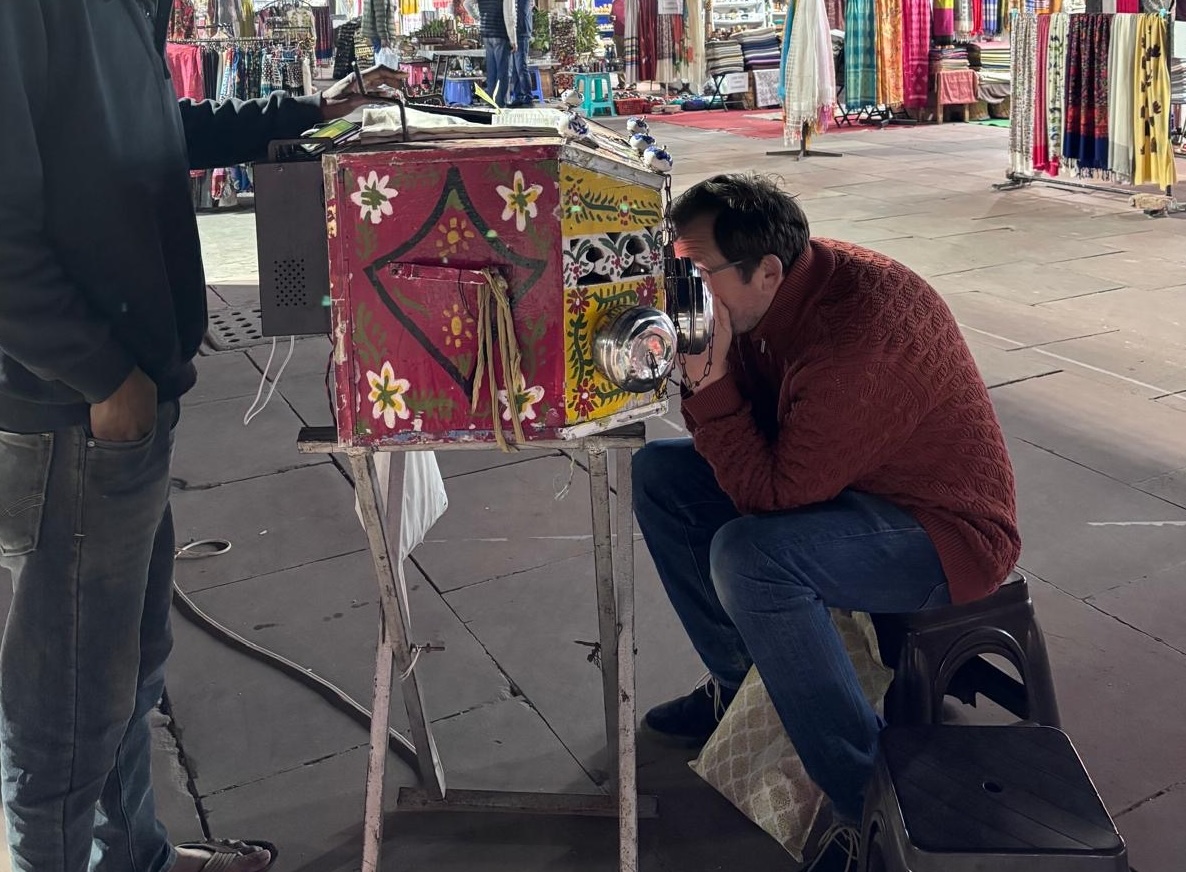
Like a steel tiffin box the size of a small packing case, the bioscope gleams in the fairy light ambience of an artisanal market in the centre of Delhi. On its polygonal front are circular portals the size of pickle jars with tin lids hanging on chain. Hurdy-gurdy handles sit atop, used to stir whatever it might contain. And a patient operative waits, patiently, confident in the appeal of his strange cargo. The night air is alive with swinging Indo-psychedelia. The track on his speaker was identified to me as ‘Yamma Yamma’ from the 1980 Bollywood movie Shaan.
I pay 50 rupees (about 40 pence in UK money) and take my seat. It’s a squat toy-like stool, that invites me to regress a little as I put my eye to the nearest porthole with irresistible curiosity. Inside glows and, somewhat upstage from my view-point is a scrolling frieze of images that now move for me, left to right, at unhurried speed. Each photograph or painting seems animated by the music, the magical light, and the stately procession of a spooling roll of thick paper which is tattered, spliced and sellotaped in a way that reflects the age of this technology.
The device, a bioscope, was once used to provide some of India’s most rural villages with a proto-cinematic experience. Of course it calls for some suspension of disbelief. But even as a twenty-first century smartphone owner, whose life has no shortage of striking colourful images, there was a wow factor to this rudimentary display. The bioscope scroll, as fragile as a holy relic, is charged with the historic pleasures it must have given to many a screen-free household.
There was no narrative for me to worry about, not even any clear sequence, and the only link between the images appeared to be that all of them are in some way representative of this epic land that is India. There were tigers. There were Hindu gods. There was a portrait of a beautiful actress, and next to her a cobra. The Taj Mahal was to roll across the golden stage, as was Q’tub Minar. I was also surprised to see a photo of the current Indian PM flanked by ministers. This updated bioscope is clearly adapted for our divisive, populist times.
The presentation finished and I was moved to applaud the eccentric contraption. And to think it was devised for an audience who would value images on the strength of visual or thematic appeal, rather than those viewers of contemporary film and television who, like me, tend to watch for the sake of the story. As such the bioscope is a fine, and globally diverse, example of the filmic attractions that were to inspire western avant gardes from surrealists to expressionists via futurists. As such, it reminded me of Tom Gunning’s influential paper and the film theorist’s argument that cinema was once valued for pure visuality and self-conscious awareness of looking.*
This location is one of the Indian capital’s less hectic spots, and it seems as if no family visit to New Delhi is complete without a couple of hours in this market, Dilli Haat. I haver been more than half a dozen times but, distracted by the shirts and the scarves, the paintings and the carvings, the spices and ceramics, plus the chai and the chilli flavoured momos, I had never noticed the bioscope before. Now I might never forget it.
* Tom Gunning, The Cinema of Attraction[s]: Early Film, Its Spectator and the Avant-Garde (1986)