Browsing Tag: travel

    Uncategorized

    Play it again and again: Rick’s Café in Casablanca

    January 12, 2026

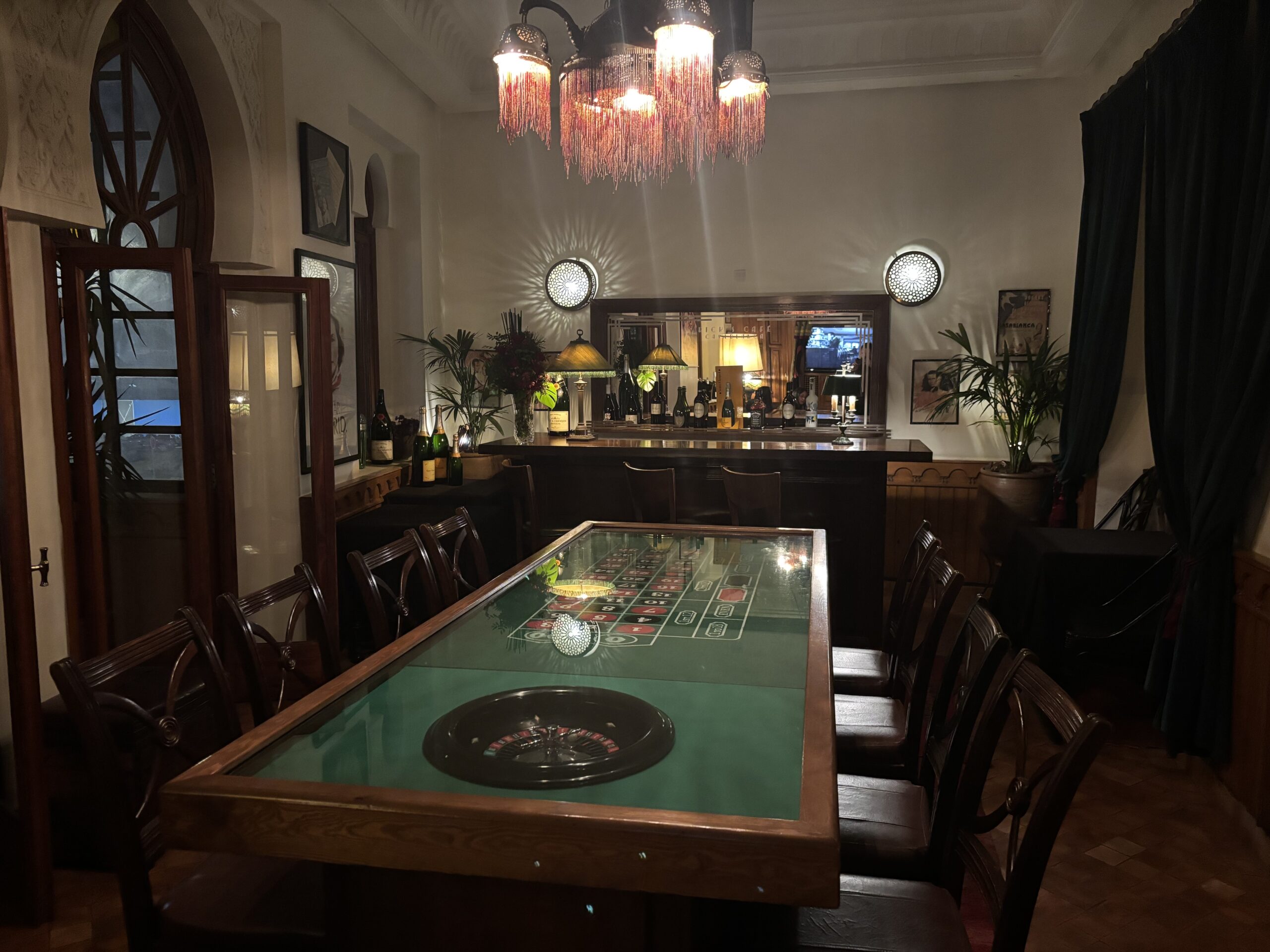
    There is a city which seems only to be famous for the film named after it. Aside from an epic mosque, Casablanca has few other claims to fame.* But the claim to have inspired a movie which some still consider to be one of the greatest of all time is strong. The connection is set in stone by a commercial recreation of that film’s most pivotal location: in 2004 a plush bar known as Rick’s Cafe opened on the seafront. Here, a short red carpet, two elegant palm trees and as many spruce doormen now flank the entrance to a fictional dimension where it is forever 1942, the year of Casablanca’s US release.

    Many are the visual, sonic and gastronomic cues that situate the visitor in the space where one of the silver screen’s most famous couples fall victim to crossed stars and geopolitical manoeuvres. Bar owner Rick and his not-quite-ex Ilsa are played of course by Bogart and Bergman. In case you need a flavour of the chemistry between these two icons, the two can be found smoking and drinking their way through a loop on a large but discreet plasma TV, built into the wooden panels of the establishment’s upstairs gambling den.

    It was here that my wife and daughter ate apple pie (because what could be more American?) and a New York cheesecake (named after Rick/Bogart). I was the only person to destroy the illusion by asking for tequila, which, as far as I can recall, has no bearing on the narrative or the atmosphere which is so powerful in the Academy Award winning film. As we quietly imbibed our orders in the bar, feeling underdressed compared with the many diners, a party of five or six Chinese tourists also broke the fourth wall by crowding round the roulette table and photographing the framed promotional posters nearby.

    Prices were definitely present day, but I made a foray through the restaurant and found that the balconies, balustrades, and riad-shaped floorplan all offered transport to the universe of Rick’s ‘original’ bar, even if that bar itself was largely an invention of a set designer. And meanwhile waiters in white linen, and fez hats, low lighting and soft cutlery clinking, along with a generally quiet dressy clientele, went some way to recapture the glamour of golden age Hollywood. On some level we were all extras in an immersive performance.

    There was a grand piano in the courtyard, same make, model and vintage as that used by a supporting character played by Arthur ‘Dooley’ Wiison: the Sam whose repertoire included “As Time Goes By”, a song he was famously asked to play “again” (even if that most famous of lines is a conflation of dialogue spoken by Ilsa and not a direct lift from the script).**

    Rick’s Cafe in Casablanca is not a pure replica and not peopled by replicants. Instead it is a hybrid recreation which blends many details from the filmset with a carefully constructed ambience that perpetuates an image of a city in which tourists can feel less like tourists for a moment and more like, well, members of a transient demimonde each of us engaged in our dubious activities in the shadow of war. At time of writing this wartime context was given added and unwanted spice by the vaunted threat of US imperial ambitions. In January 2026, Rick’s Bar could plan to open a franchise in Caracas.

    I would go so far as to say that this commercial dining establishment is — after celluloid, VHS and MP4, Original Motion Picture Soundtrack, and a paperback copy of the script — really a whole new format for Casablanca (1942 – ongoing), bearing a relation to the film akin to an experiential night at Secret Cinema or a visit to the theme park that is Shakespeare’s Globe on London’s South Bank. Bruno Latour argues that the aura of an artwork can ‘migrate’, by appearing in new versions… like this one you can walk right into. Aura might not, as Walter Benjamin was to warn on the eve of Bogie’s war, diminish in the age of mechanical reproduction, it might just migrate and accumulate. In this way Rick’s Bar does as much for distributors Warner Bros. Pictures Inc. as it does for the Moroccan National Tourist Office.

    Two people who I know would have loved to visit Rick’s Bar are my maternal grandmother and a husband we knew merely as Tom. Indeed along with a memory of the film, which I saw on video during the late 90s, my visit triggered a childhood recollection in which this rum couple dressed in matching trench coats and fedoras in an attempt to look like Humphrey Bogart in Casablanca. Spoiler: they looked nothing like him, and on our way out of the house, this Tom was so embarrassed by a last minute wardrobe mandate that a row ensued. I honestly don’t know how often they ever went out to cosplay like this together. But I guess that Casablanca was such a powerful imaginative property for them that it lent itself to tribute and pastiche over and over again. Not to mention the repetition of many famous lines, which we now all own.

    A filmic world, anchored in a lesser known city, has now given everyone the chance to participate in a shared nostalgia trip: I can report it is a trip-within-a-trip for anyone lucky enough to visit said city after seeing said film.

    * Funnily enough, my hometown has both a strong 1940s movie connection in Brighton Rock (1948) and a secondary attraction in Brighton Royal Pavilion which was built to look like a mosque.

    ** Incidentally the evening we dropped in to Rick’s cafe, there were a couple of musicians installed next to this venerable machine and traditional Moroccan music was the fare. Perhaps these days, when the in-house pianist, strikes up the tune many people are waiting to hear, the simulation gets too intense.

    tourism, Uncategorized

    Be a rambler

    July 31, 2020

    In the late 90s, Diesel ran an ad campaign promoting tourism. It was the age of cultural missions in advertising, and the fashion brand encouraged you to “Be a tourist”. Diesel’s target audience were taking gap years and backpacking in the Far East with a dog eared copy of Alex Garland’s 1996 novel The Beach. They were self-avowed travellers not just sight seers. But hey, the ads were too funny.

    20 years later, we are still falling over ourselves to eschew tourism. But why? For my PhD I’ve been reading a bit about tourism and discovered the theory that tourism is the quintessential human condition, for post-industrial westerners. Dean MacCannell, who founded the discipline of tourism studies, has argued that we assert our modernity by gazing on evidence of the past. We do this because we cannot allow ourselves to identify with our oft tyrannical ancestors.

    Ironically, travel (not tourism) is one aspect of our premodern past. Tourism evolved from travel, and not vice versa. With roots in the 16th century notion one could complete one’s classical education with a Grand Tour of classical Europe. The world’s first travel package, from Thomas Cook as it happens, was a chartered train to a rally in support of temperance. Why would you want to go back to either of those travel propositions.

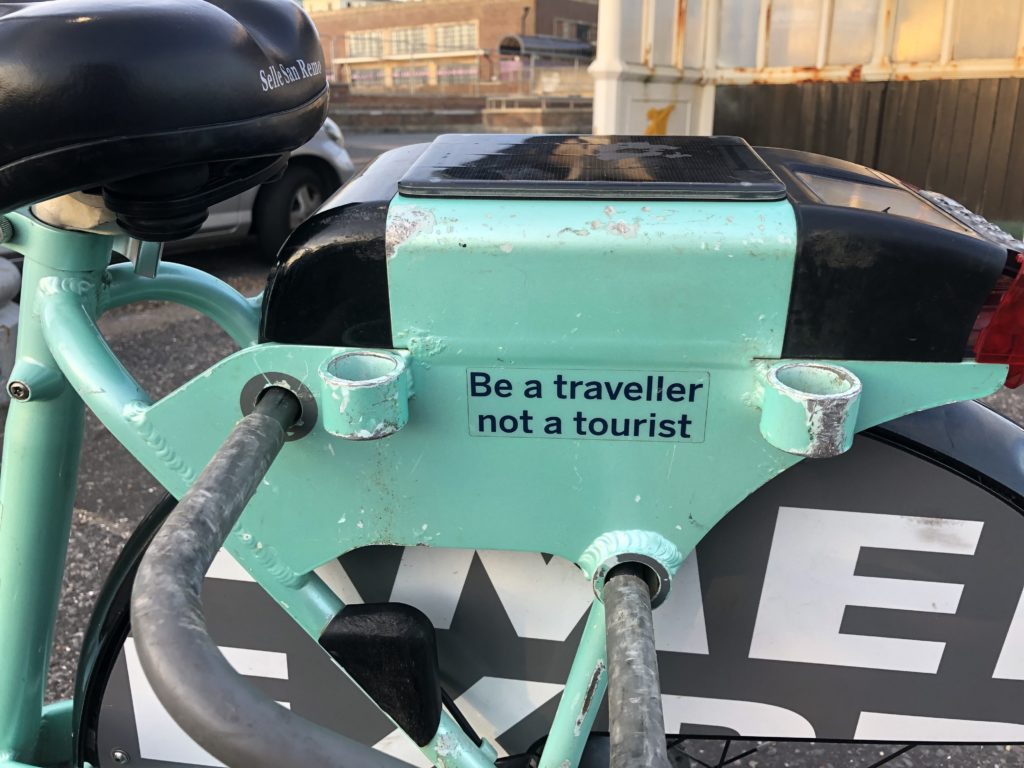
    So I was stopped in my tracks, in my hometown, on the beach, where I was neither tourist nor traveller by the exhortation on the side of BTN Bike Share hire bikes. You can read it in the photograph above. Unlike the most iconic Diesel campaigns from the nineties, it was not clear to me who was being addressed here. Surely no one living in Brighton. Day trippers are most likely, but it’s incredibly pretentious to consider yourself a traveller in a town set up to cater for hedonistic Londoners.

    Of course, Brighton does have its fair share of travellers. But most of those are parked up on the edge of Preston Park in converted horse trucks. I’m not sure they’re the corporate, app-driven, bike hire types.

    contemporary painting

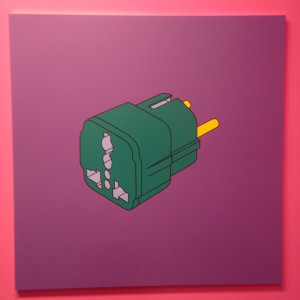
    Michael Craig-Martin, Untitled (travel adaptor), 2014

    February 10, 2016

    IMG_1036

    The Instruction Manual by John Ashbery is a poem of some 74 lines, which mentions more than 30 colours. And these colours evoke Guadalajara, Mexico, a place the speaker hasn’t even seen.

    But having said that, he pictures it well. His senses appear to have been sharpened by the deadline for a technical writing gig, and they soon take flight through an imaginary window.

    Michael Craig-Martin is, in his turn, something of a technical illustrator who makes a lively escape into colour. Here you see a sherwood green adaptor with sunny yellow tines and a blood-red interior.

    There is nothing naturalistic about this; it is as oneiric as the journey to Mexico in the poem we’ve already seen. But the pleasure is anchored in the familiar form of a travel appliance.

    What is it about precision, in writing or draftsmanship, that sets off the imagination? Is it the fact that in both these disciplines, colour is proscribed, a banned and hallucinatory substance.

    What with the smoke alarm. the memory stick and the hotel door handle (all of which feature alongside this adaptor), Craig-Martin never makes it out of his room. No en plein air for him.

    And so, much of the show suggests the paraphernalia of travel, and this survey reads a little like the difficult third album of a rock band who only write about life on the road. I jest.

    There is a case to call this pop art. And I think a more difficult case to compare it with photorealism. Certainly it shares some of the powers of observation, some of the decision making.

    Craig-Martin talks about this with artist Liam Gillick. He plays down the role of invention in art, in favour of observation. Gillick meanwhile downgrades inspiration in favour of visual choices.

    It is a fascinating discussion and well worth a look if you pick up the catalogue. If nothing else the beautiful 120 page book will give you something to cling to. Like a plug socket in Guadalajara.

    Michael Craig-Martin: Transience can be seen at Serpentine Gallery, London, until February 14 2016.