Music from a Cold War Bunker in Albania
Iso-polyphony may sound like a tech feature from a high-end speaker, but in actual fact it couldn’t be more rooted in the past. Specifically, it is rooted in ancient myth and Albanian tradition. It is an entire musical form. In recent years a sound art piece has opened at Te Kubé in Gjirocaster, wihch restores the link between this music and the siren song of Odysseus fame and the muses. These are figures said, of course, to guard Hades rather than your nearest Bang & Olufsen showroom.
It may not have spread far from the Balkans or the ancient world but Iso-Polyphony is a powerful art as well as an enduring one. At Te Kubé, it can be experienced in a 48m-long Cold War bunker, burrowing under a mountainside from the belly of a former mosque. The home of this project is now an archive, a cafe, and a shop. For some years became a trapeze school to evade closure by dictator, Enver Hoxha; there are some layers to this cultural history.
I’ll try to cut to the present. There we were, Little A and I, alone in this subterranean passage, lit green and blue by nightclubesque LEDs. We were surrounded on all sides by walls of rock, uneven both underfoot and overhead. It made me, for one, feel gently intrepid, curious about what to expect from this shaft that was receding deep into the rock. The stone glowed and appeared to ring with the music. We paced the distance in this confined space; and concealed speakers expanded the trajectory with an invisible chorus of voices singing in two unfamiliar languages: Albanian and melodic counterpoint.
This then was Iso-Polyphony a form of improvised song which assumes dissonant harmonies and evokes grief, longing, and a certain Balkan exoticism. Don’t get me wrong, I certainly don’t expect all music to be as catchy as post-1950s Western pop. I do indeed like a bit of detuned guitar, a bit of experimentation with the drone. Distortion pedals and feedback amps, yes yes. Freeform sax with added skronk, sure. But here was a genre where the instruments were unalloyed voices (plus a piano but not as we know it). Without going electric, this Byzantine polyphony offered a release as cathartic as a crunching rock breakdown with the volume turned up to 11.
A voice can express all sorts of moods and take on all sorts of tones. The mood of the voices here seemed to me to be pained. The tone was sharp and it cut to the quick. I do not speak Albanian, but this just expands the imaginable range of Iso-Polyphony for an ignorant English speaker like me.
Do they sing for grief or for broken hearts? Is it a song of defiance from Communist times or was this a twenty-first century Östalgia trip? All that can be said for sure is this: the music was not in any way already in my known cultural landscape and yet it evoked a rich beauty which I had not expected to find in the rural south of this Balkan state.
Here at the musical form’s institutional stronghold, the Home of Polyphony, the tradition is exploded. Te Kubé houses a contemporary recorded piece for an audio-visual sound installation recorded by a youth group; it is not the preserve of aged and weathered peasants in traditional dress. Composer and multi-instrumentalist Robert Bisha has also used a prepared piano, which, after Fluxus, remains a radical gesture. He titles the work Iso-Polyphony Deconstruction. For anyone with a passing knowledge of literary theory or architecture, it’s all definitely outward looking.
I think that the deconstruction takes place along the length of the tunnel as the piano, the soloists and the bass note drone singer are pulled apart by the staggered speakers. Deconstruction could also refer to the confusing turn of events in which a Cold War bunker has become a refuge for some intangible world heritage: a gesture which sees Albania opening up to Europe and impressing UNESCO with the importance of this form. To be fair, UNESCO’s official recognition could be an umbrella for the whole of the city we find ourselves in. Gjirocaster, which seems a beautiful place, is a town so closely associated with Iso-Polyphony it is nicknamed the City of Lamentation.
On the day of our visit, the City of Lamentation was permeated with grey skies and a mid-summer drizzle and a mist which wreathed the surrounding hills and dampened the dark slate rooftops of the traditional and picturesque houses. In the event of a nuclear strike, this comely scene would have been erased. The bunker, built in secret during the 1970s, remains, however, and we booked a 5pm tour of an attraction that, prior to breaking our car journey from Berat to Ksamil, we had not even known about. That’s Trip Advisor for you.
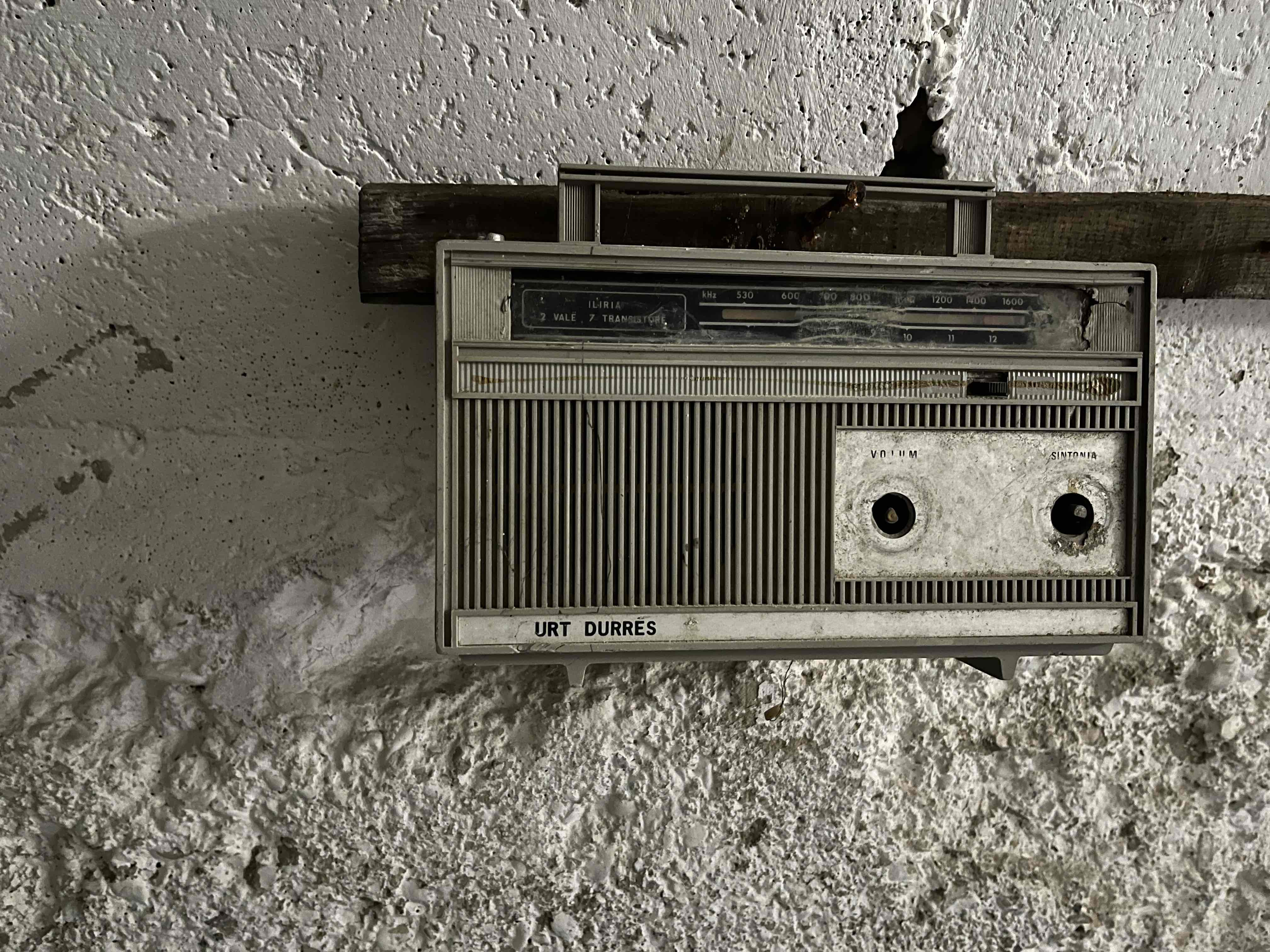
It was well worth it. Much more extensive than the sound tunnel, this bunker featured such echt period pieces as an original Škoda-built generator, portraits of Lenin in Soviet textbooks, nuclear winter bathroom facilities, and the mayor’s sole landline telephone. This site was once intended for 200 Communist Party members. Had the worst come to the worst then, existence would have become for them one endless round of queuing for tinned food and the toilet. Unthinkable really.
Shacked up in here with Enver Hoxha – no matter how enlightened, intellectual and cultured this dictator is said to have been – existence would have become a kind of living death. An Albanian CP member would be granted a free pass, therefore, to the Underworld; in the surrounding mountains there would have been few left to sing for their soul.
I was brought back once more to the nearby sound tunnel, which makes explicit a link between Iso-Polyphony and Greek myth. The other-worldly musical form, which is some 2,500 years old, comes to us replete with a close association to ship-wrecking and sailor-dooming sirens. It is fitting that a nuclear-age Hades should ring out with these voices. I am just thankful for the safe onward passage of our hire car.
Trip: August 2024. Check out the album At Least Wave Your Handkerchief At Me by Saz’iso for a flavour of this compelling genre.

No Comments