<h1>Archives</h1>
    contemporary, installation, site specific

    Review: Tatton Park Biennial 2010

    May 15, 2010

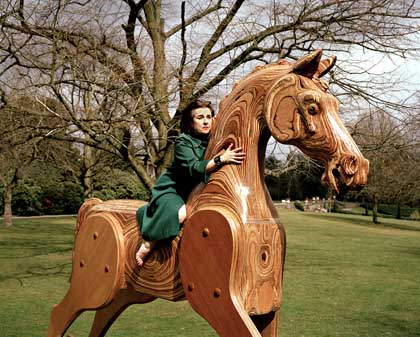
    Marcia Farquhar, The Horse is a Noble Animal (2010). Courtesy Tatton Park Biennial. Photo: Thierry Bal

    Exhibition: Tatton Park Biennial 2010 – Framing Identity, Tatton Park, Knutsford, Cheshire, until September 26 2010.

    Living in a stately home might just be the quintessential British fantasy, and Tatton Park in Cheshire is certainly the quintessential stately home.

    “People come here with a plan,” says co-curator Jordan Kaplan. “I’ll go to the house, I’ll imagine myself living in the house. I’ll go to the garden, I’ll imagine myself owning the garden. I’ll go to the shop, I’ll have some tea.”

    The 20 or so works in the Tatton Park Biennial 2010 might well upset a few of those plans. The best of them draw attention to the unreal quality of your visit.

    Fellow curator Danielle Arnaud, who teams up with Kaplan to form Parabola, says some pieces are causing the management “a lot of consternation,” claiming this is not the main point, but rather “a happy accident”.

    One of these turns an area of the gardens into a psychedelic ritual ground with alien markings in the grass, torturous-looking targets and frames festooned with ribbons.

    Artists Plastique Fantastique plan to stage dionysiac performances here in which chosen victims can expect to temporarily lose their identity. Yet despite flights of fancy, these grand surroundings usually reinforce social hierarchies and roles.

    More controversy is offered by Jamie Shovlin, who responds to the mild excitement guests would feel wandering in the gardens at night. A hermit was once employed to give them a gentle fright.

    As his title suggests, Shovlin has gone for out-and-out schlock horror, using movie soundtracks and a flickering shed to suggest a scene of carnage at the park. At the time of visiting, his team were still burying the speakers, but Rough Cut/Cut Rough (Hiker Meat) promises much.

    One-time local Jem Finer also subverts the gentility of the house with a piece inspired by teenage memories of visiting Tatton Park under the influence of narcotics. In fact, he inverts the status quo here with a spherical camera obscura, which lets you view the surrounding trees and occasional passing bird upside down.

    Another shed is used to mount the stainless steel ball, where it sits like an observation tower. The piece is described by Finer as a “totally safe altered reality experience”.

    Marcia Farquhar has also given the setting a dreamlike twist by installing a giant rocking horse near the house. From time to time she rides this wooden beast, or at least threatens to. She spends more time holding forth on all things equine. It is an incredibly fluent and captivating performance.

    “I might even ride backwards like the backwards knight from Lewis Carroll,” she says at one point. “This park really reeks of Lewis Carroll.”

    Indeed, there are many more surreal and nonsensical responses to the mansion and its 2,000-acre grounds. This may be a strange setting for art, but as art suggests, Tatton Park would have made an even stranger setting for living in.

    Written for Culture24.

    animation, computer generated, conceptual, contemporary, installation, music, sound

    Feature: Soundtracks for an Exhibition

    May 12, 2010
    Ron Terada, Soundtrack for an Exhibition, video still. Courtesy of Ikon

    Art is getting noisier. Galleries echo with moving image installations. The quieter ones provide you with audio-guides. Sound is now such a vital dimension of art, some artists are making art about that very phenomenon.

    In a boxlike construction at Ikon in Birmingham, you can pull up a beanbag and enjoy some music. On a giant screen ahead a retro turntable plays a selection of vinyl LPs. It reconstructs the type of experience you might have at home, yet you are sat in a sculpture.

    This is Soundtrack for an Exhibition (2000-) by conceptual artist Ron Terada. It features a selection of his favourite tunes from the last ten years and celebrates his first major show in Europe. Pavement, The Magnetic Fields and The Walkmen are among the bands included.

    Curator Helen Legg explains the popularity of the work: “Ron likes making mix tapes and people like having mix tapes made for them . . . so people are working out whether there is a narrative to the work.” This particular mix tape has also been pressed up as a free record that gallery goers can take home with them.

    The melancholy tunes can be heard throughout the exhibition, and it should be mentioned that this show is called “Who I Think I Am”. This personal selection of music seems a direct way of getting to know the artist, or is it?

    “I think that Ron is very smart guy,” says Legg. “He’s very self aware, so the music is both the kind of music he would listen to – they are his favourite songs quite genuinely – but he is also very aware of impression they give of him, so that’s why the show is a self portrait and the music too.”

    Either way, Terada has good taste, which makes this a contender for the best sounding show of the year. It makes you wonder why so much art is still looked at in silence.

    “I think its just a cultural habit, which I guess comes from the history of exhibition making and the way museums and galleries have operated historically,” explains Legg. “But I think with moving images becoming more prevalent within galleries that’s starting to be challenged and fade away. I think curators are increasingly becoming aware of the uses of sound, and artists too.”

    Not content with soundtracks, many creative arts shows are now developing audiovisual idents. A recent example can be found at Life in 2050 at Proud Central in London.

    Most of the work in the future-focussed exhibition, which runs in support of the 9th Sci-Fi London Film Festival, is comprised of relatively quiet illustration, photography and design. So the ident, projected from the mouth of a sculptural robot onto the white wall, sets the atmospheric tone.

    Visually, it is a code-generated animation, which appears to map the evolution and dissolution of an entire world. It is abstract, cerebral and, like the Terada piece, hypnotic. Meanwhile the ambient techno backing provides an unofficial soundtrack to your visit and indeed the entire film festival.

    Creative Director Andrew Jones and his agency Future Deluxe set out to find music that could bear repeated listening. “Some of the first pieces we looked at were quite electronic and quite structured, with too much emphasis on the beat, but when we heard Quadrant 3 [by Harmonic 313], it matched the animations because you could keep listening to it again and again,” he explains.

    Jones says that in the world of digital arts, it is now standard practice to develop an ident: “In terms of promotion and the online element it works very well, getting people talking about it, building up a bit of hype before the exhibition starts.”

    Yet he admits there is a historical precedence for silence before the work of art. “There’s definitely some things that are carried forward from the past with art galleries. There is I think an element of ‘That’s how we do things in an art gallery, because that’s how we’ve always done it.’”

    “I don’t know why,” he adds. “I don’t agree with it.” And as he demonstrates, shows with added music leave a powerful impression. Anyone might come round to Jones’ way of thinking.

    Written for Art & Music.

    contemporary, galleries

    News: Louis Vuitton Young Arts Project Launch

    May 12, 2010

    A new three-year arts education programme was launched at the Royal Academy of Arts this morning by a panel which included London mayor Boris Johnson.

    The Louis Vuitton Young Arts Project brings together five leading London galleries and will offer young people aged 13-25 a glimpse behind the scenes.

    Tate Britain, Hayward Gallery, Whitechapel Gallery and South London Gallery are taking part in the programme, along with the Royal Academy.

    “On a strictly utilitarian cost benefit basis there can be few better investments for society than getting young minds into galleries and realising their potential there,” said Johnson.

    But later he added: “There was a bit of soul missing from my speech and I want to address that. It’s not just about the London economy, it’s a great thing for kids too.”

    Thanks to the support of luxury brand Louis Vuitton, which is investing around £1 million, the young people involved can expect a high quality introduction to the art world.

    Organisers promise back of house tours, site visits and creative sessions as well as the chance to meet museum directors, curators, artists and collectors. A select few each year will be chosen to attend an intensive five-day academy in August.

    “It’s not just to think about becoming artistic practitioners themselves, it’s also about opening up other career possibilities within the art industry,” said Margot Heller, Director of South London Gallery, which is leading the programme.

    The well-connected project boasts Tracey Emin, Gary Hume, Michael Landy and Keith Tyson as members of its committee. Openings surely do not get much better.

    contemporary, craft, galleries, sculpture, Uncategorized

    Feature: Artists' Open Houses in Brighton

    May 10, 2010

    Most people would find the prospect of entertaining several thousand people in their own home somewhat daunting.

    But throughout May in Brighton, such are the visitor numbers for a typical address in the Artists’ Open House festival.

    Citywide that adds up to around 230,000 guests. It is no wonder that home-loving artists from Hanover to Hove are currently redecorating and stocking up on teabags.

    “It’s a tremendous amount of work,” says Jehane Boden-Spiers of The Yellow House, kt21 on the Kemptown trail, “But I like the way it transforms the space.”

    She likes the fact open houses are “very social” and adds: “It’s a good opportunity for me to present my work in an environment where I’m in control.”

    Boden-Spiers will showcase 15 artists in her home, a pattern repeated across Brighton as 243 venues play host to 1,300 artists. Most of those will be looking to make sales.

    “Some people sell 80%. Some people sell nothing,” she tells me, the average home shifting 30 to 40% of its wares. Turnover for the whole event should be £1 million.

    When it comes to art, the public clearly have an appetite for the personal touch. “It’s great for them. They get to see the stories behind the artworks,” says Boden-Spiers.

    “It’s a chance for them to meet the artists,” she explains, adding that domestic settings help visitors imagine what any given piece would look like in their own home.

    They have been showing art at The Yellow House for 12 years, but many artists use Open House festivals to learn about putting on a show, and dealing with the public.

    Another experienced artist and host is Ralph Levy who lives in The Handmade House from an out-of-town trail in nearby village Ditchling.

    But visitors to the former farmhouse can expect a setting every bit as remarkable as the art on display. Levy has spent five years restoring the building entirely by hand.

    This has meant fabricating everything from curtain hooks to drawer handles, plus all furniture, making an estimated total of 300 bespoke objects.

    His evident skills as a designer and a craftsman are largely self-taught. “It’s all from the back of a cornflake packet,” he says. “I trained as a ceramicist.”

    Guests will also have the chance to sample home-cooked and largely home-grown food, or wander the length of a sculpture trail which took two weeks to cut through brambles in the overgrown 60-acre grounds.

    The energetic New Zealander says of his unusual project: “It should be like a house, but a little bit more, like a modern day version of Charleston, but without the bed hopping.”

    Nearby Charleston was once home to Virginia Woolf and friends and the community of artists, designers and makers in Ditchling still feel the bohemian effects.

    But to some degree, that quality is offered by all open houses. From farmhouses in rural Sussex to terraces in the suburbs of Brighton, they all provide a chance to see artists in their element. And art too, lest anyone forget.

    contemporary, photography, Uncategorized

    Interview: Spencer Tunick

    May 5, 2010

    Few living artists get as much exposure as Spencer Tunick. But then again this live installation specialist and photographer works exclusively with nudes, hundreds and sometimes thousands of them.

    His latest project, shot over Bank Holiday weekend, is set in Salford and Manchester. Tunick is using the project as a response to the region’s best known painter of crowds, L.S. Lowry.

    “I think if you were to take the frame off of a Lowry work and stretch it on a canvas that had no ornate frame on it and hung it at the Basel Art Fair or Frieze, it would be something that a young artist would make today,” he enthuses.

    Thanks to the “scrappiness” and “gestural spontaneity” of Lowry’s paintings, he says, “The images themselves could have been made by a young 22-year-old artist coming out of Goldsmiths . . . It’s sort of the artsy crafty way of painting before it’s in style now.”

    In fact Tunick first saw his cityscape setting through the eyes of Lowry, driving from the airport directly to the Lowry Galleries, who have invited the photographer to help them celebrate their 10th anniversary.

    “I was just drawn to the fact that there are chimneys and smokestacks all throughout the landscape of his work, and now there are very few left in Manchester,” says the American artist.

    Indeed one hoped-for location for his latest work featured one giant chimney, which was subsequently demolished a few weeks before the shoot.

    “Heavy industry is gone from Manchester and in a way the new industry coming into Manchester, I guess, would be culture,” says Tunick.

    Where once were factories, he continues, you now have a large student population, a vibrant gay and lesbian scene, new museums, and now nudes.

    “So for me the masses of bodies represent the inward motion of culture, as Lowry’s masses of clothed bodies, of factory workers and pedestrians, represented industry, the former industry,” he explains.

    Tunick has never used an entire project to reference another artist’s work in this way. “I wanted to be a bit more conceptual with the exhibition,” he says. Indeed where do you go after photographing 18,000 people in Mexico City as the artist did in 2007?

    This time round 1,000 volunteers have taken part and eight locations, including Peel Park in Salford (pictured), were chosen in secret.

    “We don’t announce the locations, because it’s not a naked run with 500 runners and 100,000 people watching. It’s quite a private piece – as private as you can get in a public space,” he says.

    Tunick has also decided to freeze bodies in motion for this piece and it will be the first time he has displayed such work. Asked about the effects of this technique, he says: “It’s a cross between the negative connotations of George Orwell’s 1984 and the positive representation of a nude utopia.”

    It seems Greater Manchester may be bidding for utopian status. This weekend’s shoots have been organised with full co-operation of the local authorities, whereas in New York the artist has been arrested five times for breaking public nudity laws.

    “Well it’s very hard to hide 500 people so we have to get permission,” he explains. “Kate Farrell, the curator, has done an amazing job securing the locations from local government and co-operation from the police. So now the police will actually be helping us as opposed to being our adversary.”

    Prior to choreographing a small army of naked Northerners, Tunick was unclear about the ability of the British to cope with the cold in the nude but assured me they would have heated buses.

    “It’s definitely more of a fiery group in South America compared with Germany or Holland,” he says. “Often where the body is not as accepted in society there’s more excitement about the act of participating and you know sometimes it’s just really easy – the people are just really easy to work with – and sometimes they are so excited to be naked and be on the streets that it takes time to calm everyone down and start making some art.”

    contemporary, craft, curating, film, galleries, outsider art, sculpture, Uncategorized

    House Festival 2010 offers city-wide gallery in Brighton and Hove

    April 30, 2010

    Cities without an established home for contemporary art might well look with interest at a solution found by artists in Brighton and Hove this May.

    House Festival 2010 is a temporary gallery with nine rooms spread around the twin coastal resorts, in venues as diverse as a Regency townhouse, a day centre and a garden shed.

    Organisers Judy Stevens and Chris Lord have drafted in a handful of the region’s best known curators to support the project, which was piloted last year.

    “There are a lot of artists here with national or international reputations who never show in Brighton, because there’s no gallery,” said printmaker Stevens.

    And yet the South Coast is not short of spaces for art. Eastbourne, Chichester and Bexhill-on-Sea all boast newly developed, restored or redeveloped spaces for art.

    “This is really our response to that,” adds Stevens. “I think that is because they received a lot of regeneration money, whereas Brighton isn’t seen as needing it.”

    Room one of this virtual gallery will be The Regency Townhouse in Hove. First time visitors to 13 Brunswick Square should be impressed by the Grade I Listed terrace.

    Painstaking work is underway to recreate the fashionable look and feel of the 1820s, and this will be the context for a group exhibition on the theme of regeneration.

    Refired ceramics, collage and found objects all figure in the show of 21 artists, chosen by a team which includes Nicola Coleby from Brighton and Hove Museums, Simon Martin from Pallant House in Chichester and Woodrow Kernohan from Brighton Photo Fringe.

    Across town at Preston Manor, three more curators have commissioned 12 artists and designer-makers to respond to the furnishings and history of an Edwardian home.

    60 moulded bulldogs explore issues of nationalism, a peacock feather dress hints at the barriers of class, and a pair of glass pipes question the utility of stately homes.

    This time it is Polly Harknett, craft curator at Hove Museum, Matt Smith, independent curator and ceramicist, and Caitlin Heffernan, artist, who pull together the show, with Smith and Heffernan both contributing pieces.

    Grand surroundings then give way to a smaller setting for a third room of House, as a garden shed at 46 Buller Road plays host to a mini cinema.

    Highlight of the horticultural themed bill promises to be extracts from a 1903 version of Alice in Wonderland, the first movie adaptation of Lewis Carroll’s enduringly popular tale.

    At the time Britain’s longest film, this version of Alice was almost lost for good. It survives thanks to an incomplete print found in Hove, now restored by the BFI.

    Meanwhile, Brighton’s answer to the white cube spaces found in neighbouring South Coast towns has, for the duration of the Festival, been given a domestic makeover.

    Dream Home at Phoenix Gallery constructs a warren of lived-in rooms within the gallery, and showcases sculpture, installations and photography from local talents such as Ben Thomson, Gary Barber and Kim L. Pace.

    But lesser known, marginalised artists are on show at Wellington House, a day centre for adults with learning disabilities. Curation is by award-winning outsider artist Carlo Keshishian, with support from Pallant House Gallery.

    The remaining locations for House include smaller, local, independent galleries Permanent, Grey Area and Blank, together with a residential address in the city centre.

    Brighton and Hove may be lacking in the funds to create a purpose built art gallery, but as can be seen from this festival alone, the area has no shortage of alternatives. It is just a shame alternatives are needed.

    contemporary, installation, landscape, photography, sculpture, sound, Uncategorized, video

    Review: Underwater at Towner

    April 28, 2010

    Exhibition: Underwater, Towner, Eastbourne, until June 20 2010

    In the landscapes paintings of Eric Ravilious, the South Downs look like green waves in a rough sea, at least they do so after a visit to Underwater at Towner.

    The Eastbourne gallery has a reputation for landscape art and the local painter is one of many whose downland works feature in the permanent collection.

    Ravilious doesn’t qualify for the new show, which takes the boundaries of the landscape genre and drags them into the depths. But it might have pleased him that his hometown can now stake a place on the UK map of contemporary art.

    The big name at the current show is Bill Viola, whose 2005 video Becoming Light turns a non-specific body of water into an inky blue starry night.

    Floating just below and occasionally above the surface are an entwined couple whose struggle to remain buoyant resembles an improvised dance. They come up for air and look ecstatic. They sink away from the camera out of sight and end life as a luminous bubble of oxygen, or perhaps carbon dioxide.

    In a second video, by Dorothy Cross, the artist films herself afloat among a swarm of jellyfish. This is a nude, as much as a landscape, and a scene of painful exposure. But the creatures appear not to harm her. They merely investigate, along with our gaze.

    Klaus Osterwald also takes us below the surface of a lake, with a five speaker audio installation. Donatus Subaqua reveals a mysterious world of noisy fish, bubbling gases and overheard human calls. Space, depth and topography are rendered in sound.

    Another subaquatic landscape is provided by Seunghyn Woo, whose plaster and wire mesh sculptures look both organic and alien. Dripped with acrylic the colour of exotic milkshakes, they get even more interesting close up, like coral.

    Perhaps the underwater realm is, after all, unknowable. Detailed photographs of the sea bed here, taken by Daniel Gustav Cramer, show it as dark, murky and utterly impenetrable. Eric Ravilious would surely have been fascinated.

    20th century, abstract expressionism, architecture, constructivism, contemporary, drawing, film, minimalism

    Review: Modern Times – Responding to Chaos

    April 24, 2010

    Exhibition: Modern Times, De La Warr Pavilion, Bexhill-on-Sea, until June 13 2010

    Somewhere between art and architecture sits a drawing by minimalist sculptor Fred Sandbeck. His pencil and chalk plan for a Zurich gallery construction hovers in mid air, reminding us of the Utopian potential of pictorial space.

    The architectural role of this work would have come as no surprise to El Lissitzky. In the 1920s the Russian artist developed a mysterious term for such constructions of art. He called it Proun.

    Given that eight lithographs by the inventor of Proun find their way into this show, the concept appears central to the fantastic selection of drawings here. If so, it is also central to the history of 20th century art proposed by curator Lutz Becker.

    If that story begins with Lissitzky and Suprematism, it ends here with the minimalism of Sol Lewitt. By numbering the blocks in his Working Drawing (1996) he produces a piece of deadpan technical drawing, like a terse fullstop on all the preceeding “isms”.

    The artist’s line, once a vehicle for representation and then abstract expression, now becomes fully realised as a means for drafting perfect structures in the mind’s eye.

    Indeed, abstract expressionism here seems almost a folly. Willem De Kooning’s smudges, Franz Kline’s daubs and Robert Motherwell’s painterly blobs could be a vain rebellion against the spatial powers of the line.

    But drawing too can represent chaos, rather than clarity. Night Celebration III by Mark Tobey is an even, methodical scribble which spreads across the surface of a sheet of card like cigarette smoke at a riotous party.

    However, the lasting impression from this show is that less equals more. The works are largely monochrome. There are few figurative reference points. For every feat of excess there is a study in restraint.

    You come away feeling that in art so much can be achieved with the simplest means. A case in point is Norman McClaren film Horizontal Lines, shown alongside moving image works by Fernand Léger, Hans Richter and Viking Eggeling.

    The horizontal lines rise, fall and proliferate as if set in motion by an algorithm, but this is no dry exercise in geometry. The film is also a perfect narrative. It is high drama. Excitement runs thoughout this show like lead through a pencil.

    Written for Culture24.

    20th century, British, Camden Group, drawing, painting

    Review: From Sickert to Gertler – Modern British Art from Boxted House

    April 19, 2010

    Exhibition: From Sickert to Gertler – Modern British Art from Boxted House, Brighton Museum & Art Gallery, until September 12 2010

    Long before Brit Art, there was British Art. In the early 20th century this was typified by the painterly, figurative work of a group centred around Camden in London.

    Compared with contemporaries in Paris, the Camden Town Group were retrospective technicians. The art can seem as modest and matter-of-fact as that name.

    The System, painted in 1924-5 by Walter Sickert, is a case in point. As a portrait of a luckless character type with finely balanced colours, it is impressive. But there are no flights of abstraction. You wouldn’t guess the first Surrealist manifesto had just been published.

    Robert Bevan was another member of the Group and its his work which dominates this show. After experiments with fauvism and pointillism, his style settles into an angular yet sedate form of post-impressionism, with the emphasis on landscapes.

    In the years before and after the First World War, Bevan and his wife, Stanislawa de Karlowska, were central figures in the London art scene. It was their son, Bobby, together with his wife Natalie, who collected most of the works on display here.

    Their house was a showcase for paintings by Sickert, Bevan and Karlowska, along with Mark Gertler, Harold Gilman, Charles Ginner, Cedric Morris and John Nash. Most of these talents were also friends in one way or another.

    The web of relationships between the artworks and artists in this show is dense. To complicate matters further, Bobby built up an eclectic range of works on paper, in which Goya, Cezanne and Toulouse-Lautrec sit more or less side by side. Natalie, meanwhile, had an exhibition of her own ceramics at the Anthony d’Offay gallery.

    But it is their family home of Boxted House in Essex which draws together all these guests, possessions and passions. The artwork here is displayed room by room, so the results are no less disordered than a perusal of anyone else’s place of residence.

    In his lifetime, Bevan only sold one painting to a public gallery. Brighton Art Gallery bought The Cab Yard, Night in 1913. It was a favourite subject, but horse drawn cabs would soon be replaced by cars. In Italy, this would spawn Futurism. Here we did not exactly embrace modernity.

    Written for Culture24.