<h1>Archives</h1>
    site specific art, Uncategorized

    Tom Dale, Machine Borders (2025)

    March 3, 2025

    The Gosport ferry takes five minutes and shuttles back and forth across the Solent all day long. I was very pleased by its existence because Maps was advising me to somehow walk on water to get from Portsmouth Harbour to Gosport Museum and Art Gallery. 

    As we rode the high seas, I took in the views: the historic sight of HMS Victory once commanded by Admiral Lord Nelson, the grim sight of an aircraft carrier (either HMS Queen Elizabeth or HMS Prince of Wales, but who really cares?); plus assorted boats of all descriptions, pleasure craft and working vessels, and a thicket of masts. It was the masts I was looking out for.

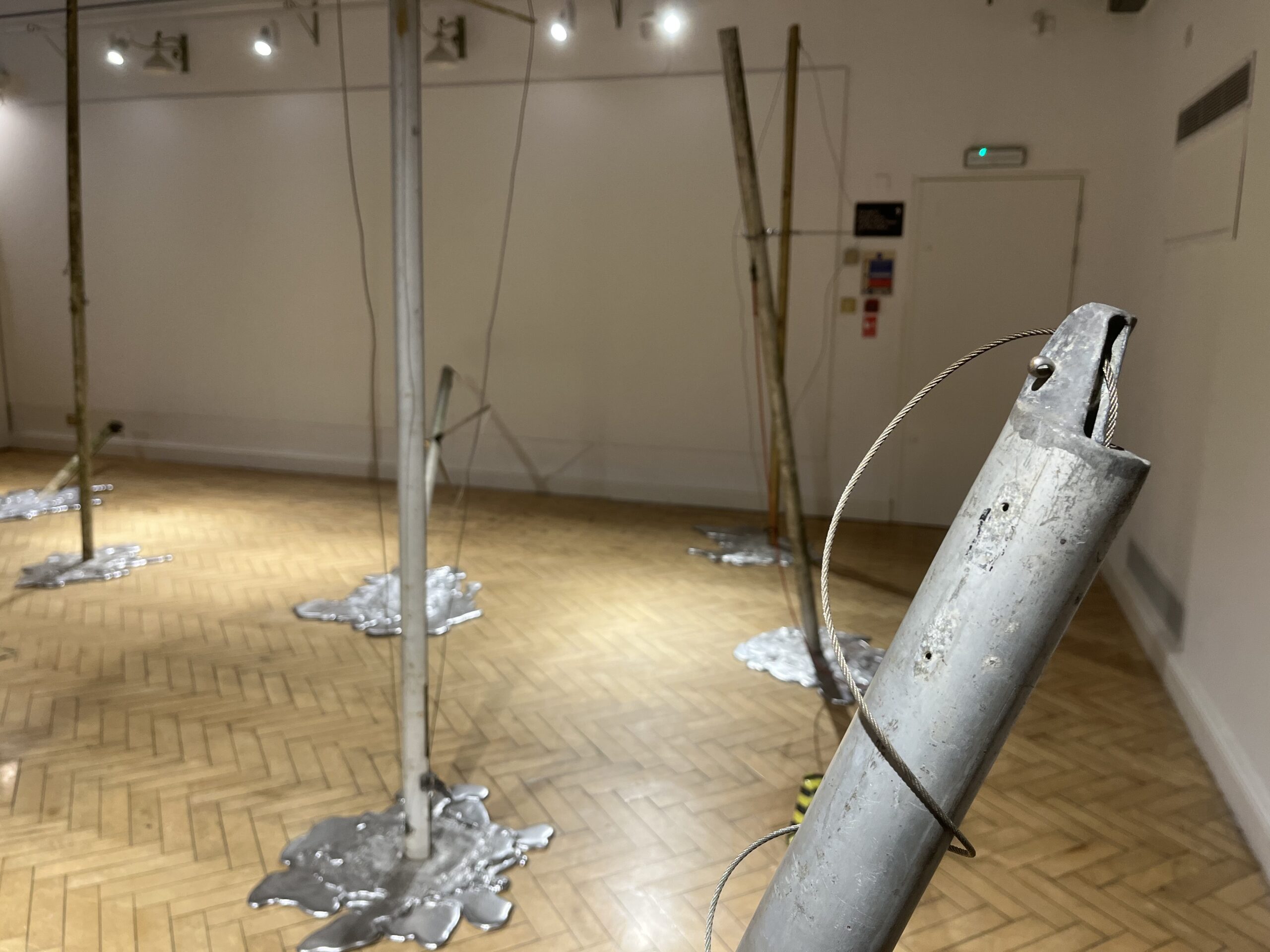
    Tom Dale is a left field sculptor who modifies found objects in order to derive poetry, comedy and at times like this tragedy from their unexpected appearance in a gallery. His latest finds are 13 unwanted yacht masts, which he has partially melted from the base up so that each of them looks as if submerging into a molten metal sea. Shafts are weathered. Rigging hangs slack. Aluminium swells in puddles on the parquet gallery floor. It has a texture like oil on water.

    But the masts are only more or less upright. Together they appear to lean about like crooked teeth or an array of tombstones in a horror film. Once seaworthy, then scrapped, now repurposed as an exhibition of contemporary art, these masts have caught the prevailing winds of a town where the shops are closed and boarded. Even in bright sunlight, the high street, which runs directly from the ferry dock to the gallery, is bewildering.

    Perhaps it is as a result of the decline of Britain as a seafaring nation. Perhaps it owes its poverty to the long years now that Britain has somehow survived without a naval battle. Or perhaps it’s an unfortunate, sadly unforeseen side effect of the UK’s post-2008 austerity politics. One expects it’s all of the above.

    But rather than neglect or redundancy, what this exhibition suggests is a roaring furnace. The dangerous, hostile environment in which this work came into being was an inferno rather than a balance sheet. Capitalism, as far as I can see, has more in common with a binfire these days, than it might have ever had with reasoned economics.

    Margaret Thatcher loved Gosport. She would pop down for the annual commemoration of her war in the Falklands, a fact learned from the rich display of local history in the museum here. It’s a history the artist flags up directly even as he dissolves its outward form. In a lowering tide all boats sink. And what to do? Despite the reference to mechanisation in the show’s title ,there is no longer even enough light industry to keep this town buoyant.

    I would however recommend a visit, with an option for the total package: the ferry trip; the peace in the museum cafe; the spectacle of the art. To see these yacht parts becalmed and brought into a former school hall is to walk into a three dimensional evocation of the soul of this town. And you’ll get to appreciate keeping your feet dry, at the same time, even as you immerse yourself.

    Machine Borders can be seen at Gosport Museum & Art Gallery until 3 May 2025.

    Uncategorized

    Stonehenge in context

    February 14, 2025

    On a contemporary experience of a prehistoric mystery

    I did not expect a pop quiz at 7.15 in the morning. The quizmaster was behind the wheel of a taxi. The contestant (me) was in the back seat, looking out at the grey dawn-lit Wiltshire countryside. It took me about half an hour, and several educated guesses to get from Salisbury to Stonehenge.

    “He was a member of the best selling three-piece rock band in the 1980s.” I don’t know. “He once sent a message in a bottle.’ Sting!

    “He was Britain’s most successful filmmaker of the 1990s.” Erm… “He was once married to Madonna.” Guy Ritchie!

    “Do you watch Would I Lie To You?” I’ve seen it. “He grew up round here.” David Mitchell!

    And so the time passed and I learned that the lead singer of The Police and the director of Lock, Stock and Two Smoking Barrels both have mansions visible from the A360. I learned that one half of Mitchell and Webb is Salisbury’s favourite son. I also learned that, for strategic wartime regions, those fetishised fighter planes known as Spitfires were manufactured in this part of the world. Oh so much to take in! And I had only ventured out this way for a visit to a well known stone circle.

    I was dropped by the security gate outside the visitor centre run by English Heritage. There were already a number of cars parked up for the head of PR, plus an in-house prehistorian, plus the marketing manager, and then three photographic artists, whose show (within the canopied galleries of indoor museum space) was the impetus for my first visit to Stonehenge. A convoy of job titles is soon rolling across the grounds. It’s a much shorter car journey and there are no more nuggets of low cultural trivia. I get out of one of then vehicles and it is there.

    It.

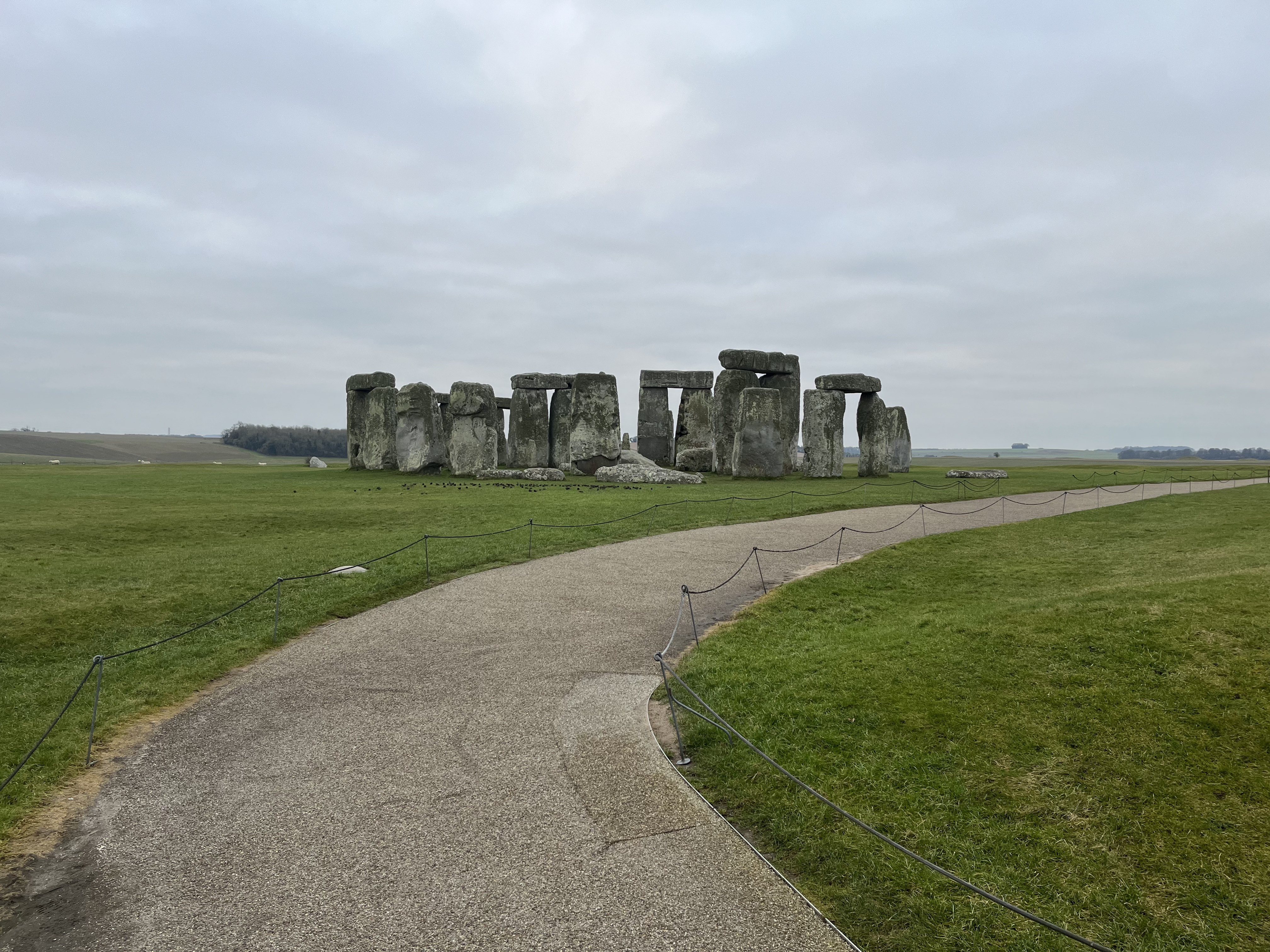
    It looks, if I may say so, quite dinky from the approach path. Not quite as wide as you might think. Taller than you would imagine. And impossible to take in at a glance. Thanks to a circle within the circle, there is no definitive vista. Sarsen stones and the Blue stones set off differing rhythms and much of the ring has collapsed. The muddy earth has begun to reclaim several of the recumbent pillars. Encircling the visitor, this impossible architecture is as square and block-like as it is round.

    Rooks flutter on the heights. Lichen spreads beautifully across stone surface. I seek primordial energy, but reaching for a nearby pillar I am reminded not to touch.

    In the absence of wind and rain, it feels like a welcoming place. In the absence of sun, it maintains a sombre grandeur. But any sense data is drowned out by a voice in my head, which tells me I am at the UNESCO World Heritage Site of Stonehenge, Europe’s heaviest stone circle, and subject of many History Channel documentaries, together with a top notch 2022 exhibition at the British Museum that really served as my introduction.

    I am in both an outdoor museum and the scene of solstice revels. I am plugged in to the extensive work of archaeologists and simultaneously a know-nothing here. My keen awareness is that this is the most important prehistoric site in the UK.

    Meandering round the stones, trying not to bump into others, I find myself in a parodic dance with – who else? – but the monument’s comms team. Who would be able to come to Stonehenge without acute awareness of where they stand, where they walk, how long they gaze? And how, I come to wonder, can the young artists mentioned, and the curators who have been working with them, ever hope to express anything of this mute monolithic presence, of this untranslatable amassing of sandstone and igneous rock, of an incontrovertible enigma that will not go away.

    Reflecting on this visit I found that my impressions were of a landmark at once very familiar and also uncanny: for that very reason. I felt like I had been here in a dream. That may be why I wanted so much to touch the stone: for the purposes of a quite unscientific authentification. Given the efforts made to assemble this spectacular creation (stones from Wales etc), my own rapid response (asking AI to confirm the backstory, booting up an online dictionary, googling synonyms for speechless), poured out here for a distracted readership, feels so helplessly glib that I can be sure the mystery is shut off from me forever.

    But I did feel a certain degree of dramatic affirmation of my ongoing interest in prehistory, and its representations. I felt that at 8am on a wednesday would be my best chance to see it afresh. The mercurial cloud of restless starlings and the ominous rooks perched atop 7m tall stones gave me somehow much more than any previous reading or viewing. It was a relief to finally get this close to Stonehenge, but it remained mediated.

    The experience was framed by the resident birdlife, by surrounding plains, by muddy footprints, a rope cordon and by the accretion of lichen in many shades. It was the home of Guy Ritchie and Sting. Far easier to talk about all of this, than the stubborn enigma brought into focus by a kaleidoscope of contemporary culture.

    Uncategorized

    Trade deal

    February 3, 2025

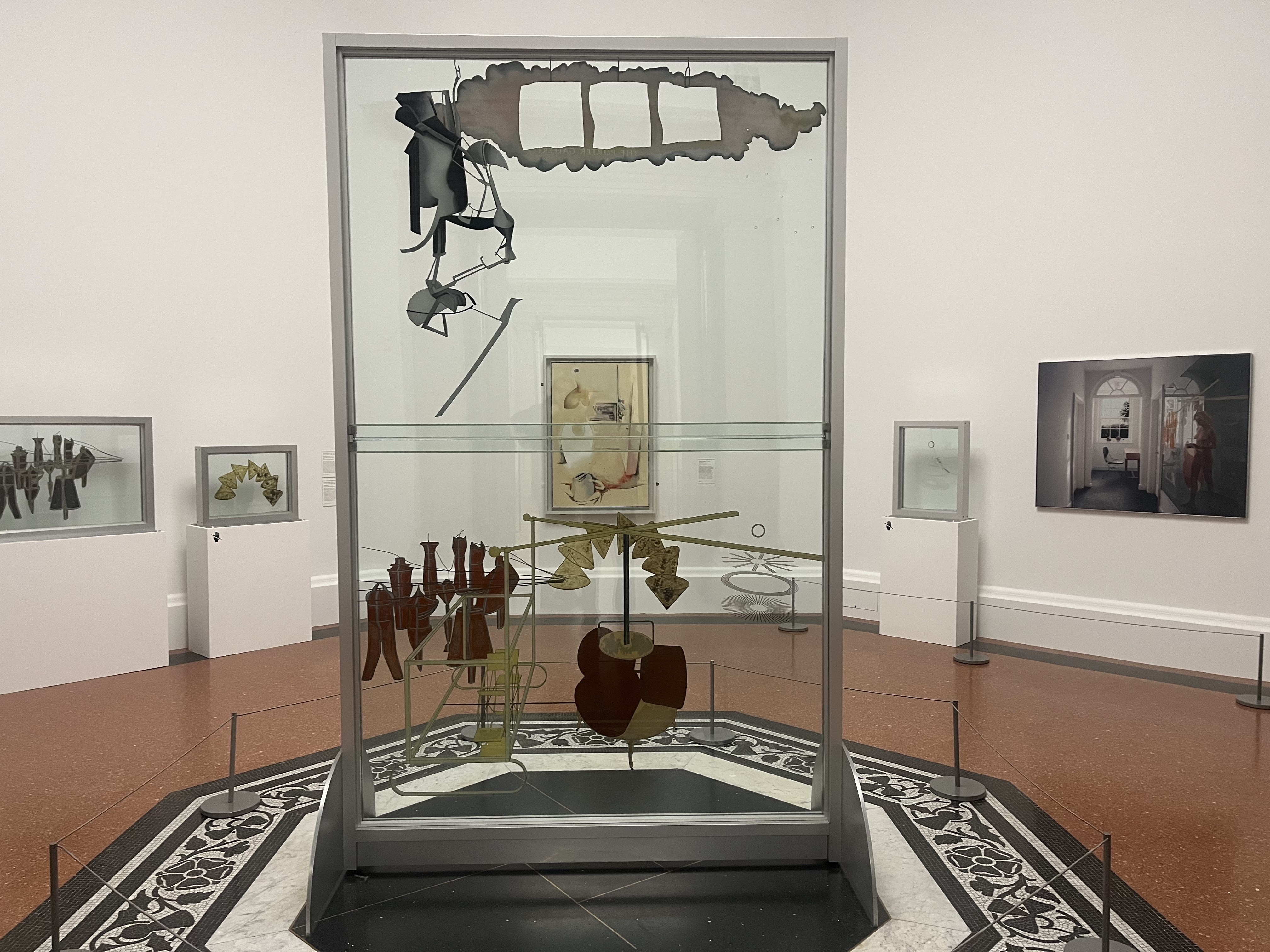
    A brief encounter with Marcel Duchamp’s Large Glass

    Like a freestanding, double-glazed patio door demo unit, the twentieth century’s most enigmatic work of art is propped vertically on its functional base, inviting showroom visitors to peer through the vitrine or merely to admire the joins and the casing.

    This particular glass sample does have a few imperfections; trapped inside the layers, for no explicable reason, is a wealth of intriguing diagrammatic tracery: a wiry, hard-to-read, set up that defies easy description. But elements you might still call cogwheels, and attenuated rotors, plus dressmaker dummies do seem present.

    There is no clear purpose to this incomplete Heath Robinsonesque arrangement, but one perhaps hinted at by the object’s official designation. Because this is, of course, The Bride Stripped Bare by her Bachelors, Even. The title fogs up the view; and this here version of the Large Glass, as it is AKA, is also a replica, further muddying the waters in Room 18, where I’m photographing the work, by Marcel Duchamp, at Tate Britain.

    Our national claim on this enigmatic piece which was to pre-occupy the French artist for much of his working life, stems from a connection to Pop artist Richard Hamilton. Hamilton was to enthusiastically correspond with Duchamp and so the reconstruction was made with the full approval of the author. It is an enhancement of the open ended suggestiveness of a work which escapes the limits of the Philadelphia Museum of Art.

    It can be unsettling to dwell for long on the uncanny doubling effect that accompanies a reproduction of an icon. But words must be said about the spread of what remains: a pure, obsessive artistic idea. Duchamp worked on The Large Glass for decades

    Duchamp was to accompany his magnum opus with an extensive archive of notes: the so-called Green Box (and the subequent Green Book) was an extensive publication full of riddling captions and confusing blueprints. Conceived as an edition of 200, and yet since Duchamp was quite indifferent to commercial success. One concludes that such propagation, and indeed replication of box-subject, all played happily into his desires for then future existence of the Large Glass.

    He signed Hamilton’s work; Tate is calling this, paradoxically, an original replica. Whatever is written about the earlier version, this reproduction (1965-6/1985) is a provocation to begin all over again with the commentary.

    The collaboration has given birth to a twin piece; you could not write a critical profile of either identical sibling, without referring to their sister or brother. Replication has therefore expanded the scope of the Large Glass, irrevocably changing the first work, giving it a new and imaginatively productive context. Handwritten letters in another glass case here align the professional output of both artists, as if this puzzle held the key to the accessible charms of British Pop art.

    And, by dint of the necessity of any replica, this one bestows a new appearance on the original. Having not been to Philadeplhia I leave it to others to compare and contrast. But I was struck when I recently visited Tate that this piece, which lived in my mind in brown cubist monochrome, does have colours. It also has polish – none of the dust which can often accrue in an archive. It further offers a degree of surprise. What is it doing here in Pimlico along with the Turners? What was I doing?

    Duchamp’s major work gives me very little. It is resolutely unaesthetic. For a study of heterosexual relationships it is utterly dry and devoid of romance, but it is not without humour: withering irony in this case. It is the irony of an attachment to the hearts and flowers, and to an act of union which is, physiologically speaking, as mechanical as an engine piston. It is the irony of the grand caprice of many of our lives, that of popping the big question, from within an economic system which otherwise dictates the affairs of men and women.

    The bride seen in this window is perpetually denuded by the attention of half a dozen suitors. She is the one for sale. Duchamp’s piece is hardly a sales tool for marriage, but it does appeal to sell the availability of this one woman to allcomers. Hamilton’s piece is a promotional stand for all that. The pages written about both are further collateral to the deal, returning me to this showroom prop.

    I was inspired to visit this work by Hamilton/Duchamp by a biography of the latter written by Calvin Tomkins. I recommend it to you, because it outlines a personality every bit as remarkable as this problem work.

    Uncategorized

    Try closing your eyes to enjoy this artwork

    January 31, 2025

    A review of Electric Dreams: Art and Technology Before the Internet at Tate Modern

    As demonically possessed tech bros appear bent on hastening the end of civilisation, Electric Dreams puts the spotlight on artists whose pioneering work with technology, prior to the advent of the internet, is a reminder that this digital world we’ve inherited was not entirely born of the greed and corporatism which now seem to characterise it. Instead this exhibition recalls the utopian dreams which ushered in this vision. Works from a time in which we might have felt in control of our ubiquitous networks, a time we might still have addressed ourselves to a computer in the same spirit as one might approach any other tool: as a discrete entity.

    But hammers and nails are also technology; it’s something which bears repeating. In 1964, German artist Günther Uecker was to drive home this point by creating White Field, a medium sized square canvas rendered hairbrush-thick with with protruding white nails. The effect is gently kinetic, as you move towards it, but as you stand back the nails looks as organic as fur. You’d want to stroke them if, so close up, you couldn’t see the matrix of sharp points, which each cast their shadow, like ones and zeroes. It’s a cumulative effect which is almost out of Uecker’s hands here. The gallery technician who hung this work might also be in thrall to his spirit level and his hammer.

    There was never any such thing as an obedient, predictable tool. The telephone, for example, which began life with the modest remit of giving means to converse over distances, is everywhere in Electric Dreams: I, and apparenlty most of the audience, use smartphones to document or commemorate our visits. I’m even now using this prosthetic handheld computer as an aide memoire; but when I come to review these visual notes they may filter my experience according to what became an appealing photo, not necessarily what were the most relevant or important pieces of artwork.

    Some artworks invite everyone to get out their phones, let’s face it. They are staged as grand photo opportunities, and one well imagines that their inclusion, in a big show like this, must endear the curators to the gallery marketing dept and outreach teams. Such installations (which very often predate digital photography) now appear made for exploring, posing for cameras, and then sharing via 5G or broadband.

    On the day of my visit, one of these immersive rooms was out of commission (I think, it was Otto Piene’s Light Room (Jena)). But from the noise generated by excited kids on the approach to Room 8, Chromointerferent Environment (1974) by Carlo Cruz-Diez was still doing the business. Through digital projection and stroboscopic spotlights, black and white stripes rippled across every surface and everybody contained therein. It was a kinetic, immersive, disorienting piece of Op Art, quite easy to imagine. I note that three other visitors, of TikTok age, have propped a phone on one of the modular cubic seats provided; they are batting one of the spherical white balloons, also provided, between them; they smile and laugh for the phone’s watching eye. This new function of art, to become social media, could not have been foreseen.

    Like many artists in Electric Dreams, Cruz-Diez seems to hav ecaptured a moment in which the world first became truly animate. Like Mickey’s broom in the 1940 Disney animation Fantasia, everyday utensils were soon to come to life. Or at least it now seems that way, looking back. Tate’s exhibition pulsates with monitor banks, flashing lights and kinetic, at times interactive, sculpture.

    Nothing pulsates more than an object you need not even perceive visually, one of the legendary Dreamachines engineered by beat poet and artist Brion Gysin: specifically, Dreamachine No.9 (1961). A cyclindrical bedside lamp, elongated perhaps by a modish designer, casts a warm orange light which blinks rapidly as it spins, A note on the wall reads, ‘Try closing your eyes to enjoy this artwork’. Light will still flicker behind your eyelids and, it is hoped, generate alpha waves in your brain to promote relaxation and calm. I present it here as a video (above); if you are able to view it fullscreen it might just work for you too.

    Our lost ability to stand back from the internet, and the temptation to close our eyes to its dark promise is readily anticipated by the first work in the show. Taking her cue from the neon cityscape in 1950s Osaka, Atsuko Tanaka was to make art’s pioneering venture into wearable technology. For use in performance, she created a dress made with brightly shining tube lights. Tate reports that it was uncomfortably hot to use and that, should it malfunction, it could prove lethal.

    I think today we are all on stage in a version of her Electric Dress (1956); we begin to overheat, we need electric power 24/7, and, thanks largely to the Internet, life has become highly precipitous. Tanaka’s crazy idea therefore came to pass, but having survived her performances, the Japanese artist left behind something that endured. My takeout from her example, and that of 70 more artist in this electrifying show, is this: we can be barely in control of our materials and yet we can live to tell the tale.

    Electric Dreams can be seen at Tate Modern, London, until June 1 2025.

    Uncategorized

    Motion pictures

    January 28, 2025

    Diving into Frameless, London’s most extensive immersive art experience

    From street level, the lobby of Frameless Immersive Art Experience looks as if it might lead to an urban co-working space. 10am on a saturday morning in January and it is already filling up with the tourists who flock to this westerly part of town. We are, after all, just around the corner from last year’s most notable new souvenir shop, sorry, venerable scholastic museum; decals in the window of Moco indicate no surprises.

    My ticket is scanned and I feel quietly expectant. My pet theory, that immersive artworks are twentyfirst century prehistoric caves, is bolstered by the beckoning escalators. Studded with mirrors, lit by animated screens, they carry me down into a subterranean realm of bright light, a gift shop, a welcoming cafe and a lobby from which we can jump off into one of four art caverns.

    I spelunk my way into the first of these huge gallery spaces. One can, if one wishes, read that all of the art in this room goes ‘Beyond Reality’. We have the Surrealism of Dalí and Max Ernst, and we take in Klimt, Munch, Bosch and Giuseppe Arcimboldo. Rousseau’s Dream is also spun out for a bit of added familiarity. But as that roll call unfolded I found myself trying to name the painter at the first hint of each famous painted motif. A petty bit of trainspottery which could not be avoided. Not sure who else was engaging in this pedantry.

    As all six walls of this art container flooded with imagery, I looked around and saw how, every one of us bathed in moving light and colour, visitors to Frameless tended to be more perambulatory and wide-eyed than visitors to, say, the National Gallery. As the surrounding projections oozed into every corner of my field of vision, it seemed no one quite knew where to stand, where to focus, whether to sit, whether to move, what to capture with my phone and whether to video that or take a still.

    Let me just say a word on the treatment of masterpieces by a phenomenon such as this. Frameless has blown up and animated more than 50 venerable art treasures, then it has added a soundtrack. Klimt’s decorative eyes wink. Dalí’s attenuated elephants march. Damned children in the Garden of Earthly Delights giggle and wriggle. All of which means that these iconic moments, so carefully preserved on canvas by some fine artists of yore, are broken up into fragments, mapped onto 3D space and, of course, sped up. Art has been repurposed for spectating rather than contemplating.

    I marvel, for example, at the effect which makes it look as if the gallery floor has become a moving platform of decorative brushwork. I can see groups of fellow visitors sliding as if on a carousel, if I gaze at their feet. Then I discover the mirrors which border the space and tile the ceiling. Even the projectors are painted silver. Looking down I can see an infinity of spectators, and just a passing periphery of Great Art, plus the opportunity to take a mindbending image for my Instagram feed.

    The looping installation runs for just over 20 minutes. Then I make my way to a second chamber of wonders, this one seemingly themed around colour. There are flecks of paint all over the floor which scatter like leaves when you kick them. This is the expressive surplus of a work by Monet; a similar trick is deployed to zhuzh up Van Gogh. As I entered, a twinkling galaxy of light dots served to introduce me to pointillism; this rippling mural also responds to visitor activity.

    Throughout Frameless there is a general rhythm in which elements of a work dance in towards the spectator from all sides and then coalesce to offer a fleeting moment, in truth worthy of a frame, a pause in which the word ‘voila’ might come to mind, as spoken by an educated conjurer, before all of the daubs or the details fall apart again and make way for the next big reveal. For some reason this is a trope which reminds me of a television ident. It is unrelenting and the works are flattened into a single frame of pointless equivalence.

    Let’s be generous and call it levelling up. Frameless is not the first to liberate works from canvas, frame, bricks and mortar. French writer André Malraux is sometimes credited with the invention of the first virtual museum. In 1949, this took book form and displayed works, in a canon of Malraux’s learned judgement, from across a wide expanse of time and space. Page after page, each of these works appeared contiguous and in black and white. They were perfect for comparison and for study in a library or in a seminar. This new ‘Museum without Walls’ was for a different age.

    Big windowless box number three, the third gallery, was given over to landscapes or, more specifically, seacapes. I was struck by the way in which individual boats on Canaletto’s Grand Canal in Venice have been cutely animated. They move independently of each other in a feat which illustrates that tech rather than artistry is in the foreground. Have you ever seen a Turner until you’ve seen the tug boat wheel rotate, as it tows the Fighting Temeraire to its final resting place? Well, yes, but that is not an intervention one can easily forget.

    One more elaboration, apparently crying out for some creative technology, was made to Hokusai’s Great Wave. As you can imagine, Frameless has rewound the Japanese masterpiece so that you can see the swell build and the foam begin to crash. (Keenly aware of what was about to happen, I began to video this. See above.). I’d like to say that a time-based interpretation is an affront to the eternal calm which, for me, The Great Wave expresses, but this painting has already spawned a tsunami of prints and pastiches, so, like most of the works here in Marble Arch, it is probably fair game.

    Worth noting also that later in this space: I resisted the temptation to thread my way to the edge of the screen in order to stand proud in romantic solitude and contemplate The Wanderer Above the Sea of Fog by Casper David Friedrich. But I did contemplate some fellow wanderers who, to the sound of Wagner, raised smartphones aloft, captured the abyss-like panorama for later ready reference should they be feeling too much like data nodes or target markets. It was interesting to see such an icon of poetic individualism subsumed into the cavalcade of mass spectacle.

    The final gallery space was devoted to abstract art and offered a very basic maze of ceiling-height screens which popped with skittering elements taken from Mondrian, Kandinsky, Klee and so on. The former’s Victory Boogie Woogie came to life and one had to say perhaps, ‘It’s what he might have wanted’. The soundtrack was jazzier and the lighting was darker. There was a nightclub vibe, enhanced by a couple of stewards on the door of this one. Don’t touch the screens, we were told, as if to say Don’t do drugs. After more than 20 minutes of this, I was ready for coffee.

    Frameless does not compare with the framed experience offered by a non-commercial museological institution. It is carnivalesque to see these works stretched and realised in, actually, four dimensions. That really is something. But innovation, trickery, creativity for its own sake… these are not aspects of art that get my dopamine receptors firing. Nevertheless, Frameless is thought-provoking. In taking us underground and enveloping us in darkness and light the experience is surely primal. But the magic was that of a creative design studio, not shamanic lair, not artistic garret, not chapel pew. Unless I’ve got it all wrong, Lascaux was not a co-working space for graphic designers.

    Back on the surface of this contemporary cave. Marble Arch is dematerialising before our eyes. It is under wraps in tarpaulin, which hides the London landmark like a conjuror’s sheet. Printed right across this tarp is a 1:1 image of the structure underneath: a gentle illusion. The Arch needs some restoration work. Nothing it seemed was permanent. All that was solid melted into air. Dalí’s watches are speeding up.

    Uncategorized

    Merry merry

    December 20, 2024

    It’s the most replica-d time of the year

    Christmas is a time for quasi replicas. In most churches, many schools and some homes you will find carefully crafted miniature stables without material referent.

    Nativities, based solely on other nativities, attempt an authentic reconstruction of a moment in time which is known of the world over. You have seen the elements: the manger, the baby, his parents, the shepherds, the wise men, the angels, the cattle and the star. They rarely change.

    This tableau originated in Bethlehem, now an occupied territory. The city appears to have been largely spared the insane wrath of Israel. Just a logistical siege, a few gas bombs and concussion grenades so far.

    There was a story from December 7th in which the 2024 nativity at the Vatican included a keffiyeh as bedding for Jesus. The ten foot tall installation was conceived by a Bethlehem artist, who told the Catholic News Agency that the presence of the keffiyeh did not betoken violence, so much as a recognition of the work and existence of the 30 Bethlehem artisans who collaborated with him. So, Pope Francis prayed before this loaded scene, Then, in accordance with sacred tradition the infant was removed. It remains to be seen whether, on the 24th December when Jesus is set to be restored to the artwork, he will be accompanied by the contentious garment.

    To say there has been bombing in Gaza is so inadequate for the scale of the destruction in that part of Palestine. To say that those bombs have been sold to Israel by the US and the UK is to conclude that either Biden and Starmer are biblically evil, or that, when they approve those sales, they experience a degree of cognitive dissonance which allows them to go about state business and yet tolerate their reflections every so often in mirrors.

    Meanwhile the Vatican has to work out how to diffuse a bomb of their own making. Do they or do they not reinstate the keffiyeh? Which of the two other religions of the book do they outrage? How many catholics are looking for the Pope to once again call out this massacre of the innocents? And how many catholics would rather maintain indifference to the suffering of Palestine, reverting to the Islamophobia of the bloody Crusades? Or how many are in fact actual, real life anti-semites?

    One thing is certain, peace on earth and goodwill to all people is unachievable right now. The photo above was taken in 2022 by a roadside in Goa, India. It was one of many such models, replicas in various sizes, and still faithful to exact stage directions. As we headed out to dinner in the vicinity of Benaulim beach, we found nativities everywhere, glowing sweetly in the 21 degree evening warmth. That was a very relaxed christmas, which seems as distant in time as it was in geography.

    The replica conveys what gets called the true spirit of christmas: a miracle of humility and divinity. By some weird Christian juju each one resonates with aftershock from a real gathering two millennia ago. Every nativity refers to every other nativity and this network stablilizes (and indeed stable-izes) the meaning of this time of year for those who, despite everything, still believe. Enjoy the festive season, dear reader, despite the festive season.

    Uncategorized

    Vampire logic

    November 19, 2024

    Infection proliferates in a Bucharest park

    I have been bitten by the replica bug and I seem to have written about many: copies of Leonardo’s Last Supper in Switzerland; the part reconstruction of the Devil’s Quoits in Oxfordshire; the plaster bones of a diplodocus skeleton in London; the Nashville Parthenon; the monumental scale 1:1 rendering of the Emperor Constantine in Rome. I find these reproductions compelling. They display an impetus of their own making. And the transcendental energy (and funds) which the various originals suck up from their localities and custodians goes far beyond use value. Its pure regeneration.

    Lascaux, for example, has such infernal power it has spawned three official copies: Lascaux II, Lascaux III, and Lascaux IV. These issues from the depths of a French hillside are the only visible, or viable, and tangible evidence of the wonders within. But they have duly drawn the life out of the original grotto.

    Does not touring a replica cave with your family and other excited tourists led by an entertaining guide sound a more lively experience than that enjoyed by a grey-haired expert? If the expert is permitted to visit at all, it must be for a gloomy solo visit of no more than 30 minutes per day. Lascaux is afraid of the light.

    Which brings me to the central caprice of this particular ramble, namely, vampirism. What I here propose is that each case of replication, reproduction, reconstruction or recreation results from an unknowable moment of unconscious infection: a vampiric bite to the archaeological imaginary. Include the virtual fly-throughs, on which I am currently working, and one might say that six new versions of Lascaux stalk the earth.

    I got thinking this way during a recent trip to Bucharest. I was there for a conference of art critics, who it is often said can feed off the blood of artists for an entire career. Anyway, I went rogue one afternoon and strolled through the autumn sunshine to Carol Park. Entering this French-style public garden, a grand vista stretched away to the south of the city. Paved walkways led to a vertiginous metallic sculpture that was beseeching the blue sky. On a terrace were stone inscriptions, floral wreaths, a fire in an amphora. But I note that given one or two ideological changes, the authorities have had to exhume numerous corpses here as Romania transitioned to and from a state of Communist rule.

    Upon climbing to the terrace, I was able to reflect solemnly on the dancing flame of the eternal torch and to double take at the sight of a guard who, being so utterly still and lifeless, I took for a while to be himself an uncanny replica. I was set straight by a local curator later on. More due diligence revealed the full name of Carol Park to be Carol I Park, as if somewhere, this very landscape has its own reiteration. Is there a Carol II Park dedicated to King Carol II? I almost expect so.

    So there I was, thinking about commemoration and looking for a further structure I had come to see: the HQ of the National Office for the Cult of Heroes. This curious building, with a mysterious function, was retired behind hoardings together with a frustrating wealth of municipal foliage. It was found in guidebooks and on touristy websites with an even more appealing moniker, Dracula’s Castle. And while it has never seen active service as a fortification for the undead, it does comprise ancient stones, ornamental battlements, that crenellated tower, steep roofs and a distinctly Byzantine mien.

    But it is a smaller model of another castle. Indeed it bears the fang marks of a clifftop castle above the Valley of the Arge; Poenari Citadel, to the North of Bucharest, was the lair of Transylvania’s original bad man, Vlad the Impaler. We’ll have to make do. Historic evidence for the life of Dracula is thin on the ground, sadly for the Romanian tourist board.*

    I came away from Carol Park with several mental images: policemen picnicking on a bench; mothers with pushchairs who looked only too pleased to be out and about; a middle-aged man launching a remote control speedboat. But thanks to the sunshine, perhaps, I did not see a single vampire. Count Dracula is too busy these days, working as a tribute act. Nor did I see Nosferatu in any filmic guise, or any of the cast of Hotel Transylvania, or Count Duckula, or the Count from Sesame Street. But the unique art object here, the abstract monument which might have lent itself to art criticism, was centred atop a mausoleum. I took in the scene, merely shivered, and decided it best to rejoin my colleagues.

    * In Bran, Transylvania, my brother and I visited a third castle, which is said to best fit Bram Stoker’s description of Dracula’s crib. All three castles are well infected with the logic of spontaneous imitation, which I believe we always post-rationalise.

    contemporary art

    Adina Mocanu, Fiind Nina/Being Nina (2024)

    November 19, 2024

    Thanks to the igneous stone scattered across the fourth floor of MNAC, as you explore this show you find yourself on uneven, uncertain ground which crunches under boot or shoe. Monitors, here and there, are like puddles of intrigue; some are suspended on near-invisible wire; and all screens feature looped black and white films of a young and plainly dressed woman – Nina – who performs a series of feats: she drives a car using the power of her mind; she appears to conduct the wind as it sweeps across a field of corn; she summons a pulsating ball of white light and sends it into the air. Whatever trickery is employed here, the show invites you to pretend this reconstruction is documentary.

    Nina Kulagina was a twentieth century housewife in Soviet Russia who achieved celebrity on account of her reputed psychic gifts. The USSR may not have ‘won the space race’. But there might have been covert and successful developments within inner space. The US made similar efforts with a programme called Stargate, but that is said to have been a relative failure. But the western imagination, on the other hand, is primed to accept the reality of Nina’s gifts; that is, the show immediately made me think of Stalker by Russian director Tarkovsky. Very obvious and perhaps the truth.

    In an audio work that accompanies this theatrical set up, the artist, Adina Mocanu, refers to spoon bending and the levitation of furniture as ‘energy work’. Nina, a celebrity as well as a homemaker, had real work to do for an ideological cause. Her profession, as psychic housewife, was as noble as that of a cosmonaut, as matter of fact as that of a factory worker, miner, farm worker, or politburo member. As a subject, she allows Mocanu to harness both Utopian thinking and an innocent sense of possibility.

    In 2024 we find ourselves with a reheated Cold War, one in which socialist ideals appear to play little part. I don’t know the current state of Energy Work Studies in the corridors of many a Kremlin-backed university. But I do know that we need new beliefs and fast. A long-playing audio work here concludes with an invitation to believe in the power of imagination: imagination can conjure telekinetic results and it can (surely, somewhere, somehow, once again) conjure a perfect world. I was also put in mind of a Shakespearean exhortation from one of his more enigmatic plays, The Winter’s Tale. As Paulina welcomes the court of Sicilia, before attempting the reanimation of an art exhibit based on Queen Hermione, she silences those present with the words “Awake your faith”.

    By layering materials and exercising her own imagination, in depth, via a range of media, the Romanian artist gives a contemporary reality to Nina and her gifts. She has produced a suite of fourteen drawings, in which Nina performs her impossible acts. They are monochrome and swiftly descriptive, as if a group of scientists were looking over the artist’s shoulder and supervising. There is also Enigma, a 36-page magazine which purports to be a special edition filled with sightings of Nina. The fantastical eyewitness accounts are all the work of Mocanu. Three of Nina’s dresses are presented as relics, invoking her presence as the wire on which they hang slowly rotates. A maquette of a Bucharest block of flats is inlaid with a screen on which we concentrate on the face of Nina, or her double. The double, who is a fictional reincarnation of NIna said to live in a village in Romania, may or may not be touched by madness.

    But out of this realm of chaos, mystery, fear, vision, and apocalyptic fervour – all of which are for me manifested at any time by any venture beyond what gives as reality in official circles – Mocanu has created a cool, objective, cohesive show which pits the modest figure of a real life woman called Nina against Cold War-era imperialism, against (I want to say) Neo-Liberaral colonisalism, and surely bestows upon her – and us – the hope of a resurgent interest in the potential not just of the mind but of progressive ways of living, or thinking. Faith can after all move plenty.

    This is a review of an exhibition at MNAC, Bucharest, which ran between 13 June and 10 November 2024.

    Uncategorized

    All creatures great and re-imagined

    October 21, 2024

    Formative fakes at the Natural History Museum

    Long before getting interested in cultural history, I was somewhat more engaged with natural history. This interest, which found primary expression in a few childhood visits to Colchester Zoo, London Zoo and the Natural History Museum, was to be superseded by other, perhaps less wholesome pursuits: from addictive computer games to adult horror novels, via late night confessional talk shows (on pirate radio). Then came the final and most corrupting rite of passage – a close acquaintance with the mid 1980s independent record charts. By the time I took possession of my first Smiths album, I had lost all interest in comparable avian wingspans, fish longevity, or running speeds for land mammals. Kensington Market, home to various examples of indie regalia, was thus soon to usurp Kensington’s finest museums.

    But once, as I well recall, a stunning, full size, wood and plaster model of a blue whale, housed at NHM, was chief among points of interest. That remained a fact. There was a totally bonkers ‘whale in the room’. Their Victorian gallery was hardly big enough to house this 28m leviathan. It could not be apprehended in a single view. You could only edge around the massive flanks or pass dangerously under its belly.

    For me it was the whale, then. For others, the NHM offered Dippy as a star attraction. I continue to reminisce, now about Dippy. They were another seeming folly, and also a crazy idea. This was a replica skeleton, as false as it was intrinsically structural, which assembled, in plaster form, the 292 bones once owned by a Jurassic-era sauropod. Yes, Dippy was a diplodocus specimen, unearthed in 1899, in Wyoming, USA, and I did think the model bones were swell, too; it mattered little that neither that whale nor Dippy the dinosaur were (what we think of as) the real thing; when young and your imagination is strong, differences between the actual versus the artificial are just a notional technicality.

    Dippy has proliferated as replicas tend to do. The original still ‘lives’ in Pittsburgh; but between 1905 and 1932, amazingly, casts were dispatched to Berlin, Paris, Vienna, Bologna, St Petersburg, Buenos Aires, Madrid, Mexico City, and Munich, plus of course the NHM in London. It has been called diplodiplomacy though it is not clear how the sauropod has been nicknamed beyond the English speaking world. On these shores, Dippy has enjoyed plenty of recent action. A tour of UK museums has seen him/her stay for periods in Dorset, in Birmingham, in Belfast, in Glasgow, Newcastle, Cardiff, Rochdale, Norwich and now in Coventry. For a single example of a creature who last drew breath some 150 million years ago, that is quite a staggering afterlife.

    Dippy’s bone count, which remains extensive, appears almost to be the fixture’s raison d’être. It would have have been easier, one expects, to make a fibreglass dinosaur with full musculature and skin. And indeed on home turf, outside the Carnegie Museum of Natural History there in Pennsylvania, onesuch model greets passersby on street level. In much the same way, it would have been possible for the NMH to settle for their 221 bone authentic skeleton of a blue whale. Nicknamed Hope by early curators, the bone whale, rather than the wooden whale, was beached off the Western coast of Ireland. This beast was another which could not have dreamed of their posthumous career.

    They had the bones; but the model was needed. As a child I would dream only of that giant model. To be in its space was to be underwater with it. It is not what you would call a highly realistic model, as the museum acknowledges. But it did let me commune with the terrors of the deep, terrors I preferred to any realistic fears a child might get; it checked out against various picture books and it allowed me to enjoy the one quality which this model shares with Hope and Dippy: mere size, which is an urgent concern at such a tiny age.

    From the earliest dioramas to the latest documentaries, presentations of the natural world can surpass its reality. Nature is an endless fund of things to reconstruct and then to gawp at. For the record, the hierarchy of attractions to be found in the NHM circa 1980 was, for me: 1) model whale; 2) model diplodocus; and then, 3) actual whale.

    immersive art, immersive art, Uncategorized

    Yayoi Kusama, Infinity Mirrored Room – Beauty Described by a Spherical Heart (2024)

    October 10, 2024

    It is wrong to call this infinity but to left, right, front and behind, the room does appears to stretch, endlessly indeed. You’ll think it possible to fall through the floor, since the suggestion of infinitude is a gaping maw; just as the sky is no longer a limit but also imbued with a sense of regression to deep space. As the title suggests, every which way is mirrored. 

    The trick, admittedly a good one, is to pave the room with colour-changing light patterns. It goes equally for the ceiling. Central to this ‘infinite’ octagon is a mirrorball too big for any dancefloor of this size. The lights duly boogie away in silence and this silver orb sends the eye in all directions. 

    Outside, it’s a plain MDF box. All that is infinite within the cosmos (love, spirit, god, time, space) is constructed like this, by chippies and glaziers. The world we share with the builders of infinity rooms is finite; death is final. There is no heaven, no hell (Imagine!), no getting away from the limits of the self.

    In fact you must fix your image in this hall of mirrors with one of the (infinite) number of selfies that have been taken in one of these installations. I took one too, natch. I had literally no better idea how to behave in this dopamine cage so beloved of…of….of everyone I can just about think of.

    To love Infinity Room is to love oneself, maybe. You (alone, standing there agog, from top to toe in a retro-futuristic nightclub environment) are the element of this piece on which Kusama really gets to work. See yourself reproduced again and again, doubled, and octupled. Selfie mode is unavoidable. In this controlled space you are given a life without horizon, but without release.

    Kusama has created more than 20 of these installations. A previous example was fully booked for a run at Tate of almost three years. This one, at the smaller commercial premises of Victoria Miro, was fully sold out before it had even opened. As paintings upstairs remind you, the Japanese artist has recently joined the ranks of artists who can be identified in store window dressing, diffusion range fashion, and arrays of cute art-flavoured gifts. She is winning the social media game as well. 

    In this East London space, where paintings and sculpture wait for sales, Infinity Room is a potent shop window. When one considers the business objective of this exhibition (‘EVERY DAY I PRAY FOR LOVE’) it is hard not to consider the (seemingly) infinite ways in which finance circulates around this city.

    But there is always only a limited supply of money. Value is infinite and that is to be found in art. I hated the claustrophobia of this piece, but with reservations.

    Yayoi Kusama: EVERY DAY I PRAY FOR LOVE can be seen at Victoira Miro until 2 November 2024.