<h1>Archives</h1>
    Uncategorized

    When the siren sounds

    September 19, 2024

    Music from a Cold War Bunker in Albania

    Iso-polyphony may sound like a tech feature from a high-end speaker, but in actual fact it couldn’t be more rooted in the past. Specifically, it is rooted in ancient myth and Albanian tradition. It is an entire musical form. In recent years a sound art piece has opened at Te Kubé in Gjirocaster, wihch restores the link between this music and the siren song of Odysseus fame and the muses. These are figures said, of course, to guard Hades rather than your nearest Bang & Olufsen showroom.

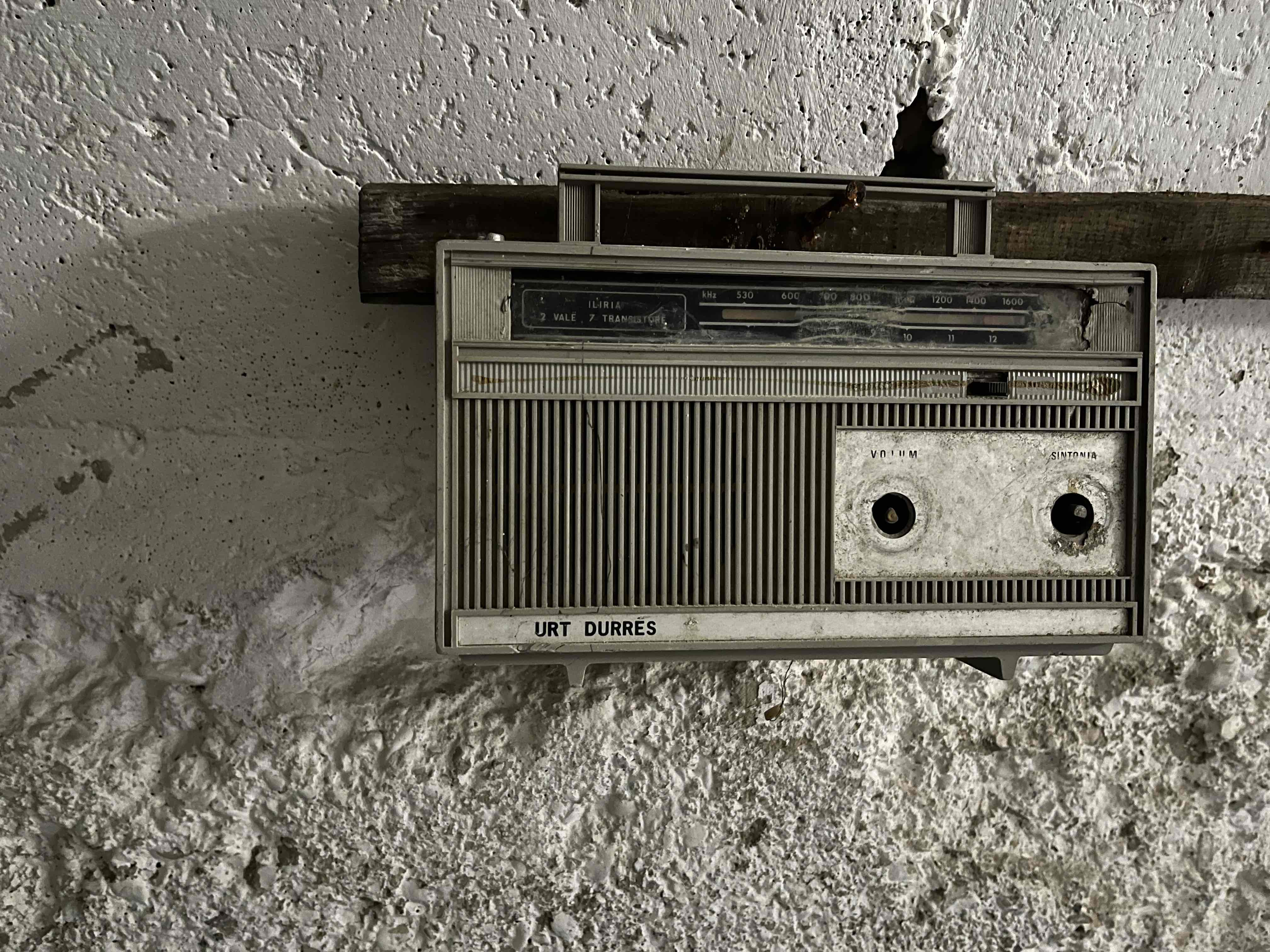
    It may not have spread far from the Balkans or the ancient world but Iso-Polyphony is a powerful art as well as an enduring one. At Te Kubé, it can be experienced in a 48m-long Cold War bunker, burrowing under a mountainside from the belly of a former mosque. The home of this project is now an archive, a cafe, and a shop. For some years became a trapeze school to evade closure by dictator, Enver Hoxha; there are some layers to this cultural history.

    I’ll try to cut to the present. There we were, Little A and I, alone in this subterranean passage, lit green and blue by nightclubesque LEDs. We were surrounded on all sides by walls of rock, uneven both underfoot and overhead. It made me, for one, feel gently intrepid, curious about what to expect from this shaft that was receding deep into the rock. The stone glowed and appeared to ring with the music. We paced the distance in this confined space; and concealed speakers expanded the trajectory with an invisible chorus of voices singing in two unfamiliar languages: Albanian and melodic counterpoint.

    This then was Iso-Polyphony a form of improvised song which assumes dissonant harmonies and evokes grief, longing, and a certain Balkan exoticism. Don’t get me wrong, I certainly don’t expect all music to be as catchy as post-1950s Western pop. I do indeed like a bit of detuned guitar, a bit of experimentation with the drone. Distortion pedals and feedback amps, yes yes. Freeform sax with added skronk, sure. But here was a genre where the instruments were unalloyed voices (plus a piano but not as we know it). Without going electric, this Byzantine polyphony offered a release as cathartic as a crunching rock breakdown with the volume turned up to 11.

    A voice can express all sorts of moods and take on all sorts of tones. The mood of the voices here seemed to me to be pained. The tone was sharp and it cut to the quick. I do not speak Albanian, but this just expands the imaginable range of Iso-Polyphony for an ignorant English speaker like me.

    Do they sing for grief or for broken hearts? Is it a song of defiance from Communist times or was this a twenty-first century Östalgia trip? All that can be said for sure is this: the music was not in any way already in my known cultural landscape and yet it evoked a rich beauty which I had not expected to find in the rural south of this Balkan state.

    Here at the musical form’s institutional stronghold, the Home of Polyphony, the tradition is exploded. Te Kubé houses a contemporary recorded piece for an audio-visual sound installation recorded by a youth group; it is not the preserve of aged and weathered peasants in traditional dress. Composer and multi-instrumentalist Robert Bisha has also used a prepared piano, which, after Fluxus, remains a radical gesture. He titles the work Iso-Polyphony Deconstruction. For anyone with a passing knowledge of literary theory or architecture, it’s all definitely outward looking.

    I think that the deconstruction takes place along the length of the tunnel as the piano, the soloists and the bass note drone singer are pulled apart by the staggered speakers. Deconstruction could also refer to the confusing turn of events in which a Cold War bunker has become a refuge for some intangible world heritage: a gesture which sees Albania opening up to Europe and impressing UNESCO with the importance of this form. To be fair, UNESCO’s official recognition could be an umbrella for the whole of the city we find ourselves in. Gjirocaster, which seems a beautiful place, is a town so closely associated with Iso-Polyphony it is nicknamed the City of Lamentation.

    On the day of our visit, the City of Lamentation was permeated with grey skies and a mid-summer drizzle and a mist which wreathed the surrounding hills and dampened the dark slate rooftops of the traditional and picturesque houses. In the event of a nuclear strike, this comely scene would have been erased. The bunker, built in secret during the 1970s, remains, however, and we booked a 5pm tour of an attraction that, prior to breaking our car journey from Berat to Ksamil, we had not even known about. That’s Trip Advisor for you.

    It was well worth it. Much more extensive than the sound tunnel, this bunker featured such echt period pieces as an original Škoda-built generator, portraits of Lenin in Soviet textbooks, nuclear winter bathroom facilities, and the mayor’s sole landline telephone. This site was once intended for 200 Communist Party members. Had the worst come to the worst then, existence would have become for them one endless round of queuing for tinned food and the toilet. Unthinkable really.

    Shacked up in here with Enver Hoxha – no matter how enlightened, intellectual and cultured this dictator is said to have been – existence would have become a kind of living death. An Albanian CP member would be granted a free pass, therefore, to the Underworld; in the surrounding mountains there would have been few left to sing for their soul.

    I was brought back once more to the nearby sound tunnel, which makes explicit a link between Iso-Polyphony and Greek myth. The other-worldly musical form, which is some 2,500 years old, comes to us replete with a close association to ship-wrecking and sailor-dooming sirens. It is fitting that a nuclear-age Hades should ring out with these voices. I am just thankful for the safe onward passage of our hire car.

    Trip: August 2024. Check out the album At Least Wave Your Handkerchief At Me by Saz’iso for a flavour of this compelling genre.

    Uncategorized

    Not in Nashville

    September 13, 2024

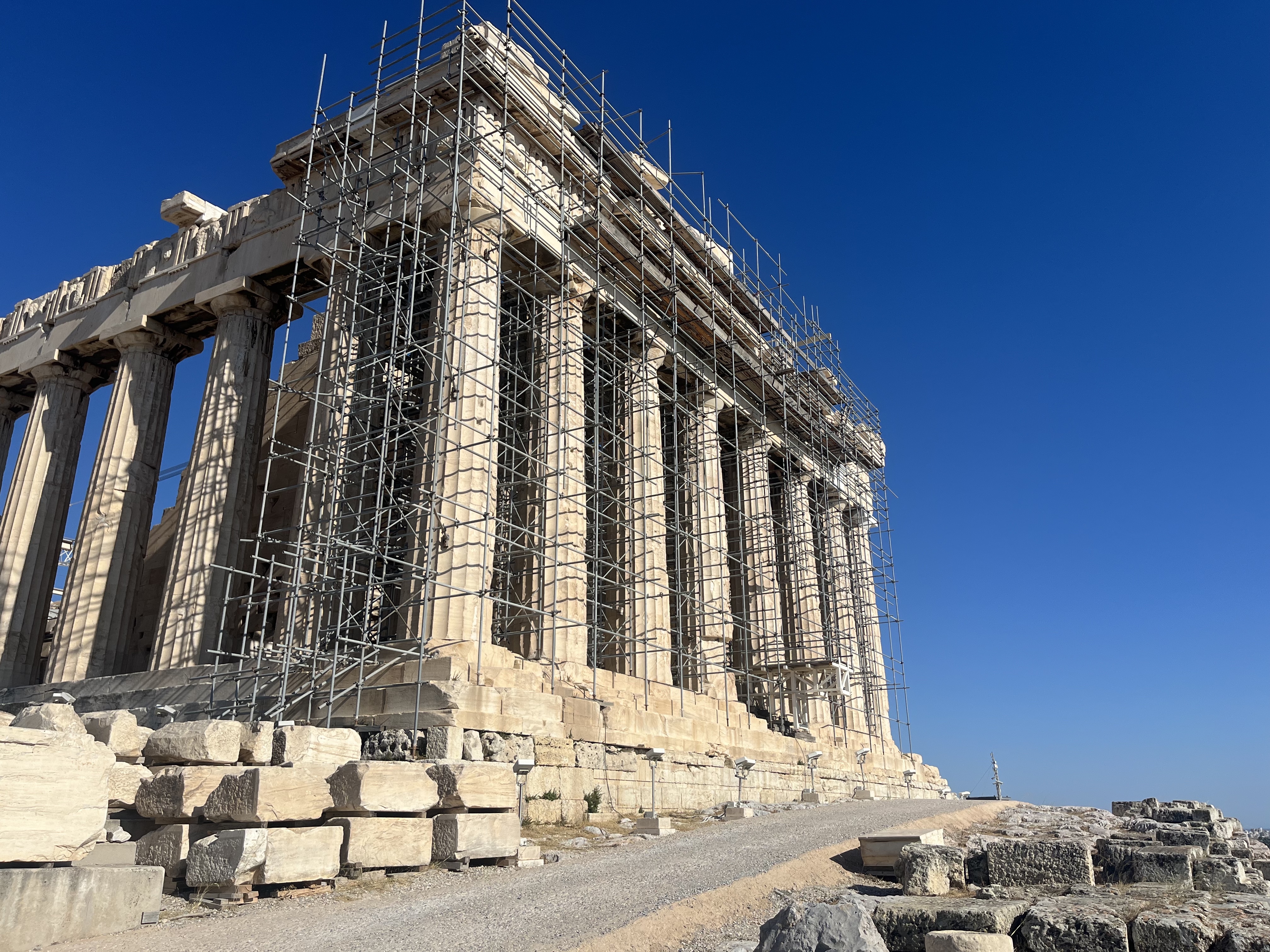
    We visit the original Parthenon, in Athens

    There is scaffolding across the near elevation of the Parthenon and it looks like the most famous monument in Greece has been subsumed by a glitchy photoshop layer. Think of an unhinged graphic designer working on the sleeve of a minimal techno album. In other words, although far too hot for the builders right now, the Acropolis has been enhanced by the patina of restoration work on its centrepiece. Civilisation evolved here; a data driven grid reflects where we’ve got to.

    Both old and new are grand in this place. The vast temple – which appears so frequently in tourist literature on Greece; which graces thousands of illustrations of myth; that you’ll find in scores of architecture source books, plus countless cartoons about philosophy, not to mention a deluge of souvenir fridge magnets – is somehow a fresh sight to me. And, from the audio guide, I learn how: the stone base is convex and the pillars lean into one another and these subliminal engineering tweaks, no matter how subtle, are what give the Parthenon its spring and glaring white energy.

    I overhear an American tourist boast about a copy in Nashville. And although tiny models of the Parthenon occupy snow domes the world over, the world’s less well-known replica is full scale and lives in a park in the Deep South. Some might say it’s better than the original since it houses a recreation of a 42ft statue of the presiding deity, Athena, and casts of the marbles which once adorned the pediment here. Greece has thus far failed to retrieve the marbles from the British Museum and the first statue of Athena is lost. So my provocative vote goes to Nashville and the year of the Tennessee Centennial Exposition, 1897, for best example of this building from the fifth century BC.

    Those marbles really are a sticking point, mind you, and I’m glad that the guidance notes which we came across in Athens do not mince words. The marbles are ‘loot’, Lord Elgin had a piratical ‘crew’, and the transport of 75m of exquisite ancient sculpture to London in 1801 is unambiguous theft, not to mention collusion with the Ottoman government of the day. So if you’ve fallen for the line that the so-called Elgin Marbles are safer in Holborn, please visit the Acropolis Museum. It is truly world class. Since the plunder Greek archaeologists have found more than enough remaining items on the famous hilltop to fill an extensive, imaginative, beautifully curated twenty-first century museum.

    When you enter this venue, you can look down from the forecourt to see a complex of ruins; the ground floor seems cantilevered over a hamlet’s worth of ancient residences You can explore this scene from a crisscross of gantries, shaded by the ground floor of the Museum overhead. Greeks are obviously fantastic custodians. The dig site boasts a museum within a museum, a sequence of glass chambers in which you can browse ancient chattels and ornaments; a panel in the floor, sealed with toughened glass, allows you to gaze down upon existing mosaics and even, here and there, walk across them.

    Somehow the upper floors manage to emphasise the artistic quality of the recovered exhibits; many have been stolen; many have not. The new building could be a contemporary art space. The British Museum, by contrast, still has neo-classical bank vibes and reflects our national fetish for classicism in its presentation of Greek relics. Here in the Acropolis Museum, one better appreciates the aesthetic values of the time as seen on the statues and friezes, with less emphasis on idealised physiques and classical history, more on creative expression, vitality and colour (One hears that the classical world was once awash with colour paint; here you can still see the bright flecks.)

    Our hosts didn’t get everything right at the Acropolis. They were, for example, reluctant to give Prof D credit for a mobility impairment and let her use the disability elevator from the foot of the Attica hill top to a vantage point from where she could get a proper look at the monument we had paid to come and see. Without this facility she would have been unable to climb any of the baking steps never mind reach the summit.

    It was also curious to see a young couple strike a ballroom dance pose together for a photo of the far end of the Parthenon. One of the guards told them off quite ‘strictly’. Those guards may think they are guarding civilisation, dignity, and civic pride. But this is also the land of Dionysus, Eros, Pan, many, many satyrs, and the philosopher Diogenes who was to openly masturbate in the Agora just to make a point. Much worse behaviour than recreating Strictly Come Athens. Anyhow the scene gave me a chuckle, not least because the male dance partner was already looking a bit embarrassed long before the guard blew her whistle and a hundred tourists turned to look their way.

    So there we were. Scaffolding at one end to provide structural maintenance and valuable protection. Gesture policing at the other end to provide compliance with brand guidelines. And a world class repository for the many priceless artefacts which were created to stock this iconic archaeological site. No photos in the museum either. The entirety really was well looked after.

    By way of an epilogue, we visited Athens at the peak of the 2024 Greek wildfires. Aided by strong winds, the fires were eating up the surrounding forests at speeds of up to 15kmh. The evening we stepped off the plane, the air smelled like a barbecue. We then sat in the Airbnb watching BBC World and contemplating the potential prospect of evacuation given that suburbs were already burning. The next day, unpeturbed, we passed our time in a tourist bubble. The acropolis, which is after all a stone mountain and the highest point in Athens was probably also the safest location. But from up there, by the evening on day two, there was no sign of fire. And day by day the risk dissipated.

    Thank the gods (and the EU Civil Protection Mechanism which triggered the arrival of firefighters and equipment from eight European countries) for saving the Greek capital on this occasion.

    Uncategorized

    A double dunk in London

    July 30, 2024

    Taking the plunge in immersive shows at both The Barbican and Tate Modern

    On the 23rd July I visited two shows in London which promised an immersive gallery experience. In their evocation of early years and final moments, neither disappointed.

    UNLIMITED SCREENTIME

    In William Golding’s 1954 novel Lord of the Flies, an island of marooned British schoolboys soon descends into chaos. In Ricochets, Francis Alÿs’s 2024 show at the Barbican, children at play in an array of global locations may be seen to embody the best of human nature not the worst.

    Ricochets takes as its theme children’s games, rather than immature attempts at self-governance. At play, whether in Switzerland or in Afghanistan, children express joy, imagination, fair play and innocence. One should add to the list ‘vulnerability’ at times of conflict, but I will return to that.

    Some of the games were new to me. Most were merely in new locations. It’s been a while, but of course I too have eagerly played tag, hop scotch, and conkers. I have improvised a go-kart, had a snowball fight and raced along with a stick and a hoop. Hard to believe I know.

    But I have not danced barefoot on a dusty roadside. I have not played laser tag with a shard of broken mirror. I have not taken part in an elaborate game of mime football, at risk of getting shot. My chances of reaching adulthood physically unharmed were always very good compared with the subjects of some of the films collected here.

    So I was surprised and yet not surprised to find that laughter and exuberant high pitched shouts can ring out from some of the worst trouble spots on Earth. The faces of our western kids do not have a monopoly on smiles. In the sometime absence of healthcare, education, and even food, children worldwide still have access to free time and creativity.

    Alÿs has bedecked the Barbican’s gallery with some two or three dozen screens. It is ironic that many of the younger visitors to this show, of which there were many at the time of my visit, will get all the screen time they want for an hour or two, while their parents sanction the exposure as artistic nourishment.

    It may be that the smartphone has supplanted the possession of any compendium of children’s games. I had a book once, with 101 activities to try with my younger brother, and I thought of games like ‘rock, paper, scissors’ or marbles as throwbacks to the time of Victorian Britain. But I couldn’t be more wrong.

    Marbles dates back to prehistoric times for example. Rock, paper, scissors is embraced by our contemporaries in many corners of the world. Interpretation on site makes the point that while civilisations rise and fall, the games children play endure, perhaps thanks to their very marginality.

    The Barbican has pressed the immersive button here to market a show which on paper sounds – I’ll be honest – quite boring.

    Actually it’s hugely rich. Not just because, as one circumnavigates the third-floor space, the films accumulate to imbue the low-lit space into a pulsating essence of play, a hub for all these games worldwide.

    Alÿs augments this 360-degree, darkened cinematic spectacle with small jewel-like paintings on backlit canvas which immortalise various dusty roads the artist has come across in his many investigative travels,. Tiny figures and cherished ludic props are an utter charm.

    These travels, to places as remote as Mosul or Juarez, might seem fraught with risk were it not for the blithe and cheerful ubiquitous presence of the most vulnerable in society. In Ukraine, the kids dress in battle fatigues and flag down passing cars in search of Russians. It must be awful to experience territorial invasion; it must be irresistible to feel as if the whole thing is a quite serious game.

    It was interesting that not one of the films had been made in Gaza. Alÿs has previously made work about the Israeli occupation of Palestine and one imagines that the planning for this show was too well advanced by this time last year to have responded to events subsequent to October7th 2023.

    Or perhaps there was time. Time, but no appetite? How could the artist have presented the lighter side of a conflict filled with so many images and reports of countless children who have had limbs amputated without anaesthetic, been wounded and orphaned, had severe burns across the whole body or been targeted by IDF snipers; shot expertly in the head.

    The harmlessness of children’s games is a major takeout of this exhibition, as are the risks which players take. The boys playing soccer without a ball on a street in Mosul are, unbelievably, risking death at the hands of the Islamic State. They are scattered by a gunshot at the end of their game.

    While the films in ‘Ricochets’ are for the most part joyful, two more elements underpin them with mystical seriousness. I have already mentioned the elegiac paintings, there are also modestly sized animations which build on their mystery and emerge from the darkness of the mezzanine level.

    By this point I was well ahead in a game that most art loving grown ups will recognise. That of pacing oneself around a gallery, studying whatever documentation one finds, and doing what it takes to release the dopamine which an art fix can provide.

    THE DYING OF THE LIGHT

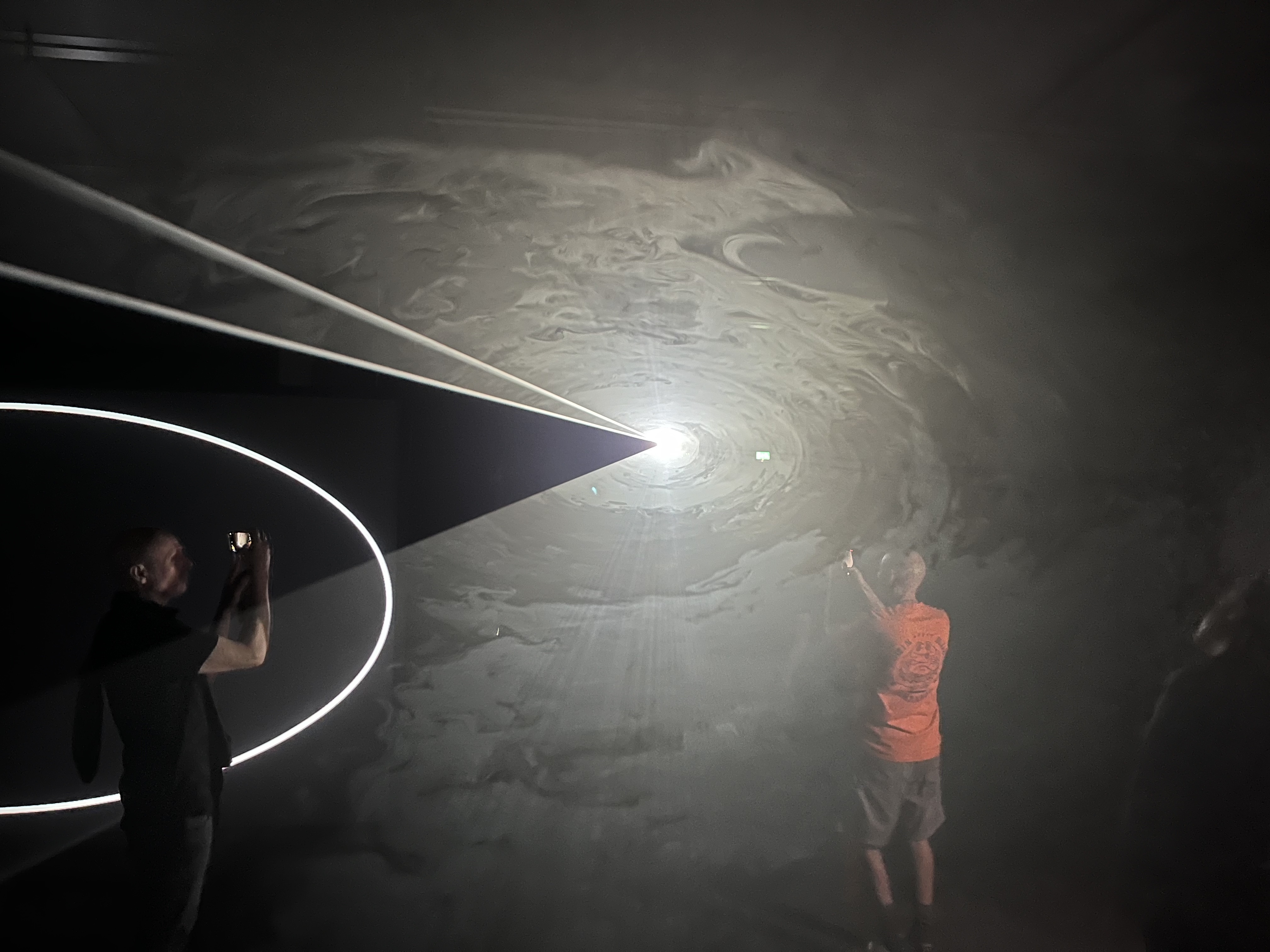
    Being akin to a near death experience, Solid Light had me craving a lit cigarette; and as a reconstruction of an artwork first shown in the 1970s New York loft scene, it had me craving to be a full chain smoker, surrounded by nicotine addicts. There we all would be, staring up and down these funnels of light and contemplating the meaning of the all-powerful pinpoints of light.

    I don’t know how else to interpret these works at Tate Modern, other than metaphors for the soul’s passage. And I don’t know anyone who wouldn’t agree that, as a spiritual journey, death would be more likely to come to me or you wreathed in tobacco smoke, rather than the artificial mist used to recreate the atmosphere of a downtown art studio. It was a sanitised mist which we are assured by the gallery notes is nontoxic.

    But I still can’t deny the power of these installations. Expanding light envelopes the viewer in a sharply defined cone. The don’t-worry-it’s-safe air pollution swirls like a sci-fi film special effect. Cloudy little puffs stream around the illuminated space and billow around in waves that seem all but sentient. This close to an imagined death there is an unveiling of previously invisible energies.

    This is a bijou exhibition which Tate may hope reaches the heights of popularity achieved by their best-known recent excursion into immersive art. I am talking about Yayoi Kusama’s Infinity Mirror Rooms which, for the longest time, was the delight of families, selfie takers and people who like to be transported by art. Antony McCall Smith’s own ‘response’ is not only a mirror for what we think of when we think of death. Unlike the Kusama, it is also an adventure in finitude.

    In the darkness of this modest space on the fourth floor of the Blavtatnik Building, there are really only two ways out. One is through the pinprick of light, the eye of a needle, and out into a blinding vision of the Pearly Gates, to mix metaphors and impose a culturally Christian reading. The other is by following a lit green Exit sign: another concession to our latter day culture of health and safety.

    But for all that, I salute the young couple who, canoodling on the gallery floor, were sharing their vision of the end of the line. They seemed caught in this imperious beam, enveloped by a happy memory which flew in the face of material realities. The prime mover in this show is a projector which, once the smoke clears, will be found to offer nothing more than a bright white full stop.

    ‘Ricochets’ is at Barbican until 1 September 2024. ‘Solid Light’ is at Tate Modern until 27 April 2025.

    Uncategorized

    By Jove, it's a replica!

    July 30, 2024

    An encounter with the Emperor Constantine in Rome

    Last month, Prof D and I visited Rome. Despite the obstacles presented by baking sun and frequent stops for street food, I was on a mission to see a piece of living history at the Museum of the Capitoline.

    A bus coughed us up before the Altare della Patria. It was completed in 1935. You might imagine it to be one more local element of the ancient world. But the steps, as wide as the bleachers of a stadium, and the portico, which fronts a temple to the fatherland rather than to a mythic god, is a monument to a nineteenth century king, Victor Emmanuel II, who unified Italy in 1861. An image of both empire and kingdom served Italy badly, and Mussolini well. The fascist dictator held his rallies here in the 20s and 30s.

    Glossing over that far right set dressing for a moment, we found an adjacent set of steps to the Musei Capitoline. We were braced to pay €30 each to get in, but after a quick exchange with a staff member I discovered that the main object of my interest could be viewed, free of charge, in a garden behind the museum.

    This well paved green space, an adjunct to the Villa Cafferelli, occupies the site of a former place of worship: the Temple of Jupiter Optimus Maximus. But I was not here to bask in the presence of Jupiter even if our sightseeing focus was no more ‘real’ than this piece of divine representation.

    As we approached an archway in the tall garden wall, we could see the household deity. But it was no supernatural entity, rather a third century emperor of Rome. He was not disguised as a bull or a swan, but took the form of a 42-foot replica statue.

    This was an ‘off the scale’ representation of the Emperor Constantine, whose notable achievements included the official recognition of Christianity and the relocation of his vast empire’s HQ to the city which for so many years bore his name, Constantinople. Given the forthcoming reach and influence of the Roman Catholic Church, Jupiter must still be spinning on his cloud at this turn of events.

    This imposing statue has had various iterations. In its first form, in around about the fifth century BC, when it first emerges from the annals, it was the God of the heavens, rather than the ruler of ancient Rome, who wore the crown here.

    In 69BC the statue got its first remake. Still dedicated to the lofty boss of the ancient world, it now took the seated form we see today: bare torso and, waist down, a cloak.

    In 80 AD, after a fire, the drapery was to inspire a hybridized successor fashioned in marble and, perhaps, bronze. As an art historian I need to describe this mixed media sculptures as an acrolith. And given that present idol is comprised of polystyrene resin, plaster powder, bronze powder, and stucco, the Colossus of Constantine remains very much a composite.

    Between 80 AD and 2024, there is an interim detail of note. Between 217 and 222 AD our rendering of the God of Thunder was struck by lightning. At which point the Romans felt okay to abandon their presiding deities and ascribe all of that power and pomp to their current leader Constantine, though perhaps that changing of the guard was a bit more ‘top down’.

    By the twenty-first century, not much was left of this repurposed monument. A head, a foot, fragmentary museum holdings rather than expressions of imperial power. But time, museum time, is surely nonlinear and on the day we visited in 2024, the glory of Rome had cycled round and restored one of its most visible outward forms, in the representation of one of its most illustrious emperors.

    Tall as he is, Constantine is all the more imperial for the fact that he is seated. We enter his presence as petitioners on foot, stepping into a cool walled garden which can barely contain him. Despite lightweight materials, and the educated technical guesswork which has led to his full three-dimensional reconstruction, this man has presence.

    Who would have thought that a fairly academic exercise, involving the study of two-dimensional photographs, literary and epigraphic sources, and the comparisons with other seated statues from the era, could yield such awesome, immediate results?

    His fierce gaze is upturned to the left, as if in recollection of something once seen by that pair of monstrous carved eyeballs. His unsmiling mouth is set with calm authority; a squared off masculinity extends from his jaw to the definition of his torso. (It is literally and metaphorically chiselled.) The haircut, it has to be said, is a bit Mark Zuckerberg, who was reportedly inspired, style-wise at least, by the fringes of the Caesars of yore.

    His props are are those of a profane ruler aspiring to the sacred. His right arm is lightly crooked around the head of a sceptre. His left arm comes towards us with an orb in his upturned palm. Both these accoutrements offer a regal mien, which appears to modern eyes in contrast to the loose and quite relaxed cloak which protects Constantine’s modesty. The plinth supporting his seat, is out of sight. A full sculptural throne, although the emperor’s appearance hints at it, would surely have been de trop!

    The original sculpture was in Parian marble and, it is thought, gilded bronze. In the reconstruction, cloak, sceptre and orb all take on a similar glitter, which gives the work a mixed media look which is surprisingly contemporary.

    For me there is a point of comparison between the Colossus of Constantine and Gazing Ball (Farnese Hercules), a 2013 work by art star Jeff Koons. The Gazing Ball series was to bring together plaster sculptures or a range of figures (by no means all classical) with electric blue, glass spheres all of which are the size of a football.

    Hercules, while nude, wears the armature of rippling muscle. Less than a quarter of the height of Constantine, he still stands more than 10ft. And while the plasterwork is chalky and as glaringly white as any monument in Rome, his titular orb is reflective offering a portrait in a convex mirror to gallery visitors who may encounter this, or any of these works from the 2010s.

    I’d wager that Koons himself, if he was to see this reproduction, might give up on emulating classicism. It is simply too epic, too full of historic meaning and even in his status as replica, Constantine reigns from the great beyond. Yes, he is artificial, but his third century representation as a serene, all-powerful 42 ft seated god was hardly anchored in reality in the first place. The emperor’s latest incarnation is still filled with the spirit of ancient Rome, a spirit which cannot be said to have ever left us.

    The ‘Colosso di Costantino’ is free to view at Villa Caffarelli until the end of 2025.

    Uncategorized

    In India, in the rockface, in triplicate

    July 3, 2024

    Goiing underground in Maharashtra

    I took a boat from India Gate to Elephanta Island, exchanging the dense throng of cars and bikes for a vast company of lively ferry passengers sweating in the Chirstmas-time sun. Our boat left the mainland and we chugged along for a full hour before reaching a quay on Mumbai’s neighbouring rock, where a young guide attached himself to me with a persistent level of ingratiating chat about cricket. I knew nothing about cricket, but he was not perturbed. He was as persistent as various hawkers who lined the steps from ferry dock to a fifth century rock-cut cave complex, which gave its name to the island.

    The portico for this warren appeared sunk into a green hillside. The seven columns were as squat as legs from two giant pachyderms. They shared a dusty yellow hue with the rocky hillock behind them. These legs were the first glimpse of an achievement by the workers who more than 1500 years ago, in their hundreds surely, chiseled a deep, cavernous structure out of solid rock. The dark spaces hinted at what might lie inside.

    I was left very little time to speculate as my guide marched me through the nearest recess and toured me around the depths of the 39m long cave, stopping only briefly to take in a towering statue of Shiva which showed the goddess in all her forms as the Creator, the Preserver and the Destroyer; each of Shiva’s faces had two names and, oh, here were seven more gods whose names stretched to a total of 43 syllables.

    It was 2018 and I was in the earlier stages of a PhD about the representation of prehistoric caves. And, like the good academic she is, Prof D took this venture very seriously and arranged for me to see two more such caves in Maharashtra. Much like the Elephanta cave complex, the state’s two-part attraction, Ellora and Ajanta caves, do not date back to before any known civilisation. In this way, they differ from the prehistoric painted caves of France and Spain. Yet all three UNESCO sites are still staggering, and staggeringly ancient: at once crowded, and yet well off the beaten track, for me at least, when compared with the Dordogne.

    Visits to these Indian caves are not regulated in the same way as their palaeolithic counterparts in Europe. Tourists are free to roam, and, at Ellora, Prof D and I were to thread our way around what must be one of the world’s largest, and perhaps only, immersive sculptures made out of basalt. To be in the largest space, Kailash Temple, felt like being at the bottom of a quarry, surrounded by a phalanx of stone elephants. Beyond these, the cast of sombre gods, whose figures we passed below and between, looked on in sublime indifference to our wonder.

    In my mind’s eye, Ellora is two realms. In the open air it is baking and parched, a scrub with paths worn around the complex between the opening to cave after cave. These number more than 100, which gives the site an epic scale not totally unlike a theme park or a zoo. The carvings pertain to three major Indian religions, Jainism and Buddhism as well as Hinduism. If you time it right, you can ride a minibus to the further reaches. Beyond this setting of dry trees, dust and rock, are the dark, cool hollowed out spaces in which the casual tourist can never know what to expect.

    But then again, how might a casual tourist even reach a tourist sight like this. The next day our casual status was tested by a three-hour, axle-punishing drive to Ajanta. Dating to the second century BCE, this complex is older than Ellora and Elephanta. It is solely Buddhist. At one time, the 30 grottoes there comprised a highly decorated monastery. And yet by casual accident, a nineteenth century Britisher ‘discovered’ the cave: a cavalry officer with the forgettable name John Smith.

    Although the site was well known to locals, in 1819, J.S. stumbled across Ajanta in the course of a tiger hunt and proceeded to carve his boring name, in full, across the painting of a serene bodhisattva, who, like the local tigers, had never done him any harm. ‘He’s a total asshole!’, you might be thinking, and you might have a point. But, by this simple act of vandalism, he seems to prove that imperialism has a philosophy and practice as developed and rewarding to its adherents as the teachings of Buddha.

    Ajanta is a string of monastic cells, forming an ambulatory sequence along an uneven path around a cliff face. It has more subtle charms than the gigantically carved caves we had seen so far. It has paintings and engravings pertaining to sutras, godheads, and divine plans. One inspects the ruins of these images in the glow cast by low level lighting, or the torch on a phone. The parietal works at Ajanta repay the time spent in queues and, even given the crowds, can still evoke the Buddhist calm, and thus retain some of their holy purpose.

    I’m afraid Prof D and I find ourselves on a path of devout agnosticism. Whether in India or in Europe we embrace the chance to enter temples, churches and shrines. At Ajanta we embraced three dozen such spaces. Visitors are free to work their way along one side of a valley surrounding the River Waghur and to hunt in the semi-darkness for icons and expressions of longstanding faith.

    We may be among the last to do so. Construction is underway on a suite of replica caves, attached to the visitor centre here at Ajanta. If you’re at all able to visit for yourself, you have two options: 1) be quick before they find the necessary funds to replicate the experience and close a number of caves to the public, or 2) enjoy the replica, as I was able to do at Lascaux, and receive a vivid picture of the works which, ironically, will offer you the best possible view.

    Via replica, you may reach Satori, and you will see Ajanta in a way that a buddhist in the second century BCE could only dream of! Indeed it joins the global ranks of heritage sites which have doubled and, even, via second-hand reports like this, tripled.

    Trip was in December 2018. Image is from Ajanta Caves.

    Uncategorized

    “I’m not sure yet.”

    June 12, 2024


    This is an artwork I heard about, and in truth there was nothing to see. Jon Carritt and Dan Palmer, two artists who share work space had erased themselves from an Open Studio weekend at Phoenix Art Space, Brighton. They had plastered over their studio door.

    A few indications remained that there was once a work space here: a smoke alarm above the soon-dry plaster facade, names and a numbered indication on the weekend floorpan, or a recent memory which a visitor might have had that surely… there was a door here!?

    I’ll quickly gloss over the pop cultural suggestions which hidden realms evoke. From The Secret Garden to Harry Potter, via Narnia and Doctor Who, any suggestion that an entrance is hidden is sure to set the imagination racing.

    However, Carritt and Palmer are conceptual artists and having visited their studio I can report it is  very minimal, with a few books, a dusty speaker, and a couple of tidy desks. If an art-loving Harry Potter fan had had the means (magical or otherwise) to break through this wall during Open Studios, they would have been sorely disappointed.

    Phoenix studios on Grand Parade were replete with c.120 additional artists who were more or less happy to exhibit some of their output and welcome you to their domains. It was all part of a busy time in Brighton, in that merriest of monks: May.

    This time of year ushers in our annual Open House season. Some 180 domestic venues across these environs offer you the chance to inspect other people’s kitchens, gardens and artwork. All this, as England’s biggest arts festival and its growing Fringe casts a jubilant shadow across town.

    Carritt and Palmer had inevitably delivered a modest affirmation of the untrammelled spirit of play and creativity that can take over during a festival or a biennial. But it was also a negation of some aspects of this energetic celebration. 

    Brighton Open House Festival is, after all, a professionally organised event which allows 100s of local artists to monetise their practice, if only for a month now (and three weekends at Christmas).

    With a light touch and a hard edge, Carritt and Palmer build on their contributions from previous years: a plinth to block the entrance, video footage their studio on the locked door, a waiting ticket dispenser, a bouquet of flowers – with apologetic note. This year their studio was ‘colonised’ by Phoenix neighbour, painter Mike Stoakes. 

    I asked Carritt for a bit of explanation of all this, specifically I wanted to know whether last year’s building work had a title. He said: “If we considered it today as an artwork, we might refer to it as ‘disappearing studio’, or ‘plastered-over studio door’, but I’m not sure yet.”

    That doubt, in a civic context where art and culture are promoted so aggressively, and blindly at times, is doubtless important. I wish I’d seen the artwork, if that it be, and I’m also glad, in a sense, that I didn’t.

    Uncategorized

    Book review: Maylis de Kerangal, Painting Time, 2021

    June 4, 2024

    Listing shades of pigment is as writerly as mixing shades of pigment is painterly. Maylis de Kerangal appears to have a handle on both disciplines as she builds the tale of Paula Karst, across a number of well-set scenes in the theatrical world of tromp l’oeil art. 

    We first meet the protagonist in Paris. We soon flash back first to art school in Brussels, and then to the studio lots of golden age Italian cinema. Then onwards to Montignac in the Dordogne, where Paula is put to work on the latest €57m replica of the prehistoric cave of Lascaux.

    Painting Time is atmosphere driven rather than plot or even character driven. Therefore it is no spoiler to say that in Montignac she closes in on the essence of at least two aspects of art: the creation and the copy. The Lascaux section (which occupies the final 50 or so pages of this slim novel) is meditative, a discussion about the meaning of parietal works, which dispenses with the usual theories about the role of the paintings in this famous grotto in favour of a mysterious question mark. which preserves them in all their part faded glory.

    But while the prose turns as purple as, well, the small patch of mauve colour which, in a world of black and ochre, is unique to Lascaux, de Kerangal grounds her flights of description with deeply researched narrative around the history of the cave from rediscovery to replica. Everything known about Lascaux is here, from the teenagers who first explored the Hall of the Bulls, to the arrival of tourists, press and dignitaries. Various personages appear on the roll call, from the photographer from LIFE, Ralph Morse, to the priest who makes the first tracings, Abbé Glory.

    De Kerengal shades fact into fiction as she imagines herself into the studio where Paula and her fellow copyists paint the cave’s famous bestiary without having seen the original. While the Lascaux hillside is visible from the window of her room, when she cycles up to the entrance, we find that not even the door is visible. De Kreangal does well to novelise the dry historical details surrounding attempts to conserve Lascaux, even making space to include Lascaux II and Lascaux III. “Little by little,” she writes, “The cave is no longer the object of copying, but has become the laboratory of the art of replicas”.

    Although Paula has friendships and relationships, such connections lead back to the art of tromp l’oeil. Foremost are two friends from her school in Brussels, Kate and Jonas: he becomes a fine artist; she gives up on her dream. In Rome, Paula has a lover, whose romantic track record has earned him the on-set nickname, The Charlatan. She befriends a make-up artist. Her team at Lascaux IV are like a family, thereby drawing her even closer into the heart of artistic creation.

    This is the fertile core of the book and the imagery pours forth from de Kerangal’s pages. She seeds the flint and the fire of prehistoric humankind very early on in this story. `She dwells on the renaissance. And one finds many more walks of artistic life within these pages. I’d recommend it to any painters or to any prehistorians, or indeed to anyone who has ever been transported by art.

    On a personal note, I was very taken with this 2021 novel since I’ve recently completed a PhD on representations of the French cave in question. As the book drew to a close, I felt I knew some of the writing on the metaphorical wall, as de Kerangal evoked detail after detail which suggested to me overlaps between our research. It was, yes, a bit like lighting a torch and seeing powerful forms, at once familiar and strange. An amazing reading experience, and I’d love to hear from anyone who reads this book or has already done so.

    Posted with thanks and great respect to Memo and Ana, who discovered this book and so kindly sent me a copy!

    drawing

    Emma Stibbon: Melting Ice | Rising Tides

    May 29, 2024
    Emma Stibbon, Sea II (2012) (detail)

    Her ink froze. Emma Stibbon was on the deck of the Antigua, a barquentine sailing boat forging a course into the arctic waters above Svalbad, Norway. The waters were rough as well as cold, and the artist was alleviating sea sickness by staying out on deck and drawing. Some works from this endeavour contain tiny spines of colour where the ice flakes have shaped the marks she was making in her sketchbook.

    Melting Ice | Rising Tides is a show resulting from a) field trips to both arctic regions and b) time spent looking at the coast of East Sussex. It is hard to imagine a more coherent yet far reaching exhibition. It has purpose: to bring home the effects of global warming. And equal weight is given to the plight of Greenland, say, and the erosion of the Seven Sisters, not far from the gallery. And it has consistency: water colour and ink washes build to create a prevailing mood of monochrome coolness, where blue, green and lilac tints add nuance to the overall picture.

    These drawings are better seen than photographed. They are beautiful: how sublime are the pale bergs upon the dark sees! How complex and enthralling is the foam atop a wave! In each of these drawings one feels the dramatic attempt of hand and eye to encompass extremes of nature and express the magnitude of the climate emergency. There are no human figures anywhere, yet our carbon footprint is everywhere in these stark and treacherous vistas.

    Along with acrylic, watercolour and ink, there are plenty of innovative materials. Stibbon uses cliff chalk and sea salt in her preparations in a gesture that blends her works with their subject. On the crest of waves, there is delicate tracery left by evaporated water; she uses seawater in some of the works. Elsewhere aluminium powder gives her ice floes additional texture and grit. The labels in this exhibition repay cross referencing with the works. This must be the poetry of fact.

    Such poetry, hardly to be expected from what is ostensibly a vast observational drawing exercise, is everywhere: breaking waves captured with impossible detail and care are mesmerising; coast guard cottages on clifftops which will eventually collapse are overwhelmingly lonely; the discovery of a local landmark in Seaford called Hope Gap results in a vertiginous study of a set of steps plunging down into a roiling sea. 

    At the heart of the show is a full scale recreation of a cliff fall, complete with chalk boulders, rocks and rubble, plus and an eight metre wide drawing of a Sussex cliff. In any other context this site specific monument would be the show stopper. Indeed, it is perfect the way that Stibbon has brought the local downland shoreline, so often celebrated here at Towner, into the white cube environment. The immensity of her subject and her theme both perhaps call for it.

    But scaled right down to a modestly-sized blackened intaglio print, Stibbon is at her intense best: capturing a chaotic wave-scape which is of course completely ephemeral. Sea II (2012) is just one example of the artist’s ability to pause time. If only our species could do the same, these impending disasters may not all come to pass.

    Emma Stibbon: Melting Ice | Rising Tides can be seen at Towner, Eastbourne, until 15 September 2024.

    contemporary painting, Uncategorized

    Andrew Sim, two rainbows and a forest of plants and trees (2024)

    May 28, 2024

    Urban nature is my favourite kind. Parks where ice cream is sold. Botanical gardens serving good coffee. Flower shows curated like art festivals. Tree lined streets leading to civic amenities. And, of course, residential gardens which allow metropolitan types to contemplate collections of plants, ready and to hand, like the contents of bookshelf. Nobody ever got eaten by a bear in a city’s green space.

    I don’t know what Andrew Sim thinks of wild nature. They (not he/him) were born in Scotland, so they may have had a chance to see much of the UK’s wildest nature. But now they reside in New York and the trees that most attract their painterly attention are those in NYC gardens. They have said they will spot them on their way from A to B and now they appear to exercise a hold, as strong as any romantic sublime, over their imagination.

    Consider the monkey puzzle tree, as Sim has done here. It is a fun tree. One follows the branches, as if through a maze. Our thoughts climb up and down the spiralling form and it is inevitable to visualise a cheeky lil’ monkey doing likewise. It is spiky as well, which is also cool, in a mildly punk rock way. And as for its puzzling nature? Well, if only every one of our societal problems could present such a low stakes dilemma as this: how a simian might get up and down a pine tree!

    On canvas, the tree was all shades of khaki and lime, made bright greener by a black background. Unlike certain flowers which don’t bloom at night, this tree is coming alive before our very eyes. We can almost see it grow, by getting closer to observe the pulsing daubs of pastel which spread out along the branches and seem to move up the trunk in waves. The growth of a tree, one of the most ‘natural’ phenomena, looks here uncanny as if stage lit. The bulb of a streetlamp or security light is just out of view.

    In this way nature is rendered theatrical and enchanted even if isolated to a single specimen of a plant most usually viewed by a roadside. This might make perfect sense in a city gallery, where the visitors also have patios and giant planters. But when I saw Sim’s painting it was ten miles outside of Edinburgh where mountainous ridges, picked out in sunlight, provided the backdrop. 

    The immediate context was a West Lothian sculpture park really full of trees; these are no doubt just as carefully husbanded as a garden pine might be, but their vibe was much more pastoral.

    This beautiful setting was Jupiter Artland sculpture park. It offers Sim the run of its nineteenth century ballroom as an indoor venue for their paintings. Hence here was nature, translated into art, surrounded by musical history, embedded in horticultural surrounds, and connected on all sides by the art system, be that UK museums, or international collectors, or even gratuitous blogs. It was very complicated, this context, even if the painting in question is quite a simple idea.

    Andrew Sim’s exhibition can be seen at Jupiter Artland, as part of Edinburgh Art Festival, until 29 September 2024.

    landscape photography, Uncategorized

    Tyler Green, Carleton Watkins: Making the West American (2018)

    May 22, 2024

    Carleton Watkins made photographs that secured business deals for industrialists. He made photographs that offered conclusive scientific proof to geologists. He made photographs that were both commodities and souvenirs. And he even made photographs in order to give evidence in corporate law. Dominated thus by clients, Watkins is presented, in Tyler Green’s 2018 biography, squarely, as an artist.

    HIs art inheres in technical innovation and an eye for composition. The photographer built his own ‘mammoth plate’ camera (almost as large as it sounds). He found vantage points in the wilderness that were to convey both scale and steepness, just some of the elusive qualities of ‘being there’. I concur in Green’s characterisation of his subject as artist, despite those commercial and scientific interests. A mere cameraperson could not have changed the course of US history, in ways both cultural and political. He was both instrumental and inspirational to expansion into the West.

    The fascinating central aspect of this book is the way in which ideas about this region were more or less invented by this pragmatic artist, at the time working hand in glove with some of the nation’s wealthiest business tycoons. Yet somehow, whatever brief he was working to, Watkins managed to create artefacts of great, and quite unnecessary, aesthetic appeal.

    Of course, there is no reason why rich folk and politicians should not appreciate some beauty in their everyday working lives. But in nineteenth century San Francisco, so many of these types were exploiting the pictured environment in the course of railroad, water, and mining ventures. Accordingly, Watkins’ art seems frequently like window dressing for the big league. But his vision is ultimately stronger than that of the various capitalists with whom he collaborates.

    Through the lens of this pioneer, the West appears a land of awesome natural power. If presented as untouched, it appears primordial. Where populated, sparsely, it is an Eden. In Watkins’ lifetime and through Watkins’ influence, tourism became a real phenomena in this part of the world. And would-be photographers were to demonstrate by their various failures, just how grandiose were Watkins’ achievements.

    He did sell from a gallery. In fact he had two consecutive spaces in San Francisco. He lost stock and records to the 1906 earthquake which must have made Green’s job of assembling the pieces of a life extremely difficult. However the author was spurred on by an eerie connection. It emerges in the course of his research, in a conversation with his father, that Watkins’ major patron, William H. Lawrence, was Green’s great-great-grandfather and one of a number of entertaining characters who appear in the milieu of the western frontier at this time.

    Readers will at this point recognise that this tenacious and admiring book is spurred by something greater than opportunistic interest. Carleton Watkins: Making the West American is born of a clear passion for a good story; Watkins’ works, while so often instrumental, were passionately adherent to the need for a good picture.

    Carleton Watkins: Making the West American is published by California University Press and can be purchased from Blackwells or elsewhere.