<h1>Archives</h1>
    contemporary art, Uncategorized

    Interview: Paul Watson

    May 16, 2024
    Bacchanalia Beneath the Wind Turbines, Paul Watson, 2019

    An artist and I stand on the summit of Whitehawk Hill, atop the hidden remains of a neolithic encampment. He is dressed in black, and smokes actual cigarettes, as I might have expected. Beyond that I’ve little idea how this meeting, with one of Folklore Twitter’s dark luminaries is about to play out.

    The setting, a prehistoric site we both chose, is disappointingly nondescript. I had hoped it will channel some chthonic energy into the piece you are about to read. But for the time being, myself, and this leading online goth and Brighton-based artist, contemplate a mobile phone mast. He seems to love it!

    “I don’t believe in magic” he tells me later in the East Brighton cafe to which we repair. But, dimly, I had thought of Paul Watson as a serious occultist, with a suitably esoteric vision. His last published body of work comprises of shadowy charcoal figure drawings of gloomy naked models. These subjects looks so close to the relic-littered soil of old Albion. His drawings reference myth, pagan spirits, and a spirit of utter dejection which is very 2024. (Watson has an abiding interest in the English civil war).

    To further characterise his drawing, I would say that his figures are very inward. In charcoal, their bodies are pale or grimy, never warm or especially inviting. Whereas classical life drawing conveys a sense of anatomical fidelity, Watson seems to dispense with flesh in favour of bone. His men are stony or grave rather than vigorous; his women perhaps dented rather than curvaceous.

    Their environment can change; it is a background of midnight black in that series, a featureless sepia desert in the latest. Sanguine pencils, rather than charcoal, give his figures renaissance pedigree, quite at odds with the mood of fin de siècle Viennese expressionism. His photography, in which he shifts gears again, is stark and notable for the models’ otherworldly masks; and Watson makes these himself.

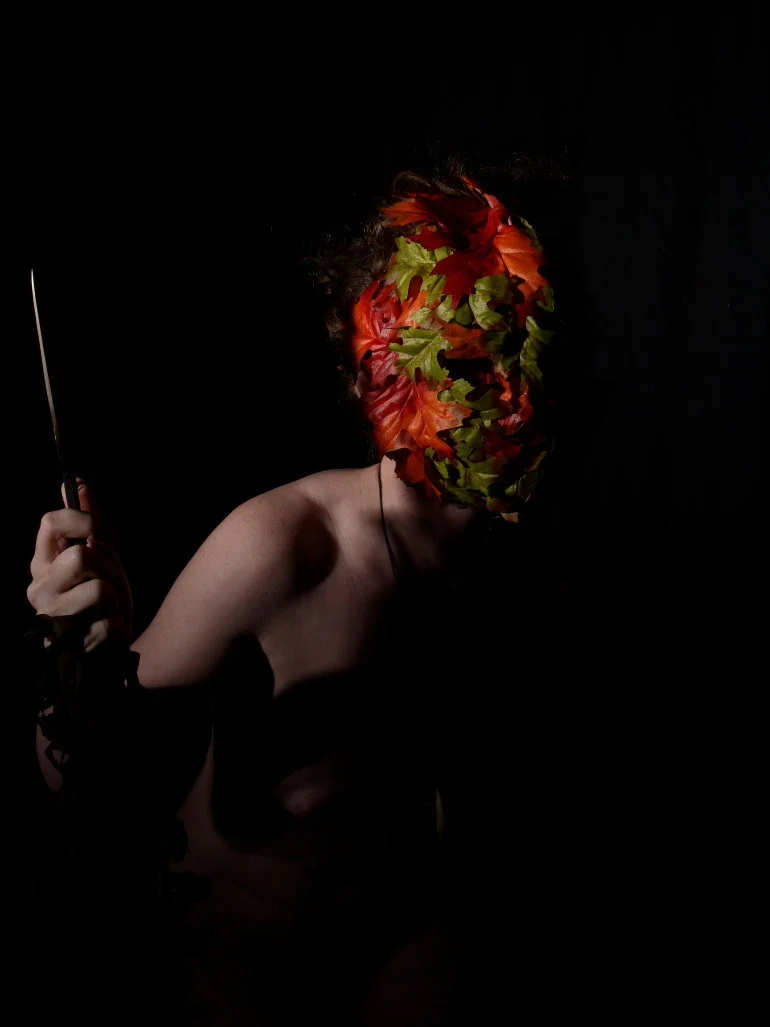
    Masks lend his sitters an air of atavistic power. It will amaze you, for instance, how a muzzle of ivy or an eye mask of oak leaves can imbue a stranger with great mystery and potency. You wouldn’t want to meet many of these photographic subjects on a dark night, and yet in their world it is always night.

    There is a vital intrigue here, because in person Watson is approachable, open and upbeat. For all the obscurity of the pagan rituals he seems to evoke, he offers complete transparency of means. He makes books, because these are more accessible (“People are in this country are far more comfortable buying books, than buying artwork. They know what to do with books.”).

    He also runs a detailed commentary on his practice at lazaruscorporation.co.uk. He is upfront about his paper, his pencils, and his process. If he is searching for a life model, you will read about it. Even his thoughts about blogging are right there, on the blog. He will also, endearingly, wear his musical influences on his artistic sleeve, having stayed true to a few bands from the 80s which I, for one, have been trying to forget. Perhaps unfairly.

    On the one hand he still inhabits an eldritch isle. His book England’s Dark Dreaming assumes the guise of a semi-mystical pamphlet. Watson took inspiration from ‘samizdat’ publications dating to the English civil war. “I started that after the Brexit vote,” he tells me, “and it was very much a cry of rage at the growing right wing presence in England”. Watson quotes the words of ‘landscape punk’ David Southwell, who claims that ‘reenchantment is resistance’. Watson concurs, aiming “not to view the world purely in materialistic terms and to use whatever is available to find wonder in the world.” Such wonder, he seems to say, will always elude the price tags of late capitalism. 

    On the other hand, he is unafraid of the light of day. “I don’t see any paradox,” he says, “between an enchanted world and a demystified process.” Watson might be horrified were I to present him as angst-ridden as, say, Ian Curtis. “I’m not interested in building on that whole artist myth of tortured genius,” he says. “I like demystifying the whole thing. I don’t think it takes away from the finished piece. I think it adds to it this whole thing.”

    How else, in the age of deep fakery, can you be verifiably real? Of his masks, for example, he says: “It was definitely not AI. It was crafted with glue and petals and wood – whatever I was using.”

    And here is the total artistic programme. When Watson is not coding software in his day job, he is working, as if from command-lines, series by series, on an attempt to create a vehicle or a lens to allow us all to imagine the unimaginable: namely the end of capitalism. Watson’s latest works are influenced by an unpublished, unfinished work of the late Mark Fisher, the theorist who is best known for saying the end of the world is easier to imagine than a working ideological alternative to the current Neo-liberal worldview. 

    Watson picks up: “I think that is true. It is very difficult to imagine something different from capitalism, so what I’ve been trying to do with Acid Renaissance [the most recent series – see above – which in fairness is warmer and lighter] is to break the imaginative chains by going into the mythic again and then start to imagine this future England almost like a social anarchist state”.

    In these sepia scenes of Leonardoesque cartoon we are confronted by details that Watson must hope we can take forward into that unimaginable future; here a laptop, there a wheelchair, in one, even and especially, wind turbines. Despite some deep historical references, Watson is clear he would like to effect change in the present. “I’m not interested in going back to the past, “ he says. “I’m interested in going to a post-industrial future”. Yet it is no pastoral idyll which the artist has in mind. “I’m fairly healthy but there are many people who rely on electricity and having the infrastructure of hospitals and things like that. So I very much don’t like these back-to-the-land fantasies. I think they’re fascist, because you’re essentially saying: we can kill off this part of the population. So I think you’ve got to imagine this post-industrial future which still does have things like electricity and healthcare”. 

    If that sounds difficult to imagine, perhaps it will indeed take a truly widespread, far reaching renaissance of an acid nature for us to collectively hallucinate what Mark Fisher’s idea of impossibility might actually look like on this planet of ours. In the meantime, we have Watson’s coming book.

    Whatever the future, there is something which the artist believes is essential to human expression. “I think there’s something very fundamental about creating images of the human body,” he says. He compels my attention with an image in England Dark Dreaming in which one of his mythic, future-past characters is making handprints on a cave wall. In this common palaeolithic act the body is implicated in “the very earliest form of art.” 

    Having spent six yeas of a research degree trying to put the term ‘cave art’ into question, I am not sure. But whatever the case it was grand to stand alongside such a thoughtful and committed contemporary artist on the site of an encampment dating back 5,500 years and look across our city by the sea.

    As Spring sunlight played on the water and the South Downs offered Brighton’s denizens their protection, we imagined being able to look across to the summit of Chanctonbury Ring by night and to see a bonfire. This mental journey back in time felt easy in the present company. Or was it a journey into the future? Reaching for my smartphone I took my own photo of the phone mast and we hiked back down the hillside.

    For more information on this artist, and to read his generous writings and/or view prints and books for purchase, visit Lazarus Corporation.

    Ritual, Part IV, Paul Watson, 2017
    Oak Leaf Mask, Paul Watson, 2014
    Whitehawk encampment, author’s photo

    Uncategorized

    Oh, and guess what!?

    May 7, 2024

    The show that cannot go on

    Well here I go, being a fucking idiot because: “Paranoids are not paranoids because they’re paranoid, but because they keep putting themselves, fucking idiots, deliberately into paranoid situations,” as the proverb from Thomas Pynchon goes.

    But I need to clear my throat and say again that the situation in Gaza is an ongoing and worsening genocide, that the campaigns against dissent (here and to an even greater extent in the US) are intolerably anti-democratic, and that a ceasefire cannot go far enough. So many lives wiped out and lives destroyed amidst pain unimaginable as we sit here in the relatively safe UK.

    It is utterly sick, this perpetuation in the name of zionism, US hegemony, white supremacy. Who could have guessed, having enjoyed the cosy assurance that has come with a liberal-seeming media and its centrist-minded, sensible grown ups, that these fascist forces would amass themselves with such energy and hate against people with nothing (there) or people with issues (here). It is genuinely terrifying.

    As a paranoid sort of guy who loves chuckling along to Pynchon more than joining barricades, I have to say that today, for example, there is nothing more important to do than protest, nothing better for a human (in possession of any humanity) to do than to put my head up, along with so many braver allies of Palestine, above the parapet and say a full-chested, Fuck this!

    About two months ago I switched bank away from Barclays since they have too many interests in maintaining the occupation and clearance of an entire subjugated nation. I kept it to myself for a number of reasons. I was afraid to tweet about it and cynical about my own motivations. Was I, wondered, I still doing the bare minimum, and would I, wondered I, simply put a target on myself by confronting a vast multinational bank on the fervid feeds of Twitter.

    Now, guess what, I no longer give a shit. I must try, according to Gilles Deleuze, to fight the cop in my own head rather than the streets. I should try and augment the positive, unafraid energy which Left Twitter exudes and which has been quietly inspiring me since long before October 7th 2023.

    By sharing this, I am, deliberately putting myself into a paranoid situation. But all my mini psycho dramas together with real or perceived threats to my career prospects, are as NOTHING, not when compared with the actual knowledge of a family in Rafah who know that, hey, bad people really are out to get them. I would like for all of us to be free, once and for all, of this fear. Freedom for Palestine is freedom for you too.

    contemporary art

    Urine: a survey

    April 9, 2024

    Piss is having a comeback in art, though some will argue that it never went away. As far as my generation is concerned this bodily fluid burst onto the scene when American artist Andre Serrano sank a crucifix into a case of his own urine and photographed the result. Piss Christ had such a cultural impact that following its appearance in 1987 it made it into discussions, just two or three years later, in a classroom at Long Road Sixth Form College, Cambridge, where I was studying an art history A-level. It had appeal outside the venerable academy as well, becoming a touchstone for radicalism and humour among friends who had perhaps no further interest in contemporary art. In Piss Christ they knew all they needed to know.

    I mention piss because this year I’ve recently found it in strong evidence twice, making pivotal appearances in two installations at work in both the UK and Switzerland. The latter example is salient, Swiss artist Shahryar Nashat is at MASI Lugano, where a prefix to his epic show is so unassuming you could miss it. But once you see this introductory work, two giant canisters of a homemade golden fluid just inside the door, it colours everything else in the basement of this slick gallery in the Swiss Italian Alps. 

    The rest of the show looks like an abattoir designed by Stanley Kubrick, and a film featuring digitally-manipulated wolves is an attractive counterweight to the grim practice of collecting what looks like two weeks’ worth of one’s own piss.

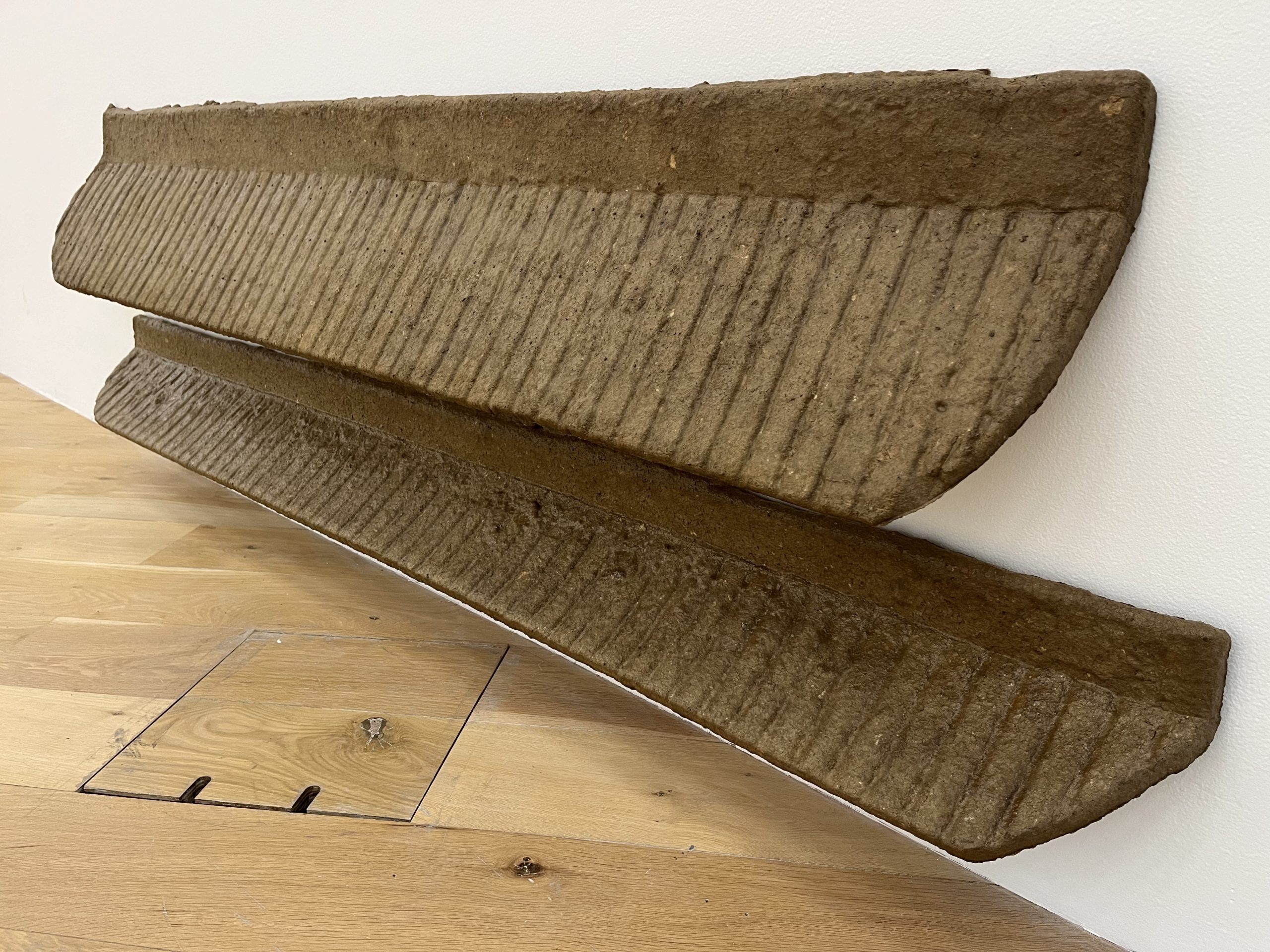
    Since the UK is the UK, piss is even more frowned upon. Actually, for the longest time it’s been frowned upon in public especially. The Croatian artist Dora Budor has fixed her attention on the many hostile architectural features which make pissing onto the side of a city building a hazard for shoes, socks and trouser ankles. There is one of these by the National Justice Museum close to the Nottingham gallery in which she is showing. Photo below. I don’t know the official term for this, but it sits about a foot off the ground and angles liquid away from the brickwork in order to frustrate drinkers who have been unfortunate enough to encounter one on the stagger home.

    Budor has produced half a dozen of these architectural oddities in cardboard. They line one large interior wall of Nottingham Contemporary where I’m sure no one would dare use them. But given that anecdotal evidence suggests that some public galleries (I mention no names) serve as public conveniences as much as platforms for public art, Budor has made it clear we should be pissed off about how life in the modern era is often quite shit.

    I’ll save shit for another blog post, suffice to say that Gavin Turk has not been entirely original by canning his own brand of piss, and selling it in packs of six, like Heinekens. Oh, and I saw a Marcus Coates film about psychosis in which this artist, who now travels the realms of madness as well as the realms of the spirits, performed a psychodrama so real to him that the frightened evidence began to soak the crotch of his jeans. I should also mention Hellen Chadwick’s Piss Flowers. Their early 90s date would indicate that this taboo art material really is a hardy perennial. Here ends my by no means exhaustive survey of urination in contemporary art. 

    I don’t know what it means. I don’t know why it compels me. But having visited these spaces in Nottingham and Lugano within four weeks of one another I can offer the observation that piss is in the air. Now if you’ll excuse me, I genuinely need to go take a leak.

    Shahryar Nasha, Streams of Spleen, is showing at MASI Lugano until 18 August 2024 // Dora Budor: Again, can be seen at Nottingham Contemporary, until 5 May 2024 // Gavin Turk, Artist’s Piss, was unveiled at 15 Bateman Street, London, in December 2021 // Marcus Coates, The Directors was an Artangel commission screened in various locations in Pimlico, London between September and October in 2022 // Helen Chadwick, Piss Flowers, was made during a residency in Banff, Alberta, 1991-92

    renaissance

    The Last Supper, again and again

    April 2, 2024

    It was as startling as a ghost. The door was ajar and in the Church of Sant’Ambrogio; it was dark and cool. I looked around me: a medieval christ on the cross; a gothic statuette of Saint Ambrose with a barbed flail; a faint fresco of the mother of God from a c.1300. But none of these revenants were to shock as much as the most spectral scene in western art: the dramatisation of an ancient betrayal so calamitous it still has the power to horrify.

    But enough of the preamble. On a press trip to Lugano, I took the opportunity to visit the Alpine village of Ponte Capriasca to look at an early sixteenth century copy of Da Vinci’s Last Supper. In writing this, I hope to understand whether, in the uncanny surrounds of a church far from Milan, is one visited by the spirit of Da Vinci? Or by some awareness of lapsed Catholic faith? Or is the spooking merely a bad case of déjà vu, triggered by the frequency in which this image occurs in contemporary life?

    Whatever the case, the sight remains arresting. Its sudden thereness gave me no time to reflect that this was the work of an engineer and former pupil of Leonardo, working at a remove of an unknown number of years and seven or eight hundred kilometres from the Dominican convent in Italy where the original commands a (no doubt) even greater presence. It did its work in a moment, dragging me in as if with shepherds’ crook.

    I can only speculate about the refectory of Santa Maria Delle Grazie, which was made by the very hand of the master; in photo after photo, the authenticity of that rendering is attested to by decay. The fading and flaking of the original add to the effect of spiritual mystery. Had I not seen the way the original is slowly dying, would the church here in Ponte Capriasca have inspired this visit, and grabbed my imagination? Perhaps the texture of decay is the very quality which removes Da Vinci and his Last Supper from our profane daily lives.

    In the Sant’Ambrogio, the drama is clear. It presents a tableau in which twelve apostles each have their own response to the brute fact of their master’s imminent and likely fate. They are grouped in interrelated trios that complexify the emotional scene. Christ has just announced that one of the assembled diners will sell him out to the Romans. Da Vinci and, then, his own followers or disciples have conceived of a range of emotions which range from anger and suspicion to fear, sorrow and utter disbelief. These expressions multiply, in shifting degrees from one copy to the next, because emotion cannot be measured like a Pantone colour. Jesus himself looks more downcast in this copy. Judas looks less filled with animus, more like a man who has made a solid business decision. 

    A few rough figures might be salient. There has been a church on this site since the 1200s. It is not documented when Cesare da Sesto completed this copy, but Leonardo’s former pupil lived between 1477and1523. Da Vinci painted The Last Supper between 1494 and 1498. It was only after getting home that I came to understand the most mind-blowing aspect of this imitation. It is not the fact that no photography is available, but rather it is the licence with which the so called Leonardeschi were to operate. Da Vinci’s followers painted about 100 last suppers in the Swiss-Italian alpine region.

    While I was in Lugano, I visited another. This was in Santa Maria degli Angeli, a beautiful church on the edge of the city’s pristine glacial lake which dates to 1499/1500. This Last Supper was by Bernardino Luini who lived between c1480 and 1532. His interpretation is more than a sharpening or inflection of facial expression. It is a loosening and unravelling of Leonardo’s scene in which bodies leave the table and the groupings of disciple are split into a triptych. This was clearly a live situation vis-à-vis the canon of western painting. But I struggled to take it all in since I arrived during a St Joseph’s day service of mass.

    I cannot say why this Italian speaking region of the Alps should contain quite so many versions of the Last Supper. It seems a very ambitious composition to transplant into these distant churches. Yet it might be said that the theatricality of the original is what allowed so many followers to re-stage it. The Italian master had established the dramatis personae and the tragic plot, it was up to his followers to re-present his work.

    The late philosopher and anthropologist Bruno Latour noted that in reproduction paintings could take on new aspects of their originals and amplify the reception of the image in the same way as each new performance of King Lear does. It too has an original, a folio which is rarely seen. In our age, we have a new ‘folio’ for The Last Supper: popular novel The Da Vinci Code. I haven’t even read it, but since 2023, when it was published, the sacred meaning of this biblical scene is forever overlaid with the sinister mood of a work of popular literature, thriller selling 80 million copies with an accompanying blockbuster film about the evils of the Catholic Church. Perhaps this is why I felt spooked.

    In which case, thank you Dan Brown for adding to the works of a very great humanist. I would like to imagine this writer on a tour of all one hundred copies of The Last Supper. I think he would soon realise that Da Vinci’s code, if that’s what we’re calling it, was as open source as Linux.

    contemporary art

    A Monastic Trio

    February 8, 2024

    Three good souls are performing, and improvising, their way through a weekday afternoon; large paintings are taking shape in the barn where they congregate. The trio combine music, movement and the slow application of bright acrylic paint. They address the canvas with gestural emphasis, and respond to one another with alacrity.

    For most of the time, they work away unseen, unsung, and unbeknownst to the majority of those in Oxford on this Wednesday. While university Fellows read and write, students sit in lectures, tourists come and go, and the remaining occupants of the city are at their day jobs, these three labour at something with little tangible value. It makes their process, and their product, all the worthier for that.

    The painted forms are abstract. The music freeform and dissonant. The dance is expressive and informal. The three make a noise and generate a real energy that can be felt beyond this cell of theirs. I hear it as I approach from the road and it feels like a calling. I push open the door and the mood in this hallowed space shifts, but only slightly. I feel accommodated by the group. A theme played by their oboe player lifts me. Their dancer and their painter may have stopped to listen to the sound of my entrance. I take a seat, feeling self-conscious, and begin to pen notes with an inevitable and unhelpful sense of theatre.

    I’m sure that it would have been welcomed were I to break into song, but I don’t want to overstate the blurring of boundaries between audience and performers. There is enough interplay without introducing this blogger as a rogue fourth element. The woodwind is provided by Christopher Redgate. The dancer is Lavinia Cascone, but she too paints. The visual artist, who cedes control, is Mark Rowan-Hull. He too moves, with slow poise, to the music. All three watch one another, listen to one another and vibe off each other.

    The paintings themselves emerge slowly as fingers dab and smear, as oil stick drips and arcs. Two canvases lean on walls, two rest on the floor. The pair without oboes are happy to wipe hands on one another and drum clean fingertips onto the canvas. They are happy to embrace stillness and move away from ostensible purpose, the production of artworks, to trace embodied arabesques around the paintings, drawing attention to the space they inhabit. The only rule, if you can call it that, is that the works, at this stage, have limited palettes: two are an infinite arrangement of blues, two are warm explosions of yellow.

    None of this would happen without the instigation of Rowan-Hull. This UK artist is many things: a mesmerising performer, a generous collaborator, and an expressive painter. What’s more, he is a member of Oxford University. And as might be expected from an affiliation with Oxford, Rowan-Hull’s work is steeped in high culture: classical music, contemporary dance, and art theory. He is also a synaesthete, so tones of music and tones of colour come together with intensity. This can be seen from the concentration with which he moves around this space, which is both studio and stage.

    Kendrew Barn, the venue, is an adjunct of St John’s College. Discreet signage directs you to an exhibition here which has run parallel to a recent conference at the College. During this event, art historians, musicologists and literary experts met to share perspectives on a most basic element of the painter’s art, gesture. But scholarly restraint was cast to the breeze on day two when Rowan-Hull staged an elaborate happening in a St John’s lecture theatre. On this occasion, Redgate and Cascone were joined by singer Maggie Nichols and artist/critic Matthew Collings, with electronica from Dr Emmanuel Lorien Spinelli. It is difficult to articulate the combined effect of these strong presences, suffice to say that one knew this quietly riotous, unfolding event to be Art with a capital A, because it fit into no other category.

    Back in Kendrew Barn, the footing is a little more stable. Next to the performance area is a room in which four static works line the floor, with a fifth propped against the wall. Gallery notes reveal that Rowan-Hull’s father was an Anglican Minister and there are a number of his clerical stoles, draped around the shoulders of the 2m tall wall-leaning painting. A vivid luminosity, which actually comes from overhead spotlights, appears to emanate from these paintings’ layered depths. Four works – two high spec digital prints on photographic paper and two hybrid print-paintings on Perspex – bring together rich blues, greens and reds as if in the glass windows one might gaze at in church.

    In this way the room sets an ecclesiastical tone which pits a 2,000-year-old religion against the latest developments in machine learning. In a paradoxical move, this show – which is after all entitled Gesture – includes two works here upon which Rowan Hull has not laid a finger. AI-generated clouds of layered colour are too rich for human hand and eye. Stained-glass meets a techno-futurist aesthetic and brings an overlay of staves, notes and musical notation together in a primordial vortex. The artist has briefed a computer to share his raw materials and then given the machine a presence in the resulting show.

    One might compare the musical notation to iron tracery, framing gestural fields of colour. It structures the abstraction. Close inspection reveals the written music to represent difficult avant-garde compositions, in rare time signatures and polarising octaves. Meanwhile, two pertinent quotes, offered as takeaway postcards, are drawn from two secular philosophers, Theodor Adorno and Hans-Georg Gadamer. I have neither the scope nor the expertise to explore these writers here, but the excerpts appear to get inside the notion of gesture as a movement that is natural and corporeal, yet also symbolic and even spiritual.

    In a third room, exposed barn rafters echo a single wooden seat, which resembles now a solo church pew. A giant cruciform hunk of rope which the artist found washed up on a Suffolk beach suggests a maritime take on the agricultural and nature-inspired works of the Italian Arte Povera group. An old-fashioned, starkly vacant pram, also a readymade, seems a nod towards dada, specifically Duchamp’s bicycle wheel. In these ways it emerges that the primary religion here is one we call art.

    Assembled for the contemplation of one visitor at a time they are situated between the churchy wooden stool and a large projection screen where a series of moving images play out. This short reel, set in a large, bare rural homestead, show Rowan-Hull engaged in forms of contemplative activity for a lone cameraperson and, in this show, a lone spectator. The title Empty House Studies, hints at the mood of isolation which the artist acts out. In more than one film the camera opens and closes on him daubing red paint on a staircase wall. It looks bloody, but it might be Farrow & Ball. Empty House Studies offers a silent, peaceable form of the Viennese art movement known as Actionism, but as if Hermann Nitsch was replaced by the composer and painter John Cage.

    Which is to say that this bijou exhibition engages with a lot of ideas, a surfeit of references, a plethora of theories. Yet at the heart of the resulting displays, which send the eye and the heart in so many directions, there is a shared performance in music, movement and paint. Redgate, Cascone and Rowan-Hull work away in a wordless realm and summon forces from across the exhibition space, channelling them into the form of paintings which are in no need of an audience, but which bear the impression of a collaborative dedication to art for unknown ends.

    Gesture: Mark Rowan-Hull ran at Kendrew Barn, St John’s College, Oxford, between 23 January and 2 February 2024.

    Uncategorized

    Between rock and hard places in Ethiopia

    January 3, 2024

    Exploring the sunken churches of Lalibela

    Lalibela is a troubled, troubling town in the Highlands of Ethiopia. It is under curfew and without power. Our 2022 trip was memorable, absolutely, a fantastic experience: memorable for the food, the scenery and eleven miraculous churches all hewn into rock; but we still get updates via text – disturbing messages about civil war, food shortages and even drone attacks. We can’t forget the churches. We can’t forget the locals.

    In summer 2022, we sat on a terrace with views across the surrounding jungle valley. Over a drink or two, our guide told us how, just last year, these treetops echoed with the sound of gun battles, a scene of bitter fighting between the Ethiopian government and Northern militia forces. Indeed, still parked outside was a residual UN jeep, some material evidence of some stark facts. We have happy memories of our Airbnb as well. Our host chatted with us as we ate breakfast; he recommended places to eat, charged our phones and even procured us a litre of honey. Both locals have our numbers now, and they reach out to us from time to time. There is nothing we can do about visas, or debts, or the threat of displacement.

    Thanks for reading criticismism! Subscribe for free to receive new posts and support my work.

    Those churches were the reason we came. To reach them we were to climb down steep red steps into man-made crevasses which brought us up against grave, square-cut facades or to small dark entry ways, hewn low in the rock. Before entering we removed shoes and padded in dusty socks around uneven floors, past priest holes like small caves and gloomy altars just a foot off the ground. A sparse interior might have a few worn rugs, a smoky candle here or there, or burnished paintings revealing devotional icons upon which we shone our phones to see ancient panels leaned with formality against walls of volcanic stone.

    Most of the churches were dug down and into the rock face, but four are actual monoliths, meaning they are cut away from all sides. The most impressive edifice, Biete Giorgis or the House of Saint George, has a cruciform footprint. You can imagine jumping from the nearby plateau onto the roof. A tour of Bet Gabriel-Rufael, the House of the Archangel, meanwhile, took us through an unlit 35m tunnel. It was confined, totally dark, said to reflect a journey through hell. Prof D found the going v. hard, but owing to the difficulties of the terrain, these were surely the most fun ecclesiastical monuments which our daughter, little A, had ever known.

    Fun was not the intention. These churches were planned, chipped, scraped and shovelled into existence during the dark ages, not widely considered one of history’s most laugh-a-minute eras. They were built in the late twelfth and early thirteenth centuries by a regional king who wanted to put his manor on the map as a new Jerusalem. Ethiopia, the home of Coptic Christianity, has done its own religious thing since the fourth century. I’ll gloss over the details, but these churches are older than most in Europe. It goes on here still, the worship, the services, the feast days. We navigated the trenches of eight or so churches, making our way around congregants from the town.

    Some of the townsfolk, I saw too much of. These were the pair of teenage boys who, having engaged me in conversation, knew my name, my place of origin, and my indulgent attitude towards young people who want to ‘practice English’ so they can ‘study at university’. In fact, they had all the English they needed to try and sell me bracelets and souvenirs. That might sound harsh, but they tailed us for a full day and gave to the beginning of our stay, a quiet sense of menace, stoked I admit from my having seen ominous films like Straw Dogs (1971) and Deliverance (1972). D, who knows territory like this, told me to ignore them. This only seemed to hurt their feelings. That was the most difficult thing about travelling to Lalibela: the requirement to ignore impecunious local inhabitants.

    Another difficulty was the permanent power cut. Lack of electricity meant that each time we stopped for food we would need to charge phones off generators. We ate to the sound of their constant chugging. After dusk we navigated the compound and our three-bed room with the help of a wind-up torch. We got early nights. We bathed in the morning with warm water brought to us in a bucket by our Airbnb host. And after breakfast I could enjoy the slow and careful preparation of a coffee or two. The strong Ethiopian brew meant that, when I left for the sightseeing, unlike my phone, I was 100% charged.

    Our room had a balcony from which you could hear insects, birds and prayer calls. The view was largely tree canopies, simple dwellings, and blue skies. I found it meditative to sit there, while D and A recovered with siestas. The new Jerusalem, during this respite in fighting, was a much more peaceful place than one finds in the vicinity of the old Jerusalem right now. It is an eternal tragedy that the world’s most holy places seem to attract the most warlike aspects of human nature. Paranoia has dominion over the Earth.

    Before we flew to Lalibela we tried to pass security at the airport in Addis Ababa. During this routine check I was pulled aside because they found a pair of binoculars in little A’s bag. It’s against on/off martial law, apparently, to bring binoculars into Ethiopia. We were heading in the direction of the conflict so, naturally, they thought that a small family on UK passports might be smuggling military equipment to the militia. Admittedly, I enjoyed the level of suspicion, given that nineteenth century poet Arthur Rimbaud took up gun-running in East Africa. But I don’t think he flew.

    The binoculars were really innocuous: small, not too powerful, and fitted snugly in a purple case branded with the logo of one of the UK’s most respectable charities: the National Trust(!). But upon their discovery we were separated, and I was escorted, by armed official, back the way we had come through the departures hall and into a windowless back office. There was quite a bit of waiting – I wondered if would we miss our flight; there was also some questioning – I wondered if I would do jail time. But after I had signed a paper or two, the binoculars were confiscated and I was taken back to departures to rejoin D and A.

    If you ever go to Lalibela, let me know. If our guide and our host are still in business, you’ll be looked after well. The churches I’m sure, will be open to visitors, for another millennia, at least, you would say.

    Thanks for reading criticismism! Subscribe for free to receive new posts and support my work.

    Uncategorized

    Season’s bleatings from Germany

    December 23, 2023

    A search for plenitude in the Christmas markets of Bonn, Siegburg and Köln

    I have never really been a Christmas person, but this year I have gone the whole hog. As whole as one of the hogs turning on a spit in Siegburg medieval market, but I am getting ahead of my tale.

    It begins with a thirteen-year-old’s birthday. Little A no longer believes in Father Christmas. In the coming seven years she will cease to believe in anything. So Prof D and I took up an opportunity to eek out the last vestiges of childhood’s magic with a visit to a land of bright lights, street food, jolly crowds, and tremendous cake. We visited three different Christmas markets and felt to have eaten and shopped our way round the entire Rhein-Ruhr metropolitan region.

    Our previous experience of a not-quite ‘echt’ German Christmas market was the one found, this time of year, in Birmingham. If you haven’t been, it’s jaw dropping. Dominating the city centre, it draws vast crowds of shirt-sleeved midlanders who quaff ice cold beer in ice cold temperatures, and they do so by the litre. It was little preparation for the civilised pleasures of Bonn.

    So we hit the central Weihnachstmarkt within hours of arriving at Frankfurt airport. At the very moment we passed beneath a wide, glowing arch, which welcomed all visitors to this market, cathedral bells began to peal. Such joy! The spirit of Christmas was so clearly upon us, that anything seemed possible: gathering winter fuel, dashing through the snow, bringing figgy pudding. Anything for which our warm hats, scarves and gloves suited us.

    Unbidden, another song came to me: ‘It’s the most wonderful time… of the year’. It swings, no? Briefly, ever so briefly, I felt like the good-natured protagonist of a coma-inducing festive movie. I felt like the hearty, mentally healthy, generous spirited font of love and good times, which a good parent must surely be, at least once a year. I stepped outside myself and began to consider the presence and the wholesomeness, which this setting was bestowing on us. I looked at D and was able to guess she was feeling something like this too.

    And it was not hard to maintain the glow on my ruddy cheeks. We had mulled wine, and mulled non-alcoholic punch. We had pretzels and flammlachs (freshly flamed salmon) with chilli mayo. There was a towering pine tree festooned with gold LEDs, and a dinky carousel ride with spinning headlamps, and a neon trimmed ferris wheel, all of which reflected back from the varifocal lenses of my tinselled spectacles. My journey from a misanthropic cynic to wassailing family man was short and direct.

    This was reinforced in the coming days. There were two or three more moments filled with crimbo spirit. In Seigburg, they serve up the Gluhwein with a medieval spin. All the stalls are lit by candles. This took us all the way back to the Middle Ages, while I continued to express my own middle-age. Gentle flames were to guide us from stand to stand. It was a trip: a very lengthy queue for roast pig led to the most perfect crackling which in turn led to a middle-aged high. We also ate oven-fresh rolls, tasting crystals of sea salt as we chewed the warm dough; this had a similar effect on D.

    In Köln, we visited a gothic sky-scraper, a delicately buttressed cathedral so vertiginous that heaven might have been just the other side of the lofty criss-cross vaulting. Part of a crowd of tourists, we milled around taking selfies, largely oblivious to the mass in progress further up the nave. One could only wonder about the lives of the many artisans who carved the stone, gilded the crosses and stained the glass. I had reason to believe they liked good crackling.

    We now gazed around dumbly, until the congregation suddenly raised their voices in song. This gave me a spiritual jolt for a nanosecond, but in that nanosecond I recalled all those lessons about the true meaning of this time of year. Recalled them and then forgot. We were soon pushing our way out of the exit and into the cold late afternoon air.

    In the shadow of the cathedral was another Christmas market, a less fantastical apparition than found in either Bonn or Seigburg. The stalls were workaday and instrumental to the sale of a range of gifts which, it must be said, had little to do with Christmas. The twinkling lights did seem weaker. There was no choice but to join a sea of punters who flowed sluggishly past the expensive wares, it was a space in which my concern was about keeping us together and not getting lost. At one point we found ourselves caught in a human tectonic drift, squeezed into a slowly heaving moshpit, that was packed with visitors of all ages, in all states of anger. This too was the spirit of Christmas.

    This suffocating mass of families – containing dozens of parents who were no doubt striving, like us, to be their best selves for the holiday season – were, more or less, facing an outdoor stage. It was gussied up in red and gold to heighten the mood of celebration. To complete a mood fitting the setting, there was a hard-working rock band up there, a covers band, who knew their market in all senses of the word.

    I’m going to stick my neck out, destroy my charitable Christmas persona, and say that this band sounded terrible. But then a Germanic rendition of Fairytale of New York is not quintessential Christmas fayre. Or it it? Having seen this classic duet performed at the Cambridge Corn Exchange in 1988, by the actual Pogues, with the actual Shane MacGowan, and the actual Kirsty MacColl, it was, for me, a murder mystery. How did I get here?

    Upon our return to Brighton, I was driving Little A to a basketball match when the original of this song came on Heart FM. “Do you like this song?” I couldn’t help ask the thirteen-year-old. “Yessss!,” she replied. “It’s SOOO good!” There it was, on the digital airwaves of a car radio, for a fleeting moment, much closer to home… Christmas plenitude. May you all experience something like it this season, no matter how briefly, no matter how incidentally.


    Uncategorized

    Constable and the beach

    December 8, 2023

    I wrote my way to a diving holiday in Zanzibar

    On the flight to Zanzibar, my head was in coastal Sussex. I was writing about a very English painter against a tight deadline, en route to a tropical island where time would slow down. Specifically, I was writing about Constable and little known paintings he made in Brighton during the 1820s. The beach, in those works he made along the seafront here, is grey and turbulent. But once I had emerged from the screen of my laptop, the Indian ocean was clear blue and calm.

    I was not calm, mind. Two days before leaving, artist Peter Harrap, who was curating a forthcoming show about Constable, got in touch out of nowhere. He asked me if I could interview him. I was imminently departing for Sub-Saharan Africa, so I said no. Two minutes later I phoned him back and said yes. Peter sounded relieved. I felt dismayed. The next day, I called at the house in Sillwood Street, Hove, where he lived. And it was where, as a blue plaque announced, Constable too once lived and worked. We recorded his account of the forthcoming show and the wild coincidence, and I transcribed it ready for the journey.

    I found air travel to be surprisingly conducive to this kind of work. By the time I reached my layover in Istanbul, the piece was already coming together. Hunger and thirst took second place to tapping away at my machine while I let a double espresso grow cold at a table on the busy concourse. By the time I reached Dar es Salaam, at about three in the morning, the piece was drafted. I was too tired even to be alarmed by the official at arrivals, who disappeared after taking my passport, and the ensuing scrum of other travellers waiting for permission to enter Tanzania.

    ***

    Prof D was already on the ground, attending a workshop, in a vast yet spartan hotel. I waited out her professional commitments, taking an auto rickshaw into the city and seeing a compound where artists were hard at work making Tinga Tinga paintings for tourists such as us. My/our ultimate destination was, however, Nungwi, a resort on the Northern tip of Zanzibar. We took a ferry, And the sea views had competition with the in-flight entertainment: monitors all around the crowded deck were showing Rambo: First Blood (1982), a film both violent and dated. At the other end we found a taxi and completed our journey in 90-minute bumpy minutes. We crossed a bridge built with a donation from Colonel Gadaffi.

    Apparently composed of a beachside strip of hotels, restaurants and bars, Nungwi presented visitors with a prospect of grey sands and the vast promise of a temperate Indian Ocean. Black sea urchins littered the shoreline like so many vicious mace heads. A fine daily schedule dictated our use of the beach: diving lessons in the AM and lurid sunsets at dusk. Diving took place first in a hotel pool, with a theoretical component in the backroom of a dive school near our hotel. D and I spent diligent hours in front of DVDs that itemised equipment, spelled out risks and underlined safety measures. We sat exams, completed medical forms, and signed disclaimers. We paid our fees, and we met our instructor. Juma had come from Kenya and he educated us on how to breathe, with therapeutic calm, when strapped to a weighty oxygen tank.

    Gearing up is one of the most demanding aspects of diving. Wetsuits, fins, weight belts, masks, snorkels and aqualungs – just the ticket 20m under the sea – are an encumbrance in a local dhow, clipping along on the high seas. The second most demanding aspect of diving is getting to your feet and stepping off the side of the boat. Assembled among the waves, Prof D, Juma, and exchanged coded hand signals, as seen on the DVD, and began our descent. Little by nervous little.

    Suspended in the water I found myself suspended outside of my usual reality. We divided our attention between fish, coral, and technical measures such as equalising pressure in my ear, nose and throat area. We were to breathe as calmly as possible and endeavour to stay horizontal at an acceptable depth; buoyancy is the next occupational demand to think about. Juma was with us, what could go wrong? Well, the greatest danger to divers is decompression sickness (the bends) rather than man-eating sharks. In the isolation and alienation found at depth I also feared panic. And unlike our underwater guardian, panic doesn’t promote calm breathing.

    We pressed on, however. Beginning with 12m depth on a 12-minute dive to 18m depth over 35 minutes. We have since completed 20 dives and the fish sightings are a bit of a blur. So apologies. I have used AI to generate a memory for us:

    “The underwater world is a symphony of shapes and patterns. Coral reefs form intricate structures that mimic branches, trees, and even underwater cities. Fish and other creatures exhibit remarkable adaptations, from the camouflage of cuttlefish to the mesmerizing patterns of butterfly fish.”

    I can confirm, we saw reefs of all colours and encountered colonies of tropical fish on their own watery terms. We also saw a turtle, kind of swam with it. But if you’ve been following my substack you’ll know how much oxygen I can take up from my readers. Excited hyperventilation, my modus scribendi, took place underwater too. But as D gave me her hand as we slowly drifted along the scheduled dive path, I registered the fact I was surviving in a brand new element, anxiously happy and happily anxious in a way I had never previously known.

    Despite the idyllic surroundings, both D and I were fairly abstemious on this trip. We got early nights for early starts and ate frugally at a tiny neighbourhood food shack, Mama Africa, where Masai tribespeople were more regular than holidaymakers. The food was highly inexpensive and local to this part of the world. Of the handful of dishes on the menu I recalled that one was with ‘meat’ and one with ‘fish’ with no further classification of what was to arrive on our plate. We did not drink alcohol, at least not on the eve of any of our five or six dives here. The evenings we did drink, we took cocktails made in our room to the twilight beach where we waited, day after day, for the perfect sunset.

    The vast horizon of the endless sea held promise and threat. There was the promise of great beauty and peace to be found beneath the waves. There was the threat of diving incident and, even in the shallows, toxic sea creatures such as jellyfish and those sea urchins. We were not equipped with beach shoes which meant that midway through our stay we stepped on a cluster of these spiny beasts and were as comprehensively spiked as our homemade cocktails. The pain was disturbing. A hawker found us on the sands, rubbing our feet, and sold us a remedy. It was papaya, apparently. There was also a papaya tree at our hotel, which the owner shook down for us. We took the fruits up to our balcony where we pressed them onto our legs, milking the sap as a talisman against pain. The things one remembers.

    Peter emailed me from Brighton to say that broadly speaking my piece for the Constable catalogue had gone across okay with the editors. There were changes, of course. In one place I had made an overclaim for the painter’s influence on Delacroix. Peter said that French art historians would not be happy with that. I began to count my chickens and realised that the amount I would be paid equalled the amount we were paying for our accommodation in Nungwi. Nice work, etc. We made further contacts with home, tapping wifi from the beachfront bars in order to speak with our five-year old and check in with her grandparents.

    The third most demanding aspect of diving is regaining the surface. It entails making a safety stop at five or six metres and holding your position here for at least three minutes. Not easy, for me at least. I think one or both of us, at some point, lost our companions and/or the boat on one of these ascents. It a mild shock to find oneself alone in open water, for however little time that may be. For Juma and his team it all seemed par for the course. We were well looked after. But I always experienced a wave (no pun intended) of relief as I took hold of the ladder and, after a bit of manoeuvring, was able to pass my fins and my weight belt up to the professionals in the boat.

    After five days of this routine we became PADI qualified divers, with log books, membership cards and the newfound freedom to sign up for diving expeditions anywhere in the world. This was 2016 and in subsequent years we took full advantage, even if we can no longer dive for reasons of poor health. Speeding towards our last dive in Nungwi, we got talking to a pair of hungover friends from the UK. There had been a party the night before and had to stop diving when one of them vomited underwater. They told us about a nightlife tour in which foreigners could explore Dar Es Salaam and hear local music. D took the name of the guide and looked them up online, the moment we got back to our hotel. She booked, which meant that on our last night in Tanzania, before flying out at three in the morning we were to drink, listen and even dance, if not twerk, well into the night.

    On the plane home I re-opened the laptop and got to grips with my edits. By the time we landed at Gatwick, the piece was finished. At the opening of Constable in Brighton, at the Brighton Museum & Art Gallery, I was able to pick up a copy of the catalogue, which featured, as Chapter Seven, my interview with Peter. It remains a surreal keepsake from my week under the African sun and the Indian seas. I had one other souvenir which, fortunately I lost in A&E upon my return. This was a worrying swollen foot and lower leg. I suspected deep vein thrombosis after the long flight back to Europe, naturally, but it cleared up with antibiotics: an infection from sea urchin quills. These slowly fell out over the coming weeks and we lost the small black spots which testified to our adventure in Zanzibar.

    Uncategorized

    A needful digression

    November 22, 2023

    Solidarity with the people of Palestine

    In 2018, 23-year-old Mohammed Khalil was attending a demonstration lasting several months in Gaza. It was known as the Great March of Return and brought thousands of people at a time to the disputed border area. Khalil was a young footballer, the captain of Al-Salah FC, shot in both knees by a sniper. He was, it is almost needless to say, Palestinian, and because he was filming the demonstration on his phone as the first bullet struck, we can see that he is the unarmed and unaggressive victim of the IDF.

    At least 160 Palestinian protestors were killed during these demonstrations, as was one Israeli soldier. But the example of Mohammed Khalil’s wounding is important; his injuries have ended his career. Football is positioned in the media as a globally unifying activity and his dream is one which football fans across the west can easily relate to.

    In a little over five years since this barely reported incident, the situation has gone, overnight, from bad to catastrophically worse. A shocking killing spree by Hamas on October 7 claimed the lives of 1,200 Israeli civilians; Israel’s escalation has been exponential. The IDF has killed 11,000 Palestinians so far. At least 5,500 of those killed are children. That’s an unarmed dead child every ten minutes. Two thirds of the population of Gaza have been made homeless.

    One cannot ignore the fact that 120 Israelis are hostages, in whose name this mass murder is being carried out. But the collective punishment, the attack on schools and hospitals, the killing of journalists, medics and some 100 UN employees, these are war crimes, despite the unlikely narrative that everyone in Gaza supports, assists or fights for Hamas (even women and children). And one must call for an end to the fighting and the deployment of enough firepower to equal two nuclear strikes. And then one must call for an end to the nightmarish ongoing scenario of apartheid whereby Israel oppresses Gaza and the West Bank. Both the UN and Amnesty International have described this occupation as a crime against humanity.

    Ceasefires do not make reparations for a 50-year history of dispossession, but only an immediate ceasefire can halt a shameful atrocity, the picture of which, is emerging tweet by tweet on social media and between the lines of mainstream news reports. You would not think a call for peace would be controversial, but in Westminster last week it was a resigning matter for several in the Labour front bench. Only 125 MPs voted for a ceasefire, and against children being killed and the siege at Al-Shifa hospital.

    This was a conscientious decision and perhaps a prudent decision because UK voters are generally less hawkish than our two leading politicians. Only 9% of the population are opposed to a ceasefire. But unlike Sunak and Starmer the public are not wholly influenced by party investors, right wing media or UK arms manufacturers. In other words, well established interests are in favour of this anachronistic crusade in the Middle East. This alliance can threaten the careers of those who speak for Palestine, in politics, academia and the media.

    The threat is not as grave as that of an IDF sniper, but it remains. It impacts on 56 Labour MPs who have had to defy their party whip. And it is reflected in biased coverage of the ongoing crisis in Gaza by openly partisan mainstream media. You will find a marked contrast in terms used on twitter, and other trustworthy sources such as Novara Media or Al-Jazeera.

    In the scheme of things, I am of course a nobody and as a nobody I have felt it futile to add my voice to those who bravely criticise Israel and its friends. But if my opinions encourage others with more clout to speak out, then why not air them? If it was to mean loss of opportunity for me, I would still have 10x more opportunity than Mohammad Khalil and his compatriots. I would still not be facing genocide.

    But that’s really a digression, Khalil warrants another mention because his experience was prior to October 7. History did not begin with the Hamas massacre. Khalil dreamed about an international playing career, not about becoming a victim of a genocidal regime. He dreamed about a good life; if you have one of those already, please speak up for the everyday people of Gaza.

    The impetus to write this came from two earlier posts which address the problems of speaking out for Palestine. In the face of genocide, the intifada must be globalised by Chloe Skinner from IDS and also Palestine Lives! But do you condemn Hamas? by Nivedita Menon.

    Uncategorized

    Invading Canada for 100 hours

    October 25, 2023

    Discovering an ancestral home in in Banff

    “Is there a doctor on board the plane?”

    Okay, they didn’t in actual fact ask this, as we cruised 40,000 foot above Greenland. But they might have done. They might have put out a call for a doctor, and then what?

    Thanks for reading criticismism! Subscribe for free to receive new posts and support my work.

    The scene was set for unprecedented hubris. En route to my first academic conference, I had passed my PhD viva days prior. In a matter of weeks I would be, officially, a doctor.

    But would I be a doctor-on-board-this-plane?”

    It’s an old gag: the Doctor of Philosophy who makes themselves known to cabin crew only to struggle when their knowledge of Etruscan pottery from the 5th century BCE is annihilated in the face of a life and death scenario.

    But I was so high on my unexpected academic achievement, I might have tried to be a medical expert. Like a schoolboy, unable to resist shooting up my hand, and turning out to be a total imposter.

    The flight passed off without incident however. I watched the latest Indiana Jones movie on the grounds that it was related to my research, but it failed to deliver. Not a good omen..

    I landed in Calgary and took a bus to Banff. Getting dark, but I was experiencing the novelty of a North American highway, the sight of the SUVs and trucks with long-nosed cabs and the way that surroundings loomed and the general Twin Peaks ambience of the hotel. It was like entering a make-believe world.

    I was also pleased that my roommate, Don, seemed chill, polite and sane: this was surely a very good start.

    Next morning, after sleeping for 12 hours, I persuaded Don to visit the town’s famous cave with me. The Rockies, which enclosed us with peaks as high as 3,600m, were resplendent in manes of fog, caps of snow. The Bow River was a tumultuous cascade of noisily white water. So beautiful.

    The cave was small but perfectly formed for bathing; at least that had happened once upon a time. Sulphur bubbled up from the sandy bottom of a deep warm pool.

    We paid eight Canadian dollars to get in and, perhaps in order to get his money’s worth, Don overlooked the DO NOT TOUCH sign and trailed his fingers in the sulphuric waters. And succumbing to peer pressure, my oldest character flaw, I did the same.

    We were soon to discover, from a helpful guide that contamination from human skin threatened the existence of an endangered species of snail which existed in no other spot upon God’s green earth. She pointed out a few of these unsuspecting snails, dark, tiny, and in slimy residence upon rafts of algae.

    I was not so much an imposter at this point, as an outlaw.

    Getting away with intrusions like this would soon become my primary objective as, in the course of three long days, I listened to a series of highly intelligent people expounding upon areas of vast expertise with great seriousness and understanding of the academic game.

    My own slot was a Damoclean sword. I was the last speaker on one of the last panels on the final day. As the hour approached I found it harder and harder to believe I actually had a PhD. I was a snail-killing lightweight.

    The conference opened with a reception where I put two of my most reliable skills to good use: eating canapés and drinking beers. But it was dawning on me, as certain introductions were made, and dedications were stated, that this was not just an academic affair, it was a chance for Canadians to meet other Canadians.

    Having flown from the UK, representing a university few here might even know. I was to be sure an outlier of extreme unlikelihood. I’m not complaining. It was amazing to be here. But as each of the speakers celebrated one another and paid tribute to various tribes of First Nations peoples upon whose land we were conferencing, I felt surreally out of place.

    I wanted to belong, who doesn’t? Especially when, as things got weird, a First Nations elder took the mic and led us on a guided meditation by which the assembled art historians could become buffalo walking into a vividly visualised storm.

    Pablo Russell, the name of this guru, was surely one of the most inspirational speakers I have ever witnessed at work.

    The UK timezone slipped away from me and I was slowly getting used to Banff time. Perhaps that was a step in the direction of belonging: falling asleep in sync with West Canada and waking up, refreshed, without needing to wonder, on Day 2, where the hell I was.

    Don presented in the morning. A good panel, it was full of cool people doing cool projects. Co-panelists included a woman who had built a solar powered shed/archive, located on a frozen lake, for accumulating data from grass roots art projects nearby. There was also an an artist using climate data to make generative artworks formatted for social media. My roommate slotted in well, with his comparison of internet based platforms for visual art.*

    By the time lunch came around I was familiar with a convention which found that the chair of every session would kick things off by apologizing to various tribes of First Nations people and thanking them for our continued presence on hereditary land. I can understand the need for this convention, but a rogue inner voice was nevertheless reassuring me that I had nothing to do with this particular form of colonization.

    Packed lunch at hand, I sat on a coach and we drove into the National Park. I was here to take part in a ‘Walking Lab’ excursion to the site of a local derelict mine.

    Let’s see, I thought, what these bastard settlers got up to here in this beautiful wilderness. I was quick to learn the term extractivism, and  I now look forward to applying it frequently to all manner of nefarious practices.

    Walking Lab entailed dousing for minerals and water with copper pendulums and listening to a pirate FM station broadcast from a backpack belonging to one of the organisers. There were artistic performances by Leah Decter (self-acknowledged white settler) and Alana Bartol (an indigenous artist working with local plants).

    At one point, I even became a participant in Decter’s mysterious performance and found myself literally tied to a piece of coal. But I ignored the symbolism. Regular reminders of the toxicity of this site amongst the ruins of a local power station, failed to prick my conscience. This was still someone else’s issue, or so I thought.

    I attended every session I could in this two-day conference and was blown away by the standard of these delegates, blown away by their focus, poise, scholarly rigour and areas of fascinating research. Even the PhD candidates were intimidating in their professionalism. How could I ever pull this off?

    That night there was the small matter of karaoke. I didn’t exactly jump at the opportunity, but there was really no other nightlife.

    Armed with a can or two of local pale ale, I followed Don into one of the Banff Arts Centre artist studios where an energetic young woman was belting out a very terrific performance of Dancing in the Dark.

    “I wanna change my clothes, my hair, my face”, she sang, and I couldn’t agree more.

    Don was brave. Before long he was performing Space Oddity with all the poise of a young David Bowie exploring movement in one of his early mime-influenced persona. In this way Don conducted an actual countdown to Major Tom’s lift off and the room went beserk.

    My room mate had achieved a measure of celebrity; I would clearly have to dust off my own tonsils and take part in this, this, this what? This gathering, this cult, this party, this ritual. Or Was it a social practice artwork?

    I chose The Whole of the Moon by The Waterboys, and it triggered something for me.

    Maybe the Celtic feel of the band brought up some ancestral memory; maybe it was the sentimental effect of the beer; maybe it was sharing a mic and a stage with representatives of the First Nations. Or sharing a stage with impressive academic speakers.

    Whatever the case, karaoke, billed here as a ‘subversive methodology for making change’, WORKED when I made a glaringly obvious connection…

    While planning this trip, my old man told me with a modicum of pride that as part of an Irish diaspora, my own grandfather had for a time lived here in Banff. As far as I know, he was not an invited guest of any First Nations tribe and were he to have used a gramophone or even an electric light, I was thereby fully implicated in the toxic legacy of the power station I had visited earlier that day.

    Saturday was upon us, with no time to assimilate this bombshell, and I was due to present around 5pm. I had reread and rehearsed my paper, as if it contained the lyrics to a karaoke track. I had come alive to its limitations, its contradictions and its possible inaccuracies. I was in a word, worried.

    There were six of us. We had 15 minites each. Subjects included tourism in Mammoth Cave, early flash photography with magnesium powder, the extractivist tendencies of photo film production, early experiments in stereoscopy including toy viewmaster viewing devices, a Life magazine feature on unborn children, and cave inspired NFTs. All fascinating. My own paper was on the first colour photographs of Lascaux in France.

    Throughout my talk I encountered a few problems: 1) I was low on confidence, but hyped on adrenalin; 2) I tried to make eye contact with audience members as if it was a wedding speech; 3) I began to panic at the thought I had somehow missed out a whole page (I hadn’t); 4)I felt as if I tried to cover too much ground and that in places I was telling the audience stuff they already knew.

    But I know for a fact that my paper also had some undeniable strengths: 1) my shirt was nicely ironed; 2) I kept to my time limit; 3) I had a swell picture of a bison 4) with my English accent I may also have had novelty value.

    For most of the Q&A that followed, I sat under the lights and tried not to look like someone waking from a dream in which they have just sat an exam in the nude. The audience seemed more interested, rightly so, by my co-presenters. I was out in the cold, cold mountain air.

    But Don, as heroic to me as Indiana Jones at that moment, brought me into the post-panel conversation with the final question of the day, and praise be, I was suddenly able to field it, and then, even deal with a follow up question. I have nightmares about Q&As.

    After our chair, Sophie, wrapped up the session and two or three people even approached to thank me for an interesting talk. Let me tell you, that made my 8,000 mile round trip feel marginally less insane.

    I said goodbye to Don at 6am the next morning and, after a bit more sleep, I headed into town to buy a souvenir or two. I would like to say that, this being grizzly country, I found a t-shirt with the legend “I Survived a Mauling”. That or a native American dream catcher, modified for very fragile professional dreams.

    I got mentally prepared to head home and the journey was as smooth as the delivery of an assistant professor with several hundred citations.

    No doctors were required on that plane either.

    *Any artists reading this, who would like a ‘museum quality’ archive online, get in touch and I’ll connect you to Don Goodes. Meanwhile arts professionals of all descriptions are invited to take part in his survey. Please take part if you can!

    Thanks for reading criticismism! Subscribe for free to receive new posts and support my work.