I wrote my way to a diving holiday in Zanzibar
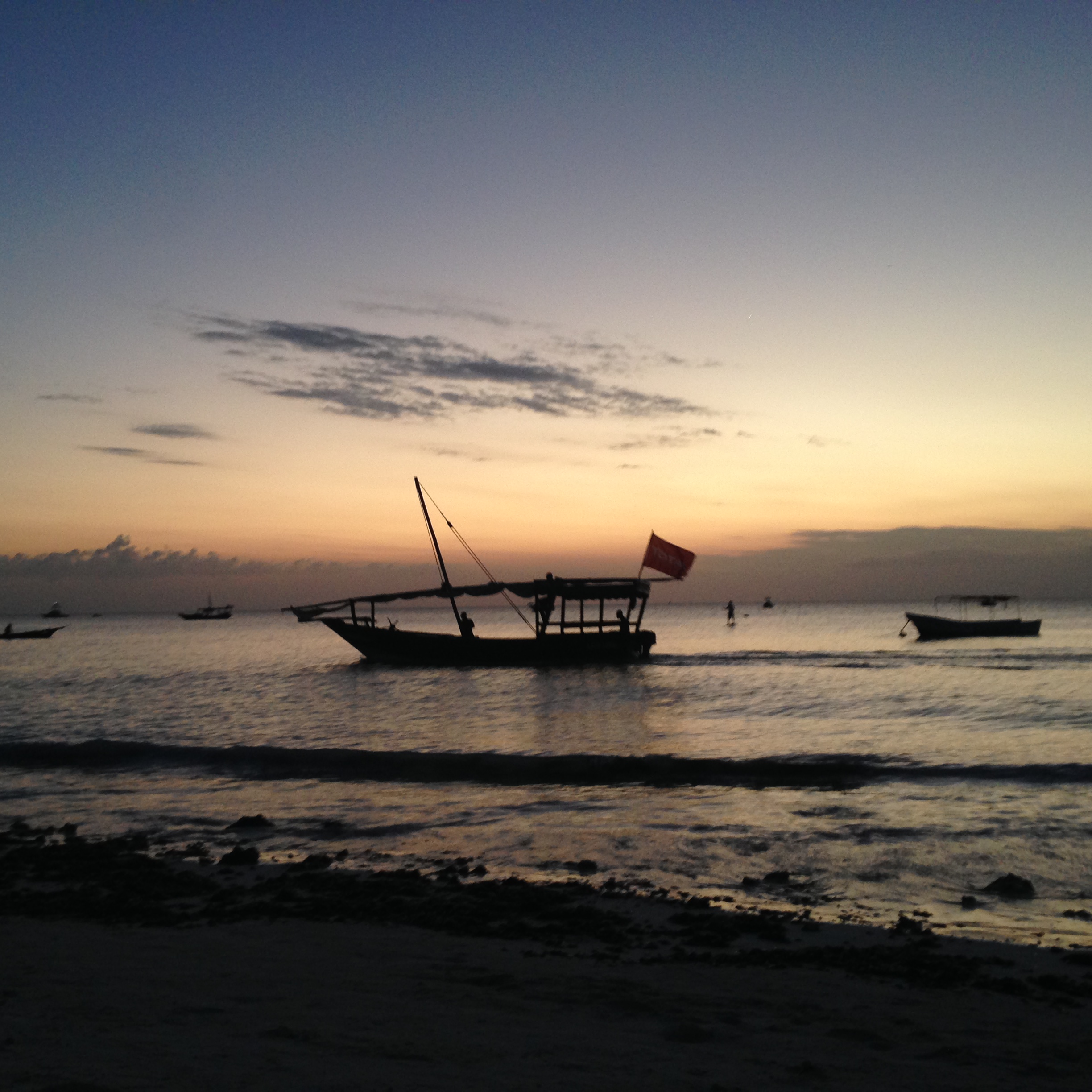
On the flight to Zanzibar, my head was in coastal Sussex. I was writing about a very English painter against a tight deadline, en route to a tropical island where time would slow down. Specifically, I was writing about Constable and little known paintings he made in Brighton during the 1820s. The beach, in those works he made along the seafront here, is grey and turbulent. But once I had emerged from the screen of my laptop, the Indian ocean was clear blue and calm.
I was not calm, mind. Two days before leaving, artist Peter Harrap, who was curating a forthcoming show about Constable, got in touch out of nowhere. He asked me if I could interview him. I was imminently departing for Sub-Saharan Africa, so I said no. Two minutes later I phoned him back and said yes. Peter sounded relieved. I felt dismayed. The next day, I called at the house in Sillwood Street, Hove, where he lived. And it was where, as a blue plaque announced, Constable too once lived and worked. We recorded his account of the forthcoming show and the wild coincidence, and I transcribed it ready for the journey.
I found air travel to be surprisingly conducive to this kind of work. By the time I reached my layover in Istanbul, the piece was already coming together. Hunger and thirst took second place to tapping away at my machine while I let a double espresso grow cold at a table on the busy concourse. By the time I reached Dar es Salaam, at about three in the morning, the piece was drafted. I was too tired even to be alarmed by the official at arrivals, who disappeared after taking my passport, and the ensuing scrum of other travellers waiting for permission to enter Tanzania.
***
Prof D was already on the ground, attending a workshop, in a vast yet spartan hotel. I waited out her professional commitments, taking an auto rickshaw into the city and seeing a compound where artists were hard at work making Tinga Tinga paintings for tourists such as us. My/our ultimate destination was, however, Nungwi, a resort on the Northern tip of Zanzibar. We took a ferry, And the sea views had competition with the in-flight entertainment: monitors all around the crowded deck were showing Rambo: First Blood (1982), a film both violent and dated. At the other end we found a taxi and completed our journey in 90-minute bumpy minutes. We crossed a bridge built with a donation from Colonel Gadaffi.
Apparently composed of a beachside strip of hotels, restaurants and bars, Nungwi presented visitors with a prospect of grey sands and the vast promise of a temperate Indian Ocean. Black sea urchins littered the shoreline like so many vicious mace heads. A fine daily schedule dictated our use of the beach: diving lessons in the AM and lurid sunsets at dusk. Diving took place first in a hotel pool, with a theoretical component in the backroom of a dive school near our hotel. D and I spent diligent hours in front of DVDs that itemised equipment, spelled out risks and underlined safety measures. We sat exams, completed medical forms, and signed disclaimers. We paid our fees, and we met our instructor. Juma had come from Kenya and he educated us on how to breathe, with therapeutic calm, when strapped to a weighty oxygen tank.
Gearing up is one of the most demanding aspects of diving. Wetsuits, fins, weight belts, masks, snorkels and aqualungs – just the ticket 20m under the sea – are an encumbrance in a local dhow, clipping along on the high seas. The second most demanding aspect of diving is getting to your feet and stepping off the side of the boat. Assembled among the waves, Prof D, Juma, and exchanged coded hand signals, as seen on the DVD, and began our descent. Little by nervous little.
Suspended in the water I found myself suspended outside of my usual reality. We divided our attention between fish, coral, and technical measures such as equalising pressure in my ear, nose and throat area. We were to breathe as calmly as possible and endeavour to stay horizontal at an acceptable depth; buoyancy is the next occupational demand to think about. Juma was with us, what could go wrong? Well, the greatest danger to divers is decompression sickness (the bends) rather than man-eating sharks. In the isolation and alienation found at depth I also feared panic. And unlike our underwater guardian, panic doesn’t promote calm breathing.
We pressed on, however. Beginning with 12m depth on a 12-minute dive to 18m depth over 35 minutes. We have since completed 20 dives and the fish sightings are a bit of a blur. So apologies. I have used AI to generate a memory for us:
“The underwater world is a symphony of shapes and patterns. Coral reefs form intricate structures that mimic branches, trees, and even underwater cities. Fish and other creatures exhibit remarkable adaptations, from the camouflage of cuttlefish to the mesmerizing patterns of butterfly fish.”
I can confirm, we saw reefs of all colours and encountered colonies of tropical fish on their own watery terms. We also saw a turtle, kind of swam with it. But if you’ve been following my substack you’ll know how much oxygen I can take up from my readers. Excited hyperventilation, my modus scribendi, took place underwater too. But as D gave me her hand as we slowly drifted along the scheduled dive path, I registered the fact I was surviving in a brand new element, anxiously happy and happily anxious in a way I had never previously known.
Despite the idyllic surroundings, both D and I were fairly abstemious on this trip. We got early nights for early starts and ate frugally at a tiny neighbourhood food shack, Mama Africa, where Masai tribespeople were more regular than holidaymakers. The food was highly inexpensive and local to this part of the world. Of the handful of dishes on the menu I recalled that one was with ‘meat’ and one with ‘fish’ with no further classification of what was to arrive on our plate. We did not drink alcohol, at least not on the eve of any of our five or six dives here. The evenings we did drink, we took cocktails made in our room to the twilight beach where we waited, day after day, for the perfect sunset.
The vast horizon of the endless sea held promise and threat. There was the promise of great beauty and peace to be found beneath the waves. There was the threat of diving incident and, even in the shallows, toxic sea creatures such as jellyfish and those sea urchins. We were not equipped with beach shoes which meant that midway through our stay we stepped on a cluster of these spiny beasts and were as comprehensively spiked as our homemade cocktails. The pain was disturbing. A hawker found us on the sands, rubbing our feet, and sold us a remedy. It was papaya, apparently. There was also a papaya tree at our hotel, which the owner shook down for us. We took the fruits up to our balcony where we pressed them onto our legs, milking the sap as a talisman against pain. The things one remembers.
Peter emailed me from Brighton to say that broadly speaking my piece for the Constable catalogue had gone across okay with the editors. There were changes, of course. In one place I had made an overclaim for the painter’s influence on Delacroix. Peter said that French art historians would not be happy with that. I began to count my chickens and realised that the amount I would be paid equalled the amount we were paying for our accommodation in Nungwi. Nice work, etc. We made further contacts with home, tapping wifi from the beachfront bars in order to speak with our five-year old and check in with her grandparents.
The third most demanding aspect of diving is regaining the surface. It entails making a safety stop at five or six metres and holding your position here for at least three minutes. Not easy, for me at least. I think one or both of us, at some point, lost our companions and/or the boat on one of these ascents. It a mild shock to find oneself alone in open water, for however little time that may be. For Juma and his team it all seemed par for the course. We were well looked after. But I always experienced a wave (no pun intended) of relief as I took hold of the ladder and, after a bit of manoeuvring, was able to pass my fins and my weight belt up to the professionals in the boat.
After five days of this routine we became PADI qualified divers, with log books, membership cards and the newfound freedom to sign up for diving expeditions anywhere in the world. This was 2016 and in subsequent years we took full advantage, even if we can no longer dive for reasons of poor health. Speeding towards our last dive in Nungwi, we got talking to a pair of hungover friends from the UK. There had been a party the night before and had to stop diving when one of them vomited underwater. They told us about a nightlife tour in which foreigners could explore Dar Es Salaam and hear local music. D took the name of the guide and looked them up online, the moment we got back to our hotel. She booked, which meant that on our last night in Tanzania, before flying out at three in the morning we were to drink, listen and even dance, if not twerk, well into the night.
On the plane home I re-opened the laptop and got to grips with my edits. By the time we landed at Gatwick, the piece was finished. At the opening of Constable in Brighton, at the Brighton Museum & Art Gallery, I was able to pick up a copy of the catalogue, which featured, as Chapter Seven, my interview with Peter. It remains a surreal keepsake from my week under the African sun and the Indian seas. I had one other souvenir which, fortunately I lost in A&E upon my return. This was a worrying swollen foot and lower leg. I suspected deep vein thrombosis after the long flight back to Europe, naturally, but it cleared up with antibiotics: an infection from sea urchin quills. These slowly fell out over the coming weeks and we lost the small black spots which testified to our adventure in Zanzibar.

4 Comments
A delightful read, diving and eating in exotic Zanzibar brought to life by a refreshingly confidential prose style. All of this bookmarked by John Constable who in a sense made the adventure.possible.
Great work.
Joe Sheerin
Thanks dad. Would love to write a follow up piece from Suffolk one day!
Fine writing, at the risk of patronising. Feels like I’m participating in these trips, but without the effort and costs. Now I want to read the Constable piece.
Thank you Micheál, I go on holiday so readers don’t have to. That’s the idea 😉