<h1>Archives</h1>
    20th century, murals

    Photo diary: murals in Derry and Belfast

    March 25, 2013

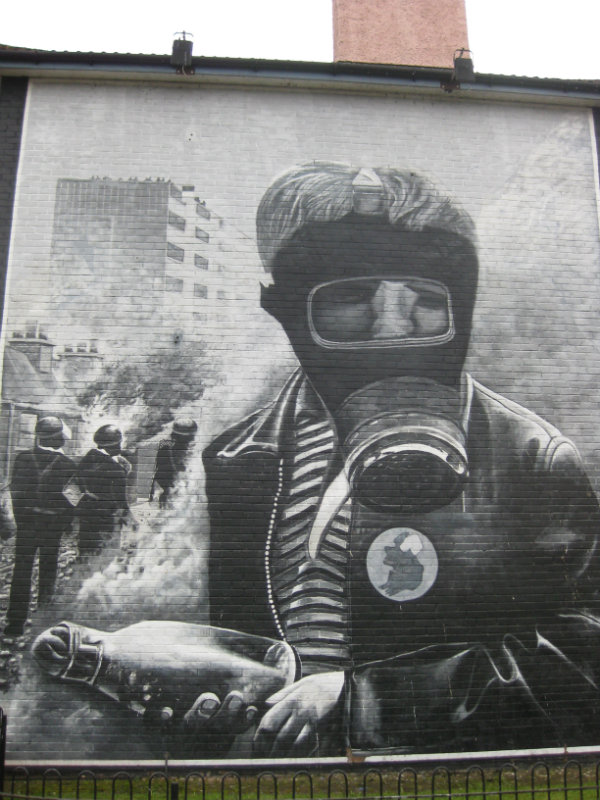
    This weekend, I was on assignment in Derry-Londonderry, UK City of Culture 2013. I’ll write about the gallery going elsewhere, and for the time being post a few photos of politically charged street art.

    martyr's families

    Above is a mural on the wall of the Museum of Free Derry. Behind the subject and the illustrated bullet holes you can see a real rifle shot taken by the wall at the time of Bloody Sunday.

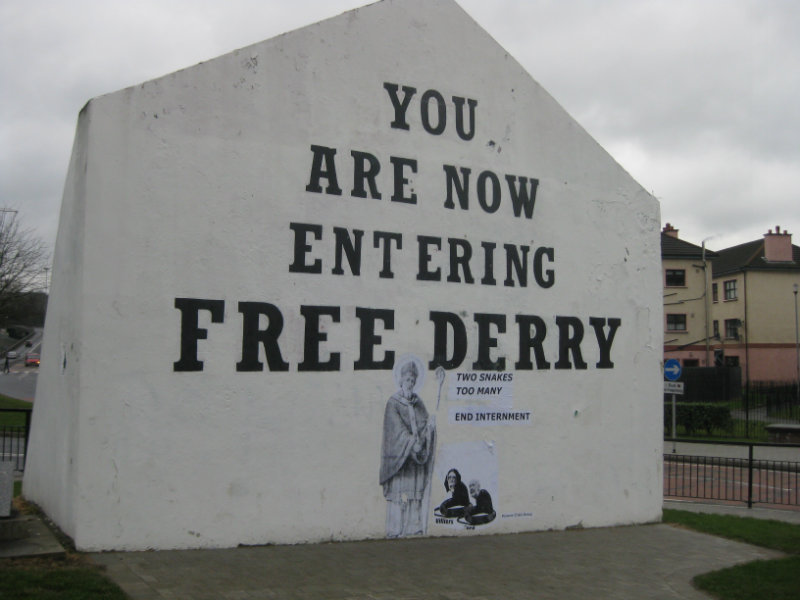
    free derry

    It’s not a strand of history they taught at my secondary school, but between 1969 and 1972 the Catholic inhabitants of Bogside established themselves as a state within a state.

    free derry 3

    This was Ireland’s taste of the times that were a-changing, a militant civil rights movement which drew inspiration from the Prague Spring and the steps made towards racial equality by Martin Luther King.


    free derry 4

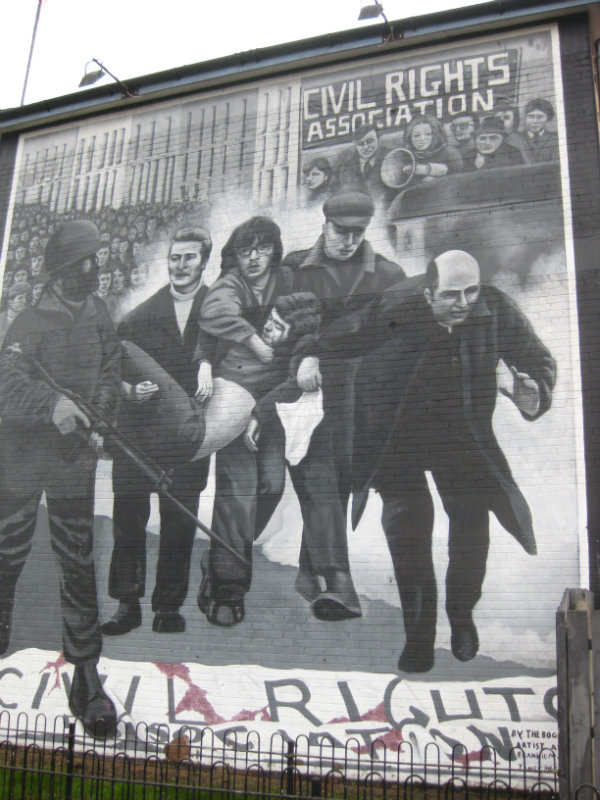
    But on 30 January1972, British paratroopers opened fire on a civil rights March killing 13 people. This mural is based on the iconic photo of Father Edward Daly waving a blood stained white handkerchief.

    free derry 6

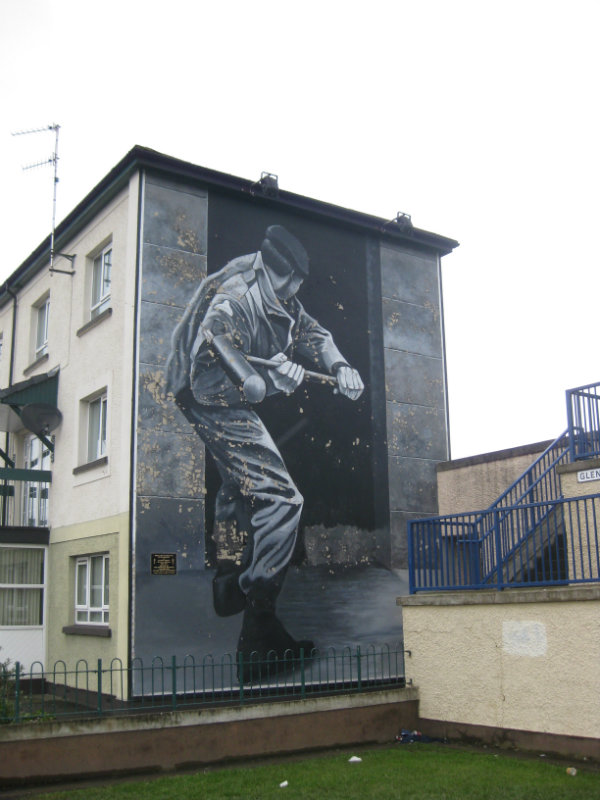
    Ultimately, the Bogside residents’ rent strike, rates strike and general insurrection proved too much for the government. Tanks were sent to clear the barricades and this mural depicts that operation.

    free derry 5

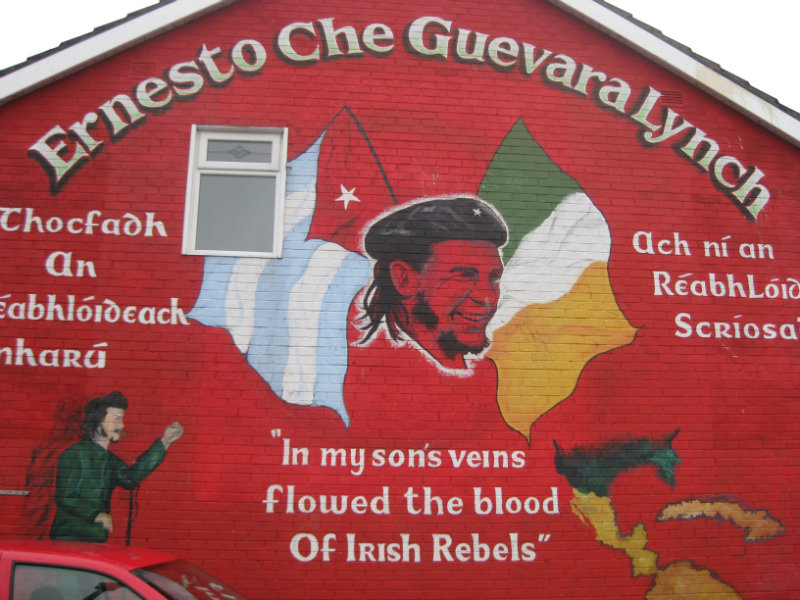
    To the local community and with varying degrees of optimism, Free Derry was a place in time on a par with Cuba after the revolution or Palestine as is today. (Che could have played football for Eire.)

    free derry 9

    Here you can see a rendering of Guernica on the wall of the Museum of Free Derry. Staffed by relatives of victims of the conflict, this great little museum is soon to be expanded.

    belfast 6

    Pictured above, and 60 miles away in Belfast, Picasso’s masterpiece gets a more faithful tribute, except this time with the inclusion of an inset featuring Hugo Chavez.

    belfast 10

    This was also on the Falls Road, an image of Ciaran Nugent, first political prisoner to go on a blanket protest against the implications of a prison uniform.

    belfast 3

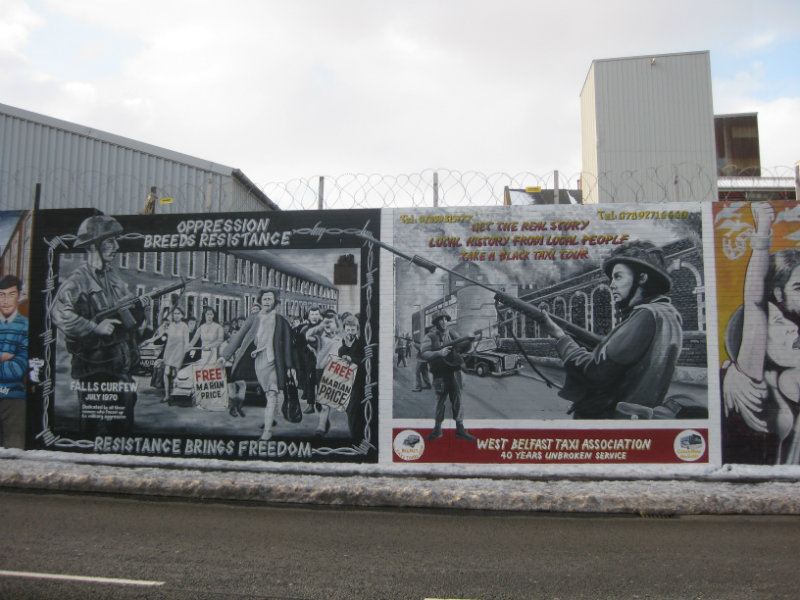
    You can see Belfast is a bit more confrontational than Derry. The mural on the right carries an ad for the West Belfast Taxi Association, which has roots in the Catholic community.

    But the cab which took me round the mean streets of Belfast was not WBTA. This may or may not have provoked our snowball attacks by local kids. No harm done.

    I don’t want to give the impression that Nationalist murals are the only show in town. There are plenty of blogworthy paintings by Unionists. I just didn’t get the pictures.

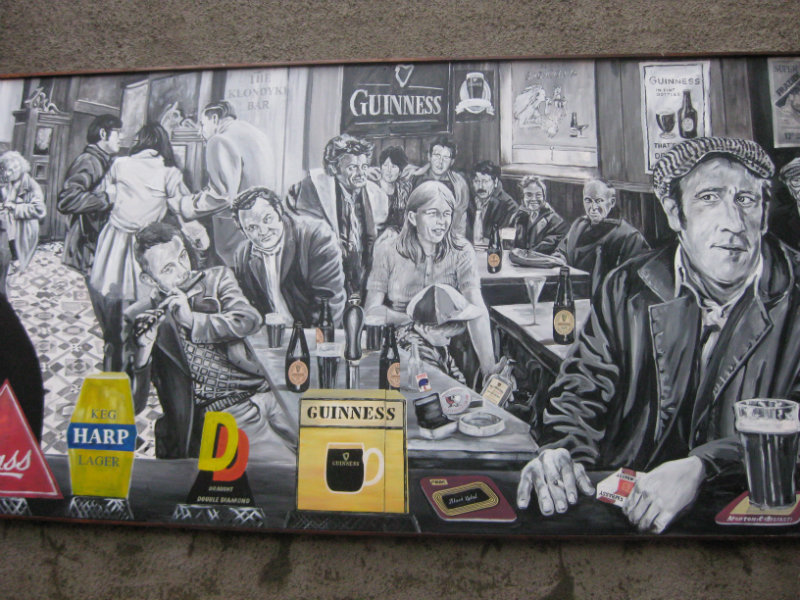
    It was a fantastic weekend, and I can only end on a positive note. Below is a mural of Belfast pub life in a courtyard across from the Duke of York. Do raise a glass to the future of both cities.

    belfast 1

    aggregation, contemporary art

    Found Objects 18/03/13

    March 18, 2013

    Salutations. This week’s art links are the usual mix between the topical and the wondrous.

    • Topical: Here’s a sad story about the death of young Dominic Elliott, friend and assistant to David Hockney. The Independent reports.
    • Also topical: the Guardian send music critic Alexis Petridis to review the record-breaking Bowie show at the V&A.
    • Highly topical: a social minded architect from Japan has won the Pritzker Architecture Prize. Read about Toyo Ito in the New York Times.
    • Sadly topical: the Guardian suggests that an education secretary who doesn’t like architecture very much could learn a thing or two from Oscar Niemeyer.
    • Also with news currency, the Art Newspaper report that US has taken back the topspot in terms of art sales, from China (via Art Observed)
    • Here’s something wondrous: photos of a lightning storm during the eruption of a volcano in Japan. Animal NY collates.
    • Also quite cool to look at is this slide show of cowboy rephotographs by Richard Prince together with a Western soundtrack. This is almost not ironic.
    • This is link of the week: Beautiful/Decay showcases the work of Gabriele Galinberti, who shoots portraits of kids along with their most prized possessions.
    • Quietly wondrous: Art Wednesday interviews Polly Staple from Chisenhale Gallery. Amazing role call of debut shows.
    • And very much finally. This photo of confiscated bootleg pharmaceuticals in China is both topical and wondrous. Thanks to Der Spiegel.

    contemporary art, sound art

    Kaffe Matthews and Mandy McIntosh, Yird Muin Starn, 2013

    March 15, 2013

    moon-us

    Given the vast technological resources made available to those who wish to explore outer space, an analogue vinyl album seems like a less than adequate way to respond to the cosmos.

    But in fact Yird Muin Starn is comprehensive in its dealings with such matters as star constellations, the Apollo missions, lunar cycles, the Pioneer probe and supersonic air travel.

    The LP opens with a spoken word account of the landing of the Possil meteorite, which fell on the outskirts of Glasgow in 1804. So space cannot be ignored even if you were a 19th century Scot.

    Other standout tracks include an Old Scots poem called Tae the Moon, which reads brilliantly even if a bit incomprehensible at time. Yird Muin Starn transates as Earth, Moon, Stars.

    Flying to the Sun is just as witty. McIntosh’s vocal gets out of sync until Matthew’s drops a stalking bassline on the track. This underpins the humorous narrative of an eight year voyage to the sun.

    Elsewhere vocals take a back seat to make way for instrumental tracks such as Betelgeuse to Rigel, Star Stream or Seven Sisters. These sound improvised or generative, whether they be or no.

    Penetrating tones, solar wind interference, electrons rattling in a tube, re-entry static, early home computing tones, liquid silver: these are all the impressions which Yird Muin Starn leaves you with.

    The album may be challenging at times, but it is never without humour and interest. You can learn much from this collaboration between artists Matthews and McIntosh.

    You may not have been aware that the moon is slowly working its way free of our orbit; or that the woman on the pioneer plaque is missing an intimate part of her anatomy. I hope both facts are true.

    But when you’re strapped for cash, you need a bit humour to explore outer space with. Yird Muin Starn also gives its name to a public artwork by the duo in Galloway Forest.

    This site is Europe’s first Sky Park, with zero light polution and reclining Sky gazers where you can sit back and voyage to your hearts content. There are even space suits you can book out.

    It sounds like the most fun you could have with someone else’s clothes on. Were this blog not composed in South East England, I’d be there like a shot, with headphones rather than a telescope.

    Yird Moon Starn, the album is available from the Annette Works label. More info on the project can be found here.

    contemporary art, mass media, sculpture

    Huw Bartlett, Harry from Ikea (2013)

    March 13, 2013

    harry

    It’s a freedom of speech issue. If you are a global corporation like IKEA you can afford to take out a full page in a national broadsheet. If you are a little known artist you can barely afford to reply.

    What IKEA tells us some 200,000 times at a go is that Harry’s passion now runs to several metres: “Harry’s passion for music has reached new levels,” the headline informs us, “Floor to ceiling.”

    In other words, his record collection has been housed by the Swedish furnishers. There he stands, stunned by his newfound archive, his one passion definitively domesticated.

    Nevermind that Harry doesn’t exist. He is an arbitrary name pinned on an aspirational model. The headline is a lie or a fiction; there should be no place for either in the Guardian.

    Bartlett’s response is to the claim is to rip out the page and recontextualise it. So Harry’s new place of residence is taped onto a disassembled and upturned IKEA table in a non commercial art gallery.

    If it wasn’t already clear where to look, Bartlett has sheathed a wooden stick in foil and pointed it in the direction of Harry, whose only aim in life is to entomb himself in vinyl.

    Bartlett describes himself as a sculptor and treats the daily paper as a 3D object. His work relates to both the everyday materials of Arte Povera and Gustav Metzger’s engagement with Page Three.

    What both artists demonstrate is how little mass media can survive scrutiny in an art gallery, be that the hallowed chambers of the RA or the down at heel basement premises of CAC.

    This is surely payback for all the nausea of consuming media. The Harry ad is not half as smart as it thinks it is. But at least some dozen visitors to a Brighton gallery can see that for what it is.

    Disclosure: Bartlett describes himself as an anti-copywriter whereas I have plied the dreaded trade in earnest before now. It was inevitable that Harry and his ilk would come up at some point.

    Harry from IKEA was a centrepiece at recent Work Project 7, Community Arts Centre (CAC), Brighton. It was on show last weekend only. Sad face 🙁

    aggregation, contemporary art

    Found Objects 11/03/13

    March 11, 2013

    Greetings from snow-gripped Brighton. Here’s my weekly selection of links better not missed:

    • Firstly, everyone must see this Fox News report as discovered by Art Fag City: George W. Bush as an emerging artist
    • Still Stateside, I enjoyed at least two reports about the Armory show in New York, both from Art Info: the first about a spate of freebie Warholesque Brillo Boxes, the second about some critical work by Liz Magic
    • Meanwhile in the UK and on the pages of The Telegraph, Mark Hudson muses on the fact that the Duke and Duchess of Cambridge have been urged to collect contemporary art. But of course, they would have to buy British
    • Another state of the nation type link: an iconic Picasso currently on show at the Courtauld is due to leave these shores for Qatar. Story in the Independent
    • Obligatory reference to Bowie coming right up: Jon Savage writes in the Guardian about a historic meeting between the other worldly singer and William Burroughs
    • Fans of Twitter and/or great writing would do well to follow @tejucole. Here’s an interview with the Nigerian/American micro-blogger and novelist from Mother Jones (Thanks @johannhari101)
    • Meaning to see this show, but in the meantime there’s a positive review with some great unearthed quotes on art-Corpus: Carl Andre at Turner Contemporary
    • This must be every art buff’s dream. The curatorial team at the Met bought a $700 dollar copy of a painting by David. But not before spotting it was a preparatory sketch worth six figures
    • Phaidon write up a new piece of public art in Hyde Park. Two precarious rocks by Fischli and Weiss on show for the time being outside Serpentine
    • Not content with mining uranium, uranium miners in Australia are threatening much celebrated sites of Aboriginal rock art. The Guardian reports.

    contemporary art, film installation, geopolitics, marxism

    Amanda Beech, Final Machine (2013)

    March 7, 2013

    Amanda Beech

    Left-leaning liberals from middle class homes should hate the discourse which runs through Final Machine by Amanda Beech. Instead it could give them a masochistic thrill.

    The action runs fast, the soundtrack faster. This is punctuated by gunshots, not always easy or even possible to follow the arguments. But you catch enough to get the gist.

    Here is a celebration of black ops. There is a justification of real politik. The American drawl adds to the flavour of tooled up expediency. Everything we know is wrong, in the world of this piece at least.

    But no one should be surprised if we have had to leave some of our humanistic tendencies at the door of LGP. The script, for there is a lengthy one, comes in part from CIA training lectures.

    And it’s been sliced together with the text of a book by philosopher Louis Althusser. So they might even trick you into signing up. Come for the Marxist theory; stay for the right wing coups.

    Visually the piece is just as enticing/compelling. It unfolds on three consecutive screens: red, amber, green, just as if arranged to programme us to GO.

    Because you will see things you won’t forget: RVs gathering to sinister purpose in the Mojave desert, modernist architecture lost in unspecified jungle, a highway running through nocturnal Miami.

    The impression of spy craft is enhanced by the visual motif of the moving circle behind which the action unfolds. You half expect a corrupt, brutally pragmatic Bond to appear with revolver in hand.

    He doesn’t but the piece goes on. The bullet reports are exhilarating: perhaps not meant for us, at least not yet. Movie goers will side with anyone, given enough aural popcorn and visual punch.

    Final Machine can be seen at Lanchester Gallery Projects, Coventry, until 31 March. See gallery website for more details.

    aggregation, contemporary art

    Found Objects 04/03/13

    March 4, 2013

    Here are the week’s most interesting art links as chosen entirely subjectively:

    • After finding horsemeat in ready meals, one wonders which artworks might be contaminated. Fortunately The L-Magazine has checked the situation out.
    • Well, this looks entirely brilliant, perhaps inadvertently so: a breathing statue of Lenin has gone on show in Moscow.
    • New York Times gives a decent write up of a Cyprien Gaillard show, decent in as much as it contains gloomy visual poetry.
    • Still in NY, it might be worth checking out Andrew Sendor at Sperone Westwater. Art historian Ben Street has good things to say about the artist.
    • Meanwhile, we in the UK have Manet at the RA, which is slated by The Flaneur who point out, quite reasonably, that a certain amount of contextual gossip would not have gone amiss.
    • Such to-ings and fro-ings are well represented by a new show in Washington DC. Daily Serving reports on the links between Jackson Pollock, Jean Dubuffet and Alfonso Ossono.
    • Gossip in Bridlington meanwhile may well revolve around the fact that famous son David Hockney is reluctant to receive the freedom of his Yorkshire town.
    • Another story from the Independent finds Dominic Lawson arguing against free admission for galleries and museums. Arts mafia paranoia.
    • In another engaging think piece, Jonathan Jones gets upset about the mere thought of a statue of former prime minister Margaret Thatcher.
    • If you remember a band called 23 Skidoo you too might get upset about that woman, but are liable to find this piece about painter William Turnbull of great interest.

    contemporary art, religious, sculptural portraiture

    Oliviero Rainaldi, Conversazione, 2011

    February 27, 2013

    conversazione

    Everyone loves a good car crash in the art world where no one really gets hurt. Last year we thrilled to the saga of Beast Jesus. The previous year this statue of Pope John Paul II became infamous.

    Critics said it looked like Mussolini. The artist reworked it to produce the version you see here. But then critics said it looked even more like the Italian dictator.

    It seems that in Italy, papal portraiture comes under a similar level of scrutiny to royal portraiture in this monarchical island of ours. Who will ever forget the first official picture of “Kate”?

    What the photos don’t prepare you for is the location of this high profile piece of public art. It is out front of an unlovely bus station, more of a municipal than an ecclesiastical gesture.

    Personal first impressions of the work were not too bad. The former pontif looks kindly at least. His robe is embracing. It welcomes you as surely as the arm-like colonnades of St Peter’s Square.

    But if you stop to consider it, there’s a mysterious darkness behind the drapery. We cannot avoid the impression of secrecy, the hint of that horrendous cover up of which many accuse the church.

    An awestruck visit to the Vatican does much to dispel any accumulated cynicism, mind you. Here you will find evidence of an ongoing patronage of the arts without which Catholicism might not be what it is.

    The expression broad church surely comes to mind as the tiny state’s museum includes a study for Francis Bacon’s screaming pope and more than one statue to the Egyptian god Thoth.

    In the ethnography department, you come across a photo of John Paul II with a koala no less. A previous holder of the highest office in this faith could not look more cuddly if he tried.

    But had Rainaldi chose this image, it would surely have been hailed as the epitome of religious kitsch. So he went for something abstracted and paid the price.

    You realise it would have taken some miracle to escape from Michaelangelo and Bernini in this city. They too are waiting in the heavily draped wings here, casting their shadow over the present.

    You can read more about the unenthusiastic reception of Conversazione in Huffington Post here.

    chess, Dada, modern art

    Marcel Duchamp, Portrait of Chess Players, 1911

    February 26, 2013

    duchamp

    Unlike a piece of writing or a piece of art, it is easy enough to get started with a game of chess. The game of kings offers a limited number of openings. You might never use more than a couple.

    For this reason, and several others, most creative people should envy Marcel Duchamp. He turned up, changed the course of art history, and well earned his retirement in the finite maze of chess*.

    What might surprise many to his current exhibition at Barbican is the casually mentioned fact that Duchamp was so good at playing chess, he represented France on the international stage.

    But the rumour that he gave up art turns out to be an exaggeration. As you can see from the painting above, chess could not completely satisfy even the most cerebral and conceptual of artists.

    Having said that, unless we be grandmasters ourselves, it is no easy matter to explain Duchamp’s fascination for the game, beyond such vague notions of strategy, lack of chance, competition.

    One of the exhibits is a travel chess board which he made himself so it might after all be fair to say he loved the game as a means of passing time, perhaps of killing it altogether.

    Musician and artist John Cage was not much of a chess player. He asked Duchamp for lessons and the older man humoured him by playing him off against his wife Teeny. Nice move.

    There is little room for creativity in chess. Even the longest or strangest games are little more than an all-consuming puzzle. Why then does this engagement of Duchamp capture the imagination?

    Perhaps, because the artist draws you or me into a dizzying world of gambits, forks, sacrifices and checks. The beauty lies in the patterns of endless play, not in the appearance of the board.

    Other artists have dabbled in chess: Yoko Ono, Alighiero Boetti. During the cold war it was perhaps the perfect expression of geopolitical realities which are now more various.

    But in rising to the top of two chosen fields, Duchamp outplays everyone. We emerge from the show in London, like Cage et al, as satisfied as any defeated opponent.

    Portrait of Chess Players can be seen in The Bride and the Bachelors: Duchamp with Cage, Cunningham, Rauschenberg and Johns showing at Barbican, London, until 9 June 2013.

    *I have a conversation with friend Simon Kirkham to thank for this observation.

    aggregation, contemporary art

    Found Objects 25/02/13

    February 25, 2013

    Sorry for lack of postings of late. I’ve been on a short break in Rome. Keen observers will find this reflected in my first two chosen links of the week:

    • In any other country he would surely be unelectable. Not so in Silvio Berlusconi’s Italy, from where Der Spiegel recalls the following gaffes.
    • As luck would have it, the Sistene Chapel was still open. It’s beyond amazing, as are the Raphael frescoes in the rest of the Vatican Museum.
    • Back on these shores was an opening of Lichtenstein at Tate Modern. Laura Cumming hails the visual ingenuity of the man
    • This is hilarious even if your French is as basic as mine. Marcel Broodthaers interviews a cat about art.
    • This too is very funny, and certainly basic: a new strain of teenage bvehaviour known as gallon smashing. Animal NY compare the kids involved to Marina Abramovic
    • The tasteful folk at Pipe blog compiled their ten favourite films. Here are the top five; more under ’older posts’.
    • The Telegraph have an exclusive slide show from what looks to be the V&A’s biggest ever show: a look back at the visual world of David Bowie.
    • Smithsonian blog about photographer Thomas Shahan who does PR work for arthropods. Seriously.
    • How to catch an art thief: offer them a plum job in a gallery. Another one from the Telegraph.
    • Finally, prepare to be charmed by a time lapse film about the staging of a new Murillo show at Dulwich Picture Gallery. Not to be missed, it seems (via @mbadeane).