<h1>Archives</h1>
    aggregation, contemporary art

    Found Objects 05/05/13

    May 5, 2013

    It’s beach weather here in Brighton, but first aggregated art links for a Bank Holiday Weekend:

    • How could a show with such a title be anything but great. Read about “Ain’t Painting a Pain?” by Richard Jackson at Orange County Museum of Art
    • Billions and billions of stars are now available for viewing at Apexart in New York for the “Slack-jawed wonderment” of all who drop by
    • Some more committed Russian protest art, this time from student Peter Pavlesnkiy. He’s stripped off and wrapped himself in barbed wire. Wince
    • It surprised me to learn that Bedwyr Williams is an official druid. Karen Wright visits the artist in his studio ahead of representing Wales in Venice this year
    • Michael Jang’s family photos are better than most. American Suburb X post a hugely enjoyable gallery of his kin larking about
    • Madrid’s Reina Sofía to show more than 200 works by Salvador Dalí. I for one would be quite ok with the legendary surrealist coming back into vogue
    • The Hammer Museum in LA is showing an exhibition of sculptural oddities by Enrico David. Contemporary Art Daily has the pics
    • Tracey Emin is interviewed at length about love, growing up and Louise Bourgeois. Art Info carry the three page story
    • Blogger Chloe Nelkin has clearly enjoyed Tate Modern’s low key show of 97-year-old Lebanese artist Saloua Raouda Choucair
    • Henri, the Existential Cat, has made a new film for the Paris Review. I think I’ve linked to him before but he is fantastique.
    artist talks, contemporary art, psychoanalysis, Uncategorized

    Interview: Martin Creed

    April 30, 2013
    (c) Jason Schmidt. Courtesy the artist.
    (c) Jason Schmidt. Courtesy the artist.

    Anyone with more than a passing acquaintance with the practice of artist Martin Creed will know all about the fastidious numbering of his works. These begin with Work No.3 in 1986 (a yellow painting) and so far stretch as far as this year’s Work No. 1461 (an installation made with adhesive tape).

    What might surprise you is that Creed’s appetite for order and record keeping extends to collecting sound files of every interview he undertakes. So when I catch him on the phone a technical hitch at his end throws the methodical artist.

    “Wait, are you recording this?” he wants to know. “Can I get a copy of it?” And after the giving and receiving of assurances that I will later send him an MP3, we are ready to continue. It is quite clear that Creed takes the business of talking seriously.

    This bodes well for those lucky enough to find themselves at the Freud Museum during Museums at Night 2013. On Thursday May 16 the Scottish artist will be on the spot, if not on the couch, as he improvises an after hours lecture, with the help of slide projections and a bit of music.

    “It’s hard to do things,” he says. “Everything seems just as difficult as everything else: it’s just as much work to try to talk and say something that I think is alright as it is to try to fix and be okay with the shapes or colours in a painting or a sculpture or whatever.”

    Creed refuses to be drawn about finer details pertaining to the evening: “I’m not sure — I’ll probably try just to think out loud and talk about whatever comes up”.

    But he does admit the event should resonate with his newfound surroundings. “Absolutely, aye,” he says, “I do psychoanalysis and I’m a fan of Freud. Yeah, I have been [in analysis] for a very long time.”

    Creed reveals he first saw an analyst in 1993: “I did it because I was desperate. I wanted to speak to someone.” Now he goes four times a week. “It’s a bit like going swimming or something like that: I think it’s an integral part of my life.”

    At any rate, intensive therapy is clearly commensurate with a blue chip art career. This most exacting of artists views the activity as labour: “It’s work and I feel like I have to keep doing it.” This may come as some surprise, considering how effortless the artist’s official numbered works appear to be.

    In 2001 he won the Turner Prize for Work No.227: The lights going on and off.  It is hard to imagine a more coolly minimal work than an empty room alternating between light and darkness. Creed has a professional detachment which belies his sometime inner turmoil.

    Nevertheless, when he agreed to take part in Museum’s at Night, the Freud Museum was his first choice. “I’ve always liked visiting there. I feel like it’s a nice place, you know?” he says. “Just seeing the consulting room and the stuff he had around.”

    But for someone with experience of therapy, Freud’s consulting room might be something of a lion’s den. Therapy and performance are bound to overlap in such a historic setting. And what to make of the rumour that the founder of psychoanalysis didn’t even like music.

    “I didn’t know that but I don’t believe that,” Creed is adamant. “And if he said that I don’t believe him.”

    So then, what would Freud have thought of contemporary art itself? Surely he would have hated it? “I don’t know, maybe,” says Creed, then adds with a laugh: “I don’t know if I like it”.

    But I remind the controversial artist that he once suggested that visitors should run around museums to see exhibits at speed. “I personally hate feeling as if I have to spend ages looking at things, as if I’ve got to be a good boy and read all the labels.

    “The thing I like about museums is that you can come and go as you please, you know, especially if it’s free to get in,” he adds. “I like being able to go into a gallery and just see one painting and then go out again. I like that about galleries, as opposed to theatres where you’re stuck in your seat.”

    This sense of duty is something the artist wrestles with in his work. With regard to public speaking, he refers to “the feeling I have to take responsibility, the feeling that I’m responsible for everything I do. It has repercussions because it affects other people.”

    “Included in that feeling is a feeling of not wanting to be…sort of fake…because I sometimes have the feeling when I’m talking or when I’m working that I’m doing something somehow conventional — the usual — as if I’ve been programmed. I don’t want to be like that and it feels like a fight not to.”

    As you can see, as a veteran of psychotherapy, Creed knows how to dissect an emotion. But strange to say, he aims to bring the results of such introspection back “into the world out of my little room on my own, because it’s scary and exciting and maybe it’s the way I learn about things really.”

    “Basically I don’t want to be a w***er sitting at home, and actually I think that’s probably why I want to do exhibitions and gigs and talks and stuff — to basically work on things in the world outside of my own domain, to get out of the house” he says.

    This calls to mind the celebrated slogan of Work No. 232, ‘the whole world + the work = the whole world’. It is something of a koan which makes you wonder about the unconscious origins of art or music. The metaphorical lights are sure to go on and off and on again when Creed does his thing.

    Advance booking required for the May 16 event at the Freud Museum. Visit the gallery website for more. Piece written for Culture24.

    Uncategorized

    Found Objects 28/04/13

    April 28, 2013

    There’s a political and a performative flavour to Found Objects this week, read on and enjoy:

    • Scriptonite blog plays tribute to an incredible stunt by the soi-disant Artist Taxi Driver, as backdoor privatisation hits the NHS.
    • We Make Money Not Art has interviewed Liberate Tate, and its happy to play devil’s advocate on this issue of corprorate sponsorship
    • God only knows how this came about, but the US President and Steven Spielberg have both taken part in a genuinely funny skit
    • Meanwhile NYC mayoral candidate Jimmy McMillan has released a bass heavy rap anthem to support his campaign. See the video on Animal NY
    • The final ruling on the Cariou v. Prince case appears to be in, with the former winning an important victory for appropriation art. See Hyperallergic
    • Back in the UK the Turner Prize shortlist has been announced. Most of the attention has gone to comic genius David Shrigley
    • Marseille is the 2013 European Capital of Culture. Observer journalist Vanessa Thorpe enjoys some sun
    • In case you’re wondering what kind of contemporary art Jonathan Jones actually likes, the answer can be found in this piece about . . . Matt Collishaw
    • Great premise for a blog. Art in Common is mapping and commenting on all the public artwork in New York. Check out this piece on Barbara Hepworth
    • Finally, churchtanks. I’ll say that again, churchtanks. If you’re still none the wiser pay a visit to Beautiful Decay for the chilling new face of modern warfare.

    Uncategorized

    Found Objects 21/04/13

    April 21, 2013

    A depressing week for current affairs not least for lack of art angles:

    • Instead we have a link to a Q&A with a very terse William Eggleston from the Independent
    • Meanwhile a serious critique of some watercolours by less radical artist, Prince Charles
    • Hennessy Youngman has released this half hour cut of so-called CVS Bangers. It is tres amusant
    • Astute readers will notice my use of French. Well, I’ve been inspired by Artnet’s contemporary art glossary
    • A joy forever: John Hamm, aka Don Draper, popped into Sesame Street to explain the meaning of the word sculpture
    • The harmless school of advertising: DDB Paris have scooped a D&AD award with a clever literacy campaign
    • Great minds think alike, but which great mind said it best. Whoworeitbetter plays snap with art (via AnimalNY)
    • Someone has lovingly animated an interview with the late great David Foster Wallace. See Brain Pickings
    • From sublime to ridiculous, this week also saw the arrival of a monkey fart as art. See Hyperallergic
    • And from the ridiculous to the ideal: a wooden slide in a library which doubles as a screening room.

    aggregation, contemporary art

    Found Objects 15/04/13

    April 15, 2013

    Hello, it seems Spring has made a belated appearance. But if you’re not already enjoying the sun, here are some art links:

    • Criticismism is sad this week (having learned that Catalan film director Bigas Luna is no longer with us). The Tit and the Moon is a personal favourite movie
    • Timothy Taylor have an Antoni Tapies show and Contemporary Art Daily has a fine selection of installation shots. So more Catalan art here
    • Next time you see a record breaking art sale make headlines, think twice about the health of the art market. Art Info tells you how to read those hyperbolic stories
    • Salon carries disturbing news about a Beatles bootleg called “No Pakistanis”. The song eventually became “Get Back”. This story’s wild
    • Stuart Jeffries from the Guardian spends time in a shed with Bedwyr Williams. The Welsh artist is always good for amusing observations
    • New York Times, meanwhile, interviews Claes Oldenberg and finds an Old World European sensibility at work in the poppy hamburgers and ice cream cones
    • This is pretty dumb and also pretty amazing. Hyperallergic record the Rembrandt-themed flashmob which launched the re-opening of the Rijksmuseum
    • Musical interlude: AnimalNY brought you a tuneful supercut filled with the movie world’s best computer hackers. Secure your mainframes
    • This is a good Q&A with an inspiring array of reference points: Lizzie Homersham interviews Salvatore Arancio for Aesthetica magazine
    • And finally, Jill Steinhauer appears to blame the market for the rise of middlebrow art. She makes clear what is and what isn’t in this piece for Hyperallergic.

    aggregation, contemporary art

    Found Objects 08/04/13

    April 8, 2013

    Hello and welcome to another round up of art-related links culled from the last seven days:

    • Here’s a piece about death etiquette from the Guardian. Did have a link to the Heffner song, but paranoia struck.
    • Film critics are generally more greatly missed that politicians anyway. Here’s a kind letter the late Roger Ebert sent to once very young fan Dana Stevens, now movie critic at Slate
    • Unequivocal good news: the rebuilding of the Rijksmuseum is a triumph. Enjoy this spacious look around with @FisunGuner from The Arts Desk
    • Der Spiegel writes about the growing importance of the cultural sector in Amsterdam and European cities beyond
    • @cmonstah flagged up a shocking interview with architect Denise Scott Brown. If you didn’t know much about her, here’s why…
    • When rural idylls go bad… the Guardian report from the trial of Graham Ovenden, the 70-year-old artist accused of child abuse
    • Unicorn chaser might be needed after that. How about this daft contraption for sending emails via your flying V guitar
    • Smithson write up a design history of the chess set. Could the game be making a comeback? Well, with a bit of help from Pentagram…perhaps
    • Whether or not you like contemporary dance, this deserves a look. Dancer with osteoporosis Claire Cunningham incorporates crutches into her performance
    • Reading Ben Street on painting is a close second best to actually looking at painting. Take this essay on Kiera Bennett, for example.

    aggregation, contemporary art

    Found Objects 01/04/2013

    April 1, 2013

    Happy Easter/April Fool’s Day/interminable winter. Here are some seasonable links from the online world of art:

    • What might happen if Guernica came back to Britain today? Nigel Wheale writes an intriguing account of the painting’s first and last visit to these shores
    • He lives in NYC, goes to 30 exhibitions a week, and still critic Jerry Saltz worries he might be getting out of touch. Read his alarming piece on the death of gallery shows
    • An artist makes a very strong statement as to why she should never have to make another artist’s statements. A must read for practitioners everywhere from Hyperallergic
    • Ruth Ewan gives Radio 4 a truly Utopian vision, even if it does get a little far fetched towards the end. But that’s what comes of working with teenagers (via @StudioVoltaire)
    • Beautiful/Decay write up a Dutch sound sculpture which takes on an aspect of Eindhoven’s history of manufacturing. Features musical cigars
    • It’s not quite kittens in boots, but We Make Money Not Art couldn’t resist these photos of dogs in cars, and neither could I
    • Here’s another piece of spectacle: two famous Nick Caves come face to face in New York where one was staging an art performance the other a rock music gig
    • So as to get anything done, the only way I enjoy console games is vicariously. But this YouTube review of BioShock Infinite could tempt anyone
    • The strange story of the week was that a Picasso through which owner Steve Wynn had once put his elbow sold for more than he paid for it. See The Independent
    • If you’re younger than 70 and you still haven’t made it in the art world, do not despair. Art Info notes a trend for pension-age breakthroughs by no less than six now well known artists.

    contemporary art, performance art, rock music

    David Lamelas, Rock Star (character appropriation), 1974 (Detail)

    March 29, 2013

    Lamelas

    One of the best opening paragraphs I know is found in Great Jones Street by Don DeLillo. The novel meditates on a certain type of fame distinct from that enjoyed by either statesmen or kings.

    No, this type of fame, “a devouring neon”, involves: “Hysteria in limousines, knife fights in the audience, bizarre litigation, treachery, pandemonium and drugs.” Yes, it is a book about a rock star.

    Artist David Lamelas would surely recognise this checklist. It is all there in this work in which he appropriated the spotlight from a field of endeavour completely different to the visual arts.

    The Argentine sculptor has dressed down for his role, borrowed a guitar and stolen the stage from an act like the Doors or Creedence Clearwater Revival, certainly something rootsy or bluesy.

    In other words he attempts something authentic, because rock is obsessed with this quality. Its stars are queuing up to prove their convictions with overdoses, dependency issues and disappearances.

    Lamelas makes a series of these photos, which serve as a record of a performative frenzy that never was. He pulls it off without having to compose, to practice, to endure life on the road.

    “If the purpose of the photographs was to explore an element of fantasy, they were a triumph. Although his rock star was a cliché, he was totally convincing,” writes Stuart Morgan in Frieze.

    But the results work on the viewer in a strange kind of silence. They cast us as fans, and extrapolate us as if we were in the pit of an auditorium, shoulder to shoulder, with hundreds.

    Cue difference between rock and art, between the sharing of a ritual and the private consumption of a thing of beauty. Rock Star harks back to a neolithic time when no distinction could be made.

    There’s a big trade in photos like this of real musicians. They adorn the walls of well-to-do fans who have outgrown their student posters. Why not? It’s an aesthetic choice you can’t argue with.

    Yet with sculptural rigour, Lamelas has distilled a whole genre of music to a partially seen figure in the darkness with two props and a glaring light. Like Brancusi, he gives us the essential.

    The entire Rock Star series can be seen in Glam! Performance of Style at Tate Liverpool until 12 May 2013. See gallery website for more details and read the words of a completely inimitable rock star from the Glam era: Noddy Holder from Slade, interviewed by the Guardian.

    20th century, murals

    Photo diary: murals in Derry and Belfast

    March 25, 2013

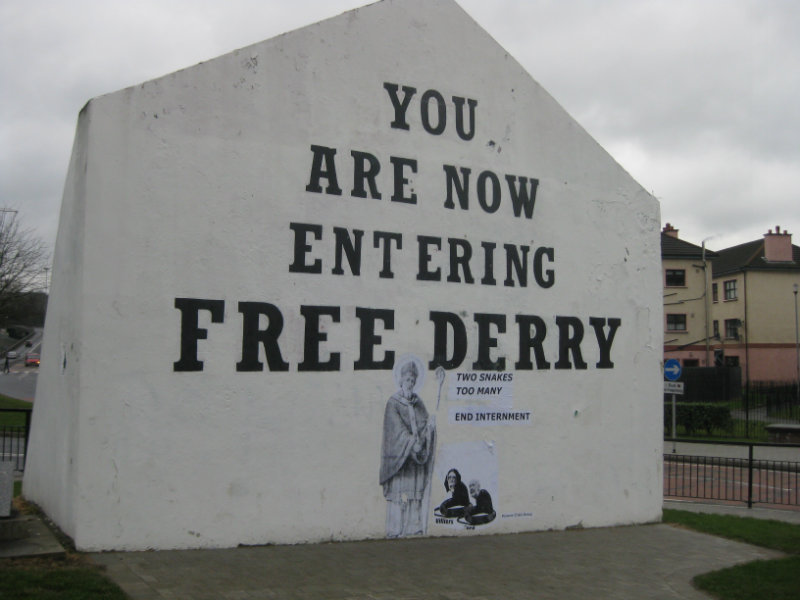
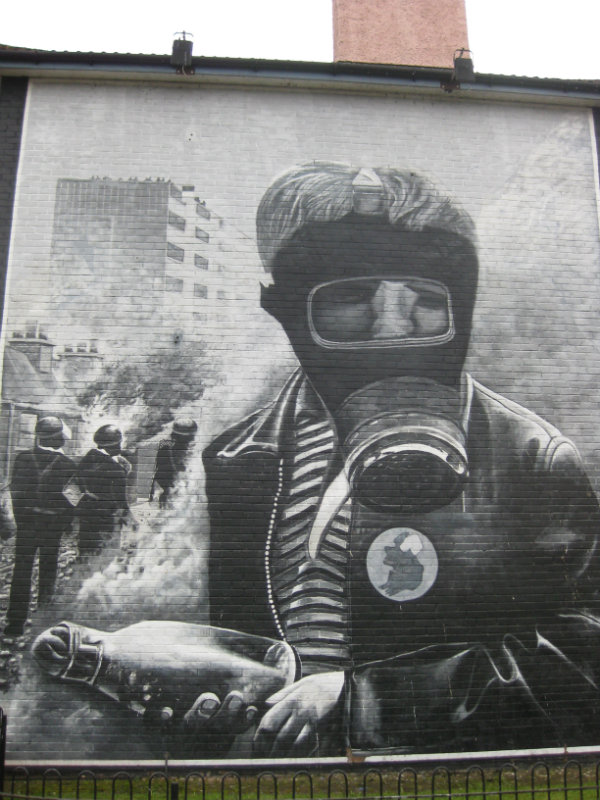
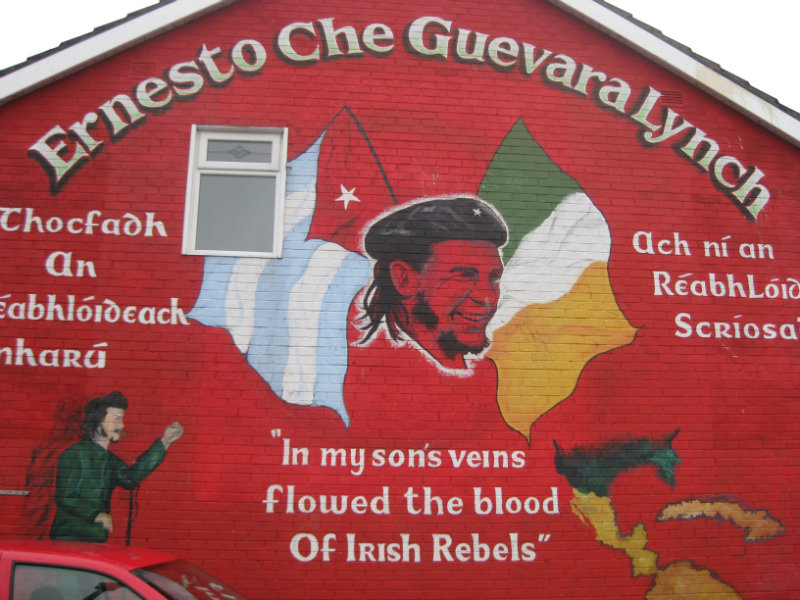
    This weekend, I was on assignment in Derry-Londonderry, UK City of Culture 2013. I’ll write about the gallery going elsewhere, and for the time being post a few photos of politically charged street art.

    martyr's families

    Above is a mural on the wall of the Museum of Free Derry. Behind the subject and the illustrated bullet holes you can see a real rifle shot taken by the wall at the time of Bloody Sunday.

    free derry

    It’s not a strand of history they taught at my secondary school, but between 1969 and 1972 the Catholic inhabitants of Bogside established themselves as a state within a state.

    free derry 3

    This was Ireland’s taste of the times that were a-changing, a militant civil rights movement which drew inspiration from the Prague Spring and the steps made towards racial equality by Martin Luther King.


    free derry 4

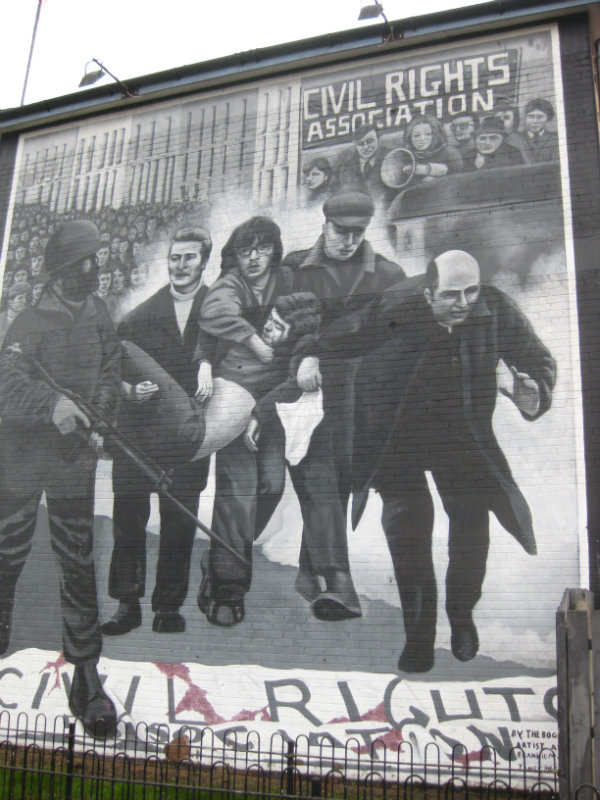
    But on 30 January1972, British paratroopers opened fire on a civil rights March killing 13 people. This mural is based on the iconic photo of Father Edward Daly waving a blood stained white handkerchief.

    free derry 6

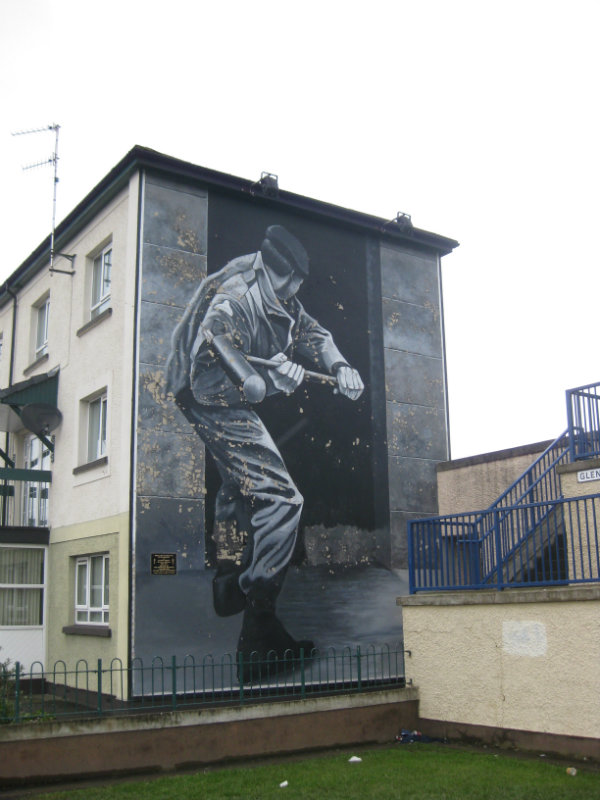
    Ultimately, the Bogside residents’ rent strike, rates strike and general insurrection proved too much for the government. Tanks were sent to clear the barricades and this mural depicts that operation.

    free derry 5

    To the local community and with varying degrees of optimism, Free Derry was a place in time on a par with Cuba after the revolution or Palestine as is today. (Che could have played football for Eire.)

    free derry 9

    Here you can see a rendering of Guernica on the wall of the Museum of Free Derry. Staffed by relatives of victims of the conflict, this great little museum is soon to be expanded.

    belfast 6

    Pictured above, and 60 miles away in Belfast, Picasso’s masterpiece gets a more faithful tribute, except this time with the inclusion of an inset featuring Hugo Chavez.

    belfast 10

    This was also on the Falls Road, an image of Ciaran Nugent, first political prisoner to go on a blanket protest against the implications of a prison uniform.

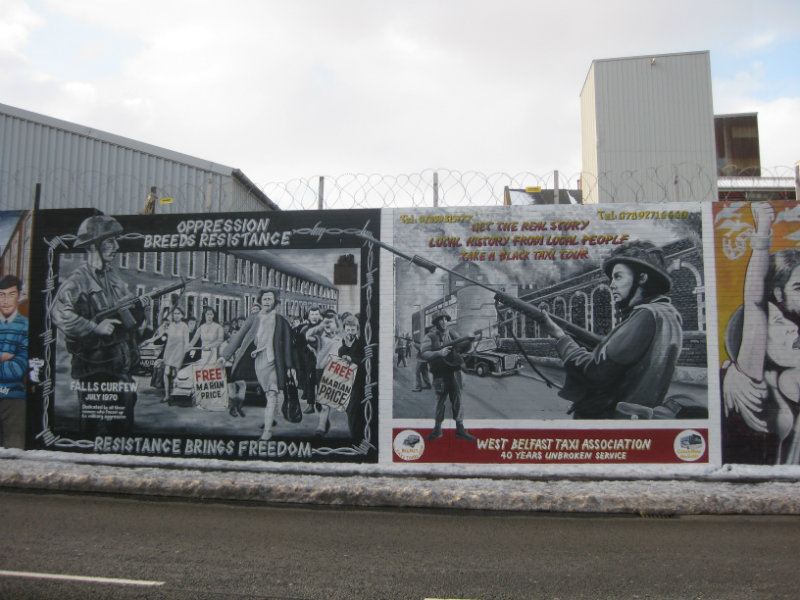
    belfast 3

    You can see Belfast is a bit more confrontational than Derry. The mural on the right carries an ad for the West Belfast Taxi Association, which has roots in the Catholic community.

    But the cab which took me round the mean streets of Belfast was not WBTA. This may or may not have provoked our snowball attacks by local kids. No harm done.

    I don’t want to give the impression that Nationalist murals are the only show in town. There are plenty of blogworthy paintings by Unionists. I just didn’t get the pictures.

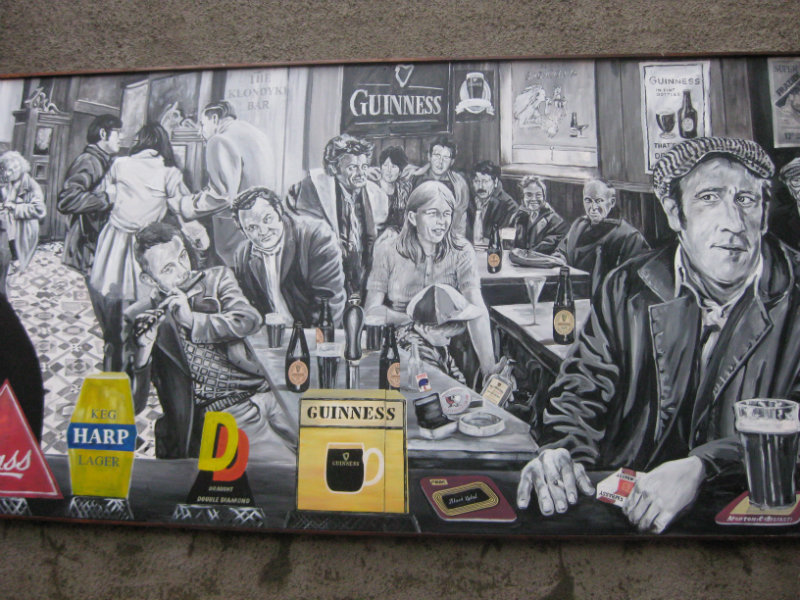
    It was a fantastic weekend, and I can only end on a positive note. Below is a mural of Belfast pub life in a courtyard across from the Duke of York. Do raise a glass to the future of both cities.

    belfast 1

    aggregation, contemporary art

    Found Objects 18/03/13

    March 18, 2013

    Salutations. This week’s art links are the usual mix between the topical and the wondrous.

    • Topical: Here’s a sad story about the death of young Dominic Elliott, friend and assistant to David Hockney. The Independent reports.
    • Also topical: the Guardian send music critic Alexis Petridis to review the record-breaking Bowie show at the V&A.
    • Highly topical: a social minded architect from Japan has won the Pritzker Architecture Prize. Read about Toyo Ito in the New York Times.
    • Sadly topical: the Guardian suggests that an education secretary who doesn’t like architecture very much could learn a thing or two from Oscar Niemeyer.
    • Also with news currency, the Art Newspaper report that US has taken back the topspot in terms of art sales, from China (via Art Observed)
    • Here’s something wondrous: photos of a lightning storm during the eruption of a volcano in Japan. Animal NY collates.
    • Also quite cool to look at is this slide show of cowboy rephotographs by Richard Prince together with a Western soundtrack. This is almost not ironic.
    • This is link of the week: Beautiful/Decay showcases the work of Gabriele Galinberti, who shoots portraits of kids along with their most prized possessions.
    • Quietly wondrous: Art Wednesday interviews Polly Staple from Chisenhale Gallery. Amazing role call of debut shows.
    • And very much finally. This photo of confiscated bootleg pharmaceuticals in China is both topical and wondrous. Thanks to Der Spiegel.