<h1>Archives</h1>
    18th century, appropriation, contemporary art, portraiture

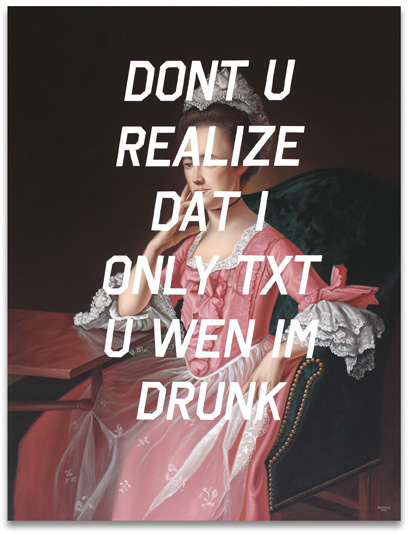
    Shawn Huckins: Dorothy Quincy, Don’t You Realize That I Only Text You When I’m Drunk (2012)

    July 7, 2012

    This is a work of many layers, the earliest one being a portrait of Dorothy Quincy by American realist painter John Singleton Copley.

    Quincy was the wife of the first man to sign the Declaration of Independence. So her portrait is also a slice of history, nevermind art history.

    Shawn Huckins has reproduced this grave example of canvas-based nation building, using the poppier medium of acryllic rather than oil.

    And the results gets fresher still as he overlays a frequently used piece of textspeak. This makes the 18th century piece of artwork look like a 21st century meme.

    The words and acronyms float between ourselves and the subject. Just as the internet can bestow attitude to cats and owls, it can do the same for historic personages.

    So viewed in a browser from the UK (owing to geographical limitations) Huckin’s work looks at first like a streetwise makeover for its targets.

    But since poor Quincy would have had limited access to a mobile phone, it seems that upon reflection this apologia for drunken texting belongs to the artist.

    And the title nails things down, addressing Quincy by name. Now the entire work can be seen as a drunken, and perhaps spurned, overture to realist portraiture.

    In this work and others like it in the series, it is as if some crude textese is the only language the unrequited Huckins can find for his haughty subject.

    Sure enough, the much maligned dialect of wired youth strips away the dignity and aspirations of America’s founding fathers. It lays pretension to waste.

    The original portrait and the latter day texts call to one another across the lifespan of a empire that now appears to be coming to an end in rofls.

    Work from Huckins’ American Revolution Revolution series can be seen in L2Kontemporary, Los Angeles, until August 18th. See his website or that of the gallery for more details.

    conceptual photography, contemporary art

    Salomé, Gérard Rancinan

    June 30, 2012

    The Disney Corporation is perhaps the most obvious of targets. Obvious because its saccharine values bear no relation to the harsh realities of life in late capitalist society.

    But taking on Disney is no easy matter. The values are promoted by one of the world’s most recognisable brands. The brand is protected by the world’s best lawyers.

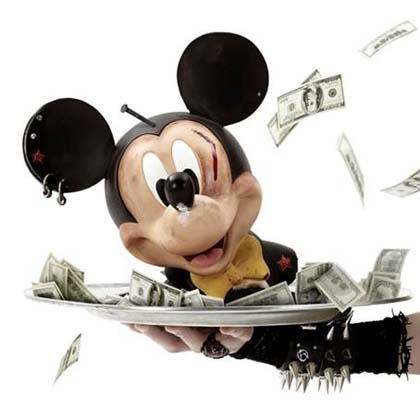
    Anyone planning to get at Mickey and his pals may as well go the whole hog. And it is wonderfully clear quite how Gérard Rancinan has violated this anthropomorphic mouse.

    If the attack is not subtle, the details are still amusing. You would not expect a Disney character to wear a red star, so perhaps things have changed in the Magic Kingdom.

    Salome is also more political than you might think. An anarchy badge is pinned to her wristband and, in just such a spirit, she garnishes her trophy with dollar bills.

    To be honest, I’m not sure how much we should read into the biblical story. One shudders to think of the messiah who may or may not have been predicted by Mickey. Goofy perhaps.

    But God knows it must have been satisfying to drive that six inch nail into the lovable chap’s forehead. This violence and scorn seems to be the real meaning of the work.

    Such work is not great for brand Disney. Though you can’t help feel that a less direct approach might have worked as well, since most brands already have an ugly side.

    In 2009, Finnish artist Pilvi Takala was refused entry to a paranoid Disneyland Paris. Her crime was merely to be dressed as Snow White in order to comment on migration.

    This work is part of Gérard  Rancinan’s Wonderful World trilogy which showed at London Newcaste Project Space in June 2012.

    architecture, contemporary art, drawing

    Chris Agnew, Sacrifice (2012)

    June 28, 2012

    If superstition ran riot, might not every human casualty take on the complexion of a sacrifice. Every death would register as an appeasement of one of our many gods.

    Admittedly, that is wacko. But here Chris Agnew juxtaposes what must be the most rational system of government, communism, with one of the least, Mayan.

    In times of drought, enemy blood would have flowed atop of Chichen Itza pyramid in Mexico. Slower deaths may have been experienced in this Bucharest tower block.

    It is arguable that both civilisations fed on the blood of their enemies. Sorry, make that all civilisations. Agnew’s drawing hints we may all be irredeemably primitive.

    But no one can deny our talent for inspiring fear and wonder, through the monuments we construct or the or the artworks we hang on the wall.

    This drawing, for example, is a marvel of concentration and detail. Agnew has built his pyramid with perhaps as much slavery as art, brick by tiny brick.

    And it is terrifying to reflect that short of raising both pyramid and apartment block to the ground, we are bound to inherit something from them.

    Perhaps an architectural synthesis of left and right wing is what we need. Or perhaps it is what we already have. We live in polarising times.

    Sacrifice can be seen in Agnew’s solo show, The Pomp of Circumstances, at Nancy Victor Gallery, London, until July 6 2012. See gallery website for more details and check out the artist’s own website.

    aggregation, contemporary art

    Found Objects 27/06/12

    June 27, 2012

    Another plethora of destinations for your mice or mobiles:

    • Anish Kapoor proves fair game for the Occupy movement as several dozen rock up at one of his second homes.
    • Two French museums dedicated to Henri Matisse to share a newly discovered cache of colourful, but unfinished, paper cut-outs.
    • The 340-tonne boulder which travelled from rural California to LA has now been officially levitated. It’s a “Huh? Wow!” moment.
    • Not noticed one of these before. The Guardian deliver an interactive art audio tour of the new Turner Monet Twombly show at Tate Liverpool.
    • You can also enjoy a relatively lo-fi visit to the Pergamon Museum in Berlin, with stunning photos on The Exhibition List.
    • This is my favourite link of the week. Artists develop new ways to revive and sustain the Viennese tradition of hanging out in cafes.
    • Thanks to @danielyanezgonz  for sharing this via Facebook: a website hosting a gallery of polaroids by the director Tarkovsky. In Russian, but just click on the photo.
    • It might seem impossible to get excited about a group of staircases, but these could be to heaven (see what I did there?). This came via @jennycobelli.
    • Some new tracks have been released from the archives of Krautrock band CAN. Iain Forsythe and Jane Pollard have done the video.
    • This feels right. Some dedicated soul has shot a frame by frame version of blade runner using watercolours.
    • This feels wrong. Art Info curate the world’s 25 wackiest art gifs. Actually they’re not bad.

    books, contemporary art, installation art

    Jukhee Kwon: Being @ La Scatola

    June 23, 2012

    Treehuggers may well like this show in which paper from books is shredded line by line to form a copse of six or seven arboreal candidates for the sentient term Being.

    The pages now flow down from book shelves just underneath the ceiling. And you have to get within hugging distance to appreciate the painstaking quality of the work.

    Breathe against them gently and the lines of prose rustle like leaves. The delicacy of this site specific work bestows an aura of great preciousness on each piece.

    But these trees also whisper towards the opposite of the show’s title: knowing. After all, these volumes were once encyclopaedia and have now been rendered illegible.

    If this is a choice we all have to make between ontology and epistemology, it is clear that Jukhee Kwon chooses the former, almost attacking the latter.

    At the far end of the show is a pocket book which has been scraped clean of its ink. The residue now forms a dusty, but useless, booklike sculpture in its own right.

    And with the coming of ebooks and tablets, Kwon’s show feels like a nail in the coffin of the printed word. If you want to live, don’t read. If you want knowledge, stay online.

    Do not pluck it from a tree. This might not only be an original sin but also, given the density of text which streams through this exhibition, a growing impossibility.

    Being can be seen at La Scatola Gallery, until August 10 2012. See gallery website for more details.

    aggregation, contemporary art

    Found Objects 19/06/12

    June 19, 2012

    Another conglomeration of interest piquers for you:

    • Scientists have found the first suggestion that Neanderthals made cave art and tis strangely exciting.
    • Upon the realisation this review has two inclusions of the word “Thwunk!” it had to be included: Adrian Searle on Yoko Ono.
    • The iconic artist comes out somewhat better from this encounter with filmmaker Sam Taylor Wood.
    • C-Monster posts good pictures from a show of International Abstraction at the Guggenheim.
    • Against the odds, Lucie Davies pins down the globetrotting Jeff Koons for an interview in The Telegraph.
    • Art21 looks back on a time when artistic adventurers looked to absinthe for inspiration. Them were the days.
    • Here’s a simple trick to making it big in art from Phaidon, only you might not want to risk it.
    • Only Vice magazine would let an intern cover a trip to a theme park on acid. The intern’s girlfriend now surely deserves a job. (Thanks @hereisafantasy.)
    • Loving this report about an artist who managed to reboot her identity, as told in a review by Beverley Knowles.
    • Brian Dillon considers the maddening task of making art about the future. (It seems the future may now be a thing of the past.)
    • The internet is a great leveller and Russell Herron’s new website completely flattens the art world (via Grey Area on FB)

    contemporary art, installation art, relational aesthetics

    Louis Brown, MAKERZINE (2012)

    June 17, 2012

    The Pure Good of Theory is one of the most oft quoted poem titles around. Wallace Stevens seems to have nailed it, but are there more spheres of pure good?

    Visitors to Brighton University last week might think so. At a degree show, you could argue for the pure good of art education, which after all does entail plenty of theory.

    But my eye was caught by the clear benefits of MAKERZINE by Louis Brown, a digital printing press on which you could churn out your own copy of the eponymous zine.

    I’m sorry to report I picked up a pre-made copy, so cannot report on the experience of cueing up a new zine. But it was simple enough with the clearly chalked instructions.

    Reclaimed scaffolding boards and hessian wrapped benches gave the workstation a sense of rough and ready utility. You could forget this was a piece of sculpture.

    Louis Brown therefore succeeds in his aim to demystify the creative and fabricational process. This was a demonstration of the pure good of making.

    The zine itself contains recipes, homebrew instructions, tips on recycling scaffolding boards to make furniture and interviews with T-shirt designers.

    As manifestos go, it could not be more pragmatic, or more optimistic, or more realistic. Its spirit of ingenuity will serve us well when civilisation collapses, or may even avert that.

    Artists are often thought of as impractical souls, dreamers, romantics, fools. But this piece is a great testimony to a more contemporary spirit of art, certainly a more purposeful one.

    MAKERZINE could be found in the Brighton University Faculty of Arts Graduate Show 2012, in the Fine Art Sculpture BA(Hons) section.

    contemporary art, contemporary sculpture, film art, happenings, performance art

    Jeremy Deller, The Bruce Lacey Experience (2012)

    June 15, 2012

    This in-depth documentary about a great living artist premiered at Brighton Festival not so long after network TV screened an in-depth doc about its maker Jeremy Deller.

    The results were two quite different films. But the subjects have more in common than both having worked together on The Bruce Lacey Experience.

    Like Deller, Lacey has fingers in many pies. As this documentary shows he is a musician, a builder of robots, an unrepentant stager of happenings and a former star of the Goon Show.

    But this is not the first time Lacey has captured the imagination of another creative spirit. A look at his Wikipedia page will tell you he is widely celebrated in music and film.

    So the slightly contentious question is this: which of these two artists has incorporated the other into their own body of work…

    Does Lacey join former miners, brass bands and wrestler Adrian Street in the parthenon of subjects pertaining to Jeremy Deller?

    Or has Deller become yet another footnote in the life of octagenarian Bruce Lacey, who by 1962 was already the star of a celebratory Ken Russell film?

    Perhaps it doesn’t matter. The Bruce Lacey Experience will surely bring the elder artist to a wider audience than Lacey can find in one of his regular appearances in the depths of Norfolk.

    Besides, the results look as if Jem has fixed it for his subject to complete a boyhood dream and take a spin in an RAF jet, or at the very least given him an excuse.

    Tracking shots of a model plane ‘flying’ around the Lacey home build to breathtaking footage from the cockpit of the real thing as it swoops over the English countryside.

    Silver Machine by Hawkwind plays. You may not even like Hawkwind (I don’t (yet)), but I would defy anyone not to be uplifted by this trip through an illustrious career.

    The Bruce Lacey Experience has its official premiere at the British Film Institute Southbank, London, on 5 July. Later in the month (from the 16th for three months) a show of Lacey’s work co-curated by Deller can be found at Camden Arts Centre, London.

    Uncategorized

    Found Objects 11/06/12

    June 11, 2012

    Another week on the news-and-views merry-go-round:

    • Frieze claims the art world has swallowed up the art itself and Dieter Roelstraete bemoans the amount of reference-heavy work that has come about as a result.
    • In the Guardian #1: Rachel Cooke visits Jenny Saville to conduct a wide ranging interview about the painter’s life and work.
    • In the Guardian #2: After its untimely end in April, Jeremy Millar teases out the humour in the career of Fishcli and Weiss. Rat and Bear clip is hilarious (thanks @RussellHillArt).
    • Mystical anarchism is the theme of a Simon Critchley piece in Adbusters. Recommended reading for all those practicing designer resistance (thanks @rpeckham).
    • A record breaking piece of prehistoric art has been found in a French cave, and so the oldest graphic mark of all time is now an, erm, vulva (on Hyperallergic).
    • From the deep past to the near future, Derek Brahney has been making Rothko paintings on his iPhone (also on Hyperallergic).
    • Der Spiegel writes up the career of artnet founder Hans Neuendorf with some dramatic flourishes that make being a multi millionaire seem reasonably exciting.
    • After the End gets in a last-minute review of the Hans-Peter Feldman show at Serpentine. The German artist has a light touch which delights.
    • Speaking of light touches, there can be few mechanisms as airy as this three dimensional representation of weather data on Prosthetic Knowledge. Includes footage.
    • Meanwhile from the land of the cute, photo of a mass transit vehicle for toddlers thanks to the Tokyo Times.

    contemporary art, installation art, literature, sculpture

    Bedwyr Williams, Stevenson Screen (2012)

    June 7, 2012

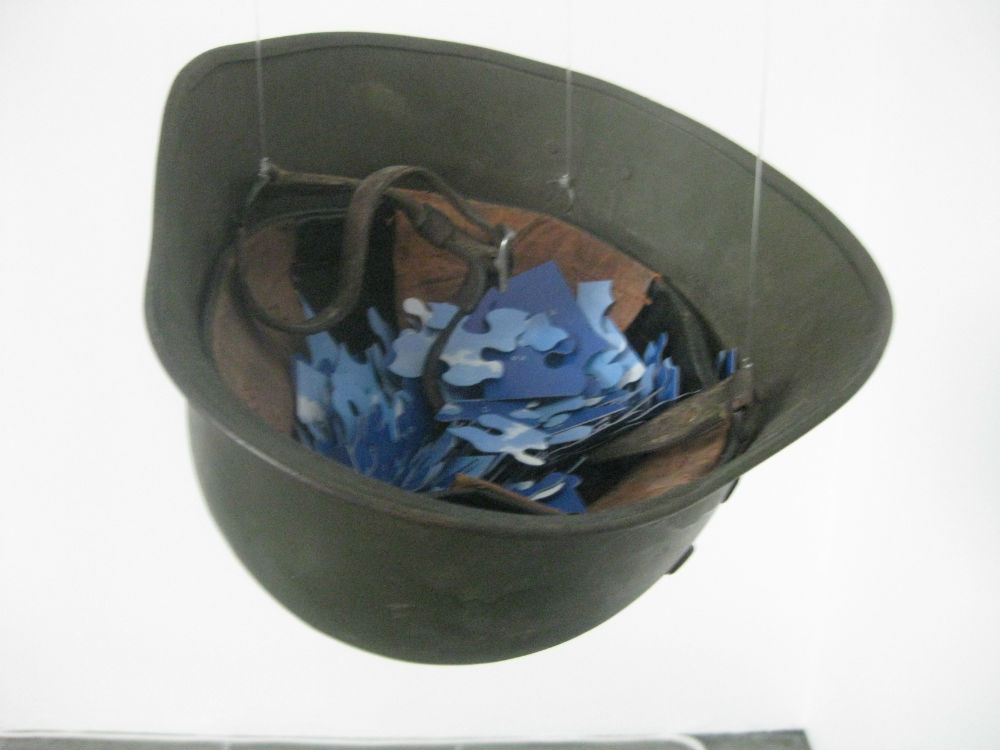
    Whether you call it a weatherbox or, more correctly a Stevenson Screen, this object provokes even more curiosity than usual. It doesn’t belong in a gallery. It doesn’t often exude a blue light.

    The light comes from a speaker wired up in there to make this sculpture appear sentient twice over. It glows and it also, growls, grunts, and gurgles.

    Impossible movie buffs will recognise the soundtrack from the transformation scene in Dr Jekyll and Mr Hyde (1931). Art buffs may know Douglas Gordon also used this.

    But here it has been repurporsed to look at the relationship between Robert Louis Stevenson and his father Thomas Stevenson, inventor of the apparatus.

    The screen offers limited exposure to the elements in the same way, as creator Williams explains, that all parents everywhere might try to bring up their child. It appears nurturing.

    Yet Thomas and Robert may have had alter egos. Hyde goes on the rampage and tramples a child. Of what might the father of the father of that monster have been capable?

    Hyde sounds as if he could break out of the cage. That would be the next act. But the polite gallery goer will look on from his or her own cage content to live as a Dr Jekyll.

    But RLS did break out. Williams is fascinated by Stevenson Jnr’s reappearance in the South Seas “dressed in a Sarong”. That must be the result of some violent change or other.

    Though for now we find him still boxed in a gallery, on the cusp of escaping his father: a great writer produced by a great engineer, in the persona of a surely great chemist.

    Stevenson Screen can be seen in Bedwyr Williams: My Bad at Ikon, Birmingham,until July 8 2012. See gallery website for more details and/or Culture24 to see what the artist had to say about this piece.