<h1>Archives</h1>
    aggregation, contemporary art, Uncategorized

    Found Objects 05/05/12

    June 5, 2012

    This week’s Found Objects are a taxidermy and economics special:

    • This NYT piece claims the art market is a totally separate economy to the one the rest of us work in, thanks to Ultra High Net Worth Individuals.
    • But UHNWIs maybe about to lose out, for a while at least, as the art bubble bursts. Such is the prediction of Charlie Finch in artnet.
    • So it sounds like the Sotherby’s art handlers have called off their ‘strike’ just in time. Art Info reports on a pyrrhic reconciliation.
    • This is awesome, and nothing to do with the bubble, LA’s MOCA have compiled Google Earth views for the location of notable pieces of land art.
    • If you haven’t already seen the taxidermied cat copter, get on it (@sheerinability). And while you’re at it you might want to look up Iris Schieferstein’s stuffed artworks.
    • This movie poster keeps on giving: a vision of Hollywood to come (thanks @hindmezaina).
    • David Lister in The Independent argues for all-year round late opening for our museums and galleries. Sounds like a plan.
    • Charlotte Mann demonstrates how to furnish an entire room using just a marker pen. Great images on Beautiful/Decay.
    • Phaidon link to a wonderful 8-minute montage of paintings by Edward Hopper. See how lonesome realism can be pepped up with a bit of jazz.
    • This is not your average pop video, but then again artist Martin Creed is not (yet) a pop star. It is NSFW, perhaps Not Suitable for Home either, but it leaves a smile.
    • Scientists reveal a new psychiatric disorder, the feeling that one is on the Truman Show. It sounds terrible but, I imagine, a good premise for some art.

    Uncategorized

    Found Objects 29/05/2012

    May 29, 2012

    It’s been a rum week in the art world. So here’s some rum, distilled:

    • A painted penis belonging to a portrait of the South African President is making plenty of headlines. In the latest twist Jacob Zuma’s lawyer weeps in court.
    • Back in London meanwhile it is YBA artist Damien Hirst who some claim has exposed himself, or at least his limitations. Jonathan Jones rants at him (via @harikunzru).
    • Ben Street writes up some modest, colour coded and exceptionally well-balanced art. And of course makes you want to see more.
    • Jerry Saltz says something, something, something about art criticism, but you cannot take it in learning he was once a trucker with the CB handle The Jewish Cowboy (thanks @S_Cardon).
    • This kind of thing makes you wish you were an entomologist: naming spiders after rock stars as reported in the L-Magazine.
    • It makes cryptozoology look kind of staid. The Exhibition List visits the world’s only museum dedicated to this dubious pursuit and has reported fun.
    • Hyperallergic picks up on an astonishing story about tax free ports storing up to $10 billion worth of art a piece. In Switzerland, naturellement.
    • If I was a pro-tools user, I’d be well tempted by these Sufi Plug Ins. The more or less in time handclaps alone sell it.
    • The international market for Botero is simply fat, in particular in humid, emerging markets. This means his works on paper can be picked up for a relative song.

    cold war, contemporary art

    Tom Dale, The Mars Society (2012)

    May 27, 2012

    Optimism is ridiculous, as daft as loading a missile with a payload of flags, as daft as creating flags for countries which don’t yet exist.

    But the positivity in Tom Dale’s piece is compelling. His 1950s rocket design looks almost cheery now, more than half a century since it became obsolescent.

    If this Tin Tin-esque craft were not innocent enough, it comes with a note about the delightful fact we once considered rockets for supersonic mail.

    So never mind Hergé, Dale’s Mars Society could be a shadowy organisation straight from the paranoid pages of Thomas Pynchon.

    The V2 shape calls to mind the US novelist’s obsession with rocket technology in his best known work, Gravity’s Rainbow, set in WWII.

    During that worldwide conflict, an unexploded bomb landed at Tatton. This too was news of a sort and clearly good news, given the outcome of the war.

    Pynchon also mines the history of an alternative postal service in his shortest book, The Crying of Lot 49. One feels he would like supersonic mail.

    But why is it that an unmanned and non lethal rocket is so comic. It is as if you take away a feared and hated enemy, the idealism of the arms/space race becomes funny.

    The Mars Society is ready to surrender to either side. But perhaps in these days of rogue states and unmanned drones, we need to take this absurd stand.

    This work can be seen in Tatton Park Biennial until 30 September 2012. See the home’s website for further details.

    illustration

    Zara Wood, Creating Characters (2012)

    May 27, 2012

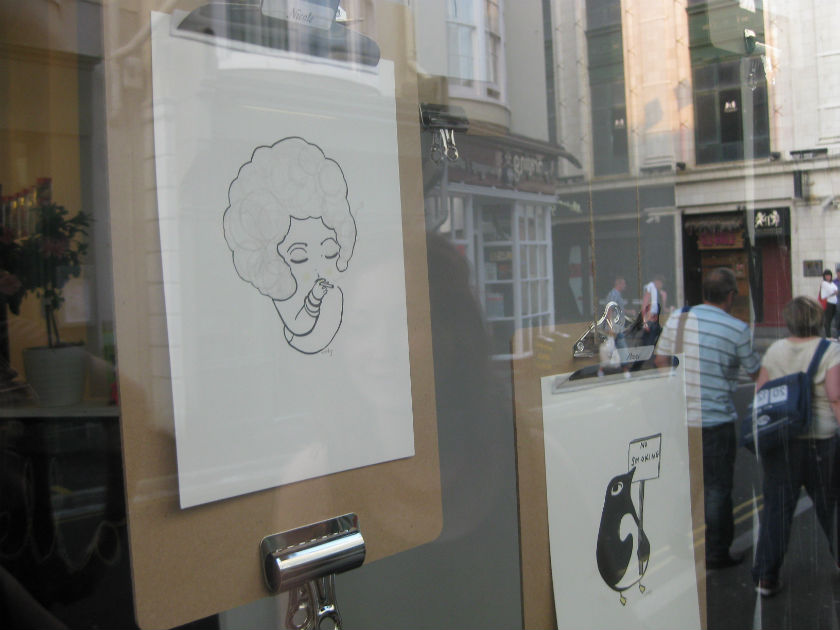
    For anyone who likes their girls with a sublimated death drive, please find above chain smoker Nicole, one of ten new characters by artist and illustrator Zara Wood.

    That‘s artist and illustrator. And it could be argued that distinctions between the two roles come down to a position with regards to the written word.

    Woods characters cry out for an author. Even swinging from their clipboards in the window of Super + Super, they appear to interact. Stories could well emerge.

    But this mini show in the midst of the Brighton festival has to some degree put the cart before the horse. They are illustrations for stories not yet written.

    And whereas illustrations put narratives first, most contemporary art puts the word, whether written yet or not, second. Text follows on the heels of oblique art.

    Such speculation about chickens and eggs may not get us anywhere. After all for most of history, so called fine artists were illustrating the greatest story ever told.

    And we don’t even know whether stories or visions came first in the prehistoric art found in and around the Pyrenees. Were these illustrations too?

    It is tempting to bring this debate back to material conditions. Nicole was drawn up in an illustrator’s studio and hangs in the window of a Brightonian creative hub.

    And she has called them characters, rather than portraits, which is hardly surprising since they include an unlikely sausage dog and a placard waving penguin.

    Okay, so Wood’s show has occasioned 200 tendentious words on this art blog, it would have been better to write some fiction about Nicole. Anyone?

    Nicole and friends can be found in the window of Super + Super in Brighton, 7 Kings Road, until June 4.

    contemporary art, performance art

    Iain Forsyth and Jane Pollard, Performer. Audience. Fuck Off. (2012)

    May 22, 2012
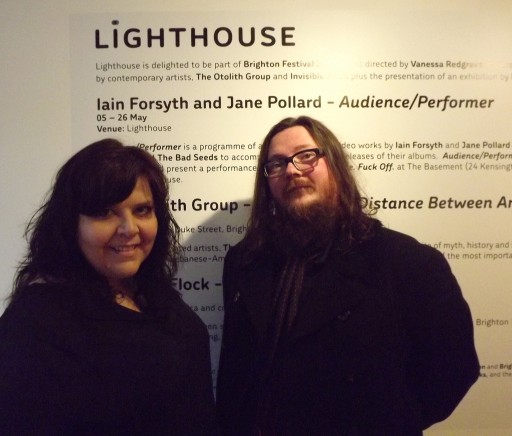
    Jane Pollard and Iain Forsyth at a post show talk at Lighthouse

    Is Brighton too cosy for a performance piece with the f-word in the title. Certainly by the end of Jo Neary’s performance on Saturday 12th it appeared that way.

    Most of the audience may have relieved that this local comedienne chose to say, mainly, nice things about us as she adlibbed her way through a 20 minute set.

    But nevertheless things were tense, as if the four letter word hung in the basement air. Looking past Neary, we could see ourselves in a wall length mirror. It didn’t help.

    Performer. Audience.  Fuck Off. is split into five minute segments in which a stand up comic talks first about physical sensations and second about the audience.

    She then turns her back on us to address the same two concerns while facing the mirror. This allowed her to be slightly less polite about herself and us.

    Forsyth and Pollard’s work is a playful spin on a performance-for-video by American artist Dan Graham. But Graham appears to have been a less threatening presence.

    Here the artists appear to suggest that Graham’s performance needs updating. Perhaps it really does need snarking up for contemporary tastes.

    Putting a comedian on the stage alerts us to the fact we may become targets of jokes. Neary‘s gentle jibes are only a taste of what might happen when this show tours.

    Name stand-ups draw audiences unprepared for the conceptual structure of the show, the lack of script, the absence of gags. Don’t like it? You know what you can do.

    More from these artists can be seen in the current show Audience/Performer at Lighthouse Brighton. See gallery website for details.

    aggregation, contemporary art

    Found Objects 21/05/12

    May 21, 2012

    In case you missed the unmissable, here are this week’s links:

    • The Guardian argues, selflessly, that the Parthenon marbles belong in Greece, and sadly appears to be right.
    • Dana Schutz, who makes a virtue of painting’s limitations, is celebrated on Hyperallergic, and her work photographs well.
    • Tracey Emin gets another feminist endorsement as novelist Jeanette Winterson praises her in the pages of The Independent.
    • Argentinian Tomás Saraceno has installed a monumental sculpture on the roof of the Met. The best views are on Phaidon.
    • Did someone say Ant Ballet? Check out the pirouetting on the nature-and-science-loving art blog We Make Money Not Art.
    • I’ve not idea what they are rapping about but this lyrical throw down in Azerbaijan looks like it was crucial.
    • A posthumous project by Mike Kelley sees Artangel, the Luma Foundation and MoCA Detroit recreate his childhood home, on wheels.
    • Smithsonian.com invite a physics student to share findings on the movements of art loving human particles in galleries and museums.
    • Tom Waits narrates a 6-minute film about John Baldessari: a must see if you haven’t already clicked on this last week (via @HuffPostArts).
    • The Paris Review pays tribute to Mexican writer Carlos Fuentes with a great quote from the great man.
    • Very much finally, here are some wedding pictures from Russia in which someone(s) have got very carried away with PhotoShop (via @FriezeMagazine).

    conceptual photography, contemporary art, digital art, music, sound art

    Trainofthoughts @ The Horse Hospital

    May 14, 2012

    You might think it’s a first world problem or a high class issue, but just how does a human being get through a seven hour traffic jam?

    Such was the predicament of Micheál O’Connell, aka Mocksim, snarled up on the M25 in what it soon emerged would be a history-making tailback.

    But while his phone ran out of battery, his digital SLR had enough charge for him to shoot apocalyptic scenes of stranded traffic through his windshield.

    On his car stereo was a sound piece by Stace Constantinou, with which he was planning to work. So Mocksim timed shutter clicks to coincide with moments in the composition.

    Constantinou’s piece was already a response to a nightmare journey: a once daily and claustrophobia-inducing commute from North Lambeth to Morden.

    But this had been displaced in his imagination by what sounds like a raid on the BBC radiophonic workshop. Field recordings from the tube mix with scripted actors.

    His protagonist does eventually reach the far side of a river thanks to a ferryperson and we learn that this place is called, with grim inevitability, Mord.

    Mocksim meanwhile cut holes in each of his shots, animated and stacked them to make a virtual tunnel which the viewer can finally fly through to freedom.

    The two works combine in a dryly amusing way at the Horse Hospital, itself once a pit stop for London cabbies. A place for breakdowns and delays.

    So the travel issues just pile up. The UK road and rail infrastructure is not one of the great themes of western culture, but it’s still a pain in the ass. Why not make art about it?

    Trainsofthought ran last weekend in London. Visit www.mocksim.org or www.myspace.com/staceconstantinou to find out more about the artists’ work. 

    aggregation, contemporary art

    Found Objects 14/05/12

    May 14, 2012

    Blimey, there is a lot to read this week:

    • The New Aesthetic was much discussed. JJ Charlesworth puts it into a wider context of post-humanist thinking and behavioural economics.
    • Writing for the L Magazine, Paddy Johnson meanwhile dismisses the movement, calling the New Aesthetic a “tumblr paired with a lecture circuit”.
    • Hyperallergic, meanwhile, opt to demonstrate the virtues of a Google Translate beatbox which may or may not exemplarise this new way of seeing.
    • In the Boston Globe, Sebastian Smee suggests that big money auctions and art fairs are, in fact, fair enough (via @BrianSherwinArt).
    • And on artnet, Pedro Vélez argues that good art will outshine silly money, and that too many critics are “marinating their rhetorical sausages in hate sauce.”
    • On the subject of millionaires, here’s Jason Alexander (once known as George Costanza) doing his best to hang with the occupying 99%. (via Monica Sanford)
    • Maybe next he’ll try hanging with Femen. Der Spiegel offers a profile of the Ukrainian femenists who bare all in service of a variety of good causes.
    • More breasts in the next link, this time in a sensational Mexican newspaper called El Grafico, as talked about on photography blog American Suburb X
    • Britain’s most convoluted road junction turns 40 and the Guardian celebrate Spaghetti Junction with a slideshow. Too nerdy?
    • Finally, brace yourself for a 360 hour David Lynch film, just one of the proposed pleasures at what might become the Marina Abramović Institute in New York.

    contemporary art, environmentalism, installation art, music, sound art

    Kaffe Matthews, ‘You might come out of the water every time singing’ (2012)

    May 8, 2012
    (c) Kaffe Matthews. Courtesy the Bluecoat, Liverpool

    “Okay, we’re 30m underwater on a ley line and we’re heading for some squid,” or words to that effect. Such is my greeting from artist Kaffe Matthews.

    My response is helpless excitement. I lie on my back on the shark platform and look up at the murky green light. You can well imagine the hammerheads are up there.

    Oscillators pump out a generative soundscape. Tremors pass through me from the matted platform. And it feels as if we are really travelling at speed.

    Matthews is a diver as well as a composer. And she has really swum with hammerheads so has really earned a right to the data which drives this piece.

    The raw materials for this music are the topographies of the ocean floor and the depths, speeds, and directions of six tagged shark specimens.

    And here is where it gets cosmic: hammerheads navigate using electromagnetic fields. So as this piece follows them, it recreates on dry land the invisible forces which bind oceans in place.

    As a result it is hard to get off the mat again, hard to break free from its magnetic pull. It is thrilling, yet as free from danger as Matthews’ dives must have been fraught. whatever she says.

    Up until now, one might have figured that Damien Hirst was responsible for the world’s most badass shark art. But his pickled tiger now has a serious contender.

    And surely everyone will come out of the water here singing the praises of this art, not to mention the joy of sharing minutes of your life with some prehistoric fish.

    This piece can be seen in the exhibition Galápagos at the Bluecoat, Liverpool, until July 1. See gallery website for more details and read my interview with Matthews on Culture24.

    aggregation, contemporary art

    Found Objects 07/05/12

    May 7, 2012

    Between headline auction lots and art fair admission fees, it’s been an expensive week in the artworld:

    • So, The Scream provokes an outcry. You can see the final suave, diabolical moments of its public appearance in this Telegraph video
    • But do high prices merely advertise the auction system itself? Jerry Saltz thinks so and hates giving works of art numbers (thanks to @thebenstreet for both links)
    • Charlie Finch meanwhile argues that money makes artworks safe, “hiding the death nautilus in an ocean of dollars”. Yikes.
    • More from the righteous anger department. Paddy Johnson points out that so-called discussions at Frieze sidestep elephants in the room (via @cmonstah).
    • Over on the Arts Desk, Fisun Guner reviews the shortlist for the Turner Prize and asks the very good question: why no Marcus Coates?
    • The Guardian invited Hans Ulrich Obrist to write the obit for David Weiss; this includes a good overview of the career of Fischli/Weiss.
    • We Make Money Not Art meanwhile write up an immortal artwork on its way to the Wellcome Collection. This installation looks like a must see.
    • Thanks to @merci-remi for drawing twitter’s attention to his laugh a minute tumblr feed, Life in Art Galleries.
    • Listen to a radio broadcast in which David Shrigley suggests what the man on the Glaswegian streets would make of Anish Kapoor.
    • The final link this week was a news event in itself. John Peel’s record collection is being digitally catalogued. Visit Peel Acres here.