<h1>Archives</h1>
    aggregation, contemporary art

    Found Objects 31/07/12

    July 31, 2012

    For your enjoyment and perusal:

    • Na na na na-na-na nah, Ai Jude! China’s dissident art superstar gave the thumbs up to Britain’s opening ceremony for the 2012 London Games.
    • Blogger Catherine Baker was more circumspect, but makes a number of good observations which still point towards room for optimism.
    • RIP Franz West. Tyler Green from Modern Art Notes posts links to an epic five part review and about now would be a good time to read it.
    • The case for visiting the Hayward’s latest show is getting stronger by the week. Here is journalist Brian Dillon’s compelling essay on the art of nothingness.
    • Architecture Week carries a highly readable interview with Sir Norman Foster which reveals, among other things, he used to be a bouncer (via/ Phaidon.com, link may time out)
    • There’s another entertaining interview on Daily Serving. Taxidermist Polly Morgan talks about how she became an artist and other uses for dead animals.
    • Speaking of which, there was a buzz online about a gourmet meal of rats staged in New York by artist Allegra La Viola. Yum!
    • Animal theme continues with a trip to the Museum of Zoology in Florence. Not the first museum you might think of visiting in that city, but well worth a look on The Exhibition List.
    • Not everyone is happy about the regeneration of Margate seafront. It used to be a well kept secret for Phoenecia at The Rightness of Wayward Sentiment blog.
    • But I think this is my favourite link of the week: Japanese art lovers going crazy for the opportunity to shoot photos of replica Vermeers in Ginza. (Story from the Japan Times).
    conceptual art, contemporary art, London 2012, sound art

    Martin Creed, Work No. 1197 (2012)

    July 27, 2012

    It is not clear what Work No. 1197 set out to achieve. But few could misunderstand just what it was they had to do, or what happened.

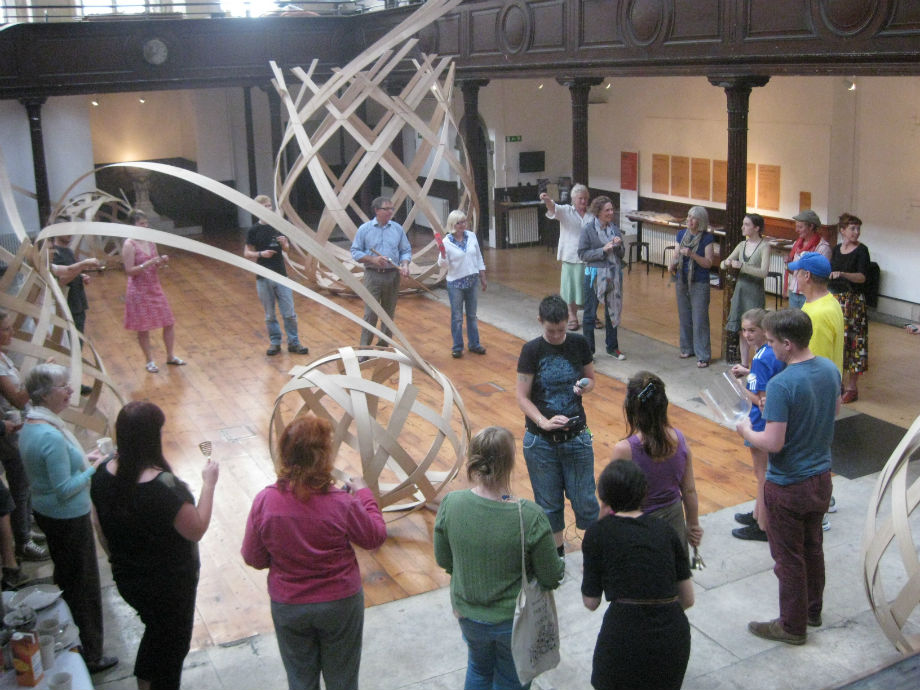
    At inestimable numbers of people came together to ring all manner of bells. They met in churches, galleries, schools and theatres. You could even try this at home.

    At Fabrica gallery Brighton some thirty volunteers and staff formed a spontaneous circle, an effortless slipping into the role of bellringers.

    The chiming began and before long an additional sound could be heard. That was, if not mistaken, an unofficial resonance, a music of the spheres, something not signed off at LOCOG.

    Few artists come across as material minded as artist Martin Creed. But in that spooky extra vibration, there was something perhaps mystical despite the early hour.

    It made me think of Abbie Hoffman’s efforts to levitate the Pentagon. The Yippie founder also wanted to turn the building orange and end the war in Vietnam.

    By all reports, Whitehall is still on terra firma and retains the colour of stone. But hey, Jeremy Hunt’s bell broke, so perhaps it worked.

    The Secretary of State for Culture, Olympics, Media and Sport joined proceedings on the deck of HMS Belfast, a suitable target for our peace-loving energies.

    New age readings aside, this was still a remarkable event. The diversity of bells in use was itself an exhaustive expression of difference and conceptual sameness.

    Top prize in my limited experience goes to the chap in Brighton with a cloche jar and an official Olympics bouncy ball on the end of a chop stick. Everyone is an artist, after all.

    Following a very quick three minutes of something approximating joy, the ringing ceased and a round of applause swept the room.

    It died down and the only sound left was a smartphone on the stage, pulsing with an official All The Bells ringtone. But since 815am, can anything else still be heard?

    classicism, contemporary art, installation art, outdoor sculpture

    Tom Dale, Banquet of Sound (2012)

    July 25, 2012

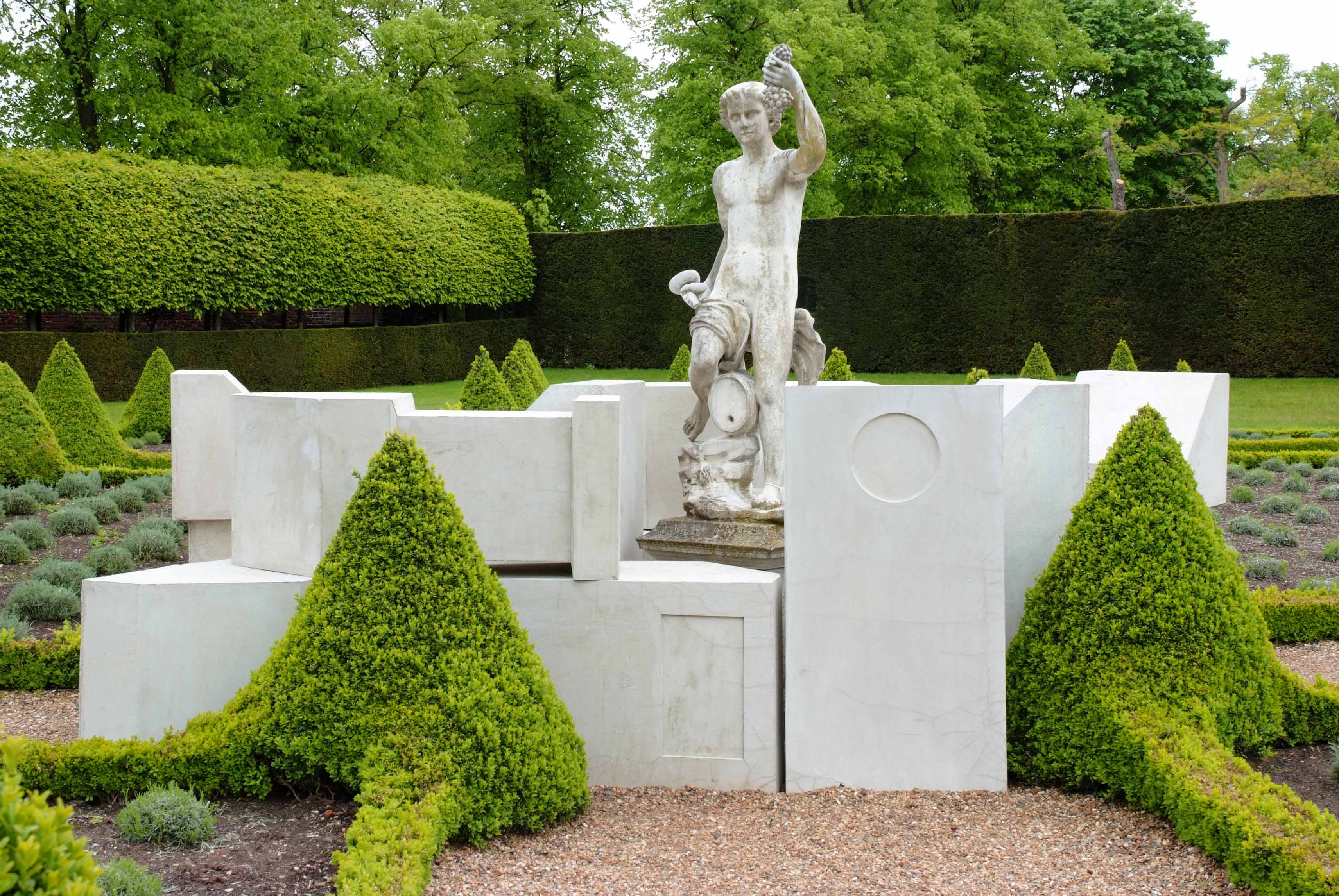
    Democracy has, one assumes, been going downhill since the time of ancient Greece. And here are the ruins of the principle: twelve abandoned, jumbled and toppled lecterns.

    In the midst of their cluster is a nod to the classical world that spawned public speaking. But the statue which has long sat in the gardens here is the most troublesome of gods, Bacchus.

    This lover of wine and experimentation is the last man standing in the in the verbal jousting matches which have led to the pile up of these metonyms of free speech.

    So Dale appears to suggest we may be intoxicated by the notion of democracy. We go to war for it. We dare not speak out against it. We brand our enemies with a disregard for it.

    But just what does our democracy add up to? The artist makes the point that lecterns are not only for politicians, but also celebrities, captains of industry, perhaps even bingo callers.

    Their proliferation (and it must have been fairly straightforward to knock up these hollow jesmonite replicas) can be seen as a media frenzy, or a point-of-view piss up.

    But cracks are already beginning to appear on the installation. In one sense this can be seen as a groundclearing exercise for something which could follow on from democracy.

    That’s not to say totalitarianism, but a preferable form of democracy. A world to come, rather than a future held in place by monolithic discourses such are represented here.

    Happily enough in the gardens of Ham House, they cancel out one another. Despite the title of this piece it is the quietest work on display. The only voice it waits for is your own.

    Banquet of Sound can be found in Garden of Reason at Ham House until September 23. See project website for more details. And read what Dale himself said about this work in an interview for Culture24.

    aggregation, contemporary art

    Found Objects 24/07/12

    July 24, 2012

    Not the most newsy of weeks, so go here for a Tate Tanks video. Otherwise:

    • My dream gallery since I can but dream of going there. Hyperallergic pokes around in The State Tretyakove Gallery, Moscow.
    • From that to this. A nightmare from the pages of Kafka turned into a sculpture currently on show at the New Museum, New York.
    • Parisian street art proves to be a good many scalpel cuts above some of its urban rivals. Check out Thom Thom‘s work on Beautiful/Decay.
    • Museum Nerd draws your attention to a new Ugly Renaissance Baby. Just who signed off this composition?
    • The Telegraph send Mark Hudson north of the M25 to report from We Face Forward in Manchester, a vital reassessment of West African art.
    • No matter what position you take on The Boss, this 17 page profile in the New Yorker is stunning journalism. Thanks to Adrian Hyland.
    • Pipe write about Zizek and Hegel with refreshing enthusiasm. As a relative stranger to both writers I loved this post.
    • Acerbic Alastair Gentry has found a remarkable doppelganger. And aptly enough, he’s laughing at you.
    • Read and weep. Goldsmiths applications down 23% and Ben Street is at a final year show to report on the end of an era.
    • Julian Opie has been making a bit of a buzz in London this week. Here’s one of the more genial reviews of his show at Lisson Gallery.

    contemporary art, environmentalism, installation art, site specific art

    Klaus Weber, Sandfountain (2012)

    July 20, 2012

    If gardens are symbols of mankind’s dominion over the natural world, then fountains are the suggestion of a triumph over physics. That’s one in your face, gravity.

    Having said that, there is nothing too agressive about the many spouts of water you can find in many a city square, many a palace or not-even-stately home.

    Fountains are decorous pieces of defiance. Perhaps they are the ultimate bourgeois placeholder. They certainly seem so in this famous scene from one of Jacques Tati’s films.

    But as we move into what has been called the anthropocene age, in which we prove we can do just what we damn well please with the planet, traditional fountains are redundant.

    That is what makes Klaus Weber’s Sandfountain so timely. It’s a technological swansong which swaps a single water pump for some dozen sandblasting units.

    The sand will erode the concrete and you can already see the disconcerting way it shifts and cascades. The sculpture mesmerises just as much as any abyss.

    Weber jokes about the global need to save water and one thing seems fairly inevitable: there will be no shortage of sand in the world to come.

    This is not the first time the German artist has perverted a piece of garden furniture. He once concocted a homeopathic solution of LSD (1:800) and put that into circulation.

    That’s one you can try at home, because it was apparently all legal and above board. Whether or not you do, spare a thought for Weber’s recycled desert next time you turn on a tap.

    Sandfountain can be seen at 5 Sugar House Lane, London, until 26 August 2012. It is part of Frieze Projects East.

    aggregation, contemporary art

    Found Objects 16/07/12

    July 16, 2012

    Greetings art lovers. Have some links from the week just gone:

    • Having once left Facebook and been lured back, my hat goes off to Man Bartlett who turned his departure into performance art
    • Few writers have ever got to grips with evil like author of The Kindly Ones, Jonathan Littell. Now he’s doing journalism in Syria.
    • Tyler Green interviews the sloganeering Barbara Kruger on the Modern Art Notes podcast.
    • Jayson Musson will soon be as famous as his alter ego Hennessy Youngman. Animal reports from his recent show of paintings of sorts.
    • While not that impressed with her retrospective at Hayward, I have to say Tracey Emin’s show at Turner Contemporary sounds swoonsome.
    • This on the other hand is gnarly: a film by Harry Dodge and Stanya Kahn which I came across this week in the course of research
    • The next best thing to having been at Documenta? Why, there’s this longread review from Paris Review, who do that kind of thing inimicably.
    • Graffiti writer and filmaker Tom Oswald writes a brilliant piece in the Guardian about the waning of tube art. Check it out.
    • There should be more of this sort of thing. Vintage cultural programming from Art Fag City with Mike Wallace on op art.

    contemporary art, fluxus, installation art, relational aesthetics

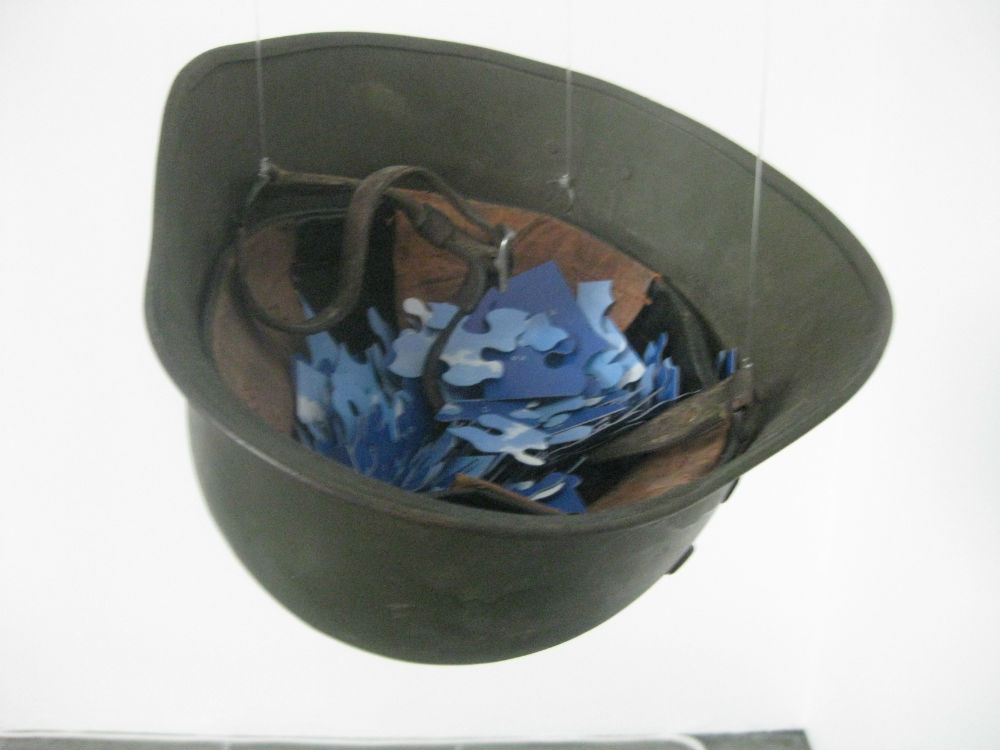
    Yoko Ono, HELMETS (2001/2012)

    July 13, 2012

    Visitors to the Yoko Ono show in London may well come away with a piece of debt to the redoubtable artist. To be precise that would be a jigsaw piece of debt.

    Early in her show at Serpentine hang some half a dozen WWII helmets filled with segments of a giant puzzle. You can guess the overall picture from a glance at any one of them.

    Were these pieces fit together again, the pattern to emerge would be blue and fluffy bits of white. It’s an invitation to think of a line by Yoko’s husband, “above us only sky”.

    Gallery notes indicate that the artist hopes her visitors will get together with their individual pieces and recreate this map of the heavens. That is really blue sky thinking.

    But we won’t of course, not in this life. Our single pieces now serve only to remind us of how atomised and unknown to one another we remain.

    The ironic twist is that military uniforms bring people together a lot more definitively than exercises in what you might call relational aesthetics.

    Nevertheless, the broken blue pieces and the grim metal lids make for a poetic juxtaposition. The same quality of patience is perhaps required to do a puzzle and to negotiate a truce.

    On the back of each piece are the artist’s inititals. You may now feel you own an orginal Yoko Ono artwork, but you don’t of course. This is very much an indefinite loan.

    Yoko Ono: To the Light can be seen at Serpentine, London, until September 9 2012. See gallery website for more details. It is a good show IMO but that won’t stop you from enjoying this savaging in the Independent.

    aggregation, contemporary art

    Found Objects 09/07/12

    July 9, 2012

    Apologies to anyone who checked in last week, I was on a break. Back on it now:

    • So, Londoners, are you pro or anti the Shard? I only ask because nothing can compete with the wrath of Simon Jenkins in the Guardian.
    • The same paper reports on a 5 year old abstract art prodigy from India. God knows how he came up with his process.
    • For a man best known for working with corpses, Joel-Peter Witkin is a right natty dresser and cheerful interviewee (video).
    • New York Magazine profiles Yayoi Kusama. Worth a look, even if you feel you’ve already had too much of the spot-loving Japanese artist.
    • Dilligent Chloé Nelkin shares photos and impressions of Verona and Padua. That’s what you call a working holiday.
    • Not sure this is a genuine flashmob, but it’s still great. An orchestra appears out of nowhere to gig in a Spanish town square. Thanks to Edward Winkleman.
    • Art Fag City pop up in Belgium to review the latest Manifesta. The 2012 theme for the roving Biennial is coalmining.
    • What with Jeff Koon’s suspended steam train and Richard Wilson’s balancing bus, this kind off thing is having a moment. (from Beautiful/Decay).
    • As remote as the Tea Party seems from these shores, a spoof art manifesto is immediate and funny. See Hyperallergic.
    • This post on blissblog hit an unlikely musical spot. Simon Reynolds curates mainstream black pop from The Whispers to The Commodores.

    18th century, appropriation, contemporary art, portraiture

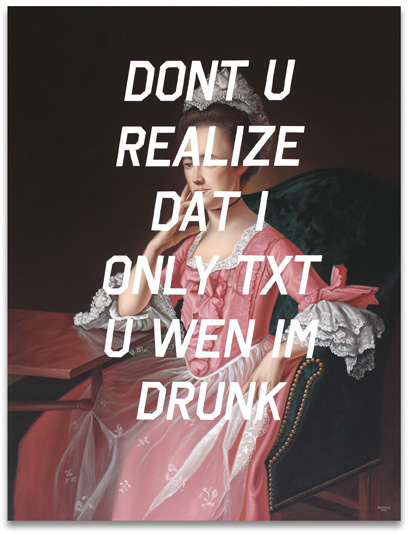
    Shawn Huckins: Dorothy Quincy, Don’t You Realize That I Only Text You When I’m Drunk (2012)

    July 7, 2012

    This is a work of many layers, the earliest one being a portrait of Dorothy Quincy by American realist painter John Singleton Copley.

    Quincy was the wife of the first man to sign the Declaration of Independence. So her portrait is also a slice of history, nevermind art history.

    Shawn Huckins has reproduced this grave example of canvas-based nation building, using the poppier medium of acryllic rather than oil.

    And the results gets fresher still as he overlays a frequently used piece of textspeak. This makes the 18th century piece of artwork look like a 21st century meme.

    The words and acronyms float between ourselves and the subject. Just as the internet can bestow attitude to cats and owls, it can do the same for historic personages.

    So viewed in a browser from the UK (owing to geographical limitations) Huckin’s work looks at first like a streetwise makeover for its targets.

    But since poor Quincy would have had limited access to a mobile phone, it seems that upon reflection this apologia for drunken texting belongs to the artist.

    And the title nails things down, addressing Quincy by name. Now the entire work can be seen as a drunken, and perhaps spurned, overture to realist portraiture.

    In this work and others like it in the series, it is as if some crude textese is the only language the unrequited Huckins can find for his haughty subject.

    Sure enough, the much maligned dialect of wired youth strips away the dignity and aspirations of America’s founding fathers. It lays pretension to waste.

    The original portrait and the latter day texts call to one another across the lifespan of a empire that now appears to be coming to an end in rofls.

    Work from Huckins’ American Revolution Revolution series can be seen in L2Kontemporary, Los Angeles, until August 18th. See his website or that of the gallery for more details.

    conceptual photography, contemporary art

    Salomé, Gérard Rancinan

    June 30, 2012

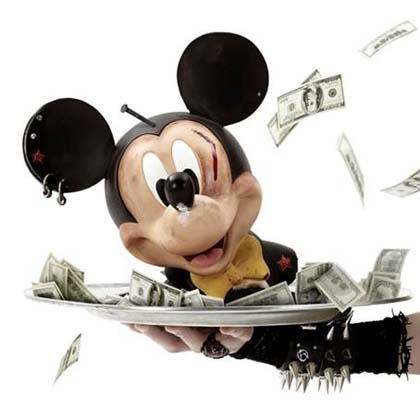
    The Disney Corporation is perhaps the most obvious of targets. Obvious because its saccharine values bear no relation to the harsh realities of life in late capitalist society.

    But taking on Disney is no easy matter. The values are promoted by one of the world’s most recognisable brands. The brand is protected by the world’s best lawyers.

    Anyone planning to get at Mickey and his pals may as well go the whole hog. And it is wonderfully clear quite how Gérard Rancinan has violated this anthropomorphic mouse.

    If the attack is not subtle, the details are still amusing. You would not expect a Disney character to wear a red star, so perhaps things have changed in the Magic Kingdom.

    Salome is also more political than you might think. An anarchy badge is pinned to her wristband and, in just such a spirit, she garnishes her trophy with dollar bills.

    To be honest, I’m not sure how much we should read into the biblical story. One shudders to think of the messiah who may or may not have been predicted by Mickey. Goofy perhaps.

    But God knows it must have been satisfying to drive that six inch nail into the lovable chap’s forehead. This violence and scorn seems to be the real meaning of the work.

    Such work is not great for brand Disney. Though you can’t help feel that a less direct approach might have worked as well, since most brands already have an ugly side.

    In 2009, Finnish artist Pilvi Takala was refused entry to a paranoid Disneyland Paris. Her crime was merely to be dressed as Snow White in order to comment on migration.

    This work is part of Gérard  Rancinan’s Wonderful World trilogy which showed at London Newcaste Project Space in June 2012.