<h1>Archives</h1>
    20th century, contemporary art, contemporary sculpture, Uncategorized

    Susan Hiller, Lucidity and Intuition: Homage to Gertrude Stein, 2011

    February 4, 2011

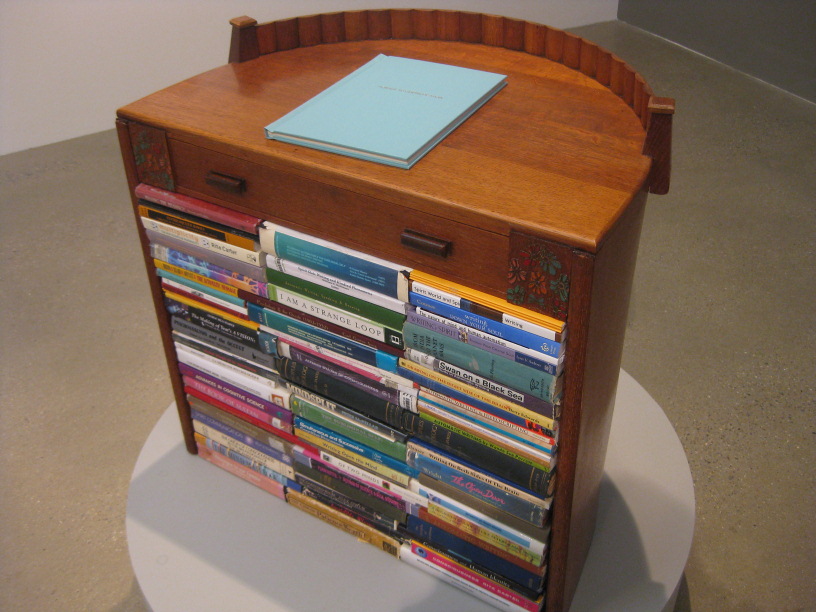
    What could be more uncanny than neat piles of books actually underneath a desk, if not neat piles of books on a decidedly uncanny subject? In this case, automatic writing.

    For Gertrude Stein, to whom this sculpture is intended as a homage, the books represent a return of the repressed. The writer went from experimenting with the technique to denying it existed

    The binder on the work surface contains her postgraduate work on the topic, with an introduction by Susan Hiller. This is the dry, public facing side of the work, the writer and perhaps the artist too.

    But the subterranean library is where you’ll find the action. Suddenly we have colour. Those books give the sculpture a transgressive energy. They fly in the face of reason.

    For me, the most unheimlich thing of all was to notice who gave Hiller her first books about Stein. According to her introduction it was Tom Verlaine. I assume that’s the singer and guitarist.

    His former band Television looms much larger in my imagination than the towering figure of 20th century art and letters to whom this piece is dedicated. Although I probably feel they shouldn’t.

    Ironic that one of my earliest influences should have found its way into this piece about suppressed artistic sources. Not that I would ever disown my love of that whole New York punk scene.

    I wouldn’t want to come home to find a poltergeist had bricked up my desk with records, after all.

    This piece can be seen as part of Susan Hiller: An Ongoing Investigation at Timothy Taylor Gallery until 5 March. See gallery website for more details.

    You might also read an interview with the artist by Rachel Cooke in the Guardian and this piece about the show at Tate Britain in the same paper by Rachel Withers.

    conceptual art, contemporary art, contemporary sculpture, modernism, performance art

    Rory Macbeth, The Wanderer by Franz Kafka, 2011

    February 1, 2011

    Looking at art and reading can seem poles apart. Galleries are public spaces in which we move from one room to another. Reading is usually sedentary and usually in some way private.

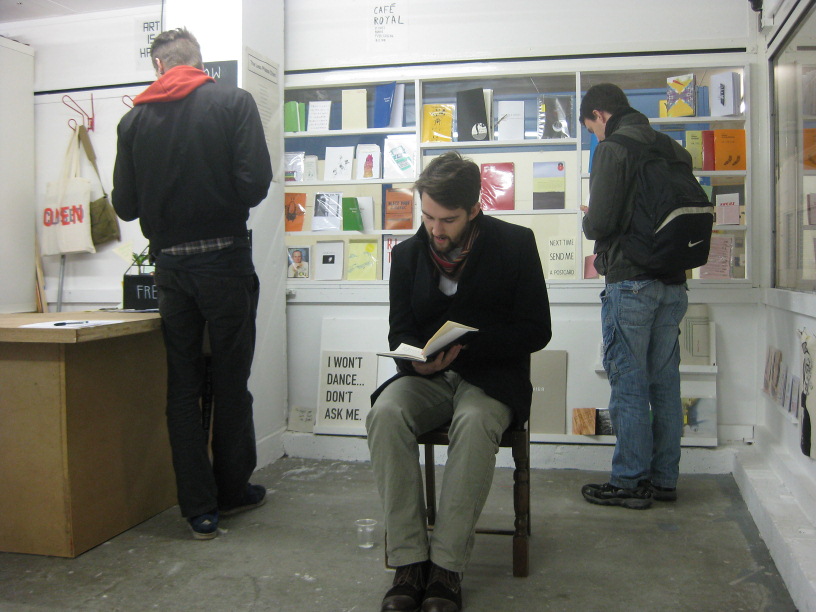
    But The Wanderer by Franz Kafka, by Rory Macbeth, suggests otherwise. The title promises a mobile activity, while the reading which took place held many gallery goers in one spot.

    In case you were wondering, this does not represent the discovery of a lost masterpiece by Kafka.That is a home-made book, a translation, and Macbeth claims not to speak German.

    Gregor Samsa crops up, so we may take this to be a version of Metamorphosis. And we may also take it that in every act of reading some translation, or metamorphosis, takes place.

    Of course, reading does get done in galleries. We read plaques, interpretation boards, even the works themselves. But this work suggests it may all stray from the path of intended meaning.

    The modernism of Kafka et al may be to blame. And this may be a warning, given the outcome for his best known protagonists. Wanderings can only go so far, after all.

    NB: That’s not the artist in the photo, but someone he delegated to perform The Wanderer at the launch of Display Copy at Kunstfreund Gallery, Leeds (29/01/11). The show features work by Rory Macbeth and Ross Downes and runs until 12 February. See gallery blog for more details.

    contemporary art, contemporary sculpture

    Urs Fischer, Untitled (2000)

    January 27, 2011

    These two mismatched halves, screwed together and suspended out of reach, bring to mind both the promise and the pitfalls of romantic love.

    First there is the seedy, fruitful aspect of these two fruits pushed together. But then there are the unavoidable differences as they find themselves hung out to dry in a marriage from hell.

    Half this story comes from a Greek myth. It is said human beings once existed in pairs, joined back to back, and that jealous god Zeus cleaved them in two “like a sorb-apple”. Aristophanes tells the tale in Plato’s Symposium.

    The playwright goes on to ask what might happen if, “with all his instruments,” Hephaestus offered to re-attach any two lovers in search of their missing wholeness.

    He concludes: “There is not a man of them who when he heard the proposal would deny or would not acknowledge that this meeting and melting into one another, this becoming one instead of two, was the very expression of his ancient need.”

    So no one can resist the invitation of the god of sculpture. This might explain why life is full of odd couples and why we invest so much in a perishable union.

    But we might yet say that this symbol of youth (apple) and symbol of immortality (pear) were made for each other. They hang in perfect balance and it is reported that as both halves decay they really do appear to melt into another.

    This piece is one of the overseas contributions to Modern British Sculpture at the Royal Academy. It can be seen there, in varying stages of decay, until7 April 2011.

    Read more about Swiss artist Urs Fischer from Calvin Tompkins in The New Yorker or from Adrian Searle in the Guardian.

    conceptual photography, contemporary art, contemporary sculpture, installation art

    Sean Lynch, DeLorean Progress Report, 2009-10

    January 25, 2011
    DeLorean Progress Report, installation view

    Tooling presses once used to manufacture a dream sports car of the 1980s are now to be found 18m below sea level, a habitation for crabs, sea cucumbers and a lobster. This is not a metaphor.

    A metaphor would be the 1981 commercial for the DeLorean DMC-12 which showed the car by the ocean with both gull-wing doors open. This image dissolved into a shot of an actual gull in flight.

    We have long been familiar with happenings in life which get called stranger than fiction. But this installation is comprised of real world objects which appear more wondrous than art.

    There are photos of submerged cast iron presses, together with crabs, taken by industrial divers. And the stainless steel body parts from a DMC-12 were made by a vintage car restorer.

    Admittedly, both forms of evidence were commissioned by artist Sean Lynch. So the first becomes a conceptual photograph and the second a contemporary sculpture.

    And yet biomarine surveys are conducted in Kilkieran Bay and there are many DeLorean owners who lovingly maintain their vehicles. So the works also display what might be called the poetry of fact.

    You may be wondering why part of a car factory is submerged off the coast of Galway. The fact is, after DeLorean went bankrupt, fishermen were among those who brought up the scrap.

    The presses became anchors for fish farms, which themselves are no longer economically viable. So as you can see from its Progress Report, the DeLorean is going nowhere fast.

    Sean Lynch’s installation can be seen as a possible future in Simon Starling: Never The Same River (Possible Futures, Probable Pasts) at Camden Arts Centre, until 20 February 2011.

    You can download a .pdf of the car’s Progress Report from the artist’s website, here. And read an indepth feature on the project written by Kevin Barry in the Dublin Review.

    contemporary art, contemporary installation

    Mike Nelson at Camden Arts Centre, 1998/2010

    January 22, 2011

    Studio Apparatus for Camden Arts Centre – An Introductory Structure: Introduction; a lexicon of phenomenon and information association; futurobjectics (in three sections), mysterious island*, or Temporary Monument *See Introduction

    The full title of Mike Nelson’s work is so verbose there’s no room for anything else in that opening paragraph. It is, like the work itself, overwhelming.

    If I could adequately describe it, Nelson would not have had to make it. Indeed, it has taken him four weeks to say something here, and the results left this visitor speechless or at least thought-free.

    Yet part one refers to a text, the Mysterious Island by Jules Verne. A one page introduction is pinned to a noticeboard in a corridor. The coffee stain on this photocopied page hints at the chaos to follow.

    Part two is an artist’s workshop. This project was borne out of a residency here in 1998. So now we see what his office might have looked like. Reading material by Marx lies alongside a magazine for Mustang enthusiasts,. He jests surely, or does he?

    Moving through another door, we step out into part three. From deep in the midst of this sprawling and towering installation it is hard to get a fix on it. A crackling radio adds to the disarray.

    Stepping away, we see the corridor and workshop from parts one and two have been augmented by a wire mesh coop, a sun deck and three looming stepladders, suggesting a modern Golgotha.

    Among the debris, we notice Mickey Mouse heads with horns, baseball caps mounted as hunting trophies, crash helmets on poles, and a figure captive in a chair. So what is this?

    This, it seems, is Nelson’s Mysterious Island, part Swiss Family Robinson, part hide-out for satanic bikers. This is make-shift civilisation and barbarism side by side. This, clearly, is an artist making themselves royally at home. Trespass at your peril.

    Temporary Monument is back on display at Camden Arts Centre as part of Simon Starling: Never The Same River (Possible Futures, Probable Pasts). It took the artist four weeks to recreate.

    contemporary art, contemporary sculpture

    Damien Hirst, Let’s Eat Outdoors Today (1990-91)

    January 20, 2011

    One way to define contemporary art may be to include anything which provokes the reaction: “That’s not art!” And Damien Hirst is certainly no stranger to this reaction.

    But the genius of this previously unseen work is that when it asks, ‘Why can’t this be art?’ as it surely does, the immediate response is it contains things-we-do-not-want-to-look-at.

    There’s a severed bovine head on the floor of the tank and no doubt tens of thousands of fat black flies. There’s a half eaten barbecue. But people do look at it. They stare for ages.

    Retinal art is back with a vengeance, and it bears consideration that even the first readymade was selected by Duchamp on account of the fact he found the movement ‘pleasant.’

    Hirst demonstrates here that visually appealing art need not even be pleasant. However, the grandeur of the work cannot be denied and even his detractors will be drawn in by the flies.

    Let’s Eat Outdoors Today is a feast for the eyes and this needs to be addressed. It throws into question how we look at art, and the wider world, and what we might be looking for.

    PS: Taking the artist at his word and judging by this interview (with Alistair Sooke in The Telegraph), you might also say this work celebrates the “beauty” of decay and death.

    You can see Let’s Eat Outdoors Today in Modern British Sculpture at the Royal Academy until 7 April 2011.

    Read Adrian Searle’s review in the Guardian here and Jonathan Brown in The Independent here. Also check out The Daily Mail coverage of Hirst’s piece, always interesting(!)

    contemporary art, futurism, sound art

    Joseph Young of the Neo-Futurist Collective: The End of Listening (ReAwakening of a City #5), 2011

    January 16, 2011

    Here is an urgent response to so-called Neo-Futurism: criticismism feels obliged to vehemently oppose it, although I realise this blog is probably doing a minor service to Joseph Young and his colleagues by doing so.

    Nevertheless, it is to be condemned. The original futurists were seductive right wing agitators who celebrated the advent of World War One and ushered in an era of fascism in Italian politics. Why would anyone want to offer an updated version of that?

    Like their forebears, the Neo-Futurists are keen on avant garde music and manifestos. Their core activities are sound art and knowing displays of self promotion, via both the web and dangerous looking rallies in the streets of Brighton.

    The movement’s avowed aims are to overcome pessimism and futile utopianism. But must it not be said that pessimism has real utility in these late capitalist times and that utopian thinking is never futile. Indeed it is a worse form of pessimism to claim as much.

    The best thing that can be said about Neo-Futurists is that their sound installation at A&E Gallery is by turns amusing and alarming, between 10 minutes and half an hour well spent. I’d recommend you visit or listen in online, only so you know what we’re up against.

    Joseph Young’s show is at A&E Gallery, Brighton, until January 23. See gallery website for more details. Or visit www.josephyoung.co.uk and/or www.neofuturist.org.
    conceptual photography, contemporary art, murals

    Cindy Sherman at Sprüth Magers

    January 15, 2011

    If you were to purchase work from Cindy Sherman‘s new show, someone would apparently come to your home and fit the piece to your room. Her photographic prints fill the whole wall.

    They are, in other words, wallpaper and their decorative potential is exaggerated by toile patterning in the background. This puts one in mind of elegant French upholstery or ceramics and I’m told the stuff is like catnip to women of a certain age and social bracket.

    So far, so tasteful, but then come giant colour photographs of the artist dressed in a range of outré costumes. We have a circus performer, a seeming inhabitant of Middle Earth, a woman in a nude-woman body suit, and five more who are no less strange for being relatively mundane.

    You could hardly say these figures blend in, although there is a ninth incarnation of Sherman who does just that. This one floats gaily through the landscape, rendered in toile-esque black and white.

    She looks as if she would be very much at home in someone’s nice home. And by contrast the others look like they come from another planet. It would be like having a permanent stranger in the room.

    So despite their resemblance to interior design, these murals do seem emphatic that Sherman’s art is no mere decoration. And its relationship with fashion, while indisputable, is filled with unease.

    There’s a great interview with Cindy Sherman in today’s Guardian and a brief but illuminating Q&A with gallery director Andreas Gegner at Dazed Digital.

    Show runs until 19 February. See gallery website for more details.

    conceptual art, contemporary art, landscape photogaphy

    Interview with Gerard Byrne

    January 14, 2011

    Written for Culture24.

    Unlike most investigations of Loch Ness, Gerard Byrne’s new show is not at all interested in the existence of a monster. His first major solo exhibition in a UK public space is about Nessie as a photographic phenomenon rather than a flesh and bone saurian.

    Speaking via phone, the Dublin-based artist explains that what piqued his interest in the place was its relation to the history of photography. “As a site it amounted to a kind of cardinal point, you might say, in the way of people’s expectations of photographs, people’s beliefs in photography as such,” he says. “Do you know what I mean?”

    Byrne has a knack of firing this short question back throughout the interview, usually after making one of his more abstract points. It is a worry because he asks it like he expects an answer.

    “Now, I’m not a puritan or a fetishist or anything like that but I’m interested in the idea of photographs as a type of material as well, as a type of material that’s generated through certain processes – both optical and chemical – and so it sort of matters that they’re analogue prints [in the show] and it sort of matters that they’ve been generated through this, you know, physical temporal commitment to that site, if you know what I mean.”

    By way of comment on the many famous pictures which claim to show what may or may not be in the local waters, Byrne has spent 10 years making a collection of his own photos of Loch Ness.

    “There are people who’ve actually lived in caravans up there and camped out. I haven’t done that. But I’ve made a lot of visits at least – I’d say at least a dozen visits, each for, like, a few days at a time, so I’ve put in some time up there,” he says.

    And as you might expect from a visual artist, Byrne sets the scene very well. “Firstly the loch is very, very big,” he says. “It’s much bigger than you might imagine. It’s quite epic in scale and it’s actually not the most beautiful part of the Highlands, the most, you know, windswept or romantic.”

    To the ears of an ignorant southerner this is almost disappointing, until he adds: “It is a little bit dark you might say. I don’t want to be melodramatic, but it is a little bit dour and dark in comparison with the surrounding landscape…it’s sort of sombre, you might say.”

    Byrne’s engagement with this figurative scenery was not without its ironies. “I go there and I make a lot of photographs and I look at the photographs after the fact and I realise that they’re all landscape photographs,” says the conceptual artist.

    “There’s a type of topography at work in the photographs,” he says. “But in the end what they really chronicle is, I think, an idea of forms which could be mistaken for other forms.”

    In other words there’s a now-you-see-it-now-you-don’t quality to the work on display, monsters at which you have to look twice.

    “That’s one of the ideas that’s very visible when you see the show – you know, this idea of the gestalt form, this idea of something that’s almost in the mind’s eye,” he adds.

    It is, after all, such gestalt forms which give rise to lake-dwelling monsters. “That’s a kind of archeptypal myth that’s found all around the world, and what distinguishes Loch Ness from the rest is precisely its mediation in the newspaper,” says Byrne.

    He goes on to explain that interest in Loch Ness peaked in the early 1930s, at a time when the mass media was becoming all pervasive and more people were becoming aware of a sense of modernity.

    “It’s interesting that there’s so much attraction to a myth that’s primarily about the primeval, that’s about the idea of something from prehistory, that could continue to live in the 20th century or the 21st century,” he says. “So there’s a strange fantasy built into that that’s about time or about escaping time or something that defies time.”

    In which case new town Milton Keynes is the last place you’d expect to find a mythical dinosaur. But now that is where you will find it, as large as life – an indisputable phenomena if nothing else.

    All works can be seen in Gerard Byrne – Case Study: Loch Ness (Some possibilities and problems), 2001-2011, Milton Keynes Gallery, Milton Keynes, January 14 – April 3 2011.

    contemporary art, contemporary installation, contemporary sculpture

    Ben Washington, I Will Eat This Sleepy Town (installation detail), 2011

    January 13, 2011

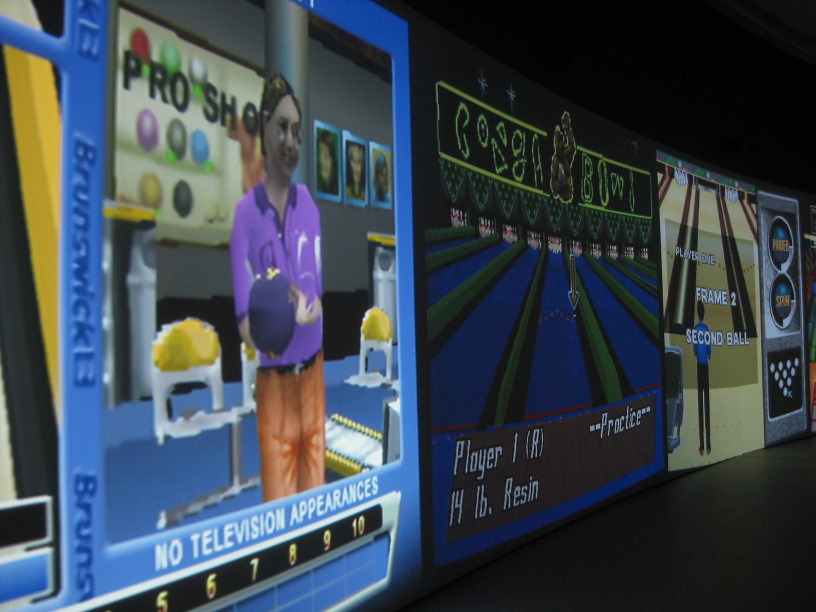
    For all the world you expect this image to move. It is a back lit screen with a casing as substantial as a cathode ray tube. We have come to expect computerised tablets to sing and dance, why not this?

    But no matter how long you watch, the piece is static. The TVs in the image remain switched off. It suggests multi-channel entertainment, but delivers nothing.

    You cannot adjust this homemade set. The photo is highly cropped, the image is blurred, and the colours are dated. The fact it glows is the best that can be said for it.

    Yet light is a powerful draw. It is still the basic element of film, television, gaming and the screen in your computer and/or phone. That must be why this work holds so much promise.

    And when you think of all the technology which 21st century minds could fit into that cumbersome wooden surround, it seems like a miracle that Ben Washington’s gogglebox simply does nothing.

    Stranger still, it does not need to. This product of a single artist can still hold the gaze, just as well as the latest 3D model. And it still hangs in the air, despite the weight of expectation.

    This work is part of a I Will Eat This Sleepy Town, a joint installation by Ben Washington and Marcin Dudek at Waterside Project Space, London. See gallery website for opening times and directions.