<h1>Archives</h1>
    contemporary, Indian, painting, sculpture

    Review: The Empire Strikes Back – Indian Art Today

    February 2, 2010
    Jitish Kallat, Public Notice 2 (2007). Fibreglass sculptures, Dimensions variable. The Saatchi Gallery, London, ©Jitish Kallat (2010)

    The very first gallery pays homage to Ghandi. 4,479 fibreglass bones spell out a text which pleads for non-violence so it seems perverse to name this show The Empire Strikes Back.

    But violent reactions wait round every corner of the Saatchi Gallery’s 11 main spaces. On this evidence, Indian art causes shudders, sharp intakes of breath and widening of the eyes.

    The worst of the horror comes from Huma Bhabha, who has created a praying figure wrapped in a bin bag. Ancient clay hands extrude, as does an antediluvian tail. It looks like a rodent or execution victim.

    The most gasp-inducing work is by Jaishri Abichandani, titled Allah O Akbar (which translates as “God is great”.) It’s written in glittering red and green whips, conveying both the rigors of Islam and the dubious glories of martyrdom.

    Then there is the awe-inspiring presence of Eruda by Jitish Kallat. This dark sculpture of a Mumbai street child stands more than 4m high. He carries books for sale, heroic in a Disneyesque way. But touch him and the black-lead finish will stain you.

    The shock factor is what you might expect from this gallery and at worst it can seem one dimensional.

    Arabian Delight by Huma Mulji is a taxidermy camel in a suitcase. It’s undeniably funny but, as a comment on the Islamification of Pakistan, it is fairly closed off to interpretation.

    But at best, such high impact work can astound and violently re-orientate you. A piece called The Enlightening Army of the Empire might suggest a choleric phalanx of men in red tunics with muskets.

    Instead, Tushar Joag presents us with a skeletal, spectral band of robotic figures, who wield car lights, spotlights, neon strips and lightbulbs.

    It strikes you that the British must often seem strange to India. Indeed, it is strange and enlightened that this exhibition should take place at all.

    Three floors of Indian art have been made available for free, together with a picture by picture guide – one of the best you are likely to come across.

    So come and let the works do violence to you. They should be resisted passively, if at all.

    Written for Culture24.
    conceptual, contemporary, installation

    To bin or not to bin? A journey into Michael Landy's Art Bin

    January 29, 2010

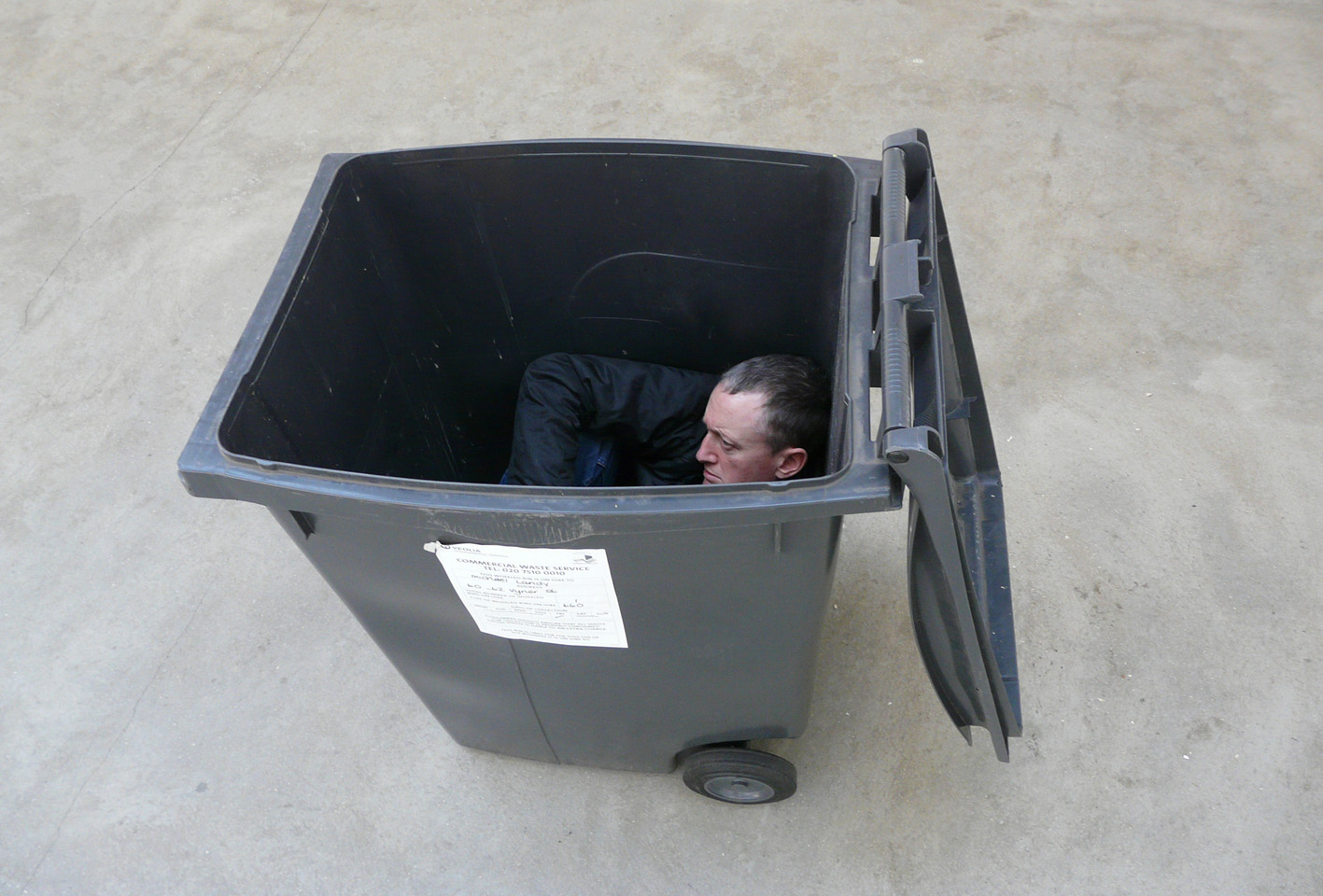
    Put work in a gallery and it becomes art. Put it in a bin and it becomes rubbish. But put work in a bin in a gallery, and you may find it becomes both. Such is the strange new context for the many damaged pieces already piling up in the Art Bin.

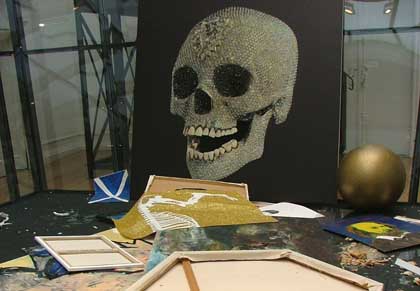
    Take the glass-encrusted skull print by Damien Hirst. Put that in an auction room and it would have become money. Nearby rests a Scottish flag, one by Tracey Emin and I’m told there’s a Gillian Wearing photo, buried. It’s art, but it’s no longer theirs.

    Art Bin is the project of Michael Landy, an artist with a track record for trashing stuff. In 2001 he destroyed all of his own possessions in a factory production line for a work entitled Breakdown. Now he is appealing for unwanted art to fill up his latest project.

    It seemed to be my journalistic duty to respond, but where to find some worthless art? A printmaker friend was begged for some or other cast off from his studio, but he refused. “I agree with the sentiment,” said the friend. “There’s too much art in the world. Just not enough of mine.”

    That’s how I came to attempt my own sketch for the Art Bin, choosing a subject much loved by tourists. It took me a cold hour on the pebbles of Brighton beach to draw the dilapidated West Pier. The result was a sort of Art Brut pastiche.

    All the while I was haunted by the possibility that Landy or his representative might reject my application to put work in the bin. He has described the installation as a “monument to creative failure.” But to fail at failure would be traumatising.

    Determined to get my masterpiece validated by an institution, I submitted it twice, first online and later in person at the gallery. This offered a chance to see the steel framed bin first hand and press my nose up against the see-through polycarbonate panels.

    “There’s nothing I can say in particular aesthetically about the bin,” said Landy, who wore the look of a stern judge, it seemed to me. “It has to be physically imposing so that it pushes people kind of up against the wall. And obviously you have to see into it.

    “It’s kind of robust,” he added. “Bins have to be robust.” In addition to a pinstripe suit jacket he wore a pair of old running trainers, presumably for getting up and down the scaffold staircase to the top of the 600m3 bin.

    What criteria, I wondered, would decide a work’s acceptance to the bin. “It’s just what I like,” said Landy. Oh dear.

    “Well, what I like is going in and what I don’t like is going in.” This was better. “So there’s nothing too good to go in the bin and there’s nothing too bad.”

    Once in the bin, however, all work is bad. “It has no value because it’s going to be destroyed,” said Landy of his unloved collection. “All the things are exactly the same. You know it gets unceremoniously thrown into the bin then something else lands on it and, before you know, it’s just mingled in with everything else as well there.”

    “For some artists this is their first show,” he joked, which seemed a carte blanche invitation to unveil my amateur offering.

    “Oh yes, you submitted this online,” said Landy. “I turned it down.” Ouch!

    “Is this a view of where you live? So it struck me, I didn’t know the circumstances, but it struck me you were bored or something and heard about this project and you thought ‘What’s out the window? Oh, I’ll just draw that and I’ll submit that as a proposal.’ So that’s what you did.”

    “I’ll try and think,” he said, looking more carefully at some of the truly artistic flourishes, or so I hoped. “I did decline you but it seems a bit mean so I’ve changed my mind. It can go in.” Success. Or should that be creative failure?

    For the overall project to succeed, the criteria are also vague. “I’ve offered this bin up to be filled with artworks that have failed somehow,” says Landy. “I don’t know how it’s going to play out. I don’t know what’s going to happen.”

    To help find out, proper artists can now make their way to the South London Gallery with work they no longer want. You could say they’ll take any old rubbish.

    Written for Culture24. Link to follow.

    20th century, 21st century, abstract expressionism, Alberto Giacometti, constructivism, Cy Twombly, Donald Judd, drawing, Fernand Leger, film, futurism, George Grosz, Jackson Pollock, Joseph Beuys, Kazimir Malevich, Louise Bourgeois, Lutz Becker, minimalism, modernism, Paul Klee, Piet Mondrian, Richard Serra, totalitarianism, Umberto Boccioni, Viking Eggeling, Willem de Kooning

    Preview: Modern Times at Kettle's Yard

    January 28, 2010

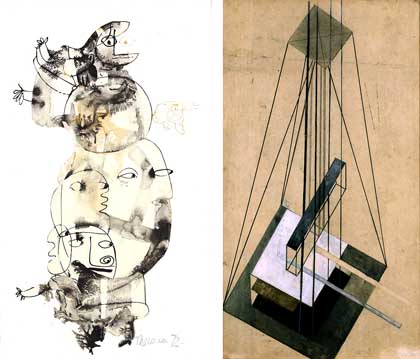
    Franciszka Themerson, Gustav Klucis. www.kettlesyard.co.uk

    Modern Times – Responding to Chaos, Kettle’s Yard, Cambridge, until March 14 2010

    Attempts to build a world order invariably result in chaos. Some of the outcomes can be seen at a new exhibition at Kettle’s Yard, Cambridge.

    Modern Times: Responding to Chaos is the first of a series of shows in which creative protagonists of the 20th and 21st century have been asked to trace a personal journey through recent history.

    First up is film-maker and painter Lutz Becker, whose personal responses to chaos are classic documentaries. Art in Revolution (1971) looks at Russian art in the early days of Communism, Swastika (1973) looks at the rise of Nazism in Germany, and Vita Futurista (1987) studies the far right Futurist movement in Italy.

    So it’s no surprise that Becker’s curatorial interests take in many artist-made films of the last hundred years. The show includes moving image pieces by Viking Eggeling, Hans Richter, Fernand Léger and even Kazimir Malevich.

    But latter-day chaos has also caused a rupture in the most longstanding of art forms, drawing. As film captured slices of reality, artists used the hand-drawn line to pit abstraction against figuration and turn geometry against spontaneous gesture.

    Malevich and Eggeling reappear on paper, along with Boccioni, Mondrian, Grosz, Klee, Pollock, de Kooning, Giacometti, Bourgeois, Beuys, Serra, Judd and Twombly.

    But what have these exponents of Futurism, Constructvism, Abstract Expressionism, Minimalism and Conceptualism left us with? More chaos, and the 21st century awaits a few comparable responses.

    Written for Culture24.

    conceptual, contemporary, installation, Michael Landy

    Preview: Michael Landy – Art Bin at the South London Gallery

    January 26, 2010


    Exhibition: Michael Landy – Art Bin, the South London Gallery, January 29 – March 14 2010

    Michael Landy, who famously destroyed all his possessions in the name of art, is set to dispose of a whole gallery of art, perhaps in the name of destruction.

    For six weeks Landy will turn the South London Gallery into a 600m2 disposal unit called Art Bin. The website shows a classic grey wheelie bin, but one hopes the work itself will be spectacular.

    For the pulverisation of his Saab and his birth certificate in Breakdown he designed a colourful production line in a disused Oxford Street store. The execution matched the boldness of the idea.

    A few of those worldly goods were themselves artworks made by other artists. So many will look on Art Bin as a sequel.

     But it also follows up a 1995 piece called Scrapheap Services, when Landy formed a corporate cleaning company to clean up an East End gallery which was infested with thousands of cut-out figures.

     While Breakdown may have worked because the stakes were so high, the London-based artist is playing down the risks in his new venture. 

    “Art Bin is about failure,” he has said, “Either within particular art work, or more generally in artists’ practice: nobody discards art which has some sort of intrinsic value, so the bin becomes a monument to creative failure”.

    Artists are invited to bring their creative failures along to South London Gallery from January 29 where Landy or his representative will assess its worthlessness. Though be warned. It may get rejected, even from a bin.

    contemporary, Japan, Norway, textiles

    Preview: Cultex – Textile as a Cross-Cultural Language

    January 25, 2010

    Kiyonori Shimada - proposal for gallery F15 installation.

    Cultex – Textile as a Cross-Cultural Language, The Hub: National Centre for Craft and Design, Sleaford, Lincolnshire, January 30 – April 18 2010

    The cultures of Norway and Japan are as far removed geographically as almost any but the UK premiere of a new exhibition shows bridges built across continents using textiles.

    Cultex, which opens at the Hub in Lincolnshire, is the work of three pairs of artists representing both countries, and many common threads were evidently found.

    Gabriella Göransson and Kiyonori Shimada had never met, but soon discovered a shared interest in primordial memory and archaic, organic forms.

    Eva Schølberg and Yuka Kawai, having met once a long time ago, hit it off with a direction new to both. Their work in the show is based on ideas of ‘gravity’ and ‘ground’.

    Meanwhile Anniken Amundsen and Machiko Agano had previously worked together, but for Cultex decided to respond to the effects of environmental change.

    As all three pairs demonstrate, there are as many connections as differences between the far North and the Far East. Knowledge of technique, materials and the history of textile art transcended all boundaries.

    “The works are interventionist in the broadest sense – intervening not only in physical space but also within the cultural and creative space of people living in particular times and particular places,” says curator Lesley Millar.

    Aren’t there more world cultures between which a textile-based intervention might be needed?

    Written for Culture24

    Amanda Beech, contemporary, LA, modernism, sculpture, video

    Preview: Sanity Assassin by Amanda Beech

    January 23, 2010
    Amanda Beech, Sanity Assassin (2009), Installation view. Courtesy of Spike Island. Photo: Stuart Bunce.

    Spike Island will hold the first major solo show in a public space for Amanda Beech. The West Country gallery promises a nightmarish trip to America’s West Coast.

    Sanity Assassin is a three screen video installation with a sinister sculptural element, a series of chainsaws atop a mirrored plinth. This display, based on a real corporate showroom, was inspired by a visit to LA, where the piece was also filmed.

    Footage centres around two very different city residents, a disillusioned European drifter and a spokesman for the new world order. As their stories synchronise to the beat of a noise soundtrack, they ultimately merge with psychotic results.

    An interview with photographer Julius Shulman, who shot California architecture, and a text by Theodor Adorno have been worked into the narrative. Equally diverse influences on the film are provided by MTV montage, the title sequences of Saul Bass, film noir and 3D building fly-throughs.

    Often thought of as a secluded playground for the rich and famous, Beech gives us a version of LA which is maddeningly claustrophrobic.

    But while the work should be highly visceral, it also sets out to examine the theories of so-called ‘exile modernism’ as found in later writings by Adorno, Thomas Mann and Bertolt Brecht.

    In 2009 Beech was awarded the main production residency at Spike Island. Sanity Assassin is a new work developed in her time there.

    Written for Culture24

    contemporary, Marcus Coates, shamanism

    Preview: Psychopomp by Marcus Coates

    January 23, 2010
    Vision Quest, Ernie by Marcus Coates. Photo by Nick David. Produced by Nomad.

    Work by modern day shaman Marcus Coates is on show at Milton Keynes Gallery in the first UK public space to hold a survey of the artist’s work.

    Psychopomp includes early film pieces, sculpture, sound, costume, photography as well as new work. In many of the pieces Coates goes to extreme lengths to commune with wildlife.

    The London-based artist has said his work is “all about our relationship with animals and nature…there is humour in the work, but a serious side explores how we use our relationship with animals to define our humanness.”

    Such humour can be seen in a film such as Goshawk in which a telephoto lens picks out a tree top in which Coates himself is perched. In Finfolk he assumes the identity of a seal and emerges from the sea speaking a made-up seal language.

    There can be no doubting his commitment, as many films show the artist engaged in shamanistic rituals, wearing animal skins and entering a trance-like state in which he attempts to summon spirits.

    In this way Coates has often worked with human communities to solve problems which have eluded the rational mind. In Norway he tackled prostitution and in Israel he explored the Palestinian conflict.

    One of the most striking pieces in his latest show features everyday people singing like birds. Dawn Chorus was filmed with the help of a sound recordist who slowed down birdsong so that it could be mimicked and then speeded up the results to echo the original calls.

    Milton Keynes’ infamous concrete cows were unavailable for comment on the show.

    Written for Culture24.

    19th century, drawing, letters, painting, post-impressionism, Royal Academy, Van Gogh

    The Real Van Gogh: The Artist and his Letters at the Royal Academy

    January 20, 2010
    Still-life around a Plate of Onions: Kroller-Muller Museum, Otterlo, The Netherlands

    Self Portrait as an Artist by Van Gogh is a defining image of the modern artist. The blue smock and bright palette are shorthand for genius. The red beard hints at the wildness we expect from this self-destructive master.

    But alongside this painting, the Royal Academy offers us Van Gogh in context as a hard-working technician, a deep thinker and a gifted writer, with a lot more to him than the stunt with the ear might suggest. 

    This is thanks to more than 900 surviving letters, about 40 of which have made it into the brilliant show. Letter 400 contains another self-portrait of sorts. An ink sketch shows a dark figure straining at the horizon, dragging a gridded plough.

    The artist must go about his work, he writes, “with a conviction that one is doing something reasonable, like the peasant guiding his plough or like our friend in the scratch who is doing his harrowing.” 

    Throughout his life, Van Gogh used letters to plough ahead with his art. Struggles with perspective, ideas about colour and a love of Japanese art are all worked through in neat handwriting.

    His methodical approach is not unlike the farmwork or weaving he observed during formative years in Etten in the Netherlands. He drew peasants for a while to the exclusion of all other subjects When friends criticized a major painting, he responded by stepping up his efforts to capture rural folk. 

    At that time, drawing was not so far removed from the soil. Landscape Near Montmajour would have been made using pens cut from reeds. The range of strokes is breathtaking. No wonder he writes in praise of the reed quality near Arles in the South of France.

    This is where he painted so many landscapes that would later dazzle the world. Yet Wheatfield With Reaper at Sunrise, Enclosed Field With Peasant and Wheatfields With Reaper all feature a lone, possibly self-referential worker out in the fields. 

    Six volumes of published letters have inspired The Real Van Gogh and many different versions of the artist will emerge. Terminals in the reading room link to the excellent website, where you can harvest quotes on any theme you like.

    “One must work as hard and with as few pretentions as a peasant if one wants to last,” contends Letter 823. With this book and show, Van Gogh’s popularity can only grow.

    Written for Culture24.

    contemporary, illustration

    Emma Stibbon: StadtLandschaften at The University of Brighton Gallery

    January 15, 2010

    The GDR did not exist. So reads the graffiti which greets visitors to StadtLandschaften, a new show by Emma Stibbon. This scrawl appears in the foreground of an ink drawing which, like much of the artist’s work, shows the brick and mortar evidence that in fact the GDR did exist. But the Soviet era building beyond the wall drips with various shades of grey. It does indeed look as if you could wash away the entire history of a nation.

    Nearby are a row of memorials in watery ink. The passing of time has made a joke of the supposed permanence of stone. A plinth sits empty and bears shrapnel scars. A statue for the fallen of WWII floats away from the earth; the soldier peers from behind the wintry branches of an overgrown tree.

    German-born Stibbon has found a surprising degree of poetry in these recent ruins. They are after all only two decades old. Her black and white studies are as atmospheric as faded newsprint, and just as realistic. It’s a pre-digital look which lends both weight and mass to her subject matter.

    Many of the works on display have been etched on blackboards using chalk. Schlossplatz is a brooding epic in which a dark palace presides over some ruined bunkers. Karl Marx Allee is a brilliantly drafted aerial shot of a major boulevard which, as we are informed, led pointedly East.

    The artist’s white lines are so fine and her medium so dusty that you get a sense that a single puff of air could blow both landscapes off the map. Elsewhere she depicts a rainy runway at Tempelhof airport. The chalk is smudged and looks like the scene could dissolve.

    In room two of the exhibition, Stibbon takes us further afield to Antarctica. Most of these scenes are just as transient. Her Whaling Station on Deception Island is in collapse. A watercolour called Drift Ice is a scene whitening into non-existence.

    Fixed on the wall is a photo of the artist. She sits on a plastic chair on the deck of a boat somewhere in the freezing ocean, sketching. Emma Stibbon exists, but had there been graffiti it might suggest otherwise.