<h1>Archives</h1>
    Uncategorized

    Found Objects 10/06/13

    June 10, 2013

    Here’s the weekly selection of links. Thanks for reading, and please note this blog will be on a week’s holiday-enforced hiatus from . . . now.

    • Entrepreneur plans world’s biggest art gallery on UK billboards. 15,000 displays of British art to go up soon. Street Fine Art or Fine Street Art?
    • Check your phone and laptop at the door and welcome to the Marina Abramović. There has been talk of a performance art cult
    • Eduardo Chillida comes indoors for a Mayfair show of the monumental sculptor’s work. Read about that, and his sporting endeavours, in an otherwise luke warm review
    • At last an MA thesis which could prove useful to a financially burdened grad. We Make Money Not Art interviews Larraine Henning about the art of squatting
    • Check out the newest addition to my blogroll: kdoutsiderart. Kate Davey writes well informed pieces about outsider art, such as this, her latest post, on Alfred Wallis
    • I loved this piece on web reading habits from Slate (by Farhad Manjoo), and yes I did read to the end. I read all these links to the end 😉
    • Beautiful/Decay lives up to at least the second half of its name with a suite of photos from a new Chapman Brothers show in Hong Kong: “pessimistic in a joyful sense”.
    • A colourful review of a colourful painter, Adriam Hamilton takes a look at Chagall, Tate Liverpool, and writes it up for the Independent
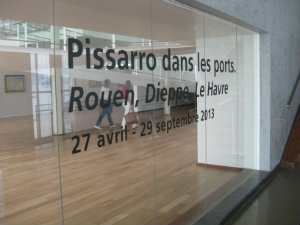
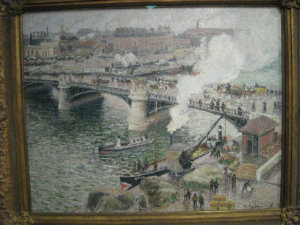
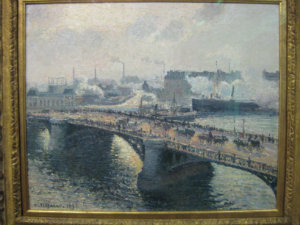
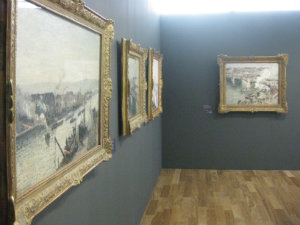
    • Blouin Art Info reports on a Major Pissarro exhibition which opens in Madrid. A chance to see why Cezanne called the painter “humble and colossal”
    • George Sugarman may be an equally neglected artist. Hyperallergic reviews his show at Gary Snyder Gallery, New York.

    Uncategorized

    Tessa Payne @ Now and Again

    June 9, 2013

    now and then 018

    Since we now have to pay tax on extra bedrooms, here’s a worthwhile bit of DIY. Why not transform your spare room into a gallery? Even if there’s no guarantee it will pay out.

    Requirements include lights and paint, both white, plus a tonne of hard work. But at least now the gallerist (Daniella Norton) can sit back and welcome people to a sterile yet domestic space.

    The white paint, however, looks blue as you walk into the six work solo show by Tessa Payne. The painter has said her pallette is inspired by the sky, and it bleeds into the surrounding space.

    Payne appears to paint faces. Her subjects, if they so be, are distilled from photographs and pushed as far from reality as you can get. Perhaps it is a weakness to see, eyes, mouths.

    Or perhaps it is a real 21st century malaise, now that we live alongside emoticons, and enthusiastic photographers prowl the wider world looking for faces in things.

    It is safer to get back to the colours. The work created to sit above a radiator is perhaps the warmest, with belts of gentle pink which ripple across the surface like isotherms.

    The piece opposite (pictured), for all the world as grey as a cold spring day in London, also has unexpected hints of purple. Payne uses colours expressively, but also minimally.

    You might say this was a portrait of an elephant, but the joke would probably be on you. Painting may be a wilfully dumb medium at times, but it is rarely as childlike as it appears.

    The show title, Maps, might provide a clue, suggesting an urban terrain. But then again faces can also be mapped, by machines, for security or so-called security purposes.

    But Payne’s faces, with their flyaway eyebrows and tick box eyes would surely pull up an error message. They function like masks to conceal the sitter’s true identity.

    House guests with masks; sounds like a great party. It is certainly a good way to kick off Brighton’s newest gallery, Now and Again, 17B Beaconsfield Villas.

    The show is open next Saturday afternoon. So check it out if you’re in town.

    contemporary art, photography, reportage

    Sean Smith, Swindon, 1994

    May 31, 2013
    (c) Sean Smith
    (c) Sean Smith

    This surely isn’t a complete picture of Swindon in the 1990s. And the town’s name sits at a variance with many of the other locations where Sean Smith has been to work.

    A current show in Kensal Green takes visitors to Palestine, Beruit, Johannesburg, Sarajevo and Kabul. But this town in South West England has thrown up one of the most disturbing scenes

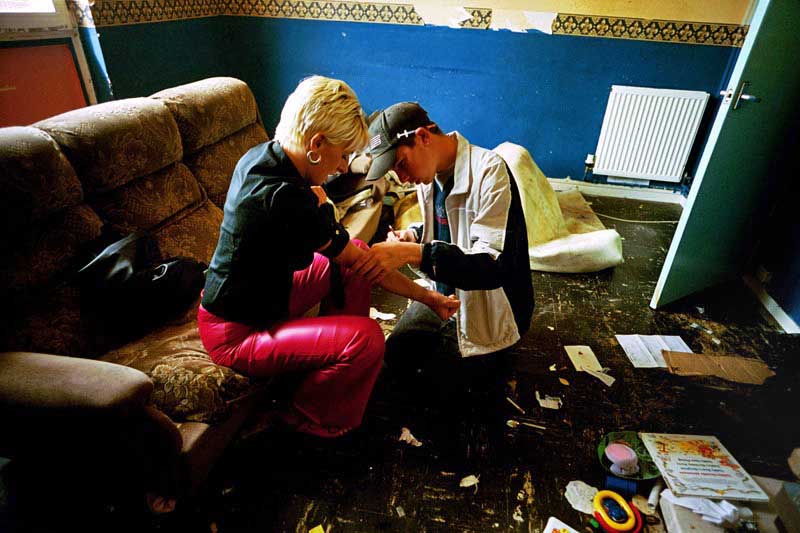
    Clearly, taking heroin is quite absorbing. You wouldn’t know there was a third figure in this room: a man with a camera. How does Smith get himself into so many wrong places at the wrong time?

    Thanks to him, we too can explore this room unseen. We note the childrens’ toys in the foreground. Observe the syringe-behind-the-ear fashion statement.

    We might assume this woman is a mother; she doesn’t look like a stereotypical addict. But neither does this too-young man. Is it his own mother? In that possibility lies the full shock.

    Mothers tend to their children. Children do not usually tend to their mothers. Once she might have fed him milk from breast or bottle, now he tenderly shoots her up with scag.

    Perhaps it is time to end my ongoing ridicule of my own mother for some of her fussier habits: covers on sofas, silverware for special occasions, candles at family meals.

    She too is an avid photographer, of a different stripe. Pleased now, that my own appearances in family snaps are in well-appointed living rooms not empty flats like this one.

    But this is still a domestic scene. Nowhere is it written that heroin use and household management can’t go together. Maybe that’s what makes this photo so subversive, its apparent normality.

    The sofa, the toys, the natty pink trousers: these all make it a homely scene. But the spoon, the needles and the tourniquet are completely out of place and unheimlich.

    All these tensions hang in the air. And there are plenty more conflicts in the surrounding works, split between a chapel and a crypt in W10. The subterranean venue adds even more atmosphere.

    It may be true that, as TS Eliot wrote, “Humankind cannot bear very much reality” But there are surely dangers in not getting enough. For this alone, visit Smith’s show if you can.

    Sean Smith: On the Margins shows in the Dissenters’ Chapel, London W10 4RA, until June 26 2013. Venue best approached from Ladbroke Grove. See map!

    aggregation, contemporary art

    Found Objects 27/05/13

    May 27, 2013

    Another week, another clutch of timely links:

    • Interesting take on cave art, from the Travel Desk of the Guardian. “The good life was invented here,” says Robin McKie
    • Playwright David Hare pays tribute to Patrick Caulfield. Ahead of the painter’s Tate Britain show this is well worth another visit to the Guardian site
    • A witty cartoon about Futurism is to be found can be found on The Casual Optimist. Bet you never thought the Italian proto-fascists could be so sweet
    • Hoodie alert. Erdal Inci has cloned a potentially dangerous yoot and set them on an endless march towards who knows what?
    • This may be the worst song ever, but hey it’s Ai Weiwei and he’s directed a video so, you know, do check out (via Hyperallergic)
    • Artists James Harvey and Ryan Humphrey had a dream of Akira retold using Simpsons characters. So far 768 artists have been recruited to make it a reality
    • Carolina Miranda reports on the stateside popularity of James Turrell right now, a sculptor who will sell you the sky
    • Something to look forward to at Blain Southern next month. The first ever UK show of JG Ballard’s favourite painter Paul Delvaux
    • Possibly only of interest if, like me, you’re from Colchester, Essex, UK. But anyhow here’s a report from a painting show by the father of Blur lead singer Damon Albarn
    • In the Telegraph, Mark Hudson paints a fair enough picture of the Land Art show at Southampton City Art Gallery. There are indeed a lot of black and white photos in it
    • From the department of difficult loves, Stephanie Bailey reviews a Jean Cocteau exhibition in Hong Kong. A good read from Hyperallergic.

    contemporary art, war art

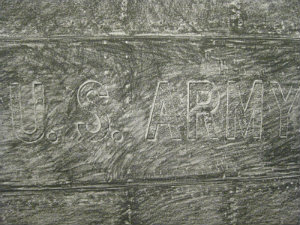
    Mariele Neudecker, Psychopomp (Hercules Missile Graphite Rubbings 1&2) (2010/11)

    May 25, 2013

    Under normal circumstances the end of a world war might be cause for reflection. And indeed, each November we have institutionalised mourning at an almost mandatory level.

    But the cold war is different. Lives were only lost in countries the US and the USSR should never have been in. Remote peoples were armed and set against one another.

    Now we reap what we sowed. Were it a just war, museums like the Nike Historic Missile Site in California might be as affecting as a trip to landing beach in Normandy.

    The Hercules Missile system was intended as a line of defence against Soviet bombers. It became obsolete as both powers came to rely on ICBMs.

    Now it is so obsolete they allow artists to climb all over the deactivated stock, for the making of graphite rubbings or whatever else it is that artists do.

    Neudecker has engaged with every inch of this 41ft behemoth. The full incarnation of this work would not even fit in the downtown Brighton gallery.

    Straddling the missiles like a peacetime Dr Strangelove, she renders cold hard steel in a manic, performative, durational scribble.

    Keen eyed defence strategists will realise there are two Hercules on display. One light, one dark. Neudecker leaves us to guess which was the real thing, which a military decoy.

    Does the lighter missile represent a tentative fear, an explosive potential which mustn’t be disturbed? Or does the darker missile indicate a deeper, more passionate engagement with the real thing?

    Either way, this is close as you’d want to get. Neudecker’s piece is evidence relating to last night’s nightmare. The East-West standoff, the three minute warnings, the paranoia . . . It happened all along.

    This piece can be seen in The Air Itself is One Vast Library at Lighthouse Arts, Brighton. See galllery website for more details.

    contemporary art, war art

    James Bridle, Under the Shadow of the Drone (2013)

    May 21, 2013

    It is one of the most frightening scenarios you can imagine: up to six armed drone aircraft circling your neighbourhood, preparing to strike and strike they do.

    Numbers are what surprised me most from reading James Bridle’s blog about unmanned aerial vehicles, or drones. If six Reapers above your village doesn’t amount to terrorism, nothing does.

    So in a laudable attempt to bring the long war home, the artist has arranged for an UAV outline to be painted on Brighton seafront, yards away from the pier and other amusements.

    It is electric green, a shade which might be to the 21st century what lapis lazuli was to the 15th. Just as they treasured their azure Madonna blue, we may fetishise our virtual, chroma key green.

    An accompanying film makes clear the drone was put in place by road painters from Hi-Way Services. And indeed you might mistake the wing outlines for some obscure parking regulation.

    But note the masterful way the paint slips down the kerbs between the promenade and the road. It has all the fluid movement and stealth you might well fear from an unfriendly UAV.

    Perhaps this is also fitting, but people don’t seem to be taking much notice. Joggers jog past. Coach parties drive past. Bridle’s work is about our ignorance as much as anything else.

    You would have to collar every passerby in turn and say, look, just yesterday two men were killed on a motorbike in the Yemen. Did you even know we were at war there already!?

    This fact is true at time of writing, gleaned from the Bureau of Investigative Journalism and posted along with the satellite view on the aforementioned blog, dubbed with cruel irony Dronestagram.

    Drones may be invisible, but we allow them to be. None of these strikes make the evening news. In the past eight years almost 3,500 people have been killed thus in Pakistan alone.

    The campaign is remote in every sense. Our hands are kept so clean that, weather permitting, we can even sunbathe nearby. Thank god the victims can’t see us, even if we can see them.

    Under the Shadow of the Drone was commissioned by Lighthouse, Brighton, and can be viewed on Madeira Drive, until May 26.

    contemporary art, film art

    Emma Critchley, Aria (2013)

    May 20, 2013

    Aria, film still (2013), (c) Emma Critchley

    Viewed through the baking darkness of a shipping container on a South coast beach, Critchley’s sub aquatic film floods the space with a certain amniotic calm.

    What you see is a cross section of a small indoor pool. With the ease of a water baby, a bikini clad free diver spins and flips back and forth with no apparent need to breathe.

    Meanwhile another respiratory athlete, this time a soprano singer, provides a soaring and swooping soundtrack. Having removed all consonants, it would read like the cry of a newborn.

    Breath is the key to this film. No matter how long its subjects hold that for, they both need to come up for air. But it surely wasn’t ever this way in the womb.

    Critchley cannot really take us back to our intrauterine beginnings, but she can offer the next best thing. She inverts the picture so the diver appears to be flying.

    This sets up a parallel between the need to draw breath and the law of gravity. Both requirements are hard to get away from, as inevitable as the “breathe, breathe, breathe” rule of labour itself.

    We may be reminded that in its prehistoric beginnings, art was made in dark places. In chambers rich with carbon dioxide, suffocating cave artists are thought to have experienced visions.

    At the same time, of course, artworks of great beauty can leave the viewer breathless. In a case of Stendhal Syndrome you might succumb to gravity and collapse.

    Critchley’s film peaks with the sudden appearance of her diver in the near ground. She is tucked into a foetal ball and spins just above the waterline. It makes you gasp.

    This is the moment she is almost, but not quite born. She reappears in the background and we can breathe again. For just a while longer we can maintain this state of pre-natal oneness with art.

    Aria can be seen in Brighton as part of HOUSE Festival 2013. See housefestival.org for more details.

    aggregation, contemporary art

    Found Objects 20/05/13

    May 20, 2013

    Links once again compiled for your edification and delight. Please read responsibly:

    • I suppose the art story of the week was a Gerard Richter painting breaking records for a living artist. “I just love it . . . I just love art,” says buyer
    • But if you’re in New York you may have been more distracted by the face off between Jeff Koons and Paul McCarthy. The Times gives this round to McCarthy
    • Also expected to do well at auction: a chimpanzee. Hyperallergic reports on the six figure fees which circus animal Mikki can hope to pull down
    • Talking of expensive polaroids, American Suburb X posts a gallery of Warholian photographs, which include shots of Debbie Harry, Tom Jones and Arnold Schwarzenegger
    • What the hell are they teaching in Russian art schools? The latest piece of slavic controversy took place in Brussels where Petro Wadkins has ‘pissed all over’ tradition
    • Another Hyperallergic story offers comfort to the middle aged. Hrag Vartanian notes the online rise of the 18th century power paunches, plus a one Daniel Lambert
    • On these shores we got excited about Tate Britain’s new hang. It includes toughened floors to support monumental Epsteins. Can’t wait to see for myself
    • The Guardian comes up trumps with at least two compelling interviews this week. The more recent is this one with the quiet man of the YBA movement, Gary Hume
    • The paper also interviews Cornelia Parker who talks about her peasant stock, her anxieties regarding cracks in the pavement, and sleeping with the enemy
    • Non football fans look away, but it’s been an emotional week for the national game. Here we see a photo which sums it up . . . Beckham in tears.

    collage, contemporary art

    David Wightman, Hero (2013)

    May 19, 2013

    wightman

    To stand facing this piece by David Wightman is, at a certain time of the day, to stand facing the sun as it sets behind Brighton’s much photographed West Pier.

    Indeed, Wightman has given us a landscape every bit as sugary as the canvases for sale down on the sea front in what has been called the city’s Artist Quarter.

    The light is pink, the waters turquoise. This is what many people expect from art, a real life scene with an exaggeration of light effects and a strange beauty.

    But Wightman’s scene is not real life. It is a composite or a chimera. He takes postcards and begins to invent. He draws cartoons in the classical sense and works up monumental paintings.

    Except nor are they paintings. His works are made from highly textured, precision cut wallpaper. They might be called collage, but only to the degree that a late Matisse would be a collage.

    Brighton’s HOUSE Festival celebrates art with a relation to domestic space. And the wallpaper does indeed tame this sublime and fictionalised landscape.

    And yet you would need a big wall to host Hero. It dominates the small glass pavilion in which it finds itself and is presented several inches from the far wall, giving emphasis to its materiality.

    This is not what people really want from a landscapes above the fireplace. And indeed the artist points out he has more in common with Bridget Riley than John Constable.

    His acid colours and fragmentary shapes play with abstraction. But at the end of the day, we are too familiar with picture postcards to avoid the representational trappings.

    Mountains and cabins and tarns and snowfall: these are all tokens of beauty. We bring them indoors as pieces of art and, in the light of Wightman’s giant pieces of décor, that is a strange convention.

    Hero can be seen in Brighton’s HOUSE Festival until May 26. See housefestival.org for more details.

    contemporary art

    Andrew Kötting with Anonymous Bosch, Underland: Beyond the Mounting Fear (2013)

    May 18, 2013

     underland2

    This show may be just a hidden outpost of a relatively obscure art festival on the South Coast. But London policewoman Marta Zawistowska has reportedly been twice already.

    In many ways this show is for her, from the cases full of postcards, to the photos and videos, and the shredded clothes and motorbike leathers on the walls.

    Zawistowska is the everyday hero who scooped Kötting off a busy London road, staunched the bleeding in his leg and saved his life.

    It was the day before the artist was due to fly to the Pyrenees with Anonymous Bosch in order to make the photographs which would have gone in this show.

    Kötting and Bosch were due to project images within a remote cave and photograph the results with pinhole camera. The cave was in Fear Mountain (Montagne de la Frau).

    In the event, the majority of images are blurry shots through a pinhole in a hospital room with a leg so scarred you can still see the broad stitches.

    But the duo did make it to a cave, albeit one nearby. A friend in Hastings has access to a smuggler’s passage through an arch in their home.

    What can you say about such luck, good and bad? Like a pair of neolithic artists, the duo were really determined to get into the Underland.

    Plato had some relevant ideas about caves. But he wasn’t prepared for a laptop and projector. He wasn’t even prepared for the pinhole camera. 

    The ward soon became a Platonic cave with Kötting as its prisoner and Bosch as the philosopher who, with help of camera, interprets the shadows.

    But the drama revolves around the crash, rather than the cave. The artist cheated death and, at the press view, still had the scar to prove it.

    For me, this baring of wounds calls to mind Coriolanus. Shakespeare’s general is encouraged to show his scars to the masses and restore order.

    He plays them down as: Scratches with briers/Scars to move laughter only. But pride is his downfall. He certainly wouldn’t have got arts funding.

    Scars remain a great way to inspire pity and awe. When done with artistry, and dedication to a life saver, there is nothing wrong with showing them off.

    Underland is part of HOUSE 2013, a festival of art in Brighton until May 26, see housefestival.org for directions and further details.