<h1>Archives</h1>
    contemporary art, film art, synaesthesia

    Interview: Daria Martin

    February 19, 2012

    If you can taste these words or see them in colour, you already know about the condition known as synaesthesia which affects 1 in 20 people worldwide. If you can’t, chances are you might like the sound of that, especially if you are an artist.

    “There are a lot of wannabe synaesthetes, including myself, out there,” says Daria Martin. But at the suggestion we may all be afflicted with the condition on an unconscious level, she points out, “you either are a synaesthete or you aren’t.”

    So who can claim to be part of this exclusive neurological club? Martin tells me that Kandinsky, Eisenstein and Rimbaud were all synaesthetes. But then there are the living examples in hew new film Sensorium Tests, including a man who can indeed taste words.

    “Synaesthesia has been described as a cross fertilisation of the senses,” says the American artist. “So historically synaesthesia has been a model of artistic media cross fertilising one another.” In other words, it’s a boon to painters and poets.

    For the rest of us, Martin’s new show at Milton Keynes Gallery may be the most direct way to understand such enhanced perceptions. The centerpiece is the 10-minute film, Sensorium Tests, which also explores a newly discovered variant Mirror Touch Synaesthesia.

    In 2005, scientists first realised that some synaesthetes have a tactile response to images – feeling pain, for example, when they see someone else bang their head. Martin is surely the first visual artist to explore this pertinent field.

    “This new form mirror touch synaesthesia was particularly intriguing because it introduces a social aspect to synaesthesia. It’s dependent on not only one person’s subjective perceptions…but also on how those perceptions relate to social interactions happening in the world outside,” she says.

    One theory of this phenomenon goes hand in hand with the recent discovery of mirror neurons, the nerves cells which may be responsible for empathy and learning. According to Martin, this does imply “how all of us can become social empathetic human beings”.

    But in the newly discovered group of synaesthetes, such cells are “somehow on overdrive or excessive,” says Martin. So “the exhibition presents mirror touch synaesthesia as a starting point to explore the ways images can trigger – from a distance – physical responses” .

    It does so by recreating a 2006 experiment into the condition and focusing on the interplay of look and gesture between the actors playing synaesthetes and scientists. But other films here may also touch the visitor to MK Gallery, featuring playing cards, robots and musical instruments.

    “The ideas in Sensorium Tests are not only about the objectivity of one’s perceptions but also the converse: the idea that objects themselves might have a sort of subjectivity,” Martin has said. In other words, she hopes to suggest “objects can be sentient or animate”.

    When images, sounds, tastes and sensations all bleed into one another, animism is  never far behind. Science may one day have the explanation for this, but until then we’ll always have visual/sonic/tactile/gustatory and olfactory art.

    Daria Martin’s show Sensorium Tests can be seen at Milton Keynes Gallery until April 8 2012. See gallery website for more details. This piece was written for Culture24.

    contemporary art, sculpture, urbanism

    Peter Marsh in Broken Ground @ Phoenix

    February 17, 2012

    A skull in a three dimension grid speaks of death and eternal life. This one belongs to a fox, at an end in physical terms, but which enjoys an afterlife of sorts in a gallery.

    The virtual scaffold which surrounds and appears to support the skull is the product of delicate handiwork. It is cropped quite close to the bone, but gestures towards infinity.

    There’s plenty more this ambient structure might represent: the gallery, the press release, the works shown alongside this piece in the show at Phoenix called Broken Ground, art itself.

    Along with this wild memento mori, artist Peter Marsh presents the skull using x-ray, tomography (the scanning of slices through a 3D form) and maps which reveal the fox’s habitat.

    Indeed, this is an urban fox, not the victim of a hunt. It haunts the city, so we are informed, like a ghost in the machine, a glitch in the matrix or a thread in the urban fabric.

    And perhaps this is why city dwellers tend to like foxes. Because vulpes vulpes has adapted to an environment which has never been planned to accomodate it.

    If the fox can do its own thing, there’s hope for us. Life feels very programmed in the digital age. The structures we inhabit criss cross in the very depths of our minds.

    But mathematical or topographical, such arrangements surely pre-exist the technology which allows us to visualise or reinforce a grid like this. We discovered them; foxes take them for granted.

    Broken Ground also features work by Derek Besant and Jayne Wilson and can be seen at Phoenix, Brighton, until March 25. See gallery website for more details.

    aggregation, contemporary art

    Found Objects 14/02/12

    February 14, 2012

    Not an especially romantic edition of Found Objects this week, but hey ho:

    • It was sad to hear that Barcelona painter Antoni Tàpies has passed away. Check out this obituary and slideshow in the Guardian.
    • Here’s a Tate Shots video dispatch from the Yayoi Kusama PV at Tate. Always good to hear a former rock star doing art crit (and Bob Geldof calls it well, imho).
    • This longform Vanity Fair piece on Lucian Freud harvests quotes from many of those who knew him best to produced a fascinating study of the man (thanks @rosieclarke)
    • Some 43,500 year old paintings have been discovered in a cave in Spain. Brooklyn art blog Hyperallergic catches the buzz.
    • If you don’t already know what a good thing Art Licks has been for the South London art scene, check out this Ideas Tap interview with Holly Willats.
    • Rural France is the last place you’d expect an Ab Ex painter to move to, but Joan Mitchell did just that. Now Art Wednesday carry shots from a show at Hauser & Wirth.
    • Don’t let it be said that artists are standing by while the coalition government dismantles the NHS. Many of them are making work for this tumblr blog.
    • And here’s an even more angry blog about the art world, which you may also find amusing, Moogee the Art Dog.
    • The best Art Thoughtz so far? Hennessy Youngman (aka the Pedagogic Pimp) holds forth on performance art.
    • Oh, and happy Valentines Day!

    archives, black music, community art, contemporary art

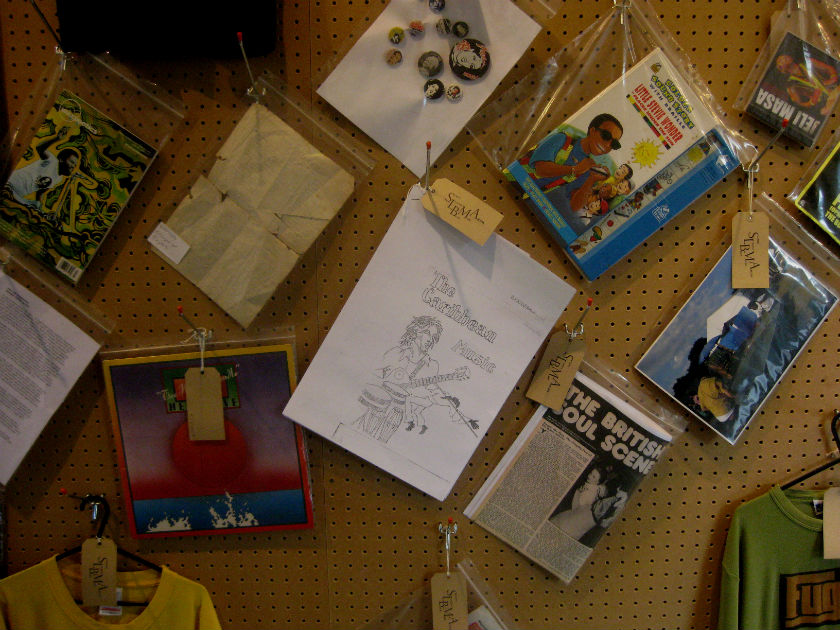
    South London Black Music Archive @ Peckham Space

    February 11, 2012

    If we accept the hypothesis that Africa was the cradle of the human race, it follows that black music predates the invention of the archive.

    Yet one of the most compelling aspects of the show at Peckham space is the newness of the exhibits: a Fugees t-shirt, a Cookie Crew album, an Amy Winehouse doll.

    The past few decades are the blink of an eye compared with the estimated 50,000 to 100,000 years which have passed since the emergence of homo sapiens.

    And not even the ancient Greek origins of archiving seem very ancient compared with that. The word comes from arkheion, which was a house of public records.

    One learns from Archive Fever by Jacques Derrida that the arkheion was inhabited by a caste of lawgivers known as the archons. So archives have their roots in law and order.

    Ever one for a spot of wordplay, the French writer goes on to flag up the derived Latin word arca, which would be a chest containing stone tablets.

    Although not quite bearing the weight of chiselled stone, Barby Asante’s show in Peckham does boast a meticulous and fairly gravitational cataloguing system.

    It’s best not to explore much further here the differential meanings of arca, which comes to stand for a cupboard, a coffin, a prison cell, a cistern or reservoir.

    But aside from the dusty world of entymology, the title of this show surely resonates with the legendary studios of dub producer Lee Scratch Perry, the Black Ark.

    Perry’s Ark was certainly in some senses arcane. And if anyone can clue me up any further about the origins of the name of this studio, I’d be grateful.

    A Google search reveals dozens of black history archives, only not so many devoted to music. The art form is not an easy one to seal up via folder, file card, or box.

    South London Black Music Archive can be found at Peckham Space until March 24. See gallery website for more details. I have also reviewed this show for Culture24.

    contemporary art, installation art, Pop Art

    Yoyoi Kusama, Aggregation: One Thousand Boats Show (1963)

    February 8, 2012


    As if to save those analysts the bother, Yayoi Kusama has already labelled Aggregation as part of her Sex Obsession series. She describes the white growths as so many phalluses.

    So you might see her boat as a metaphor for the conscious mind, floating above unconscious depths. Except here, the mind has been overrun by erotic symbolism.

    Not only has the rower lost control, she has vanished, leaving behind a single shoe. Her sexualised world view appears to have swallowed her up.

    At the risk of pathologising, this work could well dramatise one of the breakdowns which have kept Yayoi Kusama resident in a mental hospital since the late 1970s. Certainly, it is frightening.

    Whatever the artist’s actual condition, one might employ a phrase once suggested by psychiatrist Ludwig Binswanger. He called schizophrenia a “theatre of terror”*.

    And this trauma scene is theatrical. The scene is wallpapered with images of the boat. So the boat itself contrasts with its diminished image and appears live and auric**.

    The other protagonists worth mentioning are Donald Judd, who helped Kusama salvage the boat, and Andy Warhol, who three years later was to follow her lead and produce wallpaper.

    Such decorative repetition might also draw medical attention. But you can be sure it has nothing to do with the boat, and everything to do with what might be in that dark water.

    Aggregation can be seen in Yayoi Kusama at Tate Modern until June 5 2012. See gallery website for more details. References: * cited in Gilles Deleuze, Difference and Repetition; ** idea explored in Walter Benjamin, The Work of Art in the Age of Mechanical Reproduction.

    Uncategorized

    Found Objects 06/02/12

    February 6, 2012

    Sorry for lack of recent posting, especially during such an eventful week. Here’s catching up:

    • Saddest art story of the week was the death of Mike Kelley. Art Info posted a three minute video interview with the LA-based artist (thanks @markscottwood).
    • Also from Art Info is this quick guide to the Qatar royal family, who have just forked out $250 million for the most expensive painting ever sold (so far).
    • Against the backdrop of this madness, Spoonfed’s Tom Jeffreys sounds the alarm about the rise and rise of ‘museum quality‘ shows in commercial galleries.
    • Some debate whether public spaces should stay free of charge; Charles Saatchi believes they are not free enough. Check out his brilliantly out-of-step piece in the Guardian (via @Idnhal).
    • There’s been a lot of interest in the David Shrigley at Hayward. Just not enough Shrigley to go round, according to Chloe Nelkin’s blog.
    • The Independent carries an interview with Robert Montgomery. a brilliant purveyor of situationism for the people.
    • Frances Spalding brings Mondrian to life in this Guardian account of the Dutch painter’s time in Paris and London.
    • On Hyperallergic, the aptly named Ben Valentine has compiled an epic animated gif which shows people from all around the world all copping off with statues.
    • Clockwork Orange is 40. The Atlantic suggests just a few more reasons why the Kubrick film is so great (via @brainpicker).
    • Tyler Green’s MAN podcast with sculptor Mark Handforth is well worth a listen. (At 50+ minutes a whole pot of tea or coffee might be required)
    • Finally, I couldn’t but warm to this film of a rap battle between Blizzard and his English teacher Mark Grist (via @matt_goodall).

    aggregation, contemporary art

    Found Objects 30/01/12

    January 30, 2012

    Ten links from around the virtual week in art:

    • Artnet has the latest on the Prince vs Cariou case regarding copyright and image appropriation. You get to read the people specs for an A-list opening at Gagosian.
    • A paranoid genius has managed to uncover at least two partial words spelled out by Hirst’s spot paintings. A Da Vinci code for the new millennium? (thanks @TwoCoats)
    • Speaking of Leonardo, it seems that Vetruvian Man was something of a renaissance meme. Now an earlier example of the design has shown up (h/t @DaveFenton).
    • The Independent features a great interview with Sarah Maple, who has been wowing global art svengalis and builders from Crawley alike.
    • Q: Can nicking a piece of shop decor result in a home raid by a six man police team? A: Yes, if you are artist Jani Leinonen (on We Make Money Not Art).
    • Great bat sounds on this audio slideshow from The Guardian. The paper has been hanging out with Jeremy Deller as he tried to make the ultimate film about chiropteras.
    • There’s an interview with designer Marc Newson in the New York Times. It’s seven pages long but as comfortable as a ride in one of his pimped up private jets.
    • Check out Dangerous Minds and be glad you don’t have any family photos like this: vintage portraits with ‘hidden’ mothers (via @SKYENICOLAS).
    • There’s a delicate balance between civilised and riotous in this filmed performance by synaesthesic painter Mark Rowan-Hull.
    • And very much finally, a giant hare made of turf (via @artfagcity).

    constructivism, installation art, modernist sculpture, Neo-Concretism

    Lygia Pape, Livro do Tempo (Book of Time), 1961-63

    January 25, 2012
    Lygia Pape, Livro do Tempo (Book of Time) 1961-63, Installation view, Magnetized Space, Serpentine Gallery, London, (7 December 2011 - 19 February 2012) © 2011 Jerry Hardman-Jones

    This semaphore frieze will stop you in your tracks at the Serpentine. Lygia Pape calls her epic a (the) Book of Time. Well, it both is and it isn’t.

    Yes, it has 365 elements which might be called pages. They are made from wood, which is related to paper. And they have a colourful grammar all of their own.

    But this work may just be an echo of the real thing. It hints at an invisible 365 page book which could govern all of our days.

    If time‘s tome is anything like Pape‘s we should be this happy. Bold colours, dynamic shapes, fresh possibilities are all in store. No two days are the same.

    So Livro do Tempo is an antidote to the daily grind, a funhouse mirror to most folks’ experience of time. No Outlook calendar, you can enter or exit wherever you like.

    And at the risk of some national stereotyping you might say the Brazilian artist here takes Russian constructivism on a carnivalesque parade.

    But Pape loops her garland of abstraction around a whole year. So we should rather hope that the Ur-book of time, if it exists, feel the influence of this one.

    And if as novelist Thomas Mann says, “only the exhaustive is truly interesting”, could this work at Serpentine be anything else?

    Livro do Tempo (Book of Time) can be seen in Lygia Pape, Magnetized Space at Serpentine Gallery, London, until February 19. See gallery website for more details.

    Also, read what blogger Chloé Nelkin had to say about the rest of the show.

    aggregation, contemporary art

    Found Objects 23/01/11

    January 23, 2012

    Great links this week. Please tuck in:

    • I’m still not entirely sure what SOPA is, but I vehemently oppose it. Even if it has thrown up this ace Jonathan Jones rant on Wikipedia
    • As Prime Minister David Cameron calls for more commercial British films, comedian Stuart Lee offers a commercial response (via @NickMotown)
    • Third and perhaps best Guardian rant of the week comes courtesy of novelist Will Self, who mines some previously untapped comic potential from the urban space that is Trafalgar Square
    • I don’t know how it took the fashion industry 500 years to spot this trick: a handbag made according to a design by Leonardo Da Vinci. Do check the video.
    • It’s local politics, but not as you might know it. Kriston Capps reports from Washington DC on hunger-striking auto-circumcision merchant Adrian Parsons.
    • Another controversial spot of legislation saw artist Miranda July arraigned for kookiness. At least you could read it in The Onion (also via @KristonCapps)
    • Musician and photographer Patti Smith gets a first museum show in Connecticut. NY Times finds it endearing if not groundbreaking
    • Tickled with excitement by this interview with Brian Droitcour. The new poetry editor at Rhizome discusses the online potential of the medium, in effervescent verse
    • Would love to see an Ed Keinholz show, more specifically this one featured in Daily Serving. The fiercely critical artist died in a place called Hope (Idaho)
    • Theosophical dining on offer at Swiss Miss blog: a Mondrian Sandwich.

    art schools, contemporary art

    The Catlin Guide 2012

    January 18, 2012

    Say that two individuals began, at the same moment in time, to sit down with a pen and ream of paper. They will copy out the bible word for word.

    One of the pair may have been Daniel Rapley, graduate of an art MA at Chelsea. His work is soon displayed on a plinth and beneath protective perspex, with a witty title: sic.

    The other bible would most likely sink without a trace, unless it was the work of a religious nut. In which case, he or she may be deemed sick with a ‘k’.

    Given the apparent futility and questionable sanity of much of what artists do, it is clearly important that graduates get support. Herein lies the value of the Catlin Guide.

    “Making work after graduation can be difficult without the validation that art schools and tutors provide,” says Sophie Percival, who is now free to explore her preoccupation with striking environments.

    Rapley and Percival are just two of 40 hot tips for the future of art. The guide is compiled by Justin Hammond who visits close to 50 degree shows, speaking to tutor, curator and collector alike.

    More than just a list, these 40 are also validated by the production values of the guide itself, which comes in a highly tactile baize coloured slipcase.

    And packaging is important because, as most graduates no doubt learn, a professional appearance soon matters. It could be the difference, for example, between Sic and certifiable.

    You can get a copy of the Guide from the London Art Fair or any of the distributors listed on the Art Catlin website here.