<h1>Archives</h1>
    Uncategorized

    Found Objects 03/12/12

    December 3, 2012

    Ignoring the three hour old news about the Turner Prize, here are a week’s worth of high quality links:

    • You live by the market, you die by the market. Business Week reports that Damien Hirst has officially jumped the shark
    • Guest on this week’s Modern Art Podcast is Sophie Calle. Find out where she plans to be buried and savour the French artist’s unlikely sense of humour
    • This is just plain awesome: a part ruined, part working, fully faithful reconstruction of the Colosseum in Rome; and it’s all made out of Lego
    • Tower Hamlet resident Lizzie Homersham puts her blog to good use with a letter to the Mayor, with regards to the impending sale of a valuable Henry Moore
    • It’s now cool to slag off art. So does that mean that slagging off art will soon become just as uncool as art. We need to know, meanwhile there’s this piece in Slate
    • If you haven’t seen John Hinde’s Butlin’s photos, you need to. If you have seen them, you’ll know they’re great for the holiday season. American Suburb X carries a gallery
    • The L-Magazine sets out to discover what might be the most suitable day job for an artist. Essential reading for anyone at a career crossroads
    • Jon Ronson, one of the most readable journalists around, chronicles his encounter with Bryan Saunders, an artist working his way through a range of narcotic art materials
    • This film reminded me how good she is. Art 21 carry an exclusive interview and scenes from the new Tabaimo animation Dolefullhouse
    • If you have any time at all left after this week’s links, consider spending it on the drawing, painting, sculpture  archive from the Foundation Giacometti. A fantastic resource.

    conceptual art, contemporary art, sculpture

    Jochem Hendricks, Warlord, 2009-2010

    November 26, 2012

    You cannot see them, but you believe them to be there. Sewn into the lining of this greatcoat are hundreds of coins. They give it both physical and metaphorical weight.

    But were it not art, the monetary value would still not amount to much. Gallery notes reveal the coinage to be nickels and dimes. Not even pounds. Not even dollars.

    This is exactly the sort of small change you would pick up on a battlefield, or at least that is the take out from Hendricks’ sculpture. His warlord is a cheap customer.

    But the sculpture has presence. It looms over the visitor from a gibbet placed high on the gallery wall, its darkness an implacable reminder of endless US-sponsored wars.

    You cannot see the money with which this absent (dead?) warlord has lined his coat. As with much of the work by this German artist, you need to exercise faith.

    Or should that be cynicism? People profit from wars every day in manners we cannot see. You might well find yourself on a bus or train with a warlord like this.

    However, the sculpture competes for credibility with counted grains of sand, diamonds made from dead birds, and drawings done by the artist’s very eyeballs.

    So as you can see, the current show in Southampton collects some pretty wild projects together. It stretches credibility in a way that, perhaps, art always should.

    Earlier talents in earlier times might ask you to believe in a resurrection, an annunciation, or an assumption. All Hendricks insists upon is a lining of dirty coins.

    But Warlord is no less powerful for all that. As a reminder of the shabby opportunism of our ongoing campaigns around the world, few other works come close.

    So just what is this warlord’s jurisdiction? By the looks of it, he reigns over you and me and to do so costs him very little indeed. He may even get arts funding. The horror, the horror.

    Warlord can be seen in Jochem Hendricks at John Hansard Gallery, Southampton, until 20 December 2012. See gallery website for more details.

    community art, contemporary art, video

    Andrea Slater, If You Can Spass With Yoghurt You Can Spass With Caviar (2012)

    November 21, 2012

    Few sights can be as alienating as a group of healthy grown adults spassing out in imitation of the most retarded members of our wider society.

    Such scenes are the enduring images of a 1999 film by Lars Von Trier called The Idiots. The Danish director’s community of spass-ers act out one mentally backwards flashmob after another.

    Parallels can be drawn with a group art show, such as the one at CAC in Brighton, in which five artists are presented at one remove through a spassed up film by Andrea Slater.

    The Idiots du jour, who occupy the subterranean gallery for just four days are, in no order, Mike Stoakes, Huw Bartlett, Daniella Norton, Josh Uvieghara and Lou Allison.

    Having been sent works by all of the above, Slater appears to have displayed them in her home, then gone into a spasm of video art.

    The camera pans up down and around taking us on a dizzying id-driven gallery tour. We can all spass, like Slater who “saw the banality of her experience and loved it” (cf. gallery notes).

    Von Trier’s film provides the soundtrack, with quotations chosen to highlight the Utopian potential of this truly bad taste behaviour.

    And as things get nude in Von Trier’s film, so they do when Allison paints direct onto photos of the great and the good, including Sepp Blatter, Pope Benedict XVI, Nick Clegg.

    And then there is Stoakes’ collage Would You Adam and Eve It which brings in Massacio to reference the lost paradise. As if Eden was one big spassfest, which perhaps it was.

    Paradise is also shortlived at Community Arts Centre, Brighton, since this film, which opened Saturday closes later today (21/11/12).

    aggregation, contemporary art

    Found Objects 12/11/12

    November 12, 2012

    One major presidential election later . . . this blog brings you a largely indifferent set of links:

    • Obama’s uxoriousness may not be just what the world needs now. But this photo did the rounds and Phaidon has the story behind it. Seriously, it’s a relief.
    • Meanwhile in British politics, cash strapped councils are selling off historic artworks cf Tower Hamlets/Henry Moore
    • And then beyond politics altogether, we now have a trend for billionaires to hollow out their explensive plots of earth in West London: a must read.
    • A Grayson Perry interview with the Telegraph shows how far establishment have taken second best known transvestite to their hearts
    • Not news, per se, but an interesting way to pass three quarters of an hour. Hyperallergic makes the case for watching Jean Cocteau’s first feature
    • Beverley Knowles interviews Sam Belinfante and draws a startling conclusion from the current sound art show at Ikon Birmingham
    • We Make Money Not Art turns up another interesting artist. But Arnold Odermatti has a radical day job; he’s a policeman. See gallery of remarkable images
    • Daily Serving interviews William Powhida and finds a more approachable subject than you might expect from his twitter feed
    • Summer Nights is a 6-minute film by Alex Soth inspired by a monograph by Richard Adams. It captures a summer mood, which northerly readers may be missing already.

    contemporary art, installation art

    Joana Vasconcelos, Valkyrie Crown (2012)

    November 8, 2012

    Is it fair to say that a monarchist in Britain has an easier life? Certainly, they have a less paranoid one. They have got behind the head of church and state and can accept all that is bidden.

    It is, strangely, as easy for a contemporary artist. Your collectors are rich. The Queen is rich. And neither should have any problem with you celebrating Her Majesty.

    The occasional blogger calling suchwork into question is not even a fly in the ointment. As Warhol said, just measure the length of the text. Don’t worry about the content.

    QEII has been captured in many portraits, but she would surely be most hard pushed to see herself in the centrepiece of a current show at Haunch of Venison.

    Because this Valkyrie Crown, this metonym for the state, is really something monstrous and anarchic. A wealth of colour fabrics have been knitted, stuffed, stitched and patched.

    The Valkyrie series glorifies a Norse goddess who dishes out fates on the battlefield. And so the most shadowy conspiracy theories about earthly power have an origin in myth. This reassures.

    But hard to say whether this Portuguese artist would ascribe similar powers to our monarch; just note her tentacles trail the height and breadth of the two storey gallery.

    In a short time here (it is stressful to be this end of the Great Chain of Being) I noticed visitors make their way into the heart of the piece and ‘wear’ the outsize crown.

    Two staged positions were possible: loyal subject or omnipotent queen. The sprawling work leaves little room for citizens, republicans and other condemned beings. You have to watch your step.

    But on the way out, I check on the status another piece in the show: a flowerhead of steam irons. The gallery assistant confirms it is out of order that day. Not even royal decree could get it working.

    Valkyrie Crown can be seen at Haunch of Venison, New Bond Street, until 17 November 2012. See gallery website for more details.

    Uncategorized

    Found Objects 05/11/12

    November 5, 2012

    Sad week, as the extent of a hurricane’s destruction becomes apparent:

    • But Chelsea gallerists are a resilient breed. So discovers the New York Times as Roberta Smith assesses damage caused by Sandy
    • Art is no longer cool, according to Jacob Willer. This could be the best thing to happen to art since, well, since it became cool in fact
    • Thankfully, Chloe Nelkin does not (apparently) care about such niceties. She is totally bowled over by Seduced by Art at the National Gallery.
    • Thinking LA was all villas and swimming pools, this photo essay on Uncouth Reflections was a grandiose revelation
    • Mary Louise Schumacher draws inspiration from novelist Orhan Pamuk and calls for smaller more personal museums
    • Tyler Green explores the line of influence between two giants of abstract epressionism, Clyfford Still and Barnett Newman
    • Danh Vo wins the 2012 Hugo Boss Prize worth $100,000 and a show at the Guggenheim, but Art Fag City worries about the backstory
    • Bit worrying to see how much video Adrian Searle is doing. (Don’t people read any more?) But his latest interview with Jane and Louise Wilson is worth a watch
    • Tomas Saraceno’s latest installation at HangarBicocca in Milan is branded ridiculous by Animal NY. See why…
    • Ai Weiwei has given up his fight against tax evasion charges. Now he’s returning donations to supporters 🙁
    • Everyone should read and reread Don Quixote. But in the time-starved interim here are some 1968 illustrations of Cervantes’ novel.

    Uncategorized

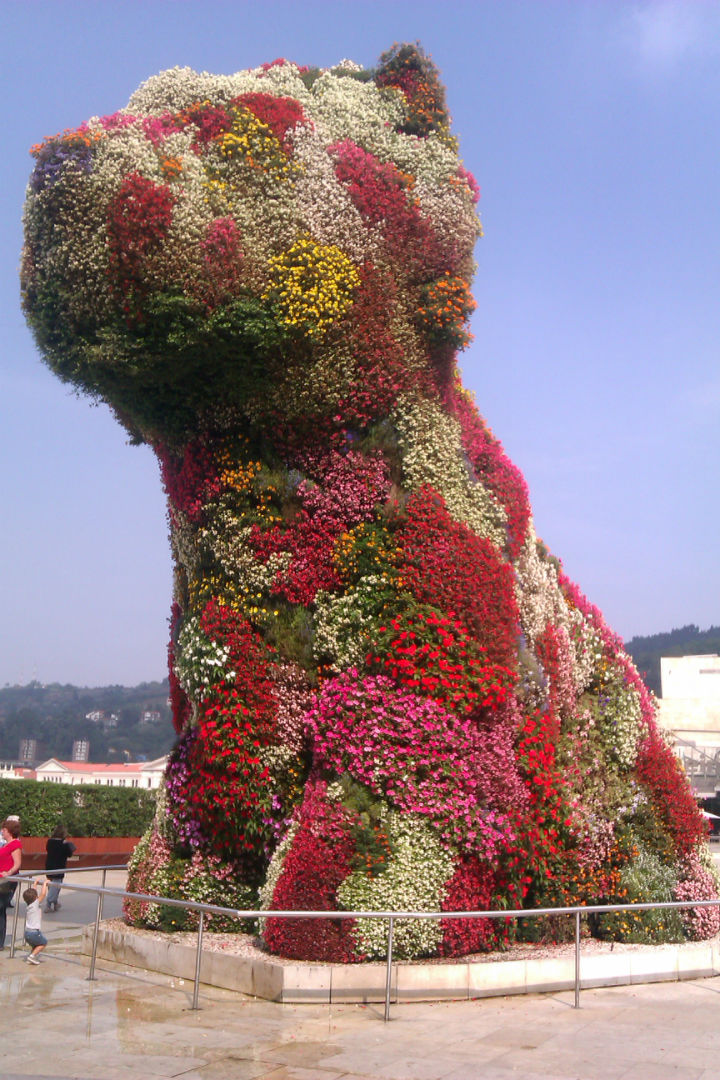
    Jeff Koons, Puppy (1995)

    November 3, 2012

    Even as he maintains his emolient sales pitch for rich customers, it is worth bearing in mind the real world catastophe at which Jeff Koons’ puppy was at the centre.

    This piece of inoffensive topiary is as cuddly as any 43ft high sculpture could ever be. Containing 60,000 plants it is said to be a piece about happiness and love .

    But even as Koons declared this to be the case, pooch showed a darker side. It played a bit part in the killing of a Spanish policeman in 1997; it almost claimed the life of the Spanish king.

    Joes Maria Aguirre was the unfortunate policeman who challenged three overalled gardeners, all bearing flowerpots, who appeared ready to tend to Koons’ sculpture.

    One of them shot him dead. It wasn’t quite the way Bilbao officials had intended the inauguration of the city’s new contemporary art museum to unfold.

    The gardeners worked for ETA. Their flowerpots contained grenades. A fire fight broke out and moved downtown. The ’gardeners’ stole three cars at gunpoint.

    The episode is like something from the pages of a thriller. Art historians will no doubt love it in years to come, just as today they love the murderous life of Caravaggio.

    And say what you like about ETA, but they engaged with Koons’ giant puppy with a certain wiley humour. It was a definitive rejection of the artist’s kitsch embrace.

    But a friend recently told me about an interesting coda to events at the opening of the Guggenheim. The alleged triggerman turned up in 2011 in Cambridge, UK.

    This to me is especially surreal as I grew up in the university town and am familiar with the Arbury estate where Eneko Gogeaskoetxea Arronategui lived.

    To his colleagues at an IT firm he was family man Cyril Macq. He was also a squash fanatic and club treasurer. He never spoke politcs to anyone.

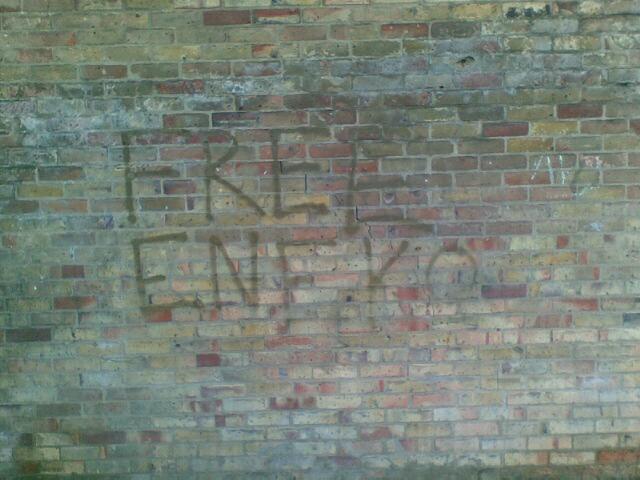
    He was extradited and tried this year. But perhaps it is a measure of his popularity and rehabilitation that the graffiti pictured below was soon to crop up near Mill Road.

    Free Eneko is not an artwork, not even a piece of street art. But it is a cry of resistance; it is real. It is the shadow cast by Jeff Koons’ monumental and perfectly obedient dog.

    (c) Adam Woodsford.

    Puppy was acquired by the Guggenheim Bilbao in 1997 where has been installed to this day in a plaza named for dead policeman Aguirre.

    Uncategorized

    Found Objects 31/10/12

    October 31, 2012

    Storms have pushed art somewhat off the agenda this week. Imagine what Sandy might have done to a Frieze tent, anyway, I digress:

    • Hyperallergic art blog catered for all your climate news needs, with a collection of photos compiled from social media by Hrag Vartanian.
    • On the Guardian’s Northerner blog, Liverpudlian Kenn Taylor takes the Anfield bus tour. A highlight of this year’s Biennial, it only sounds mundane.
    • Heavyweight critic Dave Hickey gives a candid interview about the art world. (He’s sort of retiring so he can say what he likes. Via/ @hindmezaina)
    • Pipe weighs up the evidence surrounding the demise of Vincent Van Gogh, in conjunction with a close reading of Martin Gayford’s book The Yellow House.
    • In the Telegraph Mark Hudson reviews the show about vodou at Nottingham Contemporary. Enjoy the crash course on Haitian history and culture.
    • JJ Charlesworth reposts a column from Art Review in which he bemoans the passing of things. We may never know their like again.
    • Mike Nelson branches out with some heavy geometry at Malmö Kunsthalle. (Contemporary Art Daily)
    • Smithsonian.com prints a collection scary kids in masks for Halloween. Do not want any of these on my doorstep.
    • Also in the Halloween spirit, Art Wednesday posts a Marilyn Manson video. Again, I don’t know whether to laugh or soil myself.
    • Ah, this is better: Animal NY post a quick piece on a playable tetris pumpkin. Must be seen to be believed. Both trick and treat.

    contemporary art, folk art, sculpture, vodou

    Leah Gordon, Atis Rezistans: The Sculptors of Grand Rue (2012)

    October 30, 2012

    Just as Joseph Beuys once declared his reciprocal love for America, in this film you will see a Haitian artist state: “I like vodou and vodou likes me.” He goes so far as to add, “Everyone likes vodou.”

    But whatever ghetto sculptor Guyodo might think or say, not everyone does like vodou. Not unless you count the prevalent mania for zombie fancy dress as a deep engagement with this religion.

    Guyodo was talking about his neighbourhood, however, where spirits are as popular as art and art is a way of keeping the spirits close. Missing a loved one already? Just put their skull on an effigy.

    On press day for a show of Haitian art at Nottingham Contemporary, filmmaker and photographer Leah Gordon was introduced as one of the West’s most frequent visitors to Haiti.

    Indeed, she has a freaky level of access. One sequence of her film takes us down a warren of sunless alleys into the heart of a notorious Port-au-Prince ghetto, in search of mysteries and faith.

    But the residents of these corrugated steel shacks will surprise you. Artist Andre Eugene tells Gordon there are as many great intellectuals here as there are thieves.

    Eugene also has plans to open a museum. Not a gallery, but a full blown museum because up until now it has only been the bourgeoisie who embarked upon such ventures.

    The film is not without its spookier moments. In a memorable scene we see a man channel the spirit Gede. He wears shades with the apt number of lenses and props a phallus on his walking stick.

    And in some more great footage, towards the end, we witness a jazz funeral. What a way to go! In voiceover the irrepressible Guyodo talks up the immortality of artists, regardless of earthly fame.

    If this film has whet your appetite for the art of Grand Rue, try and make it to what must be one of the largest exhibitions of Haitian art ever. Or wait for the catalogue and be there in spirit.

    Kafou: Haiti, Art and Vodou is at Nottingham Contemporary until 6 January. See gallery website for more details.

    Uncategorized

    Tracey Emin’s tip for very young artists

    October 24, 2012

    Between the condoms by the notorious bed to the film about abortion, childlessness has emerged as a major theme in the work of Tracey Emin.

    As if she has traded creative fecundity for motherhood, her prolific art has more in common with masturbation rather than procreation. She sketches the former activity at length.

    In a photographic work I’ve Got It All, the artist can even be found scooping cash up into her crotch, but unlike Danaë her visit from a shower of gold results in nothing.

    But since Emin practices a form of gesamtkunstwerk, allowing biography to become part of the art, her maternal status is all important.

    The chances are we might not have allowed this working-class, female artist to have it all. To be rich, powerful, famous, okay. But a mother as well? It might have put the nation off.

    Most celebrities get away with having babies and indeed so do many artists. But Emin would appear to be a romantic and likes to advertise a bit of suffering along with the stellar career.

    For that reason, her contribution to a new book by Faber is touching. The publishers have been asking the great and the good for answers to common kids’ questions.

    Emin was asked: What should you do when you can’t think what to draw or paint? The following is her answer, for the benefit of other people‘s children:

    I often find I can’t make art. At times like this I go and do something else. I usually go partying, play dominoes, go out to eat, or swim, take long walks, go shopping – all the normal things.

    I wake up most nights between 1 a.m. and 3 a.m. and stay awake for around two to three hours. That’s when I would most like to work but I can’t because even though I am awake I am not awake enough to get dressed and go to my studio. But now I have an app on my iPad that lets me draw. The drawings are very different from my usual style because I do them with my finger and I am still a little sleepy so the drawings come from another part of my brain. Also they are very throwaway, so I feel freer.

    Reading and swimming are the best things for me to do because the swimming physically makes me happier, and my brain starts working. And the reading fills me with other people’s images in my mind, which releases me from stress.

    I need to make and create art – I’m an artist. Without creating my life makes no sense, I lose confidence and sort of forget who I am.

    See below for infographic for Big Questions From Little People by Faber and Faber:  What Big Questions are on Your Child’s Mind?

    Big Questions Infographic