<h1>Archives</h1>
    Uncategorized

    Found Objects 29/01/13

    January 29, 2013

    Here’s criticismism’s weekly selection of art links, gathered for your enjoyment:

    • A Belgian living in Mexico with a nice line in political interventions around the world: Modern Art Notes podcast scores an interview with Francis Alÿs
    • Mark Brown from the Guardian takes a look at the new Kurt Schwitters retrospective at Tate Britain, another reappraisal of art in these isles during the 20th century
    • Meanwhile, The Telegraph reports on another fugitive from the Nazis. But Imre Goth got in hot water for painting Goering as a morphine addict (and he was)
    • Roberta Smith reviews a show on Surrealism and drawing at the Morgan Library and Museum. Sounds completely brilliant
    • Also in the Guardian was an interview with Carl Andre ahead of his show at Margate. Emma Brockes probes him about murder accusations
    • Hyperallergic blogs about the new cultural expenses being given to Brazillian workers. Expect something of a golden age in that part of the world
    • The Independent sent Tom Peck along to Lolcats – The Exhibishun, a show given over to an internet meme. He wasn’t impressed
    • The Exhibition List carries a post about the Jimi Hendrix Memorial in Seattle, a work in progress by the sounds of it.
    • Artista blog revisits Colchester for a report on the fortunes of their newbuild gallery First Site. Curved walls were always going to make curating an additional challenge
    • Slate reviews a ‘new’ Werner Herzog film about (happy) snowbound hunters living in Siberia. You can just hear the voiceover already.
    Uncategorized

    Found Objects 21/01/13

    January 21, 2013

    Welcome back to the week you’ve just lived through, but this time with premium quality links:

    • Saddest thing in the world: when an outlaw street artist is fully embraced by the mainstream. Cameron and Branson must really have it in for Ben Eine.
    • This story is weird and a bit one sided. But it’s always good value to find a Telegraph journalist frothing at the mouth over goings on at Arts Council England.
    • Long read of the week: The New York Magazine devotes an in-depth profile to gallery owner Larry Gagosian, a man for these hyper inflated times.
    • The Inependent’s tantalising In the Studio series pays a visit to that of arte povera trailblazer Giuseppe Penone.
    • Artist Nick Cave takes his Soundsuits to Grand Central in New York. Check out the video of a similar event in North Texas University. There’s a great moment about seven minutes in.
    • 150,000 animal noises have been made available online by the Cornell Lab of Ornithology. Check out the giant otter on Animal NY. It’s completely mad.
    • Here’s something we should have guessed. To experience some or other piece of art as sublime, you may want to watch a horror film beforehand. The Creativity Post explains.
    • Another link from Animal NY, this one a gallery of shops selling Jamaican dancehall records. It seems vinyl just never went away.
    • How well do avant garde short graphic films translate to Vimeo? Quite okay, as it turns out. Take a look at these three examples from Another Design blog
    • And finally, a feel good moment. Or feel less bad. Artist Justin Bettman has been trading bagels with the homeless in exchange for stories and photographs.

    contemporary, Denmark, Figurative painting, Uncategorized

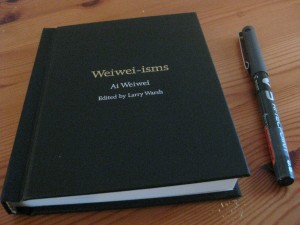
    Weiwei-isms by Ai Weiwei

    January 19, 2013

    weiweisms

    Books come in all shapes and sizes, but perhaps the most potent format is both small and black. The collected quotes of Ai Weiwei should have come in nothing less.

    Editor Larry Warsh has trawled through some 74 interviews with the Chinese artist to bring readers in the West a meditation on his life and situation in soundbites.

    Then again, his countrymen have always liked to keep things short and snappy. Ai tells us that the quotations of Chairman Mao were rarely more than a tweet-length.

    Admittedly, China’s pictographic use of Twitter allows them 140 words rather than 140 characters, but still. Confucius can be quoted just four words at a time, says Ai.

    Since these are verbal epithets, Weiwei-isms contains a degree of repetition and odd moments of banality. A modern day Shakespeare, “might be writing on Twitter.” Really!?

    But if that obvious statement were to come true, the bard could not do better than this from Ai’s twitter feed (@aiww): “The world is a sphere, there is no East or West.”

    The ultimate power of this book lies not in the words, however, but in the free-wheeling attitude they represent in one of the most restrictive societies on the planet.

    “Expressing oneself is like a drug. I’m so addicted to it,” says Ai, who has indeed found the most dangerous and least legal narcotic in China.

    As has been much publicised, in 2011 he was busted and spent 81 days behind bars. “During the days in detention I thought most about the moon,” he says, incorrigibly.

    Ai’s belief in free speech makes interview-giving an important part of his role in the art world. Along with the social media usage, one wants to call it a practice, but that word sounds too academic.

    Which this tweet certainly isn’t: “Overturning police cars is a super-intense workout. It’s probably the only sport I enjoy.” This allies him with rebel artists Voina in Russia, who did just that.

    Artists in the West have always taken risks, be that earning the displeasure of the church, rejection by the Paris Salon or simply the derision of the gallery going public.

    But on the whole making art is a legitimate enough business. Ai meanwhile is risking his neck and this gives his art another dimension. Call it a sort of realism.

    Despite our relative freedoms, his little black book really is a manifesto. Ai may be kicking against the pricks, but he makes it look easy, irrestistible, even enjoyable. So join him.

    Weiwei-isms (pp125) is edited by Larry Warsh and published by Princeton University Press. Available in all good bookshops, and this bad one.

    Uncategorized

    Found Objects 14/01/13

    January 14, 2013

    Top stories of the week include a portrait of a future queen and the new single by a former one. Read on…

    • There was much derision heaped upon Kate Middleton’s first officical portrait. My favourite was this example by Mark Hudson in the Telegraph
    • Bowie records an album in secret. But hold on, wasn’t this the subject of his so called golden tweet a few years back. Anyway, L-Magazine looks forward to the release
    • Mark Landis is a prolific art forger who gives away his work and calls it philanthropy. Meet this strange customer on the Daily Serving
    • The New York Times reviews a major Nam June Paik show at Smithsonian American Art Museum and finds the Korean artist worked best when he kept things “on screen“
    • Charlotte Higgins provides a write up of the 2013 Catlin Guide complete with some entertaining quotes from director Justin Hammond
    • This is too sad. Jorge Selarón, who designed an iconic flight of steps in Rio, was found dead on his most celebrated artwork
    • Art21 posted a film about and with artist Richard Serra. The sculptor talks about the importance of process in making any sort of visual art
    • Writer, musician and performer Paul Dutton has insightful things to say about the businessification of the arts. Check out his piece in impressive new magazine Wild Culture
    • I hought Art on the Underground was impressive but it seems in Stockholm they take Metro art to another level. Check out the gallery on Beautiful Decay
    • Finally but not leastly, Ralph Steadman’s longstanding friend Robert Chalmers makes a compelling case for the artist’s greatness, with support from Johnny Depp.

    Uncategorized

    Found Objects 07/01/13

    January 7, 2013

    Well, here’s your regular pick of the best art links around:

    • Art Observed report on a fine looking Sol LeWitt show at Marian Goodman gallery in Paris
    • Contemporary Art Daily also have pictures from what seems like a cracking show: Judith Bernstein at the New Museum
    • ArtInfo carry a short film about Russian art world star Aidan Salakhova, currently showing at the Moscow Museum of Modern Art
    • You know you’re getting old when the features on aging begin to appeal. But the Atlantic reveals how artistic talents can bloom as other parts of your brain die (Thanks Amy Riley)
    • It’s lengthy but the Guardian’s Rachel Cooke will tell you all you need to know about Kurt Schwitters in advance of his show at Tate Britain this year
    • The same paper asks why Schwitters fan Damien Hirst has parted ways from his worldwide gallery Gagosian. Because he can, seems to be the answer
    • Artist Omer Fast was apparently threatened by the FBI for making his fictionalised film about a drone pilot. That just makes his piece Five Thousand Feet is Best even better
    • The Casual Optimist blog carried a link to an interview with the late Robert Hughes. 50 mins long but time in his company is highly recommended
    • On the subject of critics @FisunGuner linked to this witty sculpture of said profession by Jasper Johns. Now that’s a bad review
    • Hyperallergic make a case for welcoming thoughts, feelings, opinion and occasional bouts of ignorance from beyond the art world. Hey, why not?

    aggregation, contemporary art

    Found Objects 02/01/13

    January 2, 2013

    A focussed set of Found Objects this week as it proves time to crank up the blog again after an extended holiday season. Good to be back.

    • Brighton might be the UK piercing capital, but even we would look twice at these Thai festival goers. Check out the gallery by Guillaume Megevand on Beautiful Decay.
    • Another collection of photos got flagged up on Twitter over the last fortnight. This time, it’s female Russian museum guards by Andy Freeberg on Slate (via @rosieclarke).
    • More photos! These are from the Tokyo Times and represent that paper’s pick of its published pics from 2012
    • Here’s a longread from photography blog American Suburb X: not photos but a republished interview with filmmaker Sergio Leone.
    • Steve Bell looks back at the year in cartoons on the Guardian website. A must for anyone with an interest in UK politics.
    • The same paper meanwhile donates a few hundred words to Grayson Perry, who talks about his earliest stabs at making art (his uncannyily clairvoyant art, one might add)
    • Art Fag City link to a film about Olaf Breuning. His 1%/99% piece looks like a suitably unsettling comment on our unsettling times.
    • On a lighter note: some insane graffiti writers from Animal New York. And the Onion reports on a boring conversation on a plane (thanks Adrian Hyland).
    • Finally Richard Moss, Editor at Culture24, has compiled an exhaustive look ahead to the exxhibtions taking place in Britain this year.: just. can’t. wait.

    artists' studios, Brighton, campaigns

    Save APEC Studios

    December 19, 2012

    apec_splash

    Industrial House in Conway Street Hove looks just as workmanlike as its name would suggest. If I was a councillor presented with the chance to knock it down, I just might.

    But having been inside the office-like space, the industry seems to be altogether more interesting than, say, just the embroidery of sports logos. Inside they are making art.

    So perhaps the resident sportswear business should have taken over the whole building. Chances are that way all talk of demolition could be avoided. Logos have clear social value.

    Art, as usual, is viewed as a marginal, obsolete activity. But there are 18 diverse artists currently working in APEC studios, housed in this building for almost 10 years.

    They range in age from 23 to more than 70. They are players in a city art scene which already suffers from lack of galleries and affordable space in which to make art.

    Now they face eviction. Shame that grants were once secured in good faith to set up APEC. Money donated by Arts Council England and Co-operative Finance, counts for nought.

    That’s not to mention the contributions of founding members, many of whom gave up their time and skills to transform the interior into workable units of creative space.

    Good news is, since this is Christmas, you can help. APEC need just 1250 signatures to prompt a debate on this matter in a full council meeting.

    “Workshops, office space, studios, storage and other premises remain affordable, appropriate and available for use,” said the council. Can’t put it much better than that.

    Please take a moment to sign the APEC petition by Friday at the latest. We can and should hold Brighton Council to their word on this.

    17th century, painting

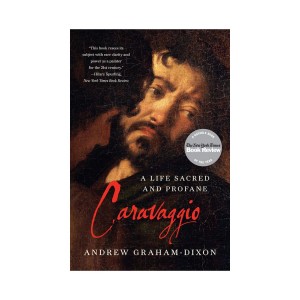
    Caravaggio: A Life Sacred and Profane by Andrew Graham-Dixon

    December 16, 2012

    caravaggio book

    Of the half a dozen mass market art paperbacks you might find in your local good book store, there may be at least two biographies of Michaelangelo Caravaggio.

    In addition to this, the latest, there may be another recent account by Peter Robb. That book, called M, emulates the passions of the painter’s life with a lyrical, some might say hysterical, tone.

    So plaudits should go to Graham-Dixon’s balanced account. Whether digging up period documents or looking closely at the paintings themselves it is a better read.

    Caravaggio: A Life Sacred and Profane debunks the conspiracy theories surrounding the painter’s tempestuous life. Not assassinated, he quite likely died of a heart attack.

    Of course some circumstances remain mysterious. However the artist escaped from a dungeon on Malta, thrown there by the island’s Knights, is to this day a riddle.

    Likewise, there will always be something shadowy about Caravaggio’s nocturnal activities in Rome. Graham-Dixon suggests he was a pimp, one of the book‘s shocks

    Another topic of wonder concerns the painter‘s craft. He appears to be self-taught. He never bothered to draw. And yet, he became one of Europe‘s most influential talents.

    Graham-Dixon even tracks his influence as far as modern day Hollywood, as we learn that Mean Streets (1973) by Martin Scorcese owes its urban sensibility and lighting to the painter.

    But what to make of his argumentativeness, his ever present sword and dagger. He even went so far as to sleep fully armed in Sicily, a man on the run.

    That image too, is a gift to cinema or literature, but has there ever been an artist in fiction with quite as much violence and passion as this real archetype, possibly not.

    Incidentally, while still reading this book I came across reference to a 1994 exhibition in Floria Brown Gallery, Woody Creek, Colorado called Two Guys With Guns Making Art.

    Those two “guys” were William S Burroughs and Hunter S Thompson, neither primarily known for the plastic arts, but unwitting heirs of Caravaggio all the same.

    This book can be found in your nearest good bookshop or, if you must, Amazon, along with a deluge of titles devoted to the life of Caravaggio.

    aggregation, contemporary art

    Found Objects 10/12/12

    December 10, 2012

    It’s been a huge week in art, if you live in Miami. On these shores it was the Turner Prize. And there was no escaping either.

    • My favourite coverage of the aforementioned Prize came from music journalist Alexis Petridis writing in the Guardian. Second fave bit of coverage came from the good folk at Pipe
    • Meanwhile the Art Newspaper pulled together a compendium of opinions on the parlous state of the art (fair) world
    • Art Info also posted a slideshow that could make you despair to not have a million or two reserved for such occasions
    • News abounded this week. From The Independent: two men were jailed for stealing a Henry Moore and selling it for £46. And a Raphael sketch went for considerably more
    • RIP Oscar Niemeyer, curve-loving architect responsible for Brazilia. He had a good innings, designing a 2003 Serpentine Pavilion in his 90s
    • The Telegraph interviewed Chuck Close. “Very often women seem to love me” – not my words
    • A Hyperallergic review of Phyllida Barlow suggests a transatlantic continuation of the form she hit last year at Hauser & Wirth Picadilly
    • Can’t wait for this British Museum show of ice age art. 40,000 years in the making, etc. The Guardian reports
    • Art Wednesday pose a Q&A with the winner of the 2012 Jerwood Drawing Prize: Karolina Glusiec
    • Finally the film of the book of the artist Robert Motherwell. That’s a gift idea you can have for free.

    20th century, abstract painting

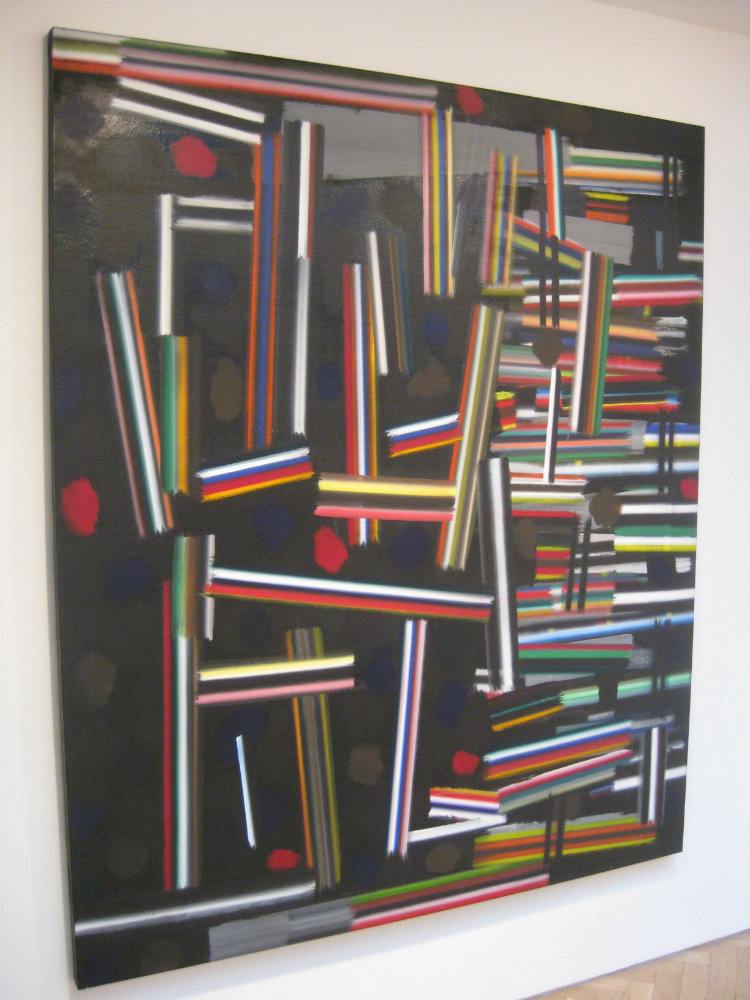
    Bill Henderson, Funky Black and Catch Me, 1978

    December 5, 2012

    This painting reaches back through the years to a teenage in the 80s. This spiky pattern would have bowled me over and indeed still does. Perhaps I once had a duvet cover like it.

    What makes Henderson’s painting, dare it be said, boyish are the preponderance of dynamic angles and bold colours, complete with moody blacks and cool greys.

    But while its colour scheme is striking, its composition is absorbing. There’s a picture-book level of detail, with fifty discrete banded painted studies within this one large scale canvas.

    Talking about another of his paintings, Henderson describes the way he builds an extensive series of ‘activities’ into a single all-consuming work.

    “The ‘activities’ within the paintings can be seen as a constantly shifting series of events, each one a more or less separate entity, but perhaps sometimes related,” he has said.

    The blurred edges give his plentiful bands a near holographic presence and together they hold the same fascination as an encyclopaedia page full of, say, flags (Pre-Wikipedia.)

    On the left they create effortless depth, and assemble into three dimensions. This is a psychedelic take on what could be a form by Caro or a trippy, possibly illegal, bit of constructivism.

    But the right is a repository of materials, a supply of colours and combinations which appears inexhaustible. If you read the painting from left to right, there’s no way out of this jam.

    To be sure, regression leads you nowhere, and indeed this probably wasn’t Henderson’s intention in making the work. But if in 1978 he was just predicting the decade to come, he got it fairly spot on.

    This painting can be seen in New Possibilities: Abstract Paintings from the Seventies at The Piper
    Gallery, London, until December 21 2012.