<h1>Archives</h1>
    contemporary art, installation art, relational aesthetics

    Alex Bowen, This is How I Roll 24/7 (2012)

    August 18, 2012

    To give this work it’s full title: This is how I roll 24/7…Not Just On A Satrday Night in a Shit Basemnt (sic). And the shit basement in question was Brighton’s Grey Area.

    It was indeed Saturday night when this work both previewed and closed. The artist was nowhere to be seen. We still cannot be sure how he rolls.

    Yet Bowen did leave us with a few clues as to his style of comportment. Ropes bolted to the wall turned the space into a fight ring. In the centre were a crateload of beers. No nonsense.

    With varying degrees of daring or innebration, visitors were lounging off the ropes. The DJ explained that the structure was inspired by a detail taken from George Orwell.

    Down and Out in Paris and London reveals that ropes like this were once employed as beds or minimal hammocks for the hobo classes in the French capital.

    Although the beers were gratis, the want of money hemmed us in on all sides. Grey Area, which in reality is a fantastic basement, is going through a phase of transition. It too might be on the ropes.

    This is not the first time Bowen has cried off from a private view. He was notable by his absence from the launch of the most recent show at his nearby gallery, Mingles Calypso (sic).

    On that occasion visitors turned up to find the space occupied by an unmanned bar. You get the feeling he is goading us with our thirst for alcohol rather than art.

    But those arty drinks won’t pay for themselves, so if any philanthropists are reading this (and according to prevailing wisdom there are plenty of you out there), please step in the ring.

    This work was at Grey Area, Brighton, on August 11. See gallery website for future events.

    aggregation, contemporary art

    Found Objects 15/08/12

    August 15, 2012

    Better late than never; this week’s art links…

    • The bravest art critic we ever had…some memories of Robert Hughes by his producer Nicolas Kent.
    • Art Fag City advances the theory that art world success is a direct correlative of the curved edges of your spectacle frames. Oh dear.
    • The dust has barely settled on this archive but it sounds amazin’. Marvin Taylor is collecting ephemera from the NYC Downtown scene.
    • Find out how to (easily) make your own glitch art in this brilliant PBS video on Animal NY. And check out Yung Jake below.
    • White Cube Bermondsey is showing the haunting work of Zhang Huang. That’s the insence ash you can almost smell.
    • Guardian Artist of the Week is the incredible Pushwagner, currently at MK Gallery. Warning: dystopian video content.
    • And here’s a unicorn chaser. L-Magazine presents part one of a list of said creatures in art. Can’t wait already for part two.
    • Follow that up with a cheery film about book binding with an awesome theme tune via Paris Review.
    • Forgive the esotericism, but artist Annabel Dover linked to these Ipswich milk floats on Twitter (@Captainpye) and they are something.
    • You can’t really blame Damien Hirst for not wanting to roll up his sleeves for this creepy crawly collage. Watch his assistants instead (thanks @ARTnewsmag).

    contemporary art, film installation, installation art, music

    circa69, What was wood will be glass (2012)

    August 10, 2012

    This is not a simple work but it is easy to enjoy. It is easy to enjoy if your idea of fun is lying back in bed listening to breakbeats and watching a movie on the ceiling.

    The footage shows scrambled data on a VDU, followed by a delapidated caravan in a clearing with a burning wheelchair alongside. Hard to make sense of, but visceral.

    And when the bass drops, you feel yourself coming up as if on drugs. With speakers on the bed posts the vibrations shake the whole bed. I did this twice for another legal hit.

    But circa69’s installation does funny things to your guts before you even follow the printed instructions to lie back on the squalid looking mattress.

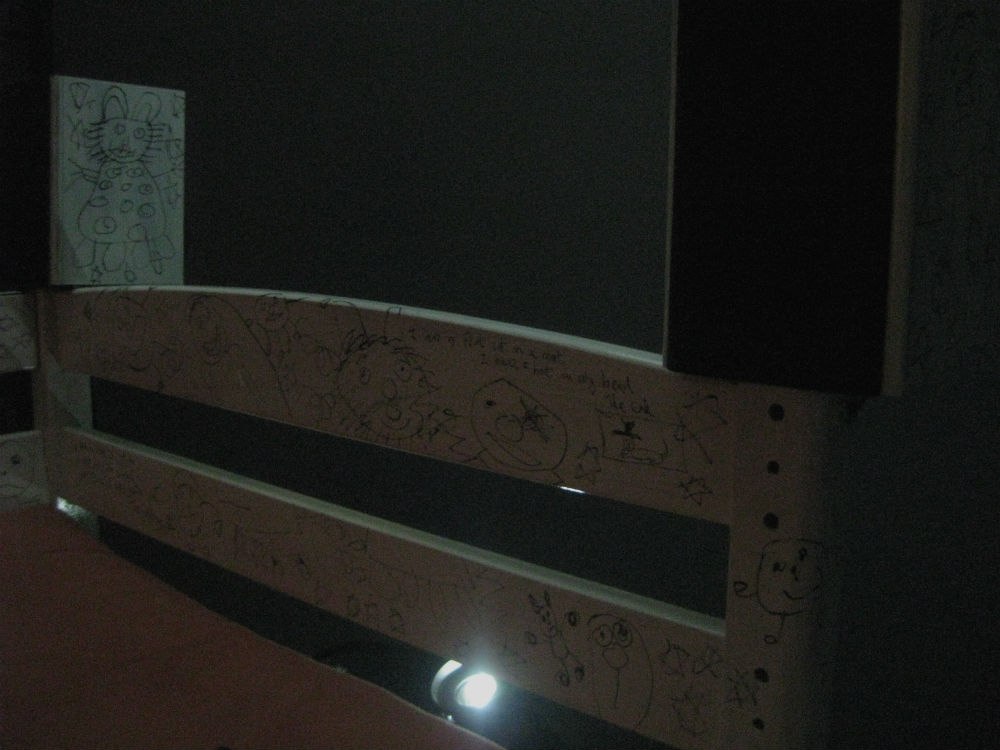
    A wall is covered in children’s drawings and somehow these are not sweet, but owing to their repetitive quality also somewhat creepy. They have run amok.

    Then there is the wheelchair, present here as a sculpture too, destroyed by fire and sitting redundant amidst clods of earth. It is hard not to believe something terrible has happened here.

    The brain struggles to construct a narrative around these elements: who occupied the chair?; did the children start the fire?; who lives in the caravan?

    Half of the sense of danger here comes from the unknowability of these things. But thanks to the visual, aural and tactile impact, you really feel the backstory matters.

    So you are left with radical doubt. It is tempting to say if David Lynch made art it would be art like this. But of course the film director does make art and it looks like this.

    This work is part of the show Invisible Bridges at Phoenix, Brighton. Run ends Sunday 12 August. See gallery website for opening times and directions and check out more work by circa69 here.

    Uncategorized

    Found Objects 06/08/12

    August 6, 2012

    Some athletically aggregated art links for the week. (That’s the only Olympics reference here):

    • Like most nurses, C-Monster’s Art Nurse could surprise you with her technical knowledge. Here she is advising on a tricky restoration project
    • This sculptural installation looks good on screen. Is that a strength of the photographer or a strength of Robert Morris, or both?
    • Frank Stella’s recent work also holds up well. So if you can’t get to New York for his show, please avail yourself of this link.
    • This is odd, in the way the 21st century is odd. A Chinese website is ripping off lesser known Western artists with little hope of redress.
    • The video for this precocious rapper‘s debut single brings Ryan Trecartin to mind. Could the video artist have predicted Glass Popcorn?
    • If you want to find a way round planning regs, maybe call your proposed backyard structure art. Chris Burden does just that.
    • Jonathan Jones goes weak at the cultural knees for the richest collection of modern art outside Europe and the US. It’s, improbably, in Iran.
    • One more unlikely cultural story. Psychopathic hippy Charles Manson becomes subject of a new musical. Looking forward to the posters on the tube.
    • This’ll make you want to have a go. Art Fag City also blogs about Book-Spine poetry by Nina Katchadourian.
    • Infographics are getting a bit tedious. Or am I just annoyed that some of these 10 Famous Visual Artists on Art Info were a bit tricky? Hmm.

    20th century, contemporary art, dance, film installation

    Linda Remahl, Mien (2012)

    August 1, 2012

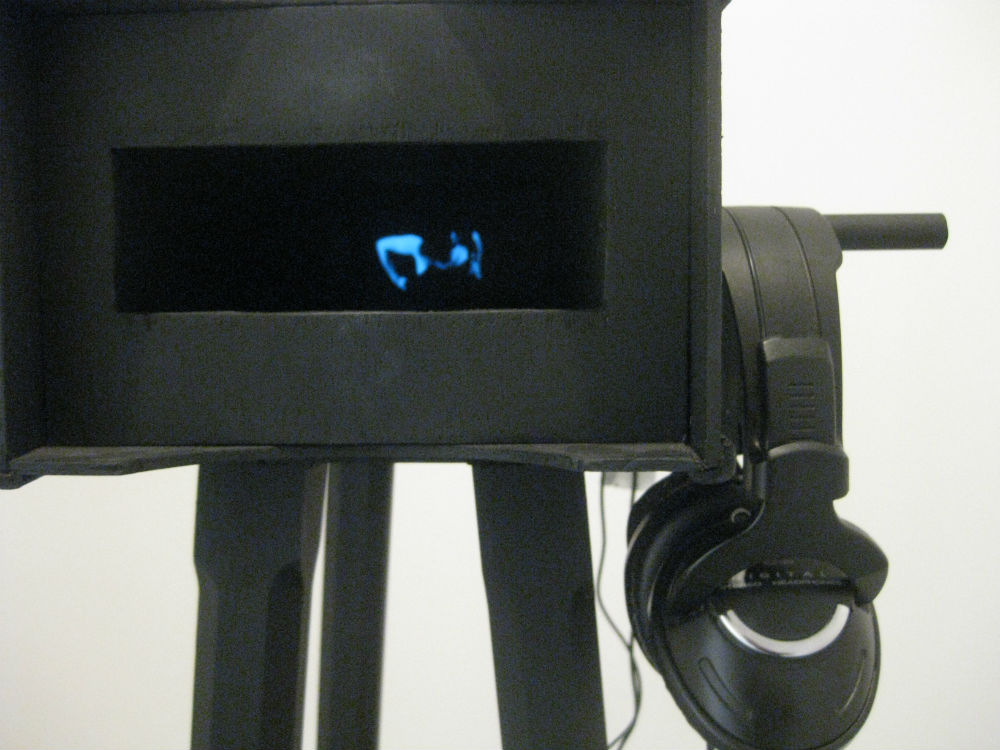
    Peeping through holes at ladies dancing is not the main prospect which comes to mind when you plan a gallery visit. And to see Remahl’s work, men will have to stoop.

    But your sense of decorum is just about preserved when you realise that this peephole only features some arty, black and white, jump cut choreography: fully clothed.

    The headphones are a lot more comfortable (and fill your head with some reassuring gypsy folk rather than, thankfully, a wakka chikka porno groove).

    Mien is a response to the poetry of Galician writer Xelis de Toro, whose book in translation, Invisible Bridges, has inspired an entire exhibition here in Brighton.

    So Remahl’s work reminds us that good writing may be seen as dancing with the pen. And the pen is surely not merely a pen, anymore than a cigar is just a cigar.

    But the apparent frivolity of dance is a stumbling block for serious poetry or prose, like the stance of anarchist Emma Goldman: “If I can’t dance, I don’t want to be part of your revolution.”

    And what if there is an element of sleaze about all dance, ergo about all writing? That might explain why the famous 1913 performance of Rites of Spring degenerated into a riot.

    No one likes to be confronted with their voyeurism, least of all the grand bourgeois of pre-War Paris. They would recognise Remahl’s work for what it is, a gentle scandal of sorts.

    The Book of Invisible Bridges can be seen at Phoenix, Brighton, until August 14 2012. See gallery website for opening times, directions and full programme of supporting activity.

    aggregation, contemporary art

    Found Objects 31/07/12

    July 31, 2012

    For your enjoyment and perusal:

    • Na na na na-na-na nah, Ai Jude! China’s dissident art superstar gave the thumbs up to Britain’s opening ceremony for the 2012 London Games.
    • Blogger Catherine Baker was more circumspect, but makes a number of good observations which still point towards room for optimism.
    • RIP Franz West. Tyler Green from Modern Art Notes posts links to an epic five part review and about now would be a good time to read it.
    • The case for visiting the Hayward’s latest show is getting stronger by the week. Here is journalist Brian Dillon’s compelling essay on the art of nothingness.
    • Architecture Week carries a highly readable interview with Sir Norman Foster which reveals, among other things, he used to be a bouncer (via/ Phaidon.com, link may time out)
    • There’s another entertaining interview on Daily Serving. Taxidermist Polly Morgan talks about how she became an artist and other uses for dead animals.
    • Speaking of which, there was a buzz online about a gourmet meal of rats staged in New York by artist Allegra La Viola. Yum!
    • Animal theme continues with a trip to the Museum of Zoology in Florence. Not the first museum you might think of visiting in that city, but well worth a look on The Exhibition List.
    • Not everyone is happy about the regeneration of Margate seafront. It used to be a well kept secret for Phoenecia at The Rightness of Wayward Sentiment blog.
    • But I think this is my favourite link of the week: Japanese art lovers going crazy for the opportunity to shoot photos of replica Vermeers in Ginza. (Story from the Japan Times).

    conceptual art, contemporary art, London 2012, sound art

    Martin Creed, Work No. 1197 (2012)

    July 27, 2012

    It is not clear what Work No. 1197 set out to achieve. But few could misunderstand just what it was they had to do, or what happened.

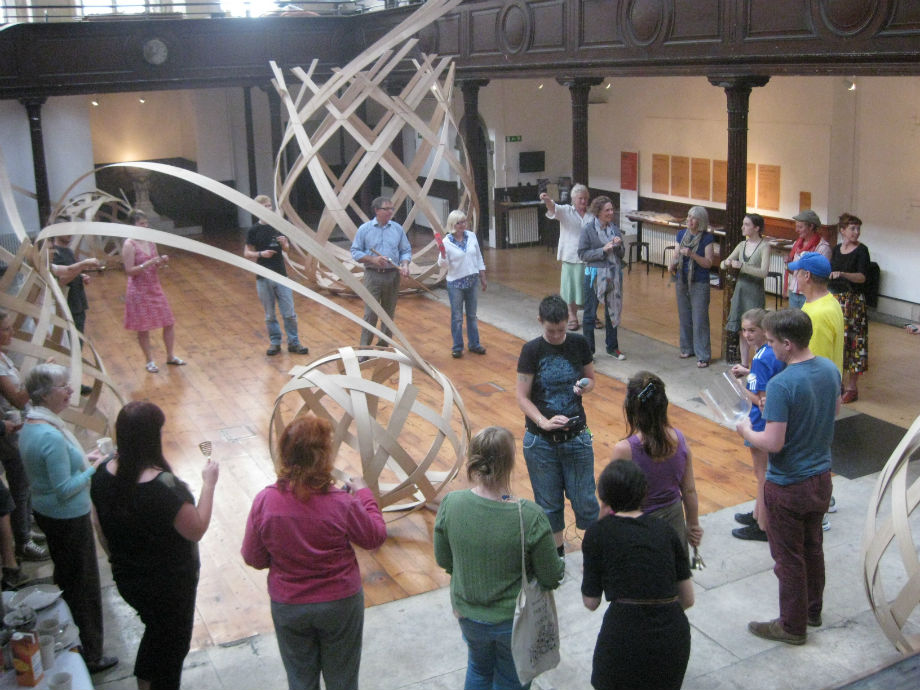
    At inestimable numbers of people came together to ring all manner of bells. They met in churches, galleries, schools and theatres. You could even try this at home.

    At Fabrica gallery Brighton some thirty volunteers and staff formed a spontaneous circle, an effortless slipping into the role of bellringers.

    The chiming began and before long an additional sound could be heard. That was, if not mistaken, an unofficial resonance, a music of the spheres, something not signed off at LOCOG.

    Few artists come across as material minded as artist Martin Creed. But in that spooky extra vibration, there was something perhaps mystical despite the early hour.

    It made me think of Abbie Hoffman’s efforts to levitate the Pentagon. The Yippie founder also wanted to turn the building orange and end the war in Vietnam.

    By all reports, Whitehall is still on terra firma and retains the colour of stone. But hey, Jeremy Hunt’s bell broke, so perhaps it worked.

    The Secretary of State for Culture, Olympics, Media and Sport joined proceedings on the deck of HMS Belfast, a suitable target for our peace-loving energies.

    New age readings aside, this was still a remarkable event. The diversity of bells in use was itself an exhaustive expression of difference and conceptual sameness.

    Top prize in my limited experience goes to the chap in Brighton with a cloche jar and an official Olympics bouncy ball on the end of a chop stick. Everyone is an artist, after all.

    Following a very quick three minutes of something approximating joy, the ringing ceased and a round of applause swept the room.

    It died down and the only sound left was a smartphone on the stage, pulsing with an official All The Bells ringtone. But since 815am, can anything else still be heard?

    classicism, contemporary art, installation art, outdoor sculpture

    Tom Dale, Banquet of Sound (2012)

    July 25, 2012

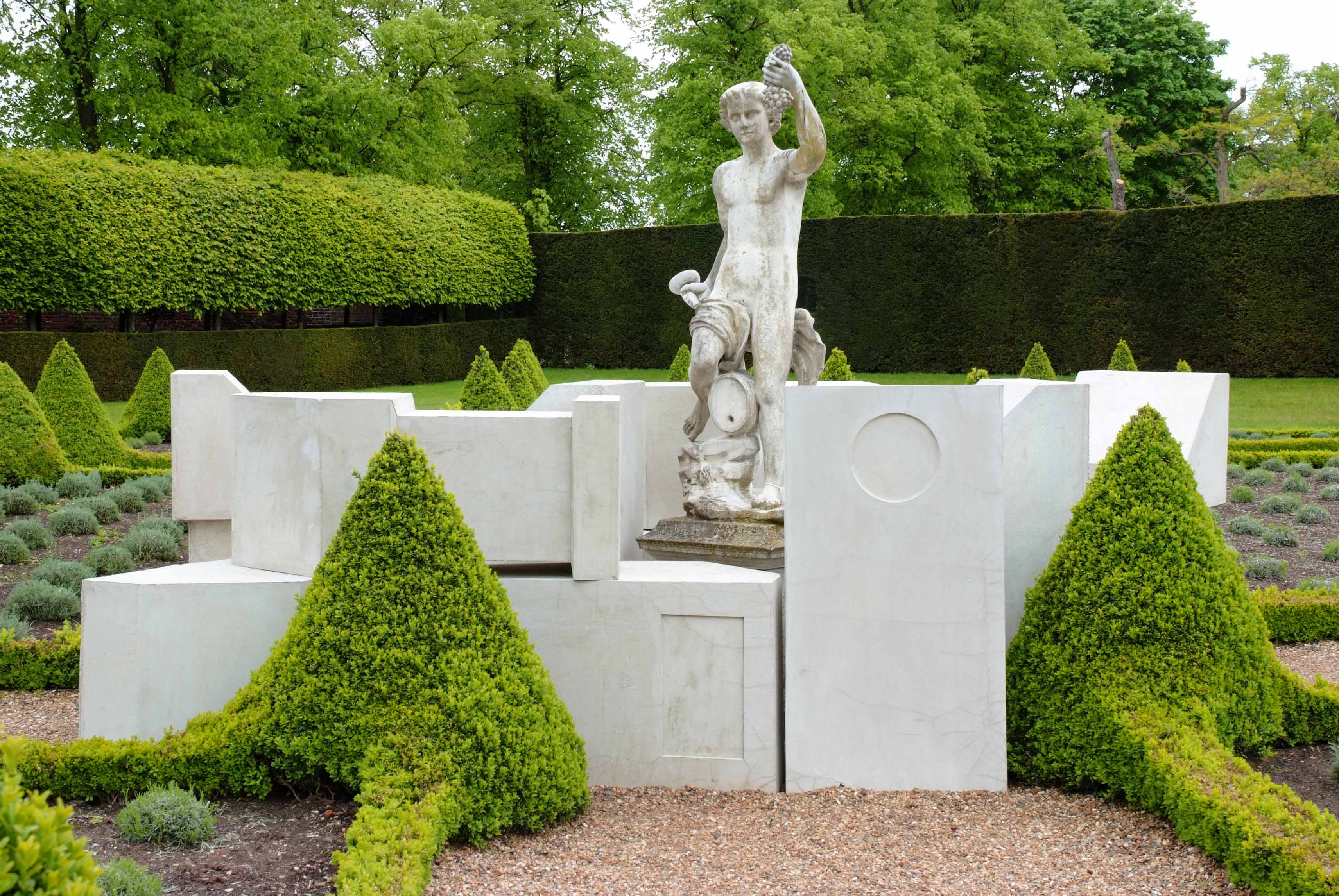
    Democracy has, one assumes, been going downhill since the time of ancient Greece. And here are the ruins of the principle: twelve abandoned, jumbled and toppled lecterns.

    In the midst of their cluster is a nod to the classical world that spawned public speaking. But the statue which has long sat in the gardens here is the most troublesome of gods, Bacchus.

    This lover of wine and experimentation is the last man standing in the in the verbal jousting matches which have led to the pile up of these metonyms of free speech.

    So Dale appears to suggest we may be intoxicated by the notion of democracy. We go to war for it. We dare not speak out against it. We brand our enemies with a disregard for it.

    But just what does our democracy add up to? The artist makes the point that lecterns are not only for politicians, but also celebrities, captains of industry, perhaps even bingo callers.

    Their proliferation (and it must have been fairly straightforward to knock up these hollow jesmonite replicas) can be seen as a media frenzy, or a point-of-view piss up.

    But cracks are already beginning to appear on the installation. In one sense this can be seen as a groundclearing exercise for something which could follow on from democracy.

    That’s not to say totalitarianism, but a preferable form of democracy. A world to come, rather than a future held in place by monolithic discourses such are represented here.

    Happily enough in the gardens of Ham House, they cancel out one another. Despite the title of this piece it is the quietest work on display. The only voice it waits for is your own.

    Banquet of Sound can be found in Garden of Reason at Ham House until September 23. See project website for more details. And read what Dale himself said about this work in an interview for Culture24.

    aggregation, contemporary art

    Found Objects 24/07/12

    July 24, 2012

    Not the most newsy of weeks, so go here for a Tate Tanks video. Otherwise:

    • My dream gallery since I can but dream of going there. Hyperallergic pokes around in The State Tretyakove Gallery, Moscow.
    • From that to this. A nightmare from the pages of Kafka turned into a sculpture currently on show at the New Museum, New York.
    • Parisian street art proves to be a good many scalpel cuts above some of its urban rivals. Check out Thom Thom‘s work on Beautiful/Decay.
    • Museum Nerd draws your attention to a new Ugly Renaissance Baby. Just who signed off this composition?
    • The Telegraph send Mark Hudson north of the M25 to report from We Face Forward in Manchester, a vital reassessment of West African art.
    • No matter what position you take on The Boss, this 17 page profile in the New Yorker is stunning journalism. Thanks to Adrian Hyland.
    • Pipe write about Zizek and Hegel with refreshing enthusiasm. As a relative stranger to both writers I loved this post.
    • Acerbic Alastair Gentry has found a remarkable doppelganger. And aptly enough, he’s laughing at you.
    • Read and weep. Goldsmiths applications down 23% and Ben Street is at a final year show to report on the end of an era.
    • Julian Opie has been making a bit of a buzz in London this week. Here’s one of the more genial reviews of his show at Lisson Gallery.

    contemporary art, environmentalism, installation art, site specific art

    Klaus Weber, Sandfountain (2012)

    July 20, 2012

    If gardens are symbols of mankind’s dominion over the natural world, then fountains are the suggestion of a triumph over physics. That’s one in your face, gravity.

    Having said that, there is nothing too agressive about the many spouts of water you can find in many a city square, many a palace or not-even-stately home.

    Fountains are decorous pieces of defiance. Perhaps they are the ultimate bourgeois placeholder. They certainly seem so in this famous scene from one of Jacques Tati’s films.

    But as we move into what has been called the anthropocene age, in which we prove we can do just what we damn well please with the planet, traditional fountains are redundant.

    That is what makes Klaus Weber’s Sandfountain so timely. It’s a technological swansong which swaps a single water pump for some dozen sandblasting units.

    The sand will erode the concrete and you can already see the disconcerting way it shifts and cascades. The sculpture mesmerises just as much as any abyss.

    Weber jokes about the global need to save water and one thing seems fairly inevitable: there will be no shortage of sand in the world to come.

    This is not the first time the German artist has perverted a piece of garden furniture. He once concocted a homeopathic solution of LSD (1:800) and put that into circulation.

    That’s one you can try at home, because it was apparently all legal and above board. Whether or not you do, spare a thought for Weber’s recycled desert next time you turn on a tap.

    Sandfountain can be seen at 5 Sugar House Lane, London, until 26 August 2012. It is part of Frieze Projects East.