<h1>Archives</h1>
    20th century artists, contemporary art, curating, feminism, mental health

    Bob and Roberta Smith interview

    January 11, 2011
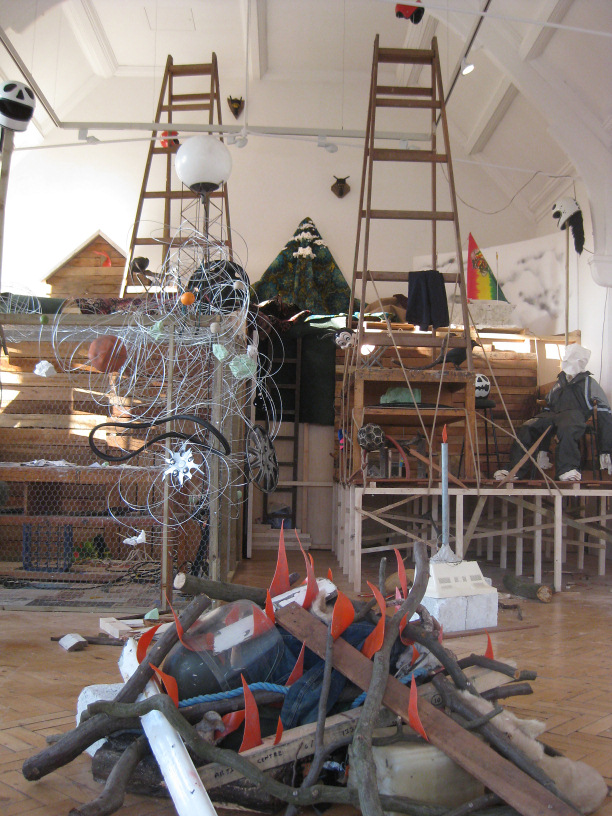
    Bob and Roberta Smith, The Life Of The Mind (2010). Courtesy the artist and Hales Gallery. © Bob and Roberta Smith

    Written for Culture24.

    Bob and Roberta Smith have called their forthcoming show The Life of the Mind, and the last notable person who offered to demonstrate that burnt down a hotel.

    The title is a quote from the 1991 movie Barton Fink with the arsonist played by John Goodman. He is very annoyed to have become the subject of a writer’s work.

    “I think artists are extraordinary people but they’re people just like anybody else,” Bob and Roberta Smith say. “There’s this idea that because you’ve got access and you’ve got power that you can interpret how the world works and what’s going on in somebody’s head, and so that image of John Goodman setting light to the hotel, he’s saying I don’t want to be patronised any more.”

    Now 26 artists who seem to be in a similar position have been gathered for the show at The New Art Gallery Walsall. Curators and contributors Bob and Roberta have looked for pieces which resist a white, male hegemonic viewpoint.

    In some ways this is Roberta’s show, I suggest, and Bob agrees: “It is a sort of proto feminist statement, but I am a bloke,” he naturally confirms, speaking via phone from an intercity train. The pseudonymous duo are brother and sister, and to me it sounds like Bob is doing most of the talking.

    “I think that thing of being hemmed in is common to all people, so although I’ve got a lot of women artists in it and it’s meant to be saying something that is feminist, it’s also saying something about mental health as well and both things are a bit overlapped and a bit merged.”

    So alongside work by Louise Bourgeois, Annette Messager and Lucia Nogueira, you will be able to glimpse the interior worlds of outsider musician Daniel Johnston and post-impressionist visionary Vincent Van Gogh. (“I do tend to think he was an incredibly talented artist who was dogged by mental health rather than somehow a great genius because of his mental health,” say Bob and Roberta.)

    The touchstone for all works included in the show is a bronze bust by Sir Jacob Epstein, whose archives can be found at Walsall. A defiant look on her face resonates with the sad story of her life. This is Epstein’s daughter, Esther, who committed suicide.

    “I wouldn’t hold him personally responsible for Esther’s suicide,” say Bob and Roberta. “It was part of a culture of parenthood in the upper classes which still continues. They send their kids off to get them out from under their feet.” But the artists do add that both children may also have been at the “wrong end” of their father’s pre-occupation with art and studio time.

    The Smiths became seriously interested in the controversial sculptor during a residency at the Gallery. “Basically all of my work prior to working on this archive has been one version or another of painting the first thing that came into my head,” laughs Bob. “But actually working on this project I suddenly realised the value of a bit of research and having a different source for one’s ideas.”

    In fact a liking for Epstein goes back to formative encounters with The Rock Drill at Tate: “I always wondered how this person could have made this amazing sort of robotic figure and also made these kind of more figurative straightforward kind of busts. It perplexed me even as a little child.”

    But even one of the biggest names in 20th century British sculpture was in his way resistant to hegemonies of the time. “He made a lot of stone carvings in situ,” Bob and Roberta tell me. “There’s one in St James’s [Park], Night and Day, and that almost caused a kind of riot because he thought he would break convention by carving it himself rather than getting assistants to do it for him.”

    Talking of hegemonies, Bob and Roberta are currently included in a show of works from the Government Art Collection. If anything, the artists seem amused: “It’s a funny thing – the Government Art Collection was set up so that MPs could have something to put in their office and I think it’s good that the government collects art. They are trying to encourage politicians to think about it, in a way.”

    It should come as no surprise that Whitehall has a life of the mind, but you do have to wonder what John Goodman’s character in Barton Fink would make of these shows. If you see him in Walsall with a can of petrol, do alert the authorities.

    The Life of the Mind: Love, Sorrow and Obsession is at The New Art Gallery Walsall from January 21 until March 20 2011. See Gallery website for more details. Works from the Government Art Collection can be seen at Whitechapel Gallery until September 2012.

    20th century artists, experimental literature

    The Interrogative Mood by Padgett Powell

    January 8, 2011

    “If Duchamp or maybe Magritte wrote a novel…it might look something like this remarkable little book of Padgett Powell’s”.

    So speaks American novelist Richard Ford on the topic of recent bestseller, The Interrogative Mood. Yes, that is the novel written entirely in questions.

    Indeed, there is question after question for 164 pages. Powell will ask one moment if your doorbell ever rings and then in the next for the number of push ups you can do. It works, sort of.

    I like the idea this book could or should have been written by one of the showmen of modern art. But in my view Duchamp could never have written it. There is too much frivolity in this work.

    Chapter 17 of Ulysses by James Joyce is also written in question form and the tone of enquiry there seems much closer to the spirit of Dada or conceptual art.

    And with all due respect to Ford, I’d have to argue that Magritte might also have written something altogether different. If find his work quite ominous, whereas this curious novel is amiable and goes out of its way to reassure at times.

    Yet there is indeed much artistry in The Interrogative Mood.  And since the gesture is so pure, the texture so rich and the composition so free from narrative of any sort, I’d have given it to Jackson Pollock, personally.

    …as the real author might say, have you read this book? What did you think? Etc, etc.

    The Interrogative Mood is published by Profile Books and is available here.

    contemporary art, Middle East, video installation

    The Refrain, Judy Price, 2008

    January 4, 2011

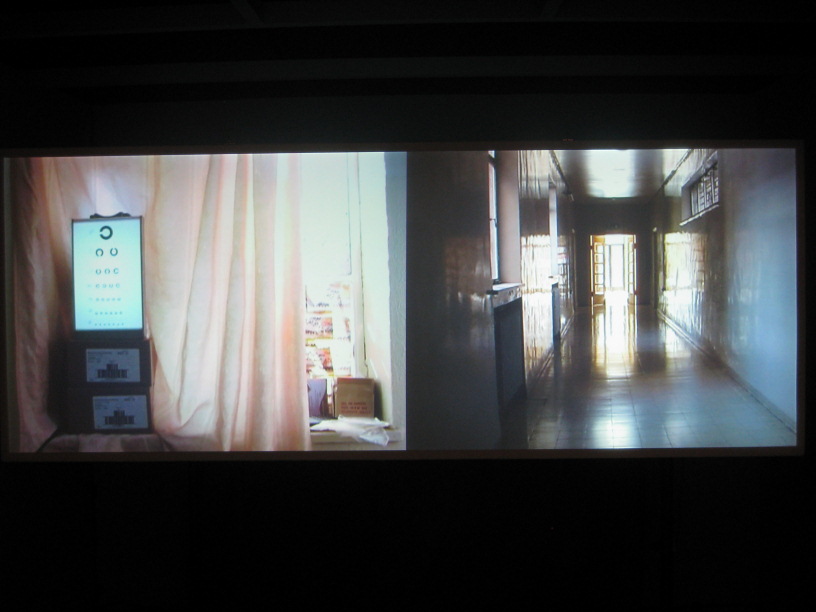
    It is quite something to come across an eye hospital in a gallery. Each one could be a metaphor for the other. In both you can expect some kind of operation on your field of vision.

    But to come across St John’s Eye Hospital in East Jerusalem is stranger still. In this two-channel video installation, Lucy Price takes us inside a cutting edge medical facility which caters to Jews and Arabs alike, regardless of ability to pay.

    So there is a blindness in the admissions policy and a deep faith in the patients of either religion as they put their eyeballs at the mercy of staff who, likewise, appear to come from both sides of the Israel/Palestine divide.

    And the threat appears very real. Eyelids are forced open. Hypodermics are wielded. Scalpels are lined up. If you wanted to take an eye for an eye, this would be the place to do it.

    The backing track by sound artist Maia Urstad is a comfort. Ambient noises from the hospital subsume birdsong, traffic and calls to prayer from the neighbouring streets. So what you see is not all you get.

    The Refrain culminates with an operation performed in semi-darkness and two gloved hands sewing up, one presumes, an incision. Even the world’s most intractable geopolitical problems may respond to skilled treatment of this sort.

    This installation can be seen as part of Over Where at University of Brighton Gallery, until 20 January. The show features more than 10 video pieces by Judy Price as well as paintings by Madeleine Strindberg. Call 01273 543010 for more details.

    art world capitals

    The capital of the art world

    December 29, 2010

    It should tell us something that art has both a world and a capital. Literature doesn’t. Music doesn’t. Film has more than one, perhaps, but these refer to production plants.

    In the case of art, the capital has been Florence, Paris, New York, and London. For long periods of time there is seemingly no capital. Yet the art world and the world at large has got by without one.

    Clearly there are (infra)structural reasons why artists gravitate towards one another. But to see and be seen should not be an integral part of any job.

    Then when a critical mass takes shape, we call it a capital. This suggests centralised power, outlying regions and perhaps borders beyond which no art worthy of the name can ever get made.

    There is some tyranny involved. Pity the artist who lives too far away to engage with the cultural dialogue without means to frequently travel to the capital, etc.

    It would be healthier to enter another period without hegemony in the field of visual art. It is better that good work and relevant shows can spring up anywhere on the map.

    Residents of various metropolises do not have a monopoly on ability, taste, or information. We all have the web, the media, and books.

    In fact the first of the latter in English was printed in Bruges, so go figure!

    2010 lists, contemporary art, Don Delillo, John Ashbery

    Top 5 art shows which I failed to see in 2010

    December 20, 2010

    The season of list-making is upon us. But lists, according to US novelist Don Delillo, are a form of ‘cultural hysteria’. As if the impending winter festival wasn’t hysterical enough.

    This year, rather than try and minimise the anxiety, I thought I’d crank things up a notch or two by compiling a list of the best shows which I never got round to this year. It is a shocker.

    • #1: Chris Ofili at Tate Britain
      Big draw: major survey, voice of a generation.
      Small excuse: January must have caught me napping.
    • #2: Jenny Holzer at Baltic
      Big draw: we need slogans more than ever.
      Small excuse: it was 292 miles away.
    • #3: Gauguin at Tate Modern
      Big draw: first showing in more than 50 years.
      Small excuse: there’s still time, but it’s 15 quid.
    • #4: Laura Belém at the Liverpool Biennial
      Big draw: showpiece of the UK’s biggest Biennial.
      Small excuse: got massively waylaid by video work.
    • #5: The The Things is (For 3) at Milton Keynes Gallery
      Big draw: mystery artist, playful anecdote-worthy work.
      Small excuse: two trips to MK in 12 months already.

    The irony of this list, of course, is that it worries me there are plenty more shows out there which didn’t make the cut. Possibly, there are even better shows I, and perhaps you, failed to see.

    It makes me think of John Ashbery’s epic poem of the 1970s, Self Portrait in a Convex Mirror. One line has always stuck: “the dread of not getting out/before having seen the whole collection.”

    But the fact is, no one can see the whole collection. Ashbery devotes more than 550 lines to just one painting by Parmagianino, and still there is probably more that could be said.

    All of which explains why lists are so popular at this time of year. You mention the title, jot down a thought, and move on. To respond more fully to the avalanche is unthinkable. Erm…merry Christmas!

    Comments welcome, as ever, if there’s maybe something you wish you saw this year and it’s giving you angst. Get it off your chest.

    Christmas, contemporary art

    Gifted at Josh Lilley Gallery

    December 14, 2010

    The artists on a gallery roster are invited to think of themselves as colleagues and take part in what we know as secret Santa. Instead of bottles of wine, DVDs and chocolates, they must give artworks.

    Secret Santa operates as a closed, rational system for regulating generosity at work. It brings teams together. It ensures no one is especially favoured or left out. Those are the pros.

    The cons are the same as any occasion of gift giving in our society. Calculation threatens the premise of altruism. It may be impossible not to expect something in return.

    Rather than a £10 limit, each of the artworks represents hours of professional time. So the shadow of calculation hangs over the workmanship, while the creative impulse escapes the circuit of trade.

    One condition for taking part is that each artist took possession of his or her gift and then made some further art with it. And the resulting hybrid works are now for sale.

    But you cannot put a price on inspiration, and that makes art the perfect gift. There is something generous about making it, buying it, even selling it, as this seasonal show demonstrates.

    Gifted can be seen at Josh Lilley Gallery, London, until January 7 2011. For more details visit gallery website.

    The show is curated by art lecturer and writer Ben Street. Follow him on Twitter: @thebenstreet.

    Advertising, Browne Report, Higher education funding, Slade occupation

    In Support of the Slade Occupation

    December 8, 2010
    A tongue-in-cheek look at the way big corps might start campaigning in favour of the Browne Report...

    Even when the profit margin is not immediately apparent, there is something to be said for ivory towers. More of that later. Now it’s time to step outside and comment on real world protests taking place at the Slade School of Art and elsewhere.

    The student demonstrations and occupations are about more than the right to spend three years putting off the shackles of employment. That right was enjoyed by most of those now in white collar jobs and certainly most of those in parliament, but never mind.

    They are also about a duty which is felt to some extent by everyone who opts to take a course in the arts or humanities, a sense that there is more to human life than succeeding in business.

    To see why arts education matters, you need only look at the heart of the most commercial sphere of all: advertising. If money talks, the £10.9bn spent on this industry in 2010 is very eloquent on the importance of aesthetics.

    As Braque said, art disturbs, and it can stir up any number of useful desires for advertisers. So if you take creative endeavours out of this context, they become more than a piece of indulgence. They becomes a catalyst for other forms of social change.

    That is why the humanities are under threat, not because they are a waste of time, but because they are potentially dangerous. Just ask anyone with a dumbed-down multi-million pound brand.

    All of this may be why culture is so often sequestered in the sort of towers which are now being attacked by the Browne Report, which incidentally features some stylish graphic design.

    Take away that bit of garnish and it would be capitalist ideology in its rawest state, and surely nobody wants to see that.

    You can read an insightful blog post on the man behind the proposed reforms to higher education by Catherine Bennett on the Guardian website here. Or take a look at this convincing argument against the competitive model for higher education by Stefan Collini on the London Review of Books website here.

    Oh, and follow the Slade Occupation blog, here. The times are as inspiring as they are frightening.

    contemporary art, contemporary sculpture

    Rostan Tavasiev, Ghost (2008)

    December 5, 2010

    There is a highlight of the current show at Grey Area. That word is used because the rest of the works are in darkness. Visitors are provided with torches. A lightbulb forms part of Tavasiev’s sculpture.

    So what it seems to illuminate is the arbitrary way we give a personality to the spirit of the dead and not yet buried. It would be shapeless white smoke were it not for those two cartoon eyes.

    These eyes are comic and two dimensional, as if beneath the glare of enlightenment thinking, we cannot allow our ghosts to have any depth of character.

    Likewise, any memory of the departed may now just be a thing to clutch in the night like a soft toy. The overhanging bulb is a discouragement to too much grief or pathos.

    This was just a toy bear, so his granite monument is absurd. But he would have more dignity, surely, if the cloud of his being was allowed to dissolve into the shadows which consume all the other works in the show.

    Ghost can be seen in Their Wonderlands at Grey Area, Brighton, until December 19. Visit gallery website for directions and opening times.

    You can also read more about the context of this piece in a blog post by the curator of Their Wonderlands, Harun Morrison. And/or check out the artist’s uncanny yet colourful website.

    contemporary art, contemporary sculpture, taxidermy

    Tessa Farmer, Swarm (2004)

    December 2, 2010

    No, your eyes do not deceive you. Those really are tiny winged skeletons riding on the back of a dragonfly. And there are a hundred or more spectacles like this in Swarm by Tessa Farmer.

    They give the impression of an airborne war, as if the skeletons are fighting for control of their glass cabinet. Which makes the artwork a theatre of conflict. Perhaps those fragile, hideous creatures are critics.

    But in fact, the gallery guide suggests they are fairies. Each one is a dessicated tinkerbell. The hope you might have cherished in secret, for a more magical world, is here turned inside out.

    And the wonder you might feel at such painstaking work soon turns to horror when you consider the results. No one wants to see dead insects, and bony fairies with fly wings attached, surely?

    Except of course, many people really do. This piece seems to fascinate visitors to the gallery. If art is a mirror, this example of it shows a spectral, parasitic species fighting over thin air.

    It is not a million miles from a battle in a desert, a debate in parliament, a war of words conducted online, or any struggle between ideas first dreamed up by those already passed away.

    Swarm can be seen in Newspeak: British Art Now Part Two at Saatchi Gallery until 17 April 2011.

    climate change, contemporary art

    Earth 350, Brighton

    November 27, 2010

    Today I found myself clapping and cheering for a piece of art although I have little idea what the work might look like and am not at all sure if it is any good.

    Nevertheless, I was participating. 2,000 of us stood on the seafront in minus temperatures for an hour and a half. At 12:45 we pointed at the sea for much longer than was comfortable.

    Then it was over. The unanimous cheering was completely spontaneous.

    Also, we looked silly. Most of those helping create this living sculpture were decked out in hooded blue ponchos. Some even less fortunate were in yellow. Subjective, I know.

    The plane was taking photos and it seems we were representing King Cnut. I made up part of the wrist of an arm raised in defiance of the sea. But the disappointing waters were like a millpond.

    Thom Yorke from Radiohead and the band’s favourite artist Stanley Donwood had designed this artwork. And it is one of 22 similar worldwide stunts to express both concern and hope around the theme of climate change.

    Hats off to the bloke nearby who brought an iPod and speaker dock on which he played the album Kid A in a gesture which seemed at once ironic and reverential. Becoming part of a Thom Yorke creation must be the ultimate experience for a Radiohead fan. (Me, I can take them or leave them.)

    It is said the sculpture will have been visible from space, though I guess what it looks like is beside the point. The real beauty of it is that so many people have endured boredom and cold for the common good. I would cheer that, any day.

    Read more about the project and check out some impressive photos of living sculptures from around the world on the Earth 350 website.

    Oh, and it seems the photos from today’s event are already online. Check them out here.