<h1>Archives</h1>
    conceptual art, site specific art

    Meaning Decoration Mass at Grey Area

    August 22, 2010

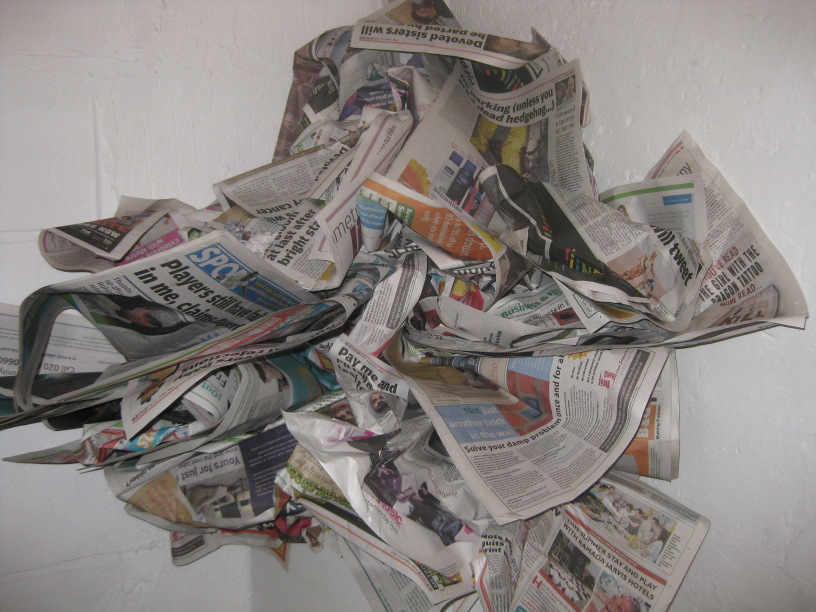
    Just as there is decorative art, so too is there decorative news. The lightweight stories in freesheets like Metro are there to soothe. The editorial is designed to sell advertising, and this is more or less true for any commercial publication.

    But as soon as a newspaper is used to decorate a gallery, meaning returns to the pages. You can see them for what they are: wallpaper. And the colour pictures and image-driven ads become eye candy without any pretension to meaning.

    Worse still, the messages which do emerge from this flat and neutralised scree of information become absurd. (The England manager says of a football game, “This is important,” and the pull quote is reprinted about a million times, as can be seen from this show.)

    You would have to say that given its context in Metro, nothing is important, and yet Metro itself, and the news culture to which it belongs, is of real concern. Here artists Huw Bartlett, Chris Smith and Lulu Allison have all highlighted the paper’s anodyne force.

    Using only scissors, glue and a few hundred copies of an August edition, the three have created a series of site specific installations at Grey Area. A 1926 quote on the wall by Theo Van Doesburg proclaims the end of art. These days he might have added something about journalism.

    Meaning Decoration Mass is at Grey Area, Brighton, until August 29. See the gallery website for opening times.

    conceptual art, Jeremy Deller

    Interview: Jeremy Deller

    August 21, 2010
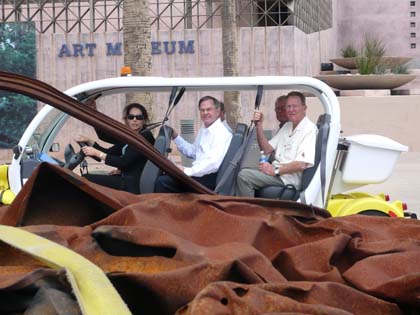
    Jeremy Deller, It Is What It Is (2009). Image courtesy Imperial War Museum

    Visitors to the Imperial War Museum in Lambeth may be shocked by the imminent arrival of a charred and mangled car that was last driven on a suicide mission in Baghdad.

    “There’s a central atrium as you come in, which has all the planes and missiles and so on, and it’s going to be right dead centre of that, so it’s almost the first thing you see when you walk into the museum. It’s an incredible statement for the museum to make,” says Jeremy Deller.

    Deller, an artist not a military historian, acquired the car in a bid to install it on the fourth plinth in Trafalgar Square. He was in 2008 shortlisted for the public art commission, eventually losing out to a less contentious piece by Antony Gormley.

    “I wasn’t surprised when it wasn’t selected, because I was kind of amazed it was shortlisted anyway, because it’s such a provocative thing to put on a plinth in the middle of Trafalgar Square, such an ugly, horrible thing really to put on public display.”

    Nevertheless, it did go on display. Last year Deller took the car to the US, where it spent more than a month at the New Museum, New York, before a three-week road trip saw it towed to Los Angeles. Two Iraq experts and a writer accompanied the vehicle on a series of meetings with the American public, who were keen to talk about the war.

    “It also brought up a lot of questions about domestic politics in America, people were talking about what it was like living in the US, what it had been like living in the US during those years in post 9/11 America, and how that had changed the landscape for a lot of people. So it brought up a lot of things,” says Deller.

    Despite the risks of taking a terrorist weapon to the American heartlands, the artist suggests this show was made for the road.

    “When it’s in a gallery you always have this problem with people thinking it’s an artwork or you’re displaying it for art purposes, if you put it like that, whereas when its on the road, you just accept it for what it is, or not accept it for what it is,” he adds.

    The name given to his stateside project was It is What it is. In the Imperial War Museum it will be called Baghdad, 5 March 2007. When proposed for the Fourth Plinth project, it was to be called The Spoils of War. Deller’s car has become more straightforward with each new setting.

    The London war museum is, for Deller, “the best place it could be.” Having killed at least 20 people in 2007, the car will now be set in a non-art context as a testament to the effects of war on civilians. The artist hopes that its new home will continue to spark discussions.

    “I think probably the public don’t realise that the Imperial War Museum is not a museum that’s out to glorify war,” he speculates.

    “Maybe it was at one point or thought that it could be, but it actually has a different role, so they are taking risks in a way one might not expect.

    “When I tell people in America about what’s happening to the car they can’t believe it. A similar institution in the US would never do this in their eyes. They couldn’t see it happening in the US.”

    Indeed, it might not have happened here so soon, were it not for some degree of artistic intervention. “It’s unlikely that the war museum would have got hold of a car and got a car from Iraq if it wasn’t for me doing it first for an art gallery and then offering it to them,” admits Deller, describing his role as an artist.

    “You’re just pushing at the edges of things and trying to make something happen – to precipitate something, is the best way of putting it.”

    Well aware of the difficulties of acquiring spent military hardware, Deller is enthusiastic when asked about the current Fiona Banner installation of fighter jets in Tate Britain: “I really like them, especially the one that’s hanging,” he says. “It reminds me of a crucifixion, so you’re in a church and that’s the crucifixion at one end.”

    But the biggest threat to public art commissions has come from the recent announcement of arts spending cuts, rather than a supposed axis of evil.

    “I think it will threaten anyone who works with museums and galleries,” says Deller.

    “Anyone who works with art in the public realm, in ways that the public can see art easily, that kind of art is going to be threatened because a lot of it’s funded centrally.”

    He also points out: “These conversations aren’t just happening in the art world. They’re happening in all different areas of British life.”

    So it may be timely that his next project celebrates exhuberance, humour and fighting spirit. “It’s the biopic of a wrestler called Adrian Street,” the artist explains.

    “He’s a British wrestler from Wales. He was a miner and he sort of left the mines and wanted to become a wrestler in London and made this sort of career for himself and now he lives in Florida and still wrestles. It’s a film about him and his life.”

    The first screening will be in Brazil in September. Clearly Deller, now an artist with a major project in a war museum, has a taste for the improbable.

    Written for Culture24.

    contemporary installation, Figurative painting, figurative sculpture, interviews, video installation

    Antony Gormley/Tomoko Takahashi/Alice Neel/Ed Pien/Jorge Santos/Simon Yuill

    August 21, 2010

    Recent reviews and previews written for Culture24. Check ’em out:

    conceptual art, Iraq, Jeremy Deller

    Jeremy Deller, It Is What It Is (2009)

    August 18, 2010

    Jeremy Deller, It Is What It Is (2009). Image courtesy IWM London.

    Not many objects could be juxtaposed with an entire country. But touring the US with the wreckage from a car bomb in a Baghdad market has surely done so.

    You would think the crumpled car would prove as unwelcome as an early readymade sculpture in a museum of fine art. But it seems Americans are nothing if not open and the vehicle is reported to have drawn more interest than antagonism during its three week trip from New York to LA.

    An artist was behind the project, but the object was not signed and it was not intended as a work of art. That would have got in the way of a first hand encounter with an effect of the recent war. If you wanted to know more, there were Iraq experts on hand to talk about the situation on the ground.

    But the minimal presentation, the simplicity of the project, and its documentation could all still be called art. The gesture itself, to trace an imaginary scar across America, is nothing else but.

    Perhaps an educator or an activist might have wanted to undertake this project, had they thought of it first and been daring enough. Perhaps Jeremy Deller is a bit of both. He, at least, knew enough to let the car, more or less, speak for itself.

    From 9 September the car will go on permanent display at the Imperial War Museum London as Baghdad, 5 March 2007.

    20th century, Figurative painting

    Alice Neel, Frank O’Hara No.2 (1960)

    August 15, 2010

    Frank O’Hara, No. 2 1960, Oil on canvas, 96.5 x 61 cm, Estate of Alice Neel

    The face of Frank O’Hara in this portrait by Alice Neel is in its way shocking. With his bad teeth, sharp nose and wild eyes the New York poet appears ugly at first, even repellent.

    There is no composure in this likeness and his expression is raw. But with all its imperfections, his face is also vulnerable. It is this which makes it difficult to look at, which makes it burdensome.

    For all the laughter, O’Hara appears unguarded here and we cannot turn away from such nudity. It must have been a face like this which philosopher Emmanuel Levinas had in mind when he spoke about the concept as follows: “The relation to the face is a relation to the absolutely weak, to what is absolutely exposed, naked and destitute.”

    Levinas also said the face was not to be confused with a portrait, but there are surely portraits and portraits. Neel does not immortalise her subjects, indeed quite the opposite. If anyone could prise away the mask and put us face to face with another human being, she could.

    Elsewhere it has been written that this portrait shows something bordering on dislike, which can coexist with pity; read a review by Adrian Searle in the Guardian here. Neel is the subject of a major show at Whitechapel at the moment and there is a review by Robin Blake in the FT, here, and one by Laura McClean-Ferris in The Independent here.

    Alice Neel – Painted Truths is currently at Whitechapel Gallery until September 17.

    20th century, abstract expressionism, conceptual, contemporary, intervention, outdoor sculpture, painting, performance, ready made, surrealism

    12 pieces of conceptual art that would probably work as tweets

    August 10, 2010

    From the 20th century onwards, the beauty of much art is it has no need for the eye of a beholder. Conceptual works, in theory, place as much importance on the idea as the finished visual object. And while lots can be said about the dozen pieces below, the kernel of each is a thought of no more than 140 characters.

    This is not to assume that simple ideas are the best. But it is possible that in a time of information overload, and web-based attention spans, they are the ones that travel best. If these artworks translate into tweets, it is only a sign of their power.

    1. Benjamin Peret, Insulting a Priest (1926):
      “A black and white photo of a surrealist poet harranguing a man of the cloth, as featured in a 1926 manifesto for the liberation of desire”
    2. Robert Rauschenberg, Erased De Kooning Drawing (1953):
      “After six weeks of careful erasing a heavily worked drawing by Willem de Kooning becomes a gold-framed piece of near blank paper”
    3. Marcel Broodthaers, Femur of a Belgian Man and Femur of a French Woman (1964-5):
      “Two human bones, one from Belgian man, one from a French woman, each painted in the colours of the flags of their respective nations”
    4. Joseph Kosuth, One and Three Chairs (1965):
      “A folding wooden chair, a photo of the same (not by the artist) and a blown up definition of the word chair to be displayed as one piece”
    5. Jannis Kounellis, Untitled (1969):
      “A white-walled Rome gallery became a temporary stable for 12 quite mucky and fairly noisy live horses”
    6. John Baldessari, The Commissioned Paintings (1969-70):
      “Out on a walk, the artist took close up pics of a friend pointing at interesting things, then asked 14 sunday painters to paint the photos”
    7. Adrian Piper, Untitled Performance for Max’s Kansas City (1970):
      “The artist wears blindfold and gloves and pays a visit to a New York bar where the art world generally go to see and be seen”
    8. Jørgen Nash, Decapitated Little Mermaid (1972):
      “The head of Copenhagen’s most famous statue is cut off by (it is said) the Second Situationist International. The artist is a member”
    9. Hans Haacke, Manet-PROJEKT 74 (1974):
      “A proposal that a Manet painting be displayed next to panels giving details of all the work’s previous owners and their business activities”
    10. Gordon Matta-Clark, Splitting (1974):
      “A suburban house is cut down the middle and undermined causing it to split and thereby open a rift in the social fabric”
    11. Gavin Turk, Cave, 1991:
      “For his degree show, the artist leaves nothing in his studio but a blue plaque with the words: Gavin Turk, Sculptor, worked here 1989-1991”
    12. Sherrie Levine, Fountain (1991):
      “Marcel Duchamp’s infamous urinal readymade has been recast in bronze to give it, at last, some respectability”

    By now you should be convinced, some of the most important works of modern and contemporary art lose little from a lot of distillation. They might even work as tweets, albeit ones with plenty more to say.

    More details on the 12 artworks can be found in Conceptual Art, by Tony Godfrey (published by Phaidon), which contains hundreds more like them all discussed in considerably more depth.

    conceptual, contemporary, performance

    Giorgio Sadotti, Went To America Didn’t Say A Word (1999)

    August 6, 2010

    A 24-hour recording of ambient city noise is, on the face of it, boring. Few people will ever sit through all of the 1999 Giorgio Sadotti piece currently on show at Milton Keynes Gallery.

    Behind the soundtrack, however, is an amazing story. Sadotti flew from London to New York, stayed overnight, and came home the next day without speaking to anyone. And that has the makings of an urban legend.

    Now simply by hearing about the artwork, you can experience it. It can be easily shared, at no cost, between friends, over a drink. Never mind the lengthy audio documentation. The anecdote, surely, is just as much the artwork, as the tapes from across the Atlantic.

    You may wonder how it was possible, logistically, to do such a thing. In its invisible way, the piece is as remarkable as a tromp l’oeil ceiling or an ornate manuscript. It must have been solitary, dogged work to produce.

    The next question is what he might have said. The title implies withheld judgement or perhaps a kept secret. It draws attention to what Sadotti was thinking and the recording offers no clue. This gives the piece an essential and age old mystique.

    In an attempt to demystify Went To America Didn’t Say A Word, I went to my local shop for a pint of milk and maintained a strict silence. Here is the documentation. You won’t find it in a gallery: Went To The Cornershop Didn’t Say A Word.wma

    The The Things Is (For 3) is at Milton Keynes Gallery until 12 September

    computer generated, contemporary, public art

    Interview: John Gerrard

    August 5, 2010
    John Gerrard, Oil Stick Work, (Angelo Martinez / Richfield, Kansas), 2008, Realtime 3. © the artist and Art on the Underground. Production: Werner Poetzelberger. Modelling: Daniel Fellsner. Programming: Helmut Bressler. Additional programming: Matthias Strohmaier. Model: Angelo Martinez

    Canary Wharf underground station offers the best and the worst opportunity an artist could hope for.

    “There are 45 million people who will travel through that station per annum, which is extraordinary. There’s no gallery in the world which could even boast a fraction of that kind of potential audience,” says John Gerrard.

    “But of course, it’s not a receptive audience. It’s a hurrying, blind audience in a way.”

    Gerrard is responsible for a vast projection on the far wall of atrium, which requires nothing if not patience. The computer generated simulation unfolds in real time, day by day, with a narrative scheduled to last for 30 years.

    Oil Stick Work (Angelo Martinez/Richfield, Kansas) is set in a Kansas landscape dominated by a grain silo. Dawn breaks about noon British Summer Time and the scene fades to darkness at around 2am.

    Between those times, a lone figure sets to work painting the building black. He paints one square metre each day with an artist’s crayon. By the time he completes his task, in 2038, US oil supplies are projected to run dry.

    Art on the Underground will be showing the astonishing time based work for 12 months, and Gerrard hopes that in that time a “fraction” of the audience will notice the work’s progression.

    The tempo of his art is a far cry from the pace of nearby life. The Jubilee Line station serves some of the world’s busiest banks. “I think the banking context is a very good foil for the work, for the slow build of the work,” says the Irish artist.

    He also expresses amazement at the latest forms of (high frequency and algorithmic) trading. “It’s almost become quite anarchic what’s happening in those environments,” he says.

    “You’ve got people basically spending billions to gain in microseconds on somebody else in terms of speculation.”

    The central theme in Oil Stick Work, intensive farming, is clearly not unrelated. In the 1930s, oil-powered agriculture caused catastrophe when the prairies succumbed to the worst dust storms ever seen in America.

    Today the same landscapes are dominated by ominous and anonymous buildings such as the grain silo above or the grow finish units used to farm and slaughter pigs. People are few and far between, but with one notable exception.

    Angelo Martinez is the name of a New York builder who auditioned as a stand-in for a worker who told Gerrard to stop taking photos of one of the installations in Kansas. Now with virtually remodelled features, the artist says it “really is a portrait of him.”

    The unreal localities which inspired Oil Stick Work are well suited to 3D simulations. “I’m slightly on my own with the medium which is curious,” notes the artist.

    “There is an established arena of game art which is in existence, but this particular kind of static approach, which I think has a lot of potential, I don’t think there’s anybody working like this at the moment.”

    That medium, according to Gerrard, “was effectively born in a military context,” and for his next work his is taking the form back to its roots.

    “The new work I’m doing at the moment is actually remaking a historical scene which is from the Iran-Iraq war, the first Iraq war from the 1980s, and in it there is a soldier figure…who is enacting a kind of impossible performance.”

    This will be the first time the artist has used military training technology to recreate a military training exercise. “I’ll see how that goes. I mean, it’s a bit of a risk,” he says.

    But despite the outward calm of a piece like Oil Stick Work, organised aggression is already very much a theme.

    “Those grow finish units on the American landscape are in and of themselves a type of horror story of gargantuan proportions,” he suggests. “I don’t think there are many games that would reach that level of…what is it? You know, the implicit violence in those scenes.”

    From Kansas to Canary Wharf, what you cannot see is what can shock the most.

    Written for Culture24.

    contemporary, installation, photography

    The The Thing Is (For 3)/Harry Hammond/Luna Park/August must-sees/Top 10 art attractions for kids

    August 5, 2010

    Here’s a round up of work for Culture24 in the last week or so. Feel free to peruse: