<h1>Archives</h1>
    contemporary art, folk art, sculpture, vodou

    Leah Gordon, Atis Rezistans: The Sculptors of Grand Rue (2012)

    October 30, 2012

    Just as Joseph Beuys once declared his reciprocal love for America, in this film you will see a Haitian artist state: “I like vodou and vodou likes me.” He goes so far as to add, “Everyone likes vodou.”

    But whatever ghetto sculptor Guyodo might think or say, not everyone does like vodou. Not unless you count the prevalent mania for zombie fancy dress as a deep engagement with this religion.

    Guyodo was talking about his neighbourhood, however, where spirits are as popular as art and art is a way of keeping the spirits close. Missing a loved one already? Just put their skull on an effigy.

    On press day for a show of Haitian art at Nottingham Contemporary, filmmaker and photographer Leah Gordon was introduced as one of the West’s most frequent visitors to Haiti.

    Indeed, she has a freaky level of access. One sequence of her film takes us down a warren of sunless alleys into the heart of a notorious Port-au-Prince ghetto, in search of mysteries and faith.

    But the residents of these corrugated steel shacks will surprise you. Artist Andre Eugene tells Gordon there are as many great intellectuals here as there are thieves.

    Eugene also has plans to open a museum. Not a gallery, but a full blown museum because up until now it has only been the bourgeoisie who embarked upon such ventures.

    The film is not without its spookier moments. In a memorable scene we see a man channel the spirit Gede. He wears shades with the apt number of lenses and props a phallus on his walking stick.

    And in some more great footage, towards the end, we witness a jazz funeral. What a way to go! In voiceover the irrepressible Guyodo talks up the immortality of artists, regardless of earthly fame.

    If this film has whet your appetite for the art of Grand Rue, try and make it to what must be one of the largest exhibitions of Haitian art ever. Or wait for the catalogue and be there in spirit.

    Kafou: Haiti, Art and Vodou is at Nottingham Contemporary until 6 January. See gallery website for more details.
    Uncategorized

    Tracey Emin’s tip for very young artists

    October 24, 2012

    Between the condoms by the notorious bed to the film about abortion, childlessness has emerged as a major theme in the work of Tracey Emin.

    As if she has traded creative fecundity for motherhood, her prolific art has more in common with masturbation rather than procreation. She sketches the former activity at length.

    In a photographic work I’ve Got It All, the artist can even be found scooping cash up into her crotch, but unlike Danaë her visit from a shower of gold results in nothing.

    But since Emin practices a form of gesamtkunstwerk, allowing biography to become part of the art, her maternal status is all important.

    The chances are we might not have allowed this working-class, female artist to have it all. To be rich, powerful, famous, okay. But a mother as well? It might have put the nation off.

    Most celebrities get away with having babies and indeed so do many artists. But Emin would appear to be a romantic and likes to advertise a bit of suffering along with the stellar career.

    For that reason, her contribution to a new book by Faber is touching. The publishers have been asking the great and the good for answers to common kids’ questions.

    Emin was asked: What should you do when you can’t think what to draw or paint? The following is her answer, for the benefit of other people‘s children:

    I often find I can’t make art. At times like this I go and do something else. I usually go partying, play dominoes, go out to eat, or swim, take long walks, go shopping – all the normal things.

    I wake up most nights between 1 a.m. and 3 a.m. and stay awake for around two to three hours. That’s when I would most like to work but I can’t because even though I am awake I am not awake enough to get dressed and go to my studio. But now I have an app on my iPad that lets me draw. The drawings are very different from my usual style because I do them with my finger and I am still a little sleepy so the drawings come from another part of my brain. Also they are very throwaway, so I feel freer.

    Reading and swimming are the best things for me to do because the swimming physically makes me happier, and my brain starts working. And the reading fills me with other people’s images in my mind, which releases me from stress.

    I need to make and create art – I’m an artist. Without creating my life makes no sense, I lose confidence and sort of forget who I am.

    See below for infographic for Big Questions From Little People by Faber and Faber:  What Big Questions are on Your Child’s Mind?

    Big Questions Infographic

    aggregation, contemporary art

    Found Objects 22/10/12

    October 22, 2012

    Unless you live in Ilfracombe, it’s been a relatively quiet week. Anyhow, here are the links:

    • The Independent predicts that over time the Great British Public may grow to love Verity by Damien Hirst.
    • But The Telegraph gives the former YBA a kicking over animal rights. Butterflies are people too.
    • Art Info reports on a highly cultural WWII prisoner camp which once held Max Ernst and Hans Bellmer. Did he miss his doll?
    • Ben Street offers some wit, wisdom and hope that artspeak may one day art speak might resemble a withered vestigial wing. Flap!
    • Art Wednesday provides a readable Q&A with gallery director Maureen Paley. Makes tenuous link between Lower East Side and the East End.
    • On the Art21 blog Jessica Lott responds to Picasso Black and White at the Guggenheim NY and paints a unambiguous picture of the artist as a lover.
    • A Kick up the Arts finds himself in Reykjavik, where he tracks down a Phoebe Unwin show on the outskirts of town. Very adventurous.
    • Enjoy an at-times-spooky photographic tour of the ARoS Kunstmuseum in Arhus, Denmark, courtesy of The Exhibition List.
    • Hyperallergic offers the most digested version of Art Review’s irksome Power 100.
    • Finally here’s a fascinating piece on cave art from Slate. Find out what made their bison so fat and their rhinos (and women) so horny.

    graphic design, independent music

    Peter Saville, After Closer (Digital Edition) 2012

    October 18, 2012

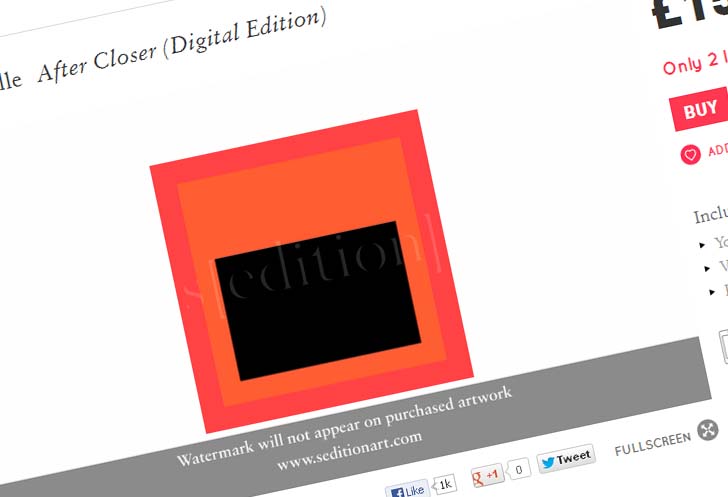
    First up, you can win, Win, WIN this artwork and then stick it on your phone, tablet, monitor screen or TV. Thanks to s[edition], it’s the very first criticismism competition.

    So what to say about After Closer? It pulls together more than two decades of iconic design for an inseparable pair of bands from Manchester: Joy Division and New Order.

    From Unknown Pleasures (1979) to Waiting for the Siren’s Call (2005), Saville has designed covers for both. One of the best known collaborations in music is also one of the longest.

    If you don’t already know the connection between Joy Division and New Order, I might ask you to go and read another blog post, because this comp’s really not for you.

    But those fans among you will recognise the visual nod to the second and final Joy Division album and might also interpret the shifting bands of colour to refer to New Order.

    A coded array of colours was used to represent the band on the cover of Power, Corruption and Lies. Saville was notorious for hiding the second Manchester band’s name.

    But here you see the former group exert gravity on the latter; the second line up energises the former. In a sense, both owe their popularity to each other.

    It has been pointed out that “closer” is a verb as well as an adjective. But this design draws attention to the fact that a great deal followed the closure in question.

    So this is a little bit of digital, hence non-corporeal, heaven for Ian Curtis (1956-1980). I have one edition to give away, worth £15 and counting. Just leave a comment below.

    Perhaps I shouldn’t be pimping out my blog in this way. What do you think? But I’m a fan of all three entities discussed here and I figured one of you might like to own this.

    contemporary art, sculpture

    Mona Hatoum, Afghan (red and black), 2008

    October 17, 2012

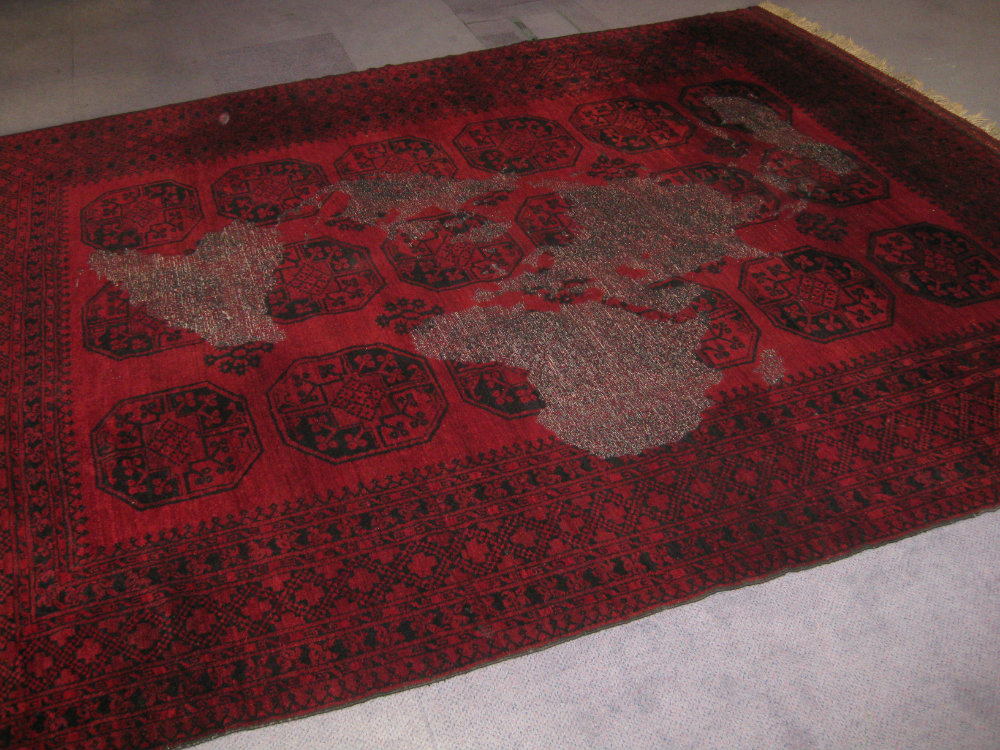
    There’s a rug shop in Brighton called GAFF (Great Art For Floors). This might raise a few eyebrows and concerns for art’s proper place in the world. But then there’s this piece Mona Hatoum.

    Perhaps great art does belong on the floor. Quality rugs, such as this one, demand a measure of true respect. They request you kick off your shoes, mentally speaking at least.

    But before you make yourself at home, just consider the geopolitical situation on this rug of ours. The map revolves around Britain, thankfully, but there’s a catch.

    Hatoum appears to have unpicked every continent on this planet of ours and distributed them around us in a vortex. Just as a world famous British shipping company might once have done.

    Since Cunard built their office here between 1914-17 no real geological changes have taken place. Yet borders have been redrawn countries have been swallowed up or have emerged.

    And it seems that soft furnishings are the quintessential response to geographical flux. You may be reminded of the 150 or so embroidered maps by Alighiero e Boetti.

    These colourful creations, which incorporated all the world’s flags, were handstitched by locals in Afghanistan. The same country crops up in Hatoum’s title here.

    No mere coincidence, perhaps. And I recently came across this passage in The Names by Don DeLillo in which a character called Charles Maitland holds forth on rugs.

    “Weaving districts are becoming inaccessible. Whole countries in fact. It’s almost too late to go to the source. . . They seem to go together, carpet-weaving and political instability.”

    This dialogue was first published in 1982, so how little has changed. But when she wove this example of a global carpet, what was Hatoum up to? Here’s the red and black catch.

    We surely have too much political stability in this part of the world, and need a few more rugs. In Afghanistan perhaps they need a few less. We need redistrubution of rug making, not wealth.

    Incidentally, the other elements which go together in DeLillo’s novel are pregnant women & martial law, plastic sandals & public beheadings, and gooey desserts & queues for petrol. Lol.

    Several works by Mona Hatoum can be seen in The Cunard Building, until 25 November, as part of the Liverpool Biennial 2012.

    aggregation, contemporary art

    Found Objects 15/10/12

    October 15, 2012

    We begin and end with Frieze, which seems only Fair (ahem). The other stories are good too:

    • Chloe Nelkin was on a pleasingly alliterative gallery binge last week. Take a deep breath and enjoy her Frieze Frenzy.
    • The Independent may be pushing it to call the Wiltshire monument an art gallery. But the findings of 72 Bronze Age carvings on Stonehenge is exciting indeed.
    • Theaster Gates brings theatre to White Cube Bermondsey. We Make Money Not Art finds a fully stocked library and, what else, a levitating fire truck.
    • Who knew LA has a Mexican mayor? Everyone now he’s been cool enough to authorise the restoration of a controversial 1932 mural. Report by Blouin Artinfo.
    • Richard Hamilton is being geared up for a posthumous show at Tate Modern, but in the meantime there’s this at the National Gallery.
    • Sobering news about the so-called cloud: someone has to house all those servers. Kyle Chayka discusses their aesthetics on Hyperallergic.
    • Can fasting help you understand Cezanne. Hemingway thought so, as C-Monster (re)discovers…
    • You might not think previous ownership by Eric Clapton would do much for a piece of art and you’d be wrong.
    • This skywriting project on Daily Serving looks pretty cool, once you get past the inevitable punnery.
    • Frieze Curator Sarah McCrory (soon to be Glasgow International Director) answers ten burning questions for Phaidon.

    aggregation, contemporary art

    Found Objects 08/10/12

    October 8, 2012

    Back from another short break with another flimsy excuse; please forgive these links for their occasional sporadicity:

    • Story of the fortnight goes to the attention-starved goon who defaced a Rothko painting. Lets hope this is the first and the last we hear of Yellowism.
    • Speaking of philistines, read all about minister Michael Gove’s architecture policy. Is there nothing good this government hasn’t come to threaten?
    • The story of one church’s mission to build a giant sculpture and the nicknames the result gets locally. God issues his verdict in the shape of a lightning strike.
    • Another extravagant sculpture story…at the Paris Review we hear from Cody Upton who spent an afternoon visiting the Flanders Duck.
    • Now for the first of two space stories. French street artist Invader has sent one of his pixelated alien craft through the atmosphere. It’s all a little bit pointless.
    • Compare that with Trevor Paglen’s message to the future. The California-based artist has produced a ‘cave painting’ legible for the next five billion years.
    • Jerry Saltz displays infectious enthusiasm for a piece of troublesome romanticism. An epic journey from Warsaw to Paris has made for some stirring and sublime art.
    • AnotherDesignBlog posted an interview with Tom Howard who shares all the joys of wayfinding graphics, such as those found at St Pancras.
    • Design post #2 finds the Whale and Dolphin Conservation Society brought bang up to date with a artfully placed curly bracket. Can you guess where?
    • Lastly, and most probably leastly, I thought I’d post the in-depth story which kept me so busy this time last week.

    prehistoric art

    Museo de Altamira

    September 29, 2012

    Read just a little of the literature about cave art and you’ll come across a report of some or other high-minded archaeologist bursting into tears at the sight of it.

    But this was never going to happen at the Museo de Altamira. The caves are closed to the public. Instead visitors are invited into a less moving replica, a neocave.

    It is still an experience. There is a holographic Paleolithic family, which the original presumably lacks. And there is plenty of supporting information to read.

    What is most striking about the ceiling covered in paintings, the Techo de Polícromos, is quite how much the prehistoric artists worked with the contours of the rock.

    This may be one of the first things you hear about cave painting, but I wasn’t prepared for quite how bulbous these 18,500 and 14,500 year old bison really are.

    Although prevailing wisdom suggests a ritual purpose for these works, it is difficult not to detect just an element of humour in these found representational forms.

    But at the same time, such three dimensional work suggests frieze-like sculpture as much as painting. This is artistic synthesis or mixed media avant la lettre.

    Just two colours are used in the so-called Polychrome Ceiling and painting here is done, to the millimetre, using pigments not unlike the originals.

    So there is something interesting about the construction of a simulated cave just 300m from where the original, ideal forms can be found. Plato would do his nut.

    You might too, if you spent too long in the gift shop. What you see in the photo above is a slab of cave painting for you to take away and put on the wall of your home.

    Just why anyone would want to do this, in light of the invention of paper and canvas, is beyond me. But the souvenir cave art does offer a way in or out of Altamira.

    To plan your visit to the museum in Cantabria, Spain, check out the website. It’s free on Sundays.

    Uncategorized

    Found Objects 24/09/2012

    September 24, 2012

    Apologies for the fortnight off, but my weekly link selection is I hope back on track:

    • Romance of the ruin doesn’t sound half bad, but Steven Thomson is concerned that, in the wake of the Olympics, two of the most signifcant East London art projects were too nostalgic.
    • A new service brings you “Everything you need to safely make an abstract expressionist painting while being intimate with the one you love.” Yes, you read that correctly.
    • This could be a glimpse of the future as Artsia sells art direct from the artist via the interwebz. Browse by style, medium or subject and have fun looking for the red dots.
    • Here’s another reason for curators to worry. It was #askacurator day on Twitter and a handful from the Tate got a hammering over BP sponsorship.
    • And so to another virtual gallery of art, this time focussing on work that has been stolen, destroyed or otherwise lost. Lost Art from Tate and Channel4 is a time sink.
    • Not what you might expect from CNN, but the channel’s website carries a first hand account of the blameless arrest of artist Molly Crabapple at Occupy Wall Street.
    • Eyeteeth report on Trevor Paglen’s latest satellite piece, a bank of images bound for space, which the artist compares with cave painting.
    • Danh Vo’s piece We the People is comprised of replica parts of the Statue of Liberty. The longer this project goes on, the better it seems to get.
    • Jonathan Jones in the Guardian claims that science is more beautiful than art. He would make a good science correspondent, I’m sure.
    • You’re never more than click or two away from a cat in this brave new world of ours. And this is a reason to be afraid.

    contemporary art, contemporary sculpture, installation art

    Richard Serra, The Matter of Time (1994-2005)

    September 22, 2012
    Photo: Elliot Levitt

    To some degree this is art for the feet. Serra’s eight sculptures invite you to walk them in sequence. In fact they demand it. How else will you get to see them?

    Thus it takes half an hour to simply cover the ground of this semi-permanent show in the Arcelor-Mittal Gallery here at the Guggenheim in Bilbao.

    It is a large space and the sculptures make it even larger. You trace a path through spirals which appear larger inside than out. You encounter barriers dividing the room.

    All the while, at some atavistic level, you experience fear that one of these forged steel slabs will lean too far in and crush you. Or you experience this as thrill.

    Rusty steel may not be the most eye-catching of materials. But it is hard to imagine more of a spectacle in any gallery than this biggest-ever group of Serra works.

    Those who believe artists must work hard at feats beyond the range of “my three year old,” should be well pleased with this piece of monumental maze-making.

    It weighs about 1,000 tons. Individual pieces have been engineered to the nearest tenth of a millimetre. Their journey from a German forge to the Basque region was epic.

    It is fitting that this gravity-deying consignment came by boat. Serra recounts how as a boy he was taken to witness the launch of a tanker ship in Brooklyn.

    After it slipped down the launch, the watching crowd held its breath as this vessel first sank and then rose to a state of sea-worthy floatation.

    “All the raw material that I needed is contained in that memory,” the artist has said. It is a great story and indeed floating ships and flying planes should fascinate sculptors.

    Visitors to The Matter of Time have two ways of approach this work. They can lose themselves on ground level or take an aerial view from a balcony on level one.

    If anything, the balcony makes Serra’s gallery look even more precarious. To enjoy this takes a measure of faith. And so the material gives rise to the immaterial.

    Perhaps that is the real effect of time on matter: some manner of transcendence, as the 25-year exhibition slowly turns amber with rust and we ourselves go grey.

    These works can be seen at the Guggenheim, Bilbao. Check gallery website for more details.