<h1>Archives</h1>
    prehistoric art

    Museo de Altamira

    September 29, 2012

    Read just a little of the literature about cave art and you’ll come across a report of some or other high-minded archaeologist bursting into tears at the sight of it.

    But this was never going to happen at the Museo de Altamira. The caves are closed to the public. Instead visitors are invited into a less moving replica, a neocave.

    It is still an experience. There is a holographic Paleolithic family, which the original presumably lacks. And there is plenty of supporting information to read.

    What is most striking about the ceiling covered in paintings, the Techo de Polícromos, is quite how much the prehistoric artists worked with the contours of the rock.

    This may be one of the first things you hear about cave painting, but I wasn’t prepared for quite how bulbous these 18,500 and 14,500 year old bison really are.

    Although prevailing wisdom suggests a ritual purpose for these works, it is difficult not to detect just an element of humour in these found representational forms.

    But at the same time, such three dimensional work suggests frieze-like sculpture as much as painting. This is artistic synthesis or mixed media avant la lettre.

    Just two colours are used in the so-called Polychrome Ceiling and painting here is done, to the millimetre, using pigments not unlike the originals.

    So there is something interesting about the construction of a simulated cave just 300m from where the original, ideal forms can be found. Plato would do his nut.

    You might too, if you spent too long in the gift shop. What you see in the photo above is a slab of cave painting for you to take away and put on the wall of your home.

    Just why anyone would want to do this, in light of the invention of paper and canvas, is beyond me. But the souvenir cave art does offer a way in or out of Altamira.

    To plan your visit to the museum in Cantabria, Spain, check out the website. It’s free on Sundays.

    Uncategorized

    Found Objects 24/09/2012

    September 24, 2012

    Apologies for the fortnight off, but my weekly link selection is I hope back on track:

    • Romance of the ruin doesn’t sound half bad, but Steven Thomson is concerned that, in the wake of the Olympics, two of the most signifcant East London art projects were too nostalgic.
    • A new service brings you “Everything you need to safely make an abstract expressionist painting while being intimate with the one you love.” Yes, you read that correctly.
    • This could be a glimpse of the future as Artsia sells art direct from the artist via the interwebz. Browse by style, medium or subject and have fun looking for the red dots.
    • Here’s another reason for curators to worry. It was #askacurator day on Twitter and a handful from the Tate got a hammering over BP sponsorship.
    • And so to another virtual gallery of art, this time focussing on work that has been stolen, destroyed or otherwise lost. Lost Art from Tate and Channel4 is a time sink.
    • Not what you might expect from CNN, but the channel’s website carries a first hand account of the blameless arrest of artist Molly Crabapple at Occupy Wall Street.
    • Eyeteeth report on Trevor Paglen’s latest satellite piece, a bank of images bound for space, which the artist compares with cave painting.
    • Danh Vo’s piece We the People is comprised of replica parts of the Statue of Liberty. The longer this project goes on, the better it seems to get.
    • Jonathan Jones in the Guardian claims that science is more beautiful than art. He would make a good science correspondent, I’m sure.
    • You’re never more than click or two away from a cat in this brave new world of ours. And this is a reason to be afraid.

    contemporary art, contemporary sculpture, installation art

    Richard Serra, The Matter of Time (1994-2005)

    September 22, 2012
    Photo: Elliot Levitt

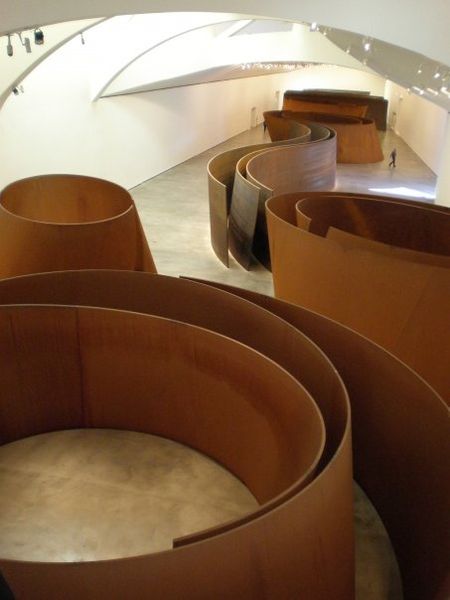
    To some degree this is art for the feet. Serra’s eight sculptures invite you to walk them in sequence. In fact they demand it. How else will you get to see them?

    Thus it takes half an hour to simply cover the ground of this semi-permanent show in the Arcelor-Mittal Gallery here at the Guggenheim in Bilbao.

    It is a large space and the sculptures make it even larger. You trace a path through spirals which appear larger inside than out. You encounter barriers dividing the room.

    All the while, at some atavistic level, you experience fear that one of these forged steel slabs will lean too far in and crush you. Or you experience this as thrill.

    Rusty steel may not be the most eye-catching of materials. But it is hard to imagine more of a spectacle in any gallery than this biggest-ever group of Serra works.

    Those who believe artists must work hard at feats beyond the range of “my three year old,” should be well pleased with this piece of monumental maze-making.

    It weighs about 1,000 tons. Individual pieces have been engineered to the nearest tenth of a millimetre. Their journey from a German forge to the Basque region was epic.

    It is fitting that this gravity-deying consignment came by boat. Serra recounts how as a boy he was taken to witness the launch of a tanker ship in Brooklyn.

    After it slipped down the launch, the watching crowd held its breath as this vessel first sank and then rose to a state of sea-worthy floatation.

    “All the raw material that I needed is contained in that memory,” the artist has said. It is a great story and indeed floating ships and flying planes should fascinate sculptors.

    Visitors to The Matter of Time have two ways of approach this work. They can lose themselves on ground level or take an aerial view from a balcony on level one.

    If anything, the balcony makes Serra’s gallery look even more precarious. To enjoy this takes a measure of faith. And so the material gives rise to the immaterial.

    Perhaps that is the real effect of time on matter: some manner of transcendence, as the 25-year exhibition slowly turns amber with rust and we ourselves go grey.

    These works can be seen at the Guggenheim, Bilbao. Check gallery website for more details.

    contemporary art, fashion, installation art, sculpture, Uncategorized

    Matthew Stone, Propaganda (2012)

    September 18, 2012

    This piece floats on a perilous sea of style mags; they buoy up a marble-effect plinth. Matthew Stone is not cool, he is stone cold.

    But these publications have more gravity than usual. Their covers are stuck to blocks of wood, giving each more permanence than a sheaf of glossy pages.

    A muted printing technique fades and dates the titles (i-D and Dazed), so what they gain in cultural validation they lose in terms of timeliness.

    This is always a trade off. One surely cannot be both hip and profound. The typography and styling which threaten to swallow this plinth have been frozen mid trend.

    And yet those headlines  (“Love changes everything” and “Everything is possible”) may be deep. But they mean next to nothing when packaged up as content.

    Fashion magazines are detached affairs, the last place to go in search of wisdom. But new trainers change everything; everything is possible to those with cash. Too true.

    Stone is said to be a favourite of the titles presented here. So his reification of the hands that feed is brave and yet, oblique; it is hard to say where he stands.

    Some of the magazines are sawn in two up and fixed with hinges. This is surely an act of love as much as destruction. It is as if everything hinges on fashion here, it seems, even art.

    Matthew Stone: Everything is Possible can be seen at La Scatola until October 5 2012. See gallery website for more details.

    Uncategorized

    Photo blog: Toledo, Spain

    September 13, 2012

    Criticismism has just got back from warmer climes. The excuse to visit Toledo was a family wedding. So I headed to Spain for the party and stayed for the El Greco.

    Doménikos Theotokópoulos, the painter known to art history as The Greek, plays a large role in the identity of this historic city. Here is a shot of the outside of his museum.

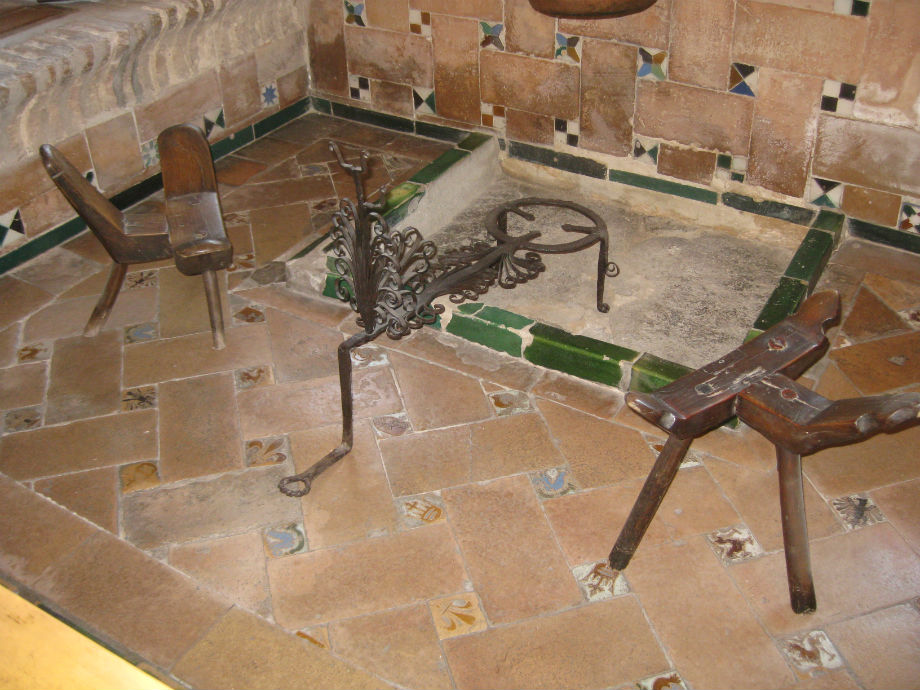
    This institution might not exist were it not for aristocrat Don Benigno de la Vega-Inclán y Flaquer. It was his mission to recreate the artist’s living conditions. Eg; comfy fireside stools:

    After several rooms, I was beginning to doubt whether the Museo del Greco actually had any paintings by its namesake. But in fact a long gallery was given over to a set of the painter’s apostles.

    Here is Saint John the Evangelist holding the original poisoned chalice. According to Christian belief, the poison didn’t kill him. But surely the sight of that evil looking lizard would have put him off.

    There are more of his paintings in Toledo’s cathedral. Catedral Primada Santa María de Toledo took more than 200 years to build and is a superlative example of medieval gothic. See interior…

    But despite its origins in the middle ages, this place of worship is anything but po-faced. As you can see it is full of opulence and includes the cheeriest statue of the virgin you will ever come across.

    Half a day was spent hunting for Toledo’s Museo del Arte Contemporaneo, but in a sign of the times it has closed down. Fortunately, the Museo de Santa Cruz, across town, was open.

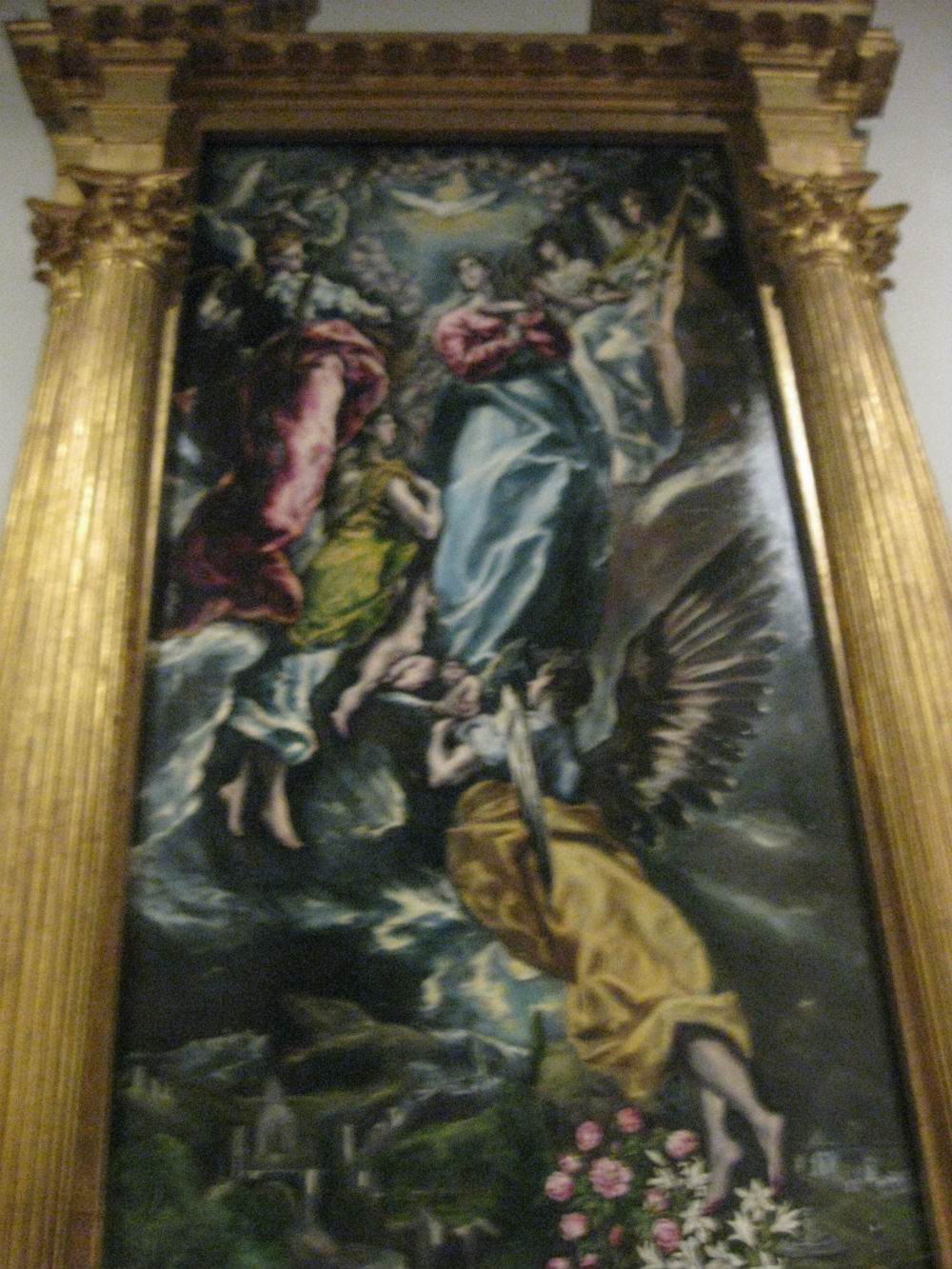
    Yet again, there was a fiesta of El Greco in full swing. Reproductions had not prepared me for this altarpiece, nor given me the chance to get right up close and follow the composition upwards.

    Elsewhere, this may be a bit kitsch, but if I’m not mistaken Ricardo Arredondo has taken realist painting into 3D and HD with highlights made by building up flecks of crumbly paint.

    The Museo de Santa Cruz also gave me the chance to discover Marian Kratochwil. The Ukrainian painter’s agricultural scene pictured here is ten times more psychedelic than it has any right to be.

    Meanwhile, Alberto Sanchez flexes some bronze to make a very Spanish bull with a pronounced prance. While influenced by futurism, this calls to mind Walt Disney rather than Marinetti.

    No visit to Toledo would be complete without checking out the available swords, cleavers and knives available freely over the counter. This CSI-themed shiv was a particular worry.

    Finally, you’re never too young to crusade. Despite the conditions of harmony in which Christians, Muslims and Jews lived for many centuries here, you can now tool up your little ones against jihadis.

    The wedding was excellent, by the way. There were no knife related mishaps, and I managed to tack on a trip to Altamira and Bilbao of which more later.

    excuses

    Hiatus

    September 4, 2012

    Just a note for anyone pondering the meaning of my absence over the next fortnight. Fact is, I’m off on holiday. Apologies for lack of links and posts, but plenty due on my return. Yes, I am going to Bilbao.

    black music, contemporary art, performance art

    David Blandy, From the Underground (2001)

    September 3, 2012

    This film by David Blandy is to my mind haunted by the suspicion culture changes nothing. You can sing all the songs in the world, but you may never be a different cast of singer.

    From the Underground is nevertheless a well rehearsed feat, a perfect lip-synced rendition of one of the Wu Tang Clan’s most hectic and profane tracks.

    And it is an act of daring. Most of us would shrink from the prospect of filming a journey into the depths of the underground, all the while performing an aggravated rap.

    But Blandy is deep in character and maybe this is what carries him through the potential risk of humiliation which seems to come with all performance art.

    Had he filmed this in his bedroom or with less conviction, it would not be half so interesting. You get instead a clash between its North London setting and its soundtrack from a US ghetto.

    And of course, the artist is white, the music black. You might say Blandy is very white, in a nerdish sort of way. While gangsta rappers are, for better or worse, another racial stereotype.

    But the artist’s youth is important too. This is a very early work by a performer and filmmaker whose latest work Anjin is a many layered and more deeply resounding piece of anime.

    In the intervening years Blandy has fully assumed a wide range of personae. Yet the man who introduced his own show on Friday appeared to be neither rapper, nor samurai.

    It brings us back to the suspicion that what we love leaves us just as we were. Our occupation of other people’s creative spaces is, sadly, temporary. I was reminded of this:

    “You’re the sort of person who, on principle, no longer expects anything of anything,” writes Italo Calvino in his remarkable book If on a Winter’s Night a Traveller.

    “There are plenty . . . who live in the expectation of extraordinary experiences: from books, from people, from journeys, from events, from what tomorrow has in store, But not you.”

    From the Underground can be seen at Blandy’s solo show Odysseys, at Phoenix(as part of the Brighton Digital Festival) until 23 September 2012. See gallery website for more details.

    Brighton, contemporary art, galleries

    Farewell Grey Area

    August 29, 2012
    Rostan Tavasiev, Ghost (2008)

    It is oft said things have to get worse before they can get better. And with news of this Friday’s vacation of Grea Area, the Brighton gallery scene couldn’t get much worse.

    In the past, usually after one or two libations, I have opined that quality of life is already good enough here on the South coast. Limited art seems like a trade off for a vibrant music scene.

    But enough is enough. The closure of Grey Area’s will perform a spleen-ectomy on a patient already weakened by loss of, perhaps, wisdom teeth with the recent closure of Permanent Gallery.

    Another promising space closed last year. That was literally called A&E. We are left with a tatty heart (Phoenix), a distracted mind (Brighton Uni) and an echoing ribcage (Fabrica).

    Some of the spirit of Grey Area should live on in nearby Mingus Calypso, perhaps a pineal gland. But the Neue Froth Kunsthalle, as it is also known, is in semi-legal possession of its premises.

    Mingus has taken the bold move to begin acquiring a permanent collection. But without a permanent space, it should prove tricky for them to secure funding and higher profile shows.

    No one ever died for want of an art gallery. But the same could be said of a football stadium. And look how councillors moved heaven and earth to secure funding and permission for the Brighton Amex.

    Since there’s now a bit less to blog about, I hope you’ll forgive me for posting a handful of links to a few past shows. As can be seen, Grey Area was great. Let’s hope it’s back soon in some form.

    Grey Area is having a closing bash this Friday. Details on ArtRabbit here.

    aggregation, contemporary art

    Found Objects 28/08/12

    August 28, 2012

    It’s been an eventful week, eventful in particular for a certain amateur art restorer.

    • Here’s the main story from Art Info, and here’s some of the inevitable meme fallout (link courtesy @sheerinability).
    • And here’s another costly art world cock up, this time by a Norwegian gallery who lost a Rembrandt.
    • Slate discuss the real threat Pussy Riot and others of their ilk pose to the Russian government.
    • Will Gompertz has a new book out. A good new book, if this yarn about Marcel Duchamp is anything to go by.
    • Speaking of Duchamp, Brain Pickings posted audio for a seven minute talk he gave in 1957.
    • Hyperallergic is allergic to the heteronormativity of this artist’s restaging of the Sleeping Beauty fairytale.
    • Paul Kindersley paints himself 67 shades of acryllic on Vimeo. Don‘t worry, he‘ll talk you through it (via @LukeStephensMUA).
    • Philosopher Simon Critchley calls for more monstrosity in art in a digestible piece for the Brooklyn Rail (hat tip @thebenstreet).
    • David Kefford from Aid & Abet in Cambridge is building a poetic collection of mobile photos.
    • This should be art: a New Yorker fakes a celebrity walkabout in Times Square and Animal blog carries the footage.

    aggregation, contemporary art

    Found Objects 20/08/2012

    August 20, 2012

    It has been an eventful week in the world of art. Here’s all the news and more…

    • Pussy Riot become the most famous punk band in existence at a cost of 2yrs imprisonment. Chess grandmaster Kasparov is also a fan.
    • Interesting speculation about the future of an early Picasso. The Guardian weighs up the options of the UK’s leading galleries.
    • The Chapman Brothers will not presumably be losing any sleep about this outcry regarding their Hitler themed crazy-golf hole.
    • Can’t understand why Tate won’t take all of Saatchi’s works. The Telegraph remind us that a £30m gift is still going begging.
    • This would make a great short story: the bittersweet memories of a studio assistant to Jeff Koons.
    • Speaking of assistants, Yukinori Yanagi enlists ants to make an eloquent point about social decay and/or the erosion of power.
    • Frieze magazine have posted a film about brands in art and digital aesthetics. Worth a look.
    • Keith Haring’s journals have their own Tumblr feed now, a very worthwhile project..
    • As promo films go, this is one of the strangest. Hind Mezaina blogs about a male voice choir doing New Order.
    • And finally a bit more music, since Animal Collective are back and their new video is a nightmarish cracker.