<h1>Archives</h1>
    contemporary art, painting, sculpture

    Interview: Corinna Spencer

    May 4, 2012
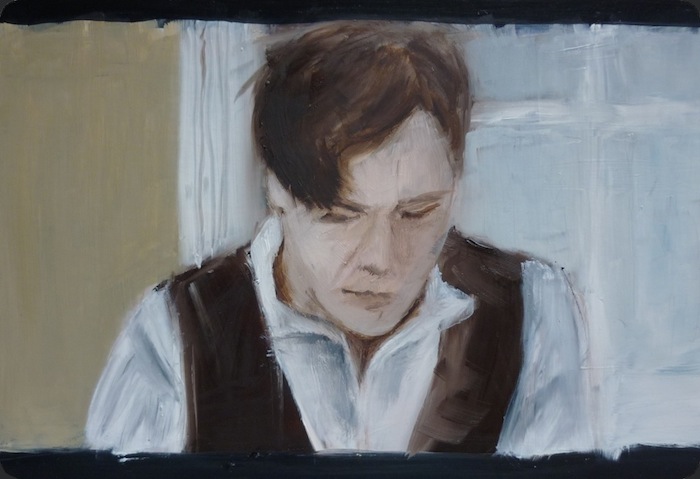
    Corinna Spencer, he listened, 2012,

    New touring exhibition Tainted Love positions itself somewhere between group show and group therapy. Twelve artists have produced work with the theme of obsessive, one-sided love. At least they will now have company.

    “We’ve transformed the gallery with these partitions,” says artist and curator Corinna Spencer, speaking on the phone midway through the installation at Transition Gallery.

    “So everyone’s got their own dedicated space to make their shrine. It isn’t a white box space. We’ve filled it with plywood. Loads of plywood.”

    It is an ambitious project for a first time curator, especially given the touring element. After a stint in London the show moves on to Meter Room (Coventry) and Down Stairs gallery at Brampton House (Herefordshire).

    “That is amazing,” says Spencer excitedly. “Because it’s an old mansion which is now a really gorgeous hotel and it’s in amazing grounds, so that will be quite an event”.

    Obsessional love can take many forms and the show reflects that. Notes Spencer: “It goes from really simple small paintings by me and Annabel [Dover] to people who have installed work and completely filled the space. That was the range I wanted to go for, from really intense to really delicate.”

    Visitors can also expect a range of detachment in treating attachment. “Quite a few people have gone for quite personal stories,” adds Spencer, “but other people have taken themselves out of it, like I have, and talked about someone else’s obsession”.

    One of the more remarkable things about the show in east London is that what brought the participants together was not so much geography as virtual proximity in social networks like Facebook and Twitter.

    “Three of the artists I didn’t know personally, so I was really, really chuffed when they said yes. I sent them an email saying ‘Will you be in my show?’” laughs Spencer. “They sent back emails saying ‘Yes, of course‘.”

    This will not surprise anyone who has come across the affable artist and Twitter user online: “Several people I only met through social networking. I found out about their shows through the network and that’s how I met them.”

    Nevertheless, Tainted Love is also reaching out to people in real life. Spencer hopes to engage art-loving teenagers and hopes to work with local schools during the Coventry leg of the show.

    “The show in general is quite relevant to the allure of celebrity and that kind of thing is relevant at the moment,” she comments.

    “Certainly teenagers will know about becoming an obsessional superfan of something or someone. I think a lot of people have been through that.”

    Her own work is in the show and it was a series inspired by 2007 film The Assassination of Jesse James by the Coward Robert Ford which gave rise to the new show’s theme.

    “That particular film I really loved and got really drawn into the relation between Jesse and Robert,” says Spencer. “Because it was kind of a love story and it turned really quite horrible.”

    She recaps the tale of youthful idolatry and eventual murder and points out: “I thought that was a great starting point for paintings about that kind of obsession.”

    Narrative and worship are two aspects to which Spencer’s intimate, icon-like works on postcards are ideally suited. And she tells me there are distinct advantages to making art on such a modest scale.

    “Sometimes lo-fi stuff is more immediate because you can get it out there quicker and sometimes that’s a bit more interesting,” she notes. Remarkable what you can do with some plywood and a Twitter account.

    Along with Spencer and Dover, the full list of Tainted Love contributors includes Alice Anderson, Kirsty Buchanan, Georgie Flood, Andrea Hannon, Paul Kindersley, Hayley Lock, Cathy Lomax, Alli Sharma, Mark Scott Wood. and Jessica Voorsanger.

    Tainted Love  is funded by Arts Council England and can be found at Transition Gallery until May 27.  See gallery website for more details.

    Uncategorized

    Found Objects 30/04/12

    April 30, 2012

    Quite a newsy Found Objects this week, so hold page 23:

    • German artists threaten to guillotine a sheep if the public don’t vote to save it. Let’s hope it has the X Factor; story in The Telegraph.
    • Larissa Sansour has reimagined Palestine as a tower block. But the Swiss Musée d’Elysée got cold feet, or were just afraid of heights. Story on Frieze blog (via @artfagcity).
    • Although loathe to send traffic to The Daily Mail, this report on the will of the late Lucien Freud is pretty interesting. Assistant David Dawson is set up for life.
    • The above paper would have been less keen on the cost of Yinka Shonibare’s ship in a bottle. The Guardian says the public are paying twice over for the fourth plinth statue.
    • The Telegraph also have an amusing story about a photo of Leda and the swan. Police alarmed about bestiality at The Scream Gallery, Mayfair, were not convinced by the classical allusion.
    • Full Stop magazine suggest that not even art-punk band Pussy Riot can stand up to the might of the Orthodox Church slash government in Russia. (They’ve duly been jailed for blasphemy.)
    • Not what you’d expect from a crochet expert, but Patricia Waller has put together a show filled with favourite childhood characters meeting grim fates. Der Spiegel tells you more.
    • After that, Ed van der Elsken’s 1954 photo series Love on the Left Bank is a real tonic. Check out the amour in this slide show on American Suburb X.
    • Modern Art Notes pod cast brings you an interview with Cory Arcangel and asks the media artist about art history and his earliest gaming experiences.
    • Hudson Hongo.com challenges you to tell Kool Keith lyrics apart from lines by James Joyce. More like this, please… (H/t @ANTIBOOKCLUB.)
    • These might just be the best animated gifs ever. Keep watching to see what goes down in these vintage scenes on Flux Machine (Thanks @WFMU).

    contemporary art, sculpture

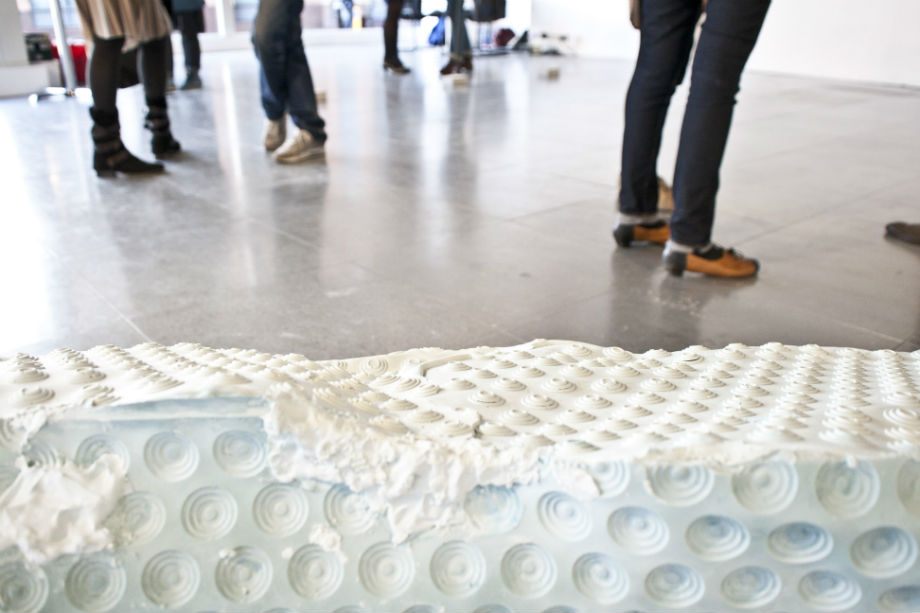
    Vera Kox, If I should loose the reason, can I choose again II, 2012

    April 29, 2012

    This bench-like sculpture is made with showermats. The candy covered suckers draw the eye and hold the attention, so this work could be the most attractive in its show.

    But it seems perverse to pick out one artwork from an exhibition which was all about the interplay between pieces by Kox and her friend the artist Rowena Harris.

    And as you can see from the title, the matted bench was only part II. I could not have told you what was part I. But this is not the kind of show where titles appear to help.

    A discolouration by what looks like bath salts gives this work of visual art a strong tactile appeal, a perceived fragrance, even an imagined taste.

    Comparisons with the concoctions of Karla Black are perhaps inevitable, and no bad thing. Kox‘s sculpture also risks interference from the over eager viewer.

    Happily, I managed to resist sitting on If I should loose the reason, can I choose again II. Just as I have resisted the minor spelling correction and adding a question mark.

    The imperfect title matches the haphazard form and the human scale of the piece. And this was all the sweeter for the more austere pieces nearby.

    This work can be seen in Punctuating at La Scatola, London, until May 4 2012. See gallery website for more details, and check out this write up in Art Review.

    contemporary art, video installation

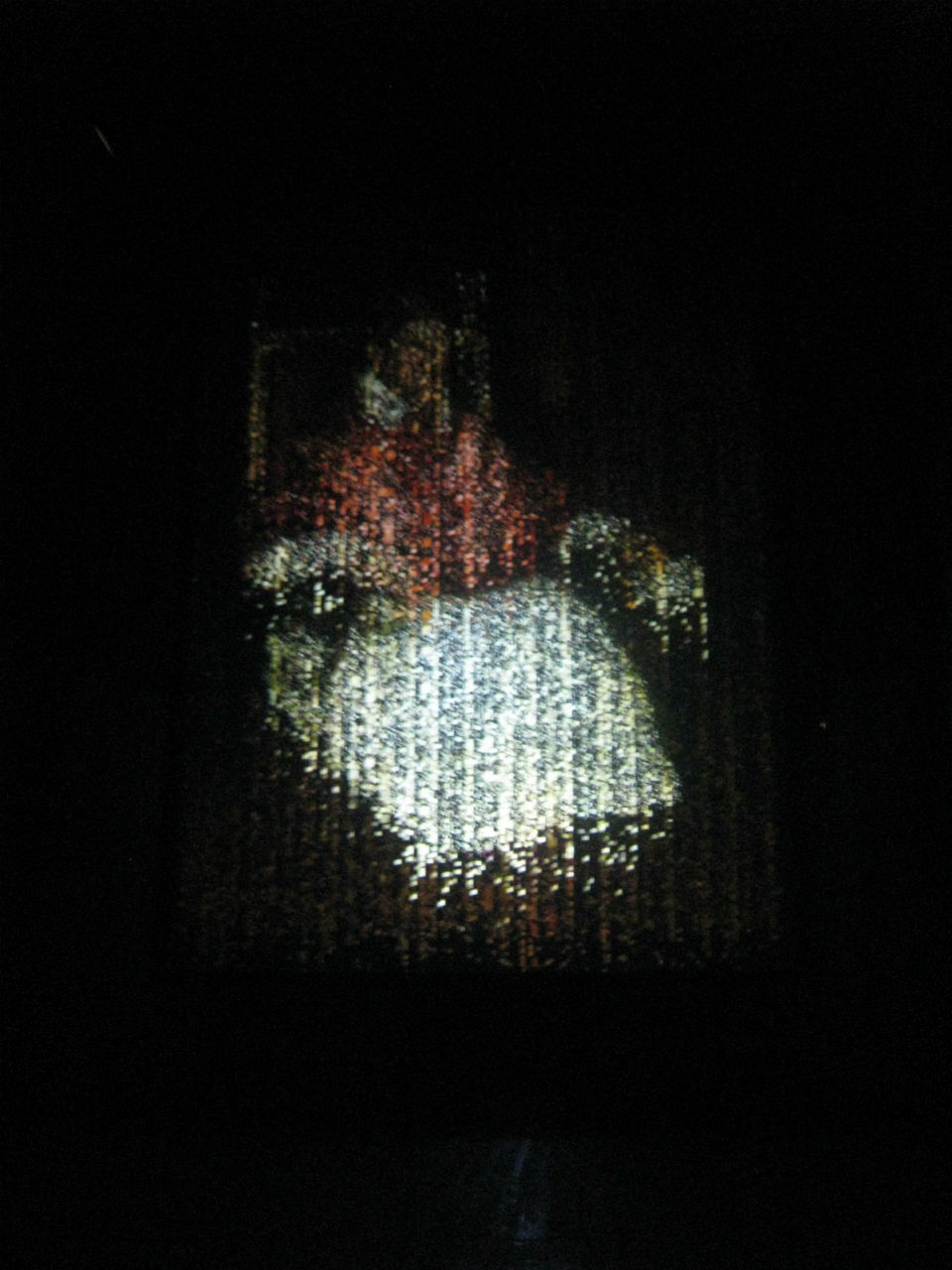
    Matt Collishaw, The End of Innocence (2012)

    April 28, 2012

    One of the more surprising things you might hear about the work of Francis Bacon is that one of his paintings hangs in a museum at the Vatican.

    The work is a study for a better known painting of Pope Innocent X. In the subsequent work his holiness appears in a gold cage screaming blue murder.

    So the inclusion of an early tilt at this piece of critical comment on the papacy gives new meaning to the phrase broad church.

    Both these studies, in which the pope appears in alternating scarlet and mauve can be deciphered in a blizzard of pixels, thanks to a new digital piece by Matt Collishaw.

    The scale of the work, its silence, and its stillness put one in a suitably reverential mood. Never mind the fact that Dilston Grove is also a former mission chapel.

    But Bacon was no altar boy, and this interpretation of his best known work is not even that faithful. The popes disintegrate and coalesce before your eyes.

    At times the 10ft screen is just a blanket of streaming information. Is the pope even there in the background? That’s perhaps a question about faith in the digital age.

    The Vatican has bought up plenty of modern art, but they cannot control their image. That has been eroded by an algorithm (here) or by an abuse scandal (everywhere else).

    Yet Collishaw’s work is more meditative than blasphemous and to be sure it deals with art history first and religion second. One assumes you can separate those terms.

    The End of Innocence brings to mind La Nona Ora by Maurizio Cattelan. The Italian sculptor has put a more final end to things by crushing Pope John Paul II by a meteor.

    It also recalls another controversial papal statue by Oliviero Rainaldi. This was never intended to be satire, and so met with criticism all the more fierce. Maybe the piece in question here could replace it.

    The End of Innocence can be seen at Dilston Grove, London, until 27 May. See gallery website for more details.

    contemporary art, Uncategorized

    Found Objects 23/04/12

    April 23, 2012

    Another frenzy of links from the last seven days:

    • Is anyone using Artstack yet, or is everyone using it already? *panics* Whatever the case here’s an enticing primer from the Guardian.
    • As a victim of procrastination, I love this curated twitter stream by media artist Cory Arcangel: wrknonmynovel or “working on my novel”.
    • Daily Serving have published an artful tour of sidestreets in Gracia, Barcelona, where street artists rub shoulders with George Orwell.
    • Orhan Pamuk argues against the world’s grandest museums. Relax, he’s not anti-museum; the Turkish novelist just has issues with scale.
    • There’s a sobering collection of sadly timeless execution portraits (from late 1970s Cambodia) on Amercian Suburb X
    • The New York Times has been running a great series called An Art Critic in Africa. Here are one or two dispatches about ritual dance and mosque conservation from Mali.
    • In an interview with The Independent, Karla Black reveals what children think of her monumental yet fragile art.
    • The irrepressible Jeremy Deller tells the BBC about his project for Glasgow International, an inflatable Stonehenge entitled Sacrilege.
    • Needless to say, he’s nothing like any of the so-called artists in this 30-minute montage of the breed in television over the years. Essential viewing.
    • Finally, Animal NY posted a rendering of John Cage’s 4’33”, comprised entirely of silences from the films of Nicholas Cage. Of course they did.

    contemporary art, Cultural Olympiad, London 2012, Uncategorized

    Art in the Cultural Olympiad, London 2012

    April 19, 2012
    Shauna Richardson's Lionheart project in the East Midlands

    It is the largest cultural celebration in the history of the modern Olympics, but you could be forgiven for letting the 2012 Cultural Olympiad pass you by so far. And if it conjures images of community dance projects and corporate sponsors holding up giant cheques at photo calls, you may be trying to ignore it altogether.

    But the figures are hard to dismiss. More than 16 million people are said to have been in or around performances so far and, between June 21 and September 9, the London 2012 Festival will give people 10 million opportunities to see events billed as World Class.

    If you hail from East London or perhaps even Middle England, the Olympiad seems to be reaching out to you. But no one is too urbane for this festival of inclusivity. Just by attending, say, David Hockney at the RA or Damien Hirst at Tate Modern, you will have taken part.

    Indeed, the cultural jamboree has co-opted numerous exhibitions taking place around the UK. And these range from the highly accessible (such as Paul Cummins’ roving English Flower Garden, made from 15,000 ceramic blooms) to the leftfield and arty (for example, Helen Petts’ Kurt Schwitters inspired show in Newcastle/Gateshead).

    The latter is co-ordinated by a project known as Unlimited, which is mainly “funded by the National Lottery, through the Olympic Lottery Distributor and is delivered in partnership between London 2012, Arts Council England, Creative Scotland, Arts Council of Wales, Arts Council of Northern Ireland and the British Council.”

    And as this quote suggests, the Olympiad is an umbrella term for the work of a wealth of funding bodies, arts organisations – and corporate partners including BP, together with BT and Panasonic.

    The festival also breaks down into six thematic programming strands, which in turn break down to regional projects organised by a plethora of smaller arts organisations. London may be the focus but the structure reaches out across the UK.

    A reported £97 million is said to have been spent on cultural events since 2008. Set that against the conservative £12 billion estimate for the games themselves and the mounting costs of security (already said to be £553 million), and the cost of bringing in culture for the feelgood factor is a bargain.

    You could argue the more money involved the less artistic licence there is to go round. Projects that celebrate Britain, the Games, community have been onto a winner for the last four years. Projects that critique big business, the security arrangements, or the incumbent government are naturally less thick on the ground.

    This does raise questions about the function of art. Perhaps in its origins on the walls of various caves or in the apse of various churches, art was a focus for celebration.

    But since the 20th century, at the very least, it has more often made a point to shock, resist, question and explore. None of which would play that well at a street party or a village hall.

    Artists Taking the Lead sees nine regional spectaculars, including a knitted lion in Nottingham, a puppet Lady Godiva in Coventry and a column of cloud on Merseyside. These may well scare the odd small child, but they are hardly likely to frighten the horses.

    One artist meanwhile makes a point about climate change by towing a small island from the Arctic around the South West coast. Critics would point out the Olympiad’s PLC partners.

    No less problematic, in its way, was the decision to enlist 12 contemporary artists to turn their hands to poster design to come up with a dozen images for both the Games and the Paralympic Games. Results were mixed, but did offer a chance for the ‘that’s not art brigade’ to get on board.

    They should also be out in force when the four public sculptures commissioned by Frieze go up at sites near to the Olympic Village.

    To be fair, visual arts were never going to be top of the agenda for a programme of universal social engagement. The London 2012 Festival, for example, advertises its wares as “dance, music, theatre, fashion, food, art, or film.”

    Seeing this, artists will soon learn their place in the pecking order. In fact it’s a surprise they come before film.

    Without doubt music and dance will be the star art forms over the coming months. Music doesn’t need to be edgy to be interesting. It can be, for example, be based on the rhythms of a train or a table tennis game and still put a smile on your face.

    But neither art nor music can compete with geography for the most inclusive element in the Cultural Olympiad. One strand of activity is called Discovering Places and this challenges the public to find local hidden gems, 2012 species of flora and fauna and places which relate to all the competing nations.

    It is unpretentious, inspiring and, dare one say, quite sweet. Artists don’t appear anywhere. Who needs ‘em?

    aggregation, contemporary art

    Found Objects 16/04/12

    April 16, 2012

    More links to edify and entertain:

    • Plimack Mangold demonstrates you can stay at home, paint and still be conceptual. That’s what gets so well argued in this essay by John Yau on Hyperallergic (Parts one, two and three)
    • Everyone’s favourite least-favourite art critic now has his own two part sampleboard on a website dedicated to his glory.  Recommended with some abstract beats.
    • It’s more than a week since Thomas Kinkade died, but Art Fag City summed up his lack of appeal with epitaph-like brevity.
    • It turns out Columbia is the place for a rise and fall in visionary urban planning. I wonder which London mayoral candidates have been to Bogota or Medellin yet.
    • Just when you thought you’d heard every Werner Herzog anecdote, a new interview opens with another classic.
    • Sorry for the Guardian overload, but Zoe Williams writes most entertainingly about the coming sale of one of Munch’s Screams in Sotherby’s London.
    • C-Monster treats us to a photo diary from the a new show of pre-Pharoanic Egyptian art at New York’s Metropolitan Museum.
    • Also from NYC here’s a slideshow from the NYT: Kraftwerk. Their residency looks every bit as amazing as you know it will sound.
    • Eyeteeth tantalises with news of a photographic project from around the tattered edges of the French presidential race.
    • This blog post ends with a bang and not a whimper today. Check out this performance by Cai Guo-Qiang at MoCA, LA.

    contemporary art, net art, performance art

    Eva and Franco Mattes aka 0100101110101101.ORG, Freedom (2011)

    April 14, 2012

    Freedom from Eva and Franco Mattes aka 01.ORG on Vimeo.

    In the terms of the ongoing wars, there is really only one side you or I can be on in the infiinte struggle between freedom and tyranny.

    But Eva and Franco Mattes have questioned the extent of that freedom, with a novel approach to playing networked console game Counter-Strike.

    With Eva at the controls, the pair have found themselves in a virtual town somewhere in the arab world, dealing with an endless parade of heavily armed American gamers.

    She too has the right to bear arms, as you would expect the genre of this game. And so we view the landscape from behind the barrel of her revolver.

    Yet she looks for all the world like a terrorist (certainly not a freedom fighter), and she uses a real time messenger window to plea for clemency on the grounds of being an artist.

    “Please don’t kill me,” she says time and again. “This is a performance art piece.” But she doesn’t survive long. There are limits to what you can get away with in a war zone.

    “You don’t want to be in this game. Go and play in paint,” suggests one of the counter-insurgents. One other, sounding for all the world like half of Beavis and Butthead says “Shut up, Matisse.”

    The title of the piece, “Freedom” is a rallying cry dropped by US soldiers running by in the distance, before he turns to gun down the immobile artist. It is too perfect.

    But as Eva asks at one point in the game, “What are we doing here?” At time of writing 54,000 people are currently playing Counter-Strike.

    That is only 14,000 less than the total number of real troops in Afghanistan. What can it mean that so many people are waged in an invisible war from the bedrooms and front rooms?

    There is total moral freedom in these environments. Bullets are scattered left, right and centre. Compared with the gunshot in this earlier performance piece, the results are total bathos.

    Freedom can be seen in Anonymous, untitled, dimensions variable at Carroll/Fletcher, London, until 18 May, see gallery website for more details. For my review of the whole show on Culture24, click here.

    aggregation, contemporary installation

    Found Objects 09/04/12

    April 9, 2012

    For no real reason, this week is a Bank Holiday special:

    • It’s always good to hear what the animal world might have to tell us. Guardian chats with their spokesman Marcus Coates (via @LizzieHom.)
    • Beverley Knowles writes up a pleasing memory feat and takes in art, human rights and, emo. Intrigued?
    • 90% of guns seized in Mexico were made in the US. This should be the subject of legisation; in the meantime there’s an art show.
    • Brian Dillon captures the light but cosmic touch of artist Katie Paterson in an essay on his blog Ruins of the 20th Century.
    • Read about artist and blogger Jon Perreault’s growing dislike for Clyfford Still. (He is ‘still’ inspired to put forward plans for his own civic museum.)
    • Art Observed posts about a new show of photos by Cy Twombly at the Palais des Beaux-Arts, Brussels. Goes without saying they are painterly gems.
    • Pipe blog also runs with some photos from an installation by David Hall at Ambika P3 , London. There’s a very interesting account of the show to boot.
    • Last photo story of the week is an essayistic look at East London’s docks by Phoenicia on the Rightness of Wayward Sentiment blog.
    • Is it too late to wish you Happy Easter? Either way, this post on Another Design Blog is a bit of a perennial bonus.
    • And for those of you still off your face on chocolate, here’s a full stream of the new Spiritualised album (via @ArtCasual)

    contemporary art, contemporary sculpture, installation art, YBAs

    Damien Hirst, Lapdancer (2006)

    April 8, 2012

    If needing just one word to sum up Damien Hirst at Tate Modern, you might resort to some made up slang invented for a work of dystopian fiction.

    The violence of his killed and pickled animals is horrorshow, as is the vitrine pictured. Real horrorshow, the ultimate accolade for gang member Alex in A Clockwork Orange.

    Lapdancer packages up a world of medical pain in four glass shelves of surgical tools. There are saws and knives you want to hope you never encounter outside the gallery.

    But as the title makes clear, there is an erotic attraction with the apparatus of death. Or perhaps it is the death drive which in turn draws men to lap dancing clubs.

    Whatever the lure, one cannot but reflect that our own final days may feature some of these tools. En steely masse, they reflect the power in a pair of surgeon’s hands.

    They also reflect the apparatus of medical knowledge. By shipping a room full of surgical tools into a gallery, Hirst throws the authority of science into question .

    Like the earlier work Pharmacy, Lapdancer allows for art historians to scrub up and begin to operate on the assumptions of modern science.

    That’s not to say that if you break a leg, you should go to a gallery for treatment. But there is a creeping sense in which medicine serves its own ends with proliferating diagnoses.

    But this piece also reminds us that medicine and art have long been close. The mastery of figuration could not have been achieved without dabblings in anatomy.

    Hirst himself spent some formative years drawing in the anatomy department of Leeds Uni. And he is not the first artist to bring the operating theatre into the gallery.

    One has to ask though, is Lapdancer clinical enough? Those serrated blades will give you chills. In front of this work itself, your critical faculties all desert you. Mine did. It was horrorshow.

    Damien Hirst runs at Tate Modern until September 9. See gallery website for more details. And see this Brian Dillon review for a great analysis of the numb shock value present in his work.