<h1>Archives</h1>
    contemporary art, performance art, philosophy, video installation

    Plastique Fantastique, Impossible Diagrams

    May 27, 2011

    What to make of a flicker between a bandaged head and a face carved in a brieze block. Or an unshaven mouth which hi-jacks a news report. Or self-immolation illustrated as if for a kids’ book.

    Quite a bit happens in the Plastique Fantastique show at Grey Area. Not all is easy to describe and even less is easy to interpret. The entertainment above is on a reel called PFTV.

    On this channel a masked and spangly demon pops up, curses us, and with a voice garbled-by-vocoder intones: “There is not and never has been anything to understand.”

    It transpires Plastique Fantastique are into the philosophy of Deleuze and Guattari. The love of nonsense and invention of mad schemas with which to overlay reality may come from there.

    So a nearby video installation breaks down PFTV content into idiot-proof diagrams. Captions such as “You taste the object/ The object tastes you,” are still stupefying.

    Still, you should never dismiss the incomprensible. Two Plastique Fantastique performances, documented here, the ritual punishment of a victim by a band of futuristic savages.

    Hanging the man from his feet may be aim at inverting the status quo. But if not, these scenes still feel urgent and deep in meaning. It’s a feeling; there may be no point understanding it.

    Impossible Diagrams is at Grey Area, Brighton, until May 29. See gallery website for more details.

    Uncategorized

    Simon Faithfull, Limbo (2011)

    May 25, 2011

    In April this year the story broke that now ubiquitous iPhones and 3G iPads are recording details of everywhere their owners go, storing locations and timestamps on a secret file.

    This may not be a conspiracy, but it would seem to be one more step towards a transparent world in which privacy belongs to a halcyon past before surveillance technology and the world wide web.

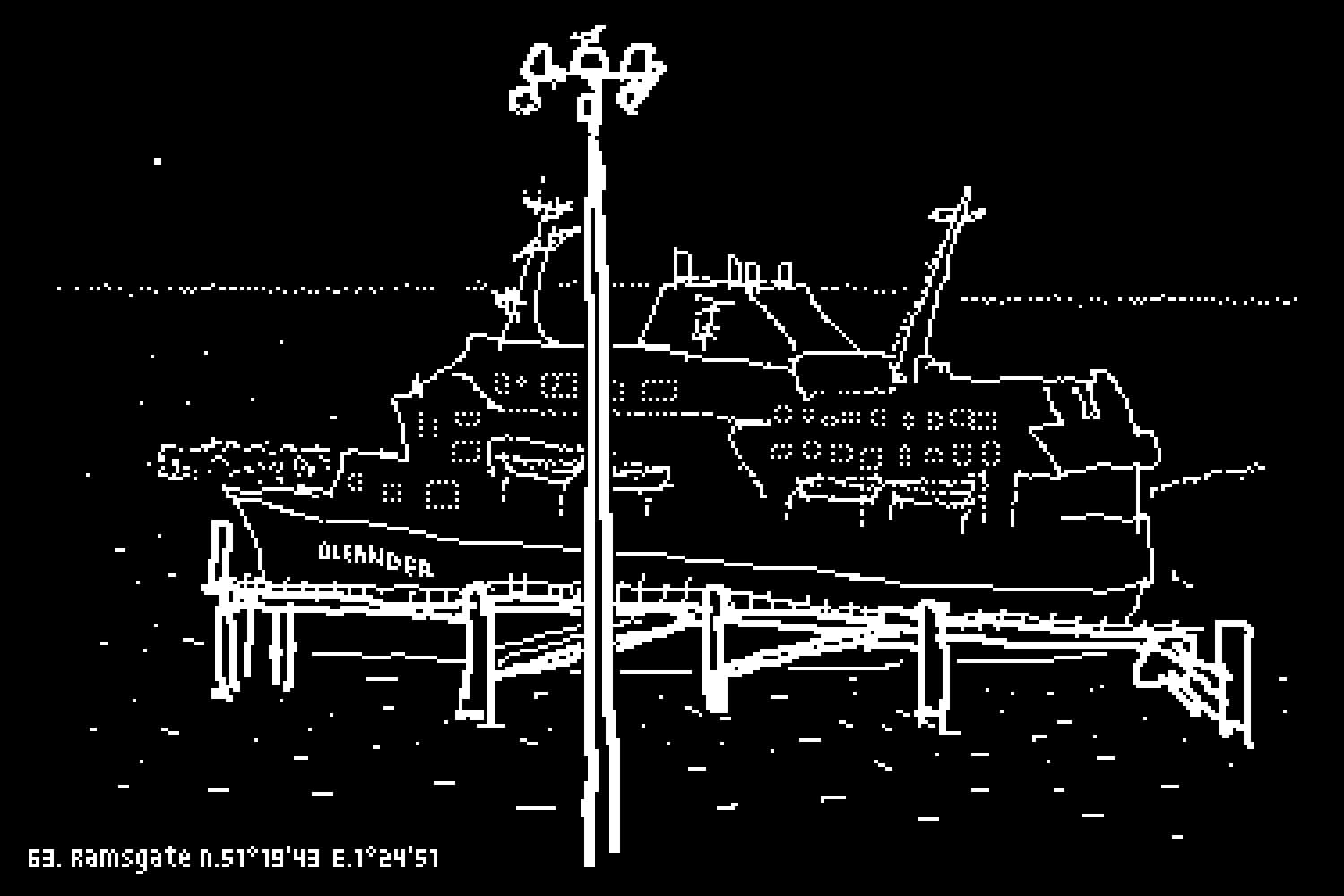
    But Simon Faithfull’s 10-year long project is located squarely where satellite positioning meets the mobile internet. Above you can see a rare example of a drawing with a geotag (bottom left).

    That’s what you might expect from a photo. And imaging technology also has a role to play in the laying bare of our lives. 1.85m CCTV cameras in Britain. Nearly 100 billion photos on Facebook.

    Considered together with Google Earth and Street View, this does appear to be a mad accumulation of empirical data. But the science of omniscience does have one major blindspot: subjectivity.

    Faithfull calls web-based artwork “an expanding atlas of subjectivity.” Unlike previous atlases, this one will therefore be infinite as no two viewpoints can really be the same.

    Nor can they be exhausted. The artist has stuck with the drawing software of an early Palm Pilot. It leaves wide empty spaces. It falls so far short of realism as to leave plenty to the imagination.

    And here is a perfect vessel for dreaming. Faithfull has just completed a four day residency on this cross channel ferry, giving it a mystique which even a sketchbook may have failed to.

    If you have an iPhone you can download a Limbo app and get fresh drawings from anywhere in the world. These too are secret files, clear if you experience the world, but invisible to your digital device.

    Limbo is the second 2011 web commission from Film and Video Umbrella. Check out some more of the drawings and get the app on the project website.

    British art, contemporary art, installation art, sculpture

    Mike Nelson, The Coral Reef (2000)

    May 18, 2011

    You are in the HEROIN ROOM. You can see: a painting, a broken chair, a lighter and some tin foil. There are exits: SE, SW. What do you want to do? _

    That’s not meant to be the worst dropped intro ever written, but a faithful reproduction of the game-like dynamics of one of Mike Nelson’s most labyrinthine works.

    Because for visitors of a certain age, making their way through the 14 rooms here is reminiscent of the text-based adventures which came on 80s computers. What do you see? Which way next?

    The video game experience seems fully intended. Somewhere near the heart of The Coral Reef is a vintage arcade machine, an obscure platformer called Black Magic.

    And there is something magical about the way you can interact with this work, and certainly something dark about the world which Nelson has created. Yet it’s as comic as pixels and bleeps.

    These days, seventh generation console games let you explore virtual worlds in ways we could not have dreamed of. But none compare with Nelson’s sculpture for potential suspended disbelief.

    So this blogger even went so far as to spend 15 disoriented minutes making a map. It looks a bit like a medieval mappa mundi, and it does contain spoilers, but get in touch if you’d like a pdf.

    All I can say is it was a shock to find so many political, religious and cultural extremists were living in such proximity. If we can get lost in a sculpture, we stand no chance in the world at large.

    Find out why Jonathan Jones said this work was “one of the true masterpieces of modern British art” by reading his 2010 blog post in the Guardian. Meanwhile Art Safarist Ben Davis rates Nelson’s chances of winning a Golden Lion at Venice this year.

    Unsurprisingly, this is one of the most blogged about pieces of art I have come across. For some good photos, check out Corinna Spencer’s.

    The Coral Reef can be seen as part of Tate Britain’s current display of Contemporary Acquisitions. And the gallery advise you to check it’s on view before visiting (or you could live dangerously).

    contemporary art, drawing, installation art, transgressive art

    Maxime Angel, Let My Eyes Be Your Mirror

    May 17, 2011

    From the pencil shavings and strewn magazines on the floor, it looks something like Maxime Angel has been living in the gallery. Indeed, there are reports she has slept on several works.

    She may even have slept inside the containerboard on the wall. The gallery assistant tells me the college-trained artist was also for a period of time a rough sleeper. Cardboard was canvas.

    Other details suggest Maxime is not exactly the girl next door. Visitors are confronted with the dark energy of a range of illustrated cocks and may spot two graphic all male orgy scenes.

    A spot of (desk) research confirms the artist is transgender, and HIV positive. So the lead-blunting skulls here are not just for effect. The memento mori have been lived in as well.

    Take away the biography and you would still have a show with charge. What it might lack in imagination and finesse, it makes up for with desire and suffering. No press release needed.

    But the life story will still impress. Angel sounds like an outlaw. Her exposure to life on the streets and a deadly pandemic are among factors which might just authenticate this work.

    Otherwise, it could still be said the show is a worthy example of an artistic tradition which dates back to the Salon des Refusés. It is powerful either way; too strong if anything.

    Let My Eyes Be Your Mirror is at Centre for Recent Drawing, London, until 17 June 2011. See gallery website for more details. There’s a brief but interesting Q&A with the artist in Dazed Digital.

    aggregation, contemporary art

    Found Objects 15/05/2011

    May 15, 2011

    We’ve had seven more days of neuron-firing stories on-line, including:

    • Scientists told the media that art can boost dopamine levels. But can it also give you the munchies? (from The Telegraph)
    • On artnet, Ben Davis considers the Vatican’s decision to put the Sistine Chapel online and asks how they can get their heads round Flash but not gay rights, etc.
    • In the Guardian, Jenny Uglow writes about the peaking popularity of the Lake District. Art seems to have only served to wreck the place.
    • And some say that kaleidoscopic building exteriors are out of control in Baghdad. The New York Times reports, but there are worse things surely than an ‘anarchy of taste’.
    • Formerly homeless Maxime Angel has good reasons for working with cardboard as Laura Bushell finds out on Dazed Digital.
    • Hyperallergic carries a picture of the painting that’s waited 25,000 years to come back into fashion.
    • Whereas, milliseconds are ‘almost leisurely’ in the brave new world of automated trading. Donald MacKenzie writes a startling account of this mind-boggling practice in London Review of Books.
    • Pictures probably do more justice than words to the latest work by Anish Kapoor. The Independent obliges, but (at time of post) cannot seem to decide how to spell Leviathan.
    • Film-maker Harmony Korine makes a film about curb dancing that’s both parody and celebration. For a less surreal example of the genre, Cf. this clip (Via Animal NY).
    • Perhaps one day I’ll see a meme like this in my pending comments folder. Slate offers a reason to keep it brief.

    architecture, contemporary art, film installation, Middle East, sculpture

    KutluÄŸ Ataman, Mesopotamian Dramaturgies / Mayhem (2011)

    May 13, 2011

    KutluÄŸ Ataman has got into the spirit of the Brighton Festival with a carnivalesque metaphor for the recent turmoil in the Arab world: a waterfall which defies gravity.

    (This reading of Mayhem needs its full context, a series named after a region encompassing Iraq, Iran and Syria. And nearby here is another piece (Su) in which Islam is a more explicit theme.)

    But the relative safety of an art space in the West, gives us some distance from this drama. Like a television with the sound down, Ataman’s film cools off the spectacle of unrest.

    Indeed water is used often in Islamic architecture for this very purpose: to keep occupants cool. Three of the channels are projected onto the floor like pools in a mosque.

    In a visual sense, this is a monumental feat of plumbing. The work offers a strong contrast with the vast disused space of the Old Municipal Market and its dusty concrete floors.

    And at the risk of wearing out his name, Duchamp did once say that plumbing was the difference between sculpture and architecture. His fountain and Ataman’s both play with that distinction.

    But only a sculptural film installation could harness the power of the Iguazu Falls. This wild South American region is also called Mesopotamia. But which one is the newer world?

    The Old Municipal Market is on Circus Street, Brighton, and the show runs until 29 May 2011. It’s organised by Lighthouse. See their website for more details.

    contemporary art, religious, renaissance, sound art, Uncategorized

    Janet Cardiff, The Forty Part Motet (2001)

    May 11, 2011

    When a gallery is a deconsecrated church and the artwork is a piece of religious music, walking in is a hair’s breadth from turning up for Sunday worship. It’s humbling, even humiliating.

    The early choral work, Spem in Alium by Thomas Tallis, is drawing people in off the street, nevertheless. This is one church that’s full. The only people lacking are clergy and choristers.

    Instead 40 state of the art speakers surround the ad hoc congregation. They are placed at person height and a different voice from Salisbury Cathedral Choir can be heard on each.

    Were this a live performance, it would feel even less like art. Empassioned song fills the gallery, but the singers are absent. Their lack of presence is the most engaging aspect of the piece.

    The choir is an effect of technology so perhaps God is just an effect of such choirs. He and they are both here and not here. It depends whether or not you close your eyes.

    But the voices are in layers, so there is something fathomless about that question. And the several parts of the composition can surprise you. Phrases come at you from different angles.

    Cardiff has said she wants this to work to explore the ways in which sound can structure a space. It can certainly dominate a place and resonate with a building’s original function.

    So, walking in is strange. And as notes here point out, the experience is intimate. We are, one supposes, naked under the eyes of God. Hence a bit of embarrassment.

    There’s little choice but to join the flock and accept the embrace of this work. But getting out of church is still a relief. Weddings, funerals, ecclesiastical art shows, you name it.

    There are plenty more voices offering counterpoint to this. Classical music blog An Overgrown Path has specced out the audio equipment. Todd Gibson on From the Floor found it emotional.

    Dugal McKinnon’s blog, meanwhile, offers a compelling analysis which spells out the transcendental qualities of the work and goes much further on the theme of presence and absence.

    The current show at Fabrica runs until 30 May 2011.  See website for more details.


    aggregation, contemporary art

    Found Objects 08/05/2011

    May 8, 2011

    Some favourited links from the last seven days:

    • Big news of the week. Osama Bin Laden may have been a frustrated architect? Steve Rose builds a case in the Guardian.
    • The Telegraph reports Art dealer Philip Mould was victim of a poison pen campaign. When it was alleged that he couldn’t afford a painting, that was the final straw.
    • The colon “is not intellectual super-glue”. Just one of the insights in this untitled piece about the titles of art shows (from Frieze).
    • In Modern Art Notes, Tyler Green has so much to say about Lewis Baltz, his review runs to more than 2,500 words. But all of it is vital, so find it here (Part 1) and here (Part 2).
    • In a GQ interview, Chris Heath plays up the crazier aspects of director Werner Herzog’s life and work. This does however make for a good read (via @Jeff_Sparrow).
    • No one uses the C-word quite so well as Tracey Emin, according to novelist Ali Smith in the Guardian.
    • Jeff Koons cares so much he appears to wheel around his sculptures on hospital gurneys. Here’s video evidence.
    • Some street art which gets to the point.
    • An REM video directed by Sam Taylor Wood captures that iPod feeling (via @FisunGuner).
    • After listening to that, you may need to listen to this (via @edgeofchaos999).


    20th century artists, abstract painting, chance, watercolour, Zen buddhism

    John Cage, River Rocks and Smoke 4/11/90 No.1

    May 6, 2011
    John Cage, River Rocks and Smoke. Courtesy The John Cage Trust

    The universe, it seems, has good taste. Here is a painting it did. Or rather, here is a painting John Cage allowed to happen, letting the I-Ching direct his brushstrokes if true to form.

    Observe the wispy sfmuato effect, created by students with burning straw. Look at that delicate use of colour and the almost Assyrian shapes, each one traced round the edge of a stone.

    You could hang this on a wall and feel a deep oneness. Or you could marvel at the process involved, the radical shift towards egolessness.

    Either way, it is great in theory. You don’t even need Cage for this. You could leave a sketchbook out in the rain or scatter blossom on an adhesive canvas. That too would be pretty.

    Of course, Cage is pushing at the boundaries. Perhaps he is saying we don’t even need artists, in the same way it seems he once said we don’t need composers. Perhaps we don’t.

    But surely life is not a zen garden. It seems more like a game of chess. Chance dictates which side we are on and then we need to attack and defend. Aimlessness is not often the best approach.

    Cage apparently loved chess, but he wasn’t the world’s best player. It is said friend Marcel Duchamp was known to lose all patience with him for making silly mistakes.

    Of course, the I-Ching paintings may have been an ! move in chess terms, threatening bishops and laying siege to kings. Except Cage is so light-handed, he hardly touches his pieces.

    John Cage: Every Day is a Good Day is at De La Warr Pavilion, Bexhill-on-Sea, until June 5 2011. See gallery website for more details. Read my review of the show at Culture24.