<h1>Archives</h1>
    redevelopment, studio/gallery space, Uncategorized

    Interview: David Litchfield, Development Manager at Phoenix Brighton

    March 18, 2010
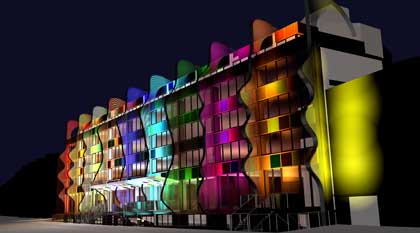
    How the new studios, gallery, café/bar and shop could look at night

    The largest artist-led arts organisation in the South-East of England aims to get bigger, or at least better.

    Phoenix Brighton, which currently provides studio space and a gallery for 100 artists, last week announced plans to revamp their city centre building at a projected cost of more than £2 million.

    Development Manager David Litchfield hopes that a new entrance way, façade and lift will all help open up the building to wider audiences. A refurbished gallery, new café, shop, and workshops are also planned inside.

    While the “core purpose” of Phoenix remains the provision of affordable studio space, Litchfield is pragmatic when it comes to finances, admitting the building needs to generate new income to ensure its long-term survival.

    A recent programme of public events, including annual jumble sale Art Junky, one-night festival White Night and experimental evening Factory have allowed the energetic director and his team to road test their vision of developing a visual arts hub in Brighton.

    He claims 90,000 cars pass Phoenix on their way into the city every day. “The building has a real opportunity not just to announce the fact that it’s a creative centre for the arts, but also to welcome people to Brighton, to be symbolic of the arts activity here,” he adds.

    A slightly larger gallery with better specifications should attract high profile exhibitions with a focus on working process, reflecting the organisation’s main raison d’être.

    “We want it to be a place where artists can come and explore and experiment,” says Litchfield.

    “We want that to then extend out to the public so that they can come and engage with that working process to get insights into how artists think and work.”

    The shop will be a place where artists can sell their work, with the adjacent café/bar a place where they can meet. Late openings are planned at weekends alongside an events programme including curated talks, visiting artists, performances, music, installations and a curated film programme.

    Development will be tailored to the needs of the building’s studio users. “It’s very easy to take an architect’s drawing and get the builders to build you a café/bar,” says Litchfield.

    “You could get something that looks like it’s come out of an airport or a hotel, and that’s kind of not evocative of the Phoenix spirit,” says Litchfield.

    Instead he has involved the artists in choosing colours and materials and designs. This, he says, will not only provide both a feeling of “ownership” and a “sense of continuity about Phoenix and what it is.”

    But because the organisation has a 17-year history of independence to maintain, they face a challenge in terms of financing most of the planned work themselves.

    A sizeable chunk of funds could, pending the approval of Brighton and Hove City Council, come from an advertising hoarding on the building façade, raising £500,000 during the four-year course of the project.

    More revenue could come from the ground floor redevelopment, in which the café, shop and workshops, together with a commercial letting space, could generate £50,000 a year over and above the rent from fully-booked studios.

    For the rest of the funding, artist-led Phoenix will be looking for business partners. But the temptation to cash in on their real estate – the organisation bought the building with help from a Council grant in 1993 – would be “completely wrong”, argues Litchfield.

    The motives behind starting Phoenix have informed every stage of the redevelopment. “It is a provider of affordable studio spaces, out of which flows a gallery, out of which flows a desire to engage with our audiences,” he reflects.

    The building’s all-important residents range from painters and sculptors to filmmakers, wood and metal workers, curators and performance artists. They’re “generally extremely supportive”, according to Litchfield.

    “It’s exactly where they want to see Phoenix going,” he says. “I suppose because of that, we actually might be able to make this happen.”

    Written for Culture24.
    Artes Mundi prize, contemporary, drawing, installation, photography, video

    Feature: Artes Mundi Prize at National Museum Cardiff

    March 18, 2010
    A Moscow museum, photographed by shortlisted artist Olga Chernysheva

    The UK’s biggest art prize, Artes Mundi, is vying to become the most talked about. At £40,000 it is worth twice as much as the Turner, which should provide twice as much scope for controversy.

    While installing work by shortlisted artists at National Museum Cardiff, the organisers make clear their intent. “We’ve taken down a Madonna and Child from the 1600s and put in an LCD screen – we are very pleased with that,” says Director Tessa Jackson.

    It now shows the work of film maker, photographer and painter Olga Chernysheva, one of eight international artists contending for the prize. Chernysheva is from Russia, her competition from Peru, Israel, Albania, Bulgaria, Taiwan and Kyrgyzstan.

    Jackson points to this worldwide range as the main difference between the fourth Artes Mundi and the annual hoopla of the Turner award. “The Turner prize is very focused because it’s British. It’s every year. It’s a constant search,” she says.

    Artes Mundi, by contrast, is held every two years, and the shortlist is chosen by a team of curators who sit apart from the judging panel, which she calls a “different architecture”.

    “Each Artes Mundi will set up a different discussion and we have cultural commonalities and cultural differences,” she says of the Turner comparisons. “But we do quite a lot of work, as they do, around familiarising people with contemporary art.”

    Indeed, during eight years Artes Mundi has brought 32 international artists to Cardiff. The 2008 show broke records with 70,000 visitors. Last year’s Turner Prize, although a paid exhibition, drew only 7,000 more to Tate Britain.

    To convert that interest into lively nationwide debate, Artes Mundi are pulling out the stops in terms of visitor engagement and interactive technology.

    Head of Administration Carl Grainger is clearly excited about the virtual comments board. “The idea is you can write or type comments on the exhibition,” he explains. “It appears on the LCD screen in the reception area and selected comments get transferred to our blog. I have never seen anything else quite like that.”

    Each proudly wears a t-shirt proclaiming, in English and Welsh, “I’ve met the artists, ask me.” Artes Mundi education co-ordinator Ffion Rhys corroborates this fact.

    “The guides all have met the artists, so they all know them first hand,” she declares. “They have all researched a lot of their past work, not just the work included here, and will be able to tell the audience more about other pieces they might have done.”

    Live Guide Ruth McLees was clearly enthused by her encounter with the finalists.

    “It was amazing speaking to someone, rather than reading about it, and also being able to ask background questions and meet people as a person rather than just an artist,” she says. “They are just a person like us. And they have all these experiences as people which feed into the work.”

    Given the geographical range of artists included in the show, the viewer might need these points of reference. Curators Viktor Misiano, from Russia, and Levent Çalikoglu, from Turkey, have chosen an uncompromisingly serious selection in which film and photography predominate.

    The results will make demands on your time and offer unfamiliar viewpoints from across the globe. There are no quick hits like those you might find at Brit Art’s biggest prize.

    But popularism has never been the only benchmark of success, as Lucy Stout, Head of Development at Artes Mundi, points out: “Of course we all know that some people loathe something so much other people have to see if they loathe it as well,” she concedes. “It’s all good. It’s all talk.”

    So whether or not you think the best art should deal with international politics, head for Cardiff and have your say.

    Written for Culture24.

    contemporary, performance, shamanism, video

    Interview: Marcus Coates

    March 11, 2010

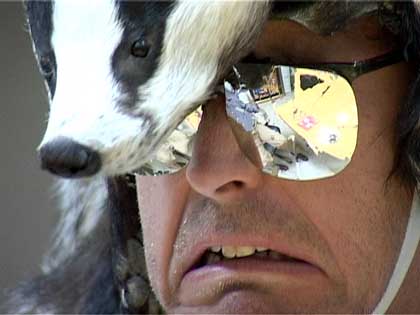
    Marcus Coates, The Plover’s Wing, 2009. Courtesy the Artist and Workplace Gallery.

    Marcus Coates arrives wearing neither badger fur nor stag antlers. He drinks tea, not peyote, and does not bark, yelp or fall into a trance. In fact there is no evidence at all this man has a hotline to the animal kingdom.

    His genial conversation is a far cry from the spooky rituals which have made the artist’s name. In order to tackle social issues, Coates has after all consulted with plover, moorhen, sparrowhawk and deer.

    The resulting performances might suggest he has a true gift and you could speculate there were years living with some remote tribe, learning their ways, but no.

    Of his shamanic training, he says, “I haven’t really had any.” Although he does have a weekend course under his belt. “I think what I possibly take is an idea called core shamanism. The idea that the fundamentals of the shamanistic technique are open to everyone.”

    Instead of magic, Coates uses meditation in what he describes as a “watered-down” version of indigenous tribal practices. The sceptics among you were right all along.

    “I think firstly I should say that I am deeply skeptical myself, particularly about new age culture,” he says. Disappointment soon gives way to relief.

    “Usually I kind of expect people to walk out,” he says of his rituals, “and I’m quite open to people calling me a charlatan and laughing. I quite like people not to be so reverential.”

    But those who stick around until Coates snaps out of his trance may be surprised at the vivid descriptions he brings back and even benefit from the advice he dispenses.

    “When I went to Israel I did a series of rituals in a shopping centre and people would come and ask me questions which were very serious,” he recalls. “One woman came up to ask me about her anorexic daughter and that’s when I realised I had an enormous responsibility.”

    The same day Coates was besieged with long queues, despite the deeply held religious beliefs of people from that part of the world. It was enough to make him consider giving up shamanic work. “Maybe religion isn’t extreme enough,” he muses.

    Faced with real problems of any scale, Coates looks to his imagination for a solution. The possession-like trance is in fact a creative process

    “It’s really just an elaborate and extended form of meditation where I conjure up an imaginative world where I don’t control it. I don’t run it. I’m just very separate to my imagination. I’m guided by it,” he explains.

    His art background is what he claims has given him “some fundamental skills” to do shamanic work.

    “It wasn’t like one day I thought I’d be a shaman. For years I had this strategy as an artist to become animal. I suppose that was to reconcile the gap between myself and another being.”

    In doing so, Coates was influenced by a 1974 enquiry by philosopher Thomas Nagel: What is it Like to Be a Bat? “There are degrees to which we can know each other and know of each other,” says the artist.

    Which prompts the questions of what our native fauna might make of contemporary art: “I think the fact about wildlife is its indifference to us. It reacts to us. It responds to us, but in terms of caring, that doesn’t really come into it.”

    Art in turn is not just cut off from the natural world, according to Coates: “I see it as cut off from the world generally. I think lots of artists are very interested in art itself. I’m not particularly interested in art. I see art as a by-product of what I do.”

    What primarily he does is explore the present day resonance of indigenous belief systems, the power of ritual, and the leaps of faith needed to create and enjoy art.

    It needs pointing out that humour is another strong by-product of his endeavours. But, says Coates,”That is totally undeliberate. The attempts are very serious, but I think the incongruities that are formed create the humour.”

    But the strength of his performances lies somewhere between mischief and make believe. Indeed, he says, “Most of the work comes from the idea of being an 8 year old.”

    Written for Culture24.

    contemporary, installation, sound

    Preview: Imogen Stidworthy at Arnolfini

    March 6, 2010
    Imogen Stidworthy,I Hate, 2007, Mixed Media installation, Commissioned by Documenta 12, Kassel; Courtesy MuHKA (Museum of Contemporary Art, Antwerp)

    Exhibition: Imogen Stidworthy, Arnolfini, Bristol, until April 25

    In some ways the work of Imogen Stidworthy goes beyond the limits of visual art, because her main area of interest is speech.

    Accent, slang and speech therapy are all explored in her new show at Arnolfini. It is the first UK survey of the Liverpool-based artist.

    But despite her concern with language, Stidworthy translates well. She has built up an international reputation, and one piece in her current show was commissioned by Documenta XII, the serious-minded exhibition in Germany that only comes round every five years.

    The result is called I Hate and studies the rehabilitation of a photographer who lost his voice in a cycling accident. Sessions with the therapist are filmed along with his own shots of a major scene of demolition and reconstruction, the Eurostar Terminal at St Pancras prior to November 2007.

    Her European audience may not get on so well with recent film Barrabackslarrabang. The soundtrack here is Backslang, a language spoken by British criminal types to hide shady deals from the ears of the law. Onscreen imagery weaves in pertinent themes such as class, race, trade and desire.

    As two other pieces in the show suggest, language is closely tied to place. Get Here and Topography of a Voice both listen carefully to how Scousers speak, exploring physical word formation and nuance.

    This is familiar territory for linguists, yet not so much for artists.

    Written for Culture24.

    contemporary, galleries, installation

    News: Ai Weiwei to undertake Unilever commission at Tate Modern Turbine Hall

    March 6, 2010
    Ai Weiwei, Fountain of Light, 2007. Steel and glass crystals on a wooden base. (h)700 x 529 x 400 cm. Photocredit Ai Weiwei. © Ai Weiwei

    Ai Weiwei, best known for helping create a ‘Bird’s Nest’ stadium for the Beijing Olympics, is bringing his talents for grand scale work to the Turbine Hall of Tate Modern.

    Ai becomes the eleventh artist to accept the Unilever-sponsored commission, yet still the first who lives and works in the Asia-Pacific region.

    Vicente Todolí described him as “one of China’s greatest living artists” and said: “Ai Weiwei’s compelling installations are among the most socially-engaged works of art being made today.”

    He said it would be thrilling to see how the vast public space might be filled later on this year. The installation will run from October 12 2010 to April 25 2011.

    As a conceptual artist, curator, critic, designer and architect, Ai has been a player in his native China for the last three decades.

    His career includes both a spell in the now-disbanded avant-garde art group Stars (1979-1983) and a 12-year period living in the US from 1981.

    Ai often uses Chinese antique readymades in his work. In 1995 he created a three-part self-portrait called Dropping a Han Dynasty Urn, from which the urn never recovered. Other pieces have been based around Qing and Ming Dynasty chairs as well as doors and windows from destroyed Chinese buildings.

    At the Haus der Kunst in Munich, the artist used children’s backpacks to spell out a tribute to the victims of the 2008 Sichuan earthquake.

    Since around that time Ai has distanced himself from the Olympic games and been an outspoken critic of his government.

    Written for Culture24.

    20th century, contemporary, design, drawing, installation, painting, screenprinting

    Review: Richard Hamilton – Modern Moral Matters

    March 4, 2010

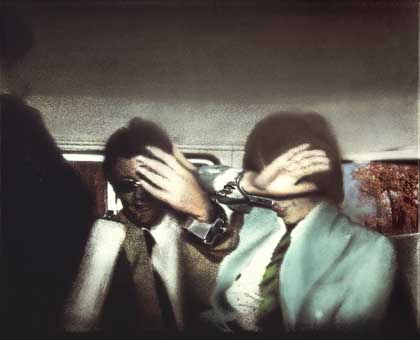
    Richard Hamilton, Swingeing London 67 (f) (1968-69). Screenprint on canvas, acrylic and collage. © 2010 Richard Hamilton

    Exhibition: Richard Hamilton – Modern Moral Matters, Serpentine Gallery, London, until April 25 2010

    More than 50 years since Pop Art began, it is a 1960s aphorism which best explains the varying effects in this show. Marshall McLuhan may have coined the phrase, but it is Richard Hamilton who really demonstrates the adage that “the medium is the message.”

    In his Swingeing London series, he blows up and recreates a newspaper photo until it becomes an icon. Ten versions fill one of the Serpentine’s galleries and the repetition is Warholian, but no two are executed in the same way.

    Across the series, Hamilton paints with oils, acrylic, watercolour and gouache. He draws with pencil and pastels. He screen-prints, etches, photo-engraves, die-stamps, embosses and prints using aquatint. He makes stencils and collage.

    So in at least ten different ways we see a transfiguration of the arrest of Mick Jagger and Hamilton’s friend Robert Fraser into art. Press cuttings make up a nearby Swingeing London poster and evoke the labyrinthine narrative of the event.

    Elsewhere he borrows the conventions of the triptych to sanctify three protagonists in the Northern Irish conflict.

    Central to this piece is The Citizen, in which a long-haired hunger striker appears both Christ-like and counter-cultural. He too is a painter, as can be seen from the walls of his cell and his well-documented medium is excrement.

    Hamilton also does installation. His chilling Treatment Room contains a hospital bed, sink with disinfectant, a reinforced glass window and an environmental control panel.

    In lieu of a doctor, a TV shows a reel of interviews with Margaret Thatcher. This time the medium interrogates Thatcherism even as the former Tory leader seems to be treating the viewer.

    Recent work by Hamilton, now in his late 80s, takes the form of digital printing onto canvas. These are the most direct works in a highly political show.

    Each makes a simple point: Israel is crushing Palestine; in its coverage of the Gulf war, the media has blood on its hands; and Tony Blair fancied himself as a bit of a gunslinger.

    But perhaps the real message is around the all-pervasiveness of virtual realities and advertising techniques in the visual realm. The canvas is all but invisible behind the full bleed image.

    Written for Culture24.

    collage, contemporary, design, installation, interviews, mixed media, painting, performance, spoken word, video

    Art must-sees this month: March

    March 4, 2010
    Jordan Baseman, Nasty Piece of Stuff 2009 (film still), Courtesy of the artist and Matt’s Gallery, London, Co-commissioned by ArtSway and The Photographers’ Gallery, London

    Here are my visual arts picks from around the UK for March. Written for Culture24.

    Richard Hamilton – Modern Moral Matters, Serpentine Gallery, London

    60 years after his first solo show, Richard Hamilton is still making loaded images. His show at Serpentine is a mixed media commentary on conflict in Northern Ireland, the Middle East and Vietnam. It’s not a retrospective so much as a political demo.

    Jordan Baseman – The Most Powerful Weapon in this World, BALTIC Centre for Contemporary Art, Gateshead

    Taking candid interviews as his starting point, Jordan Baseman makes video art sound as compelling as it looks. Three pieces comprise this show by the American-born artist with themes ranging from gangsterism to gay rights via herb collecting.

    Nicholas Hedges – Mine the Mountain, Surface Gallery, Nottingham

    This show may serve as an introduction to the term ‘dark tourist’, as Nicholas Hedges visits sites of genocide and massacre. His search for a personal connections leads him to the Welsh mines, where he pays tribute to the fallen of the First World War.

    Sonia Boyce: Like Love – Parts One & Two, the Bluecoat, Liverpool

    Making work around the theme of care has meant working with those most in need of it for artist Sonia Boyce. A residency with young parents and a collaboration with adults who have learning disabilities both result in an inspirational show.

    But what of Frances Stark, standing by itself, a naked name, bare as a ghost to whom one would like to lend a sheet?, CCA: Centre for Contemporary Arts, Glasgow

    Here’s a first chance for artlovers in Scotland to check out LA-based artist Frances Stark. White collages, which often take performance as a theme, also feature text by writers as diverse as Emily Dickinson and Mark E. Smith from the Fall. Be intrigued.

    Imogen Stidworthy, Arnolfini, Bristol

    These four recent works by Imogen Stidworthy have one thing in common, the human voice. Language is a social space in her multimedia show which listens to accent (scouse) speech therapy and a blackmarket slang known as backslang.

    installation, mixed media

    Preview: Nicholas Hedges – Mine the Mountain

    March 4, 2010

    Nicholas Hedges, The Wall. Photo courtesy Surface Gallery.

    Exhibtion: Nicholas Hedges – Mine the Mountain, Surface Gallery, Nottingham, March 6 – March 19 2010

    Artists may travel, but it is debatable whether they take holidays. Certainly, in his choice of European destinations, Nicholas Hedges has not made it easy for himself

    While preparing his mixed-media installation for the new show at Surface Gallery, he visited the three former concentration camps and two World War One battlefields. Auschwitz, Belzec, Majdane, Ypres and Verdun are not renowned for their beaches.

    What Hedges found at all these sites of historical trauma was an experience of ‘dark tourism’, a theme he explores in Mine the Mountain. Not so easy to find were traces of the individuals to whom he might relate.

    Instead, he was confronted with mountains of shoes, piles of ash, lists of names  But on some of these lists were miners from Welsh mine which once employed members of Hedges own family. This was Hedge’s connection to the Great War

    The discovery prompted a further trip, this time as a tourist of the self. On his visit to Wales, he attempts to open a dialogue with his own past. You can see for yourself if his artistic practice manages to overcome the facelessness of mass slaughter.

    Written for Culture24.

    contemporary, interviews, video

    Preview: Jordan Baseman – The Most Powerful Weapon in this World

    February 27, 2010

    Jordan Baseman, Nasty Piece of Stuff 2009 (film still), Courtesy of the artist and Matt’s Gallery, London, Co-commissioned by ArtSway and The Photographers’ Gallery, London

    Exhibition: Jordan Baseman – The Most Powerful Weapon in this World, BALTIC Centre for Contemporary Art, Gateshead, until May 9 2010

    Jordan Baseman knows a thing or two about juxtaposition, as you might expect from an artist with roots in the US who now lives and works in the UK

    At Baltic he uses unlikely images to give three documentary type films a poetic twist. Sound and vision collide.

    The soundtrack really carries the story. Each video is put together around an often candid interview in which Baseman explores themes of identity with his subject.

    Inside Man listens to a career criminal talk about his CV with particular reference to his past sexual conquests against a backdrop of original music. But the woman seen dancing with friends is taken from archival footage shot in 1977.

    On another film we hear the voice of a gay activist talk about the difficulties he faced coming of age in the 1960s. He sounds calm, but the16mm footage of Soho in more recent times is frantic.

    The show is rounded off with something more sedate. An octagenarian recounts her experiences collecting herbarium specimens for the British Museum, Kew Gardens and the Royal Botanic Gardens. But the clash of words and picture are still unsettling.

    Like the others, she has been displaced by the films she appears in. Her identity is in question as surely as if she was crossing a border.

    contemporary, drama, installation, video

    Preview: Eija-Liisa Ahtila at Parasol Unit

    February 27, 2010

    Eija-Liisa Ahtila, Where is Where?, 2008, 53 min 43 sec, 6-channel projected high definition installation with 8-channel sound. Photographed by Marja-Leena Hukkanen. Courtesy of Marian Goodman Gallery, New York and Paris. © 2008 Crystal Eye – Kristallisilmä Oy

    Exhibition: Eija-Liisa Ahtila, Parasol Unit, London, until April 25 2010

    “Human dramas” may bring to mind the worst sort of sunday evening TV, but don’t be put off by Eija-Liisa Ahtila’s description of her own work.

    It’s true the Finnish video artist deals with universal themes, such as love and death. Her primal emotions and strong characters will appeal to any primetime audience.

    But unless you have found a channel simulcasting contemporary art reels and have a few large screens installed in your living room, there ends the comparison.

    Ahtila’s films are multi-layered, her installations are immersive, and her narratives unfold in a complex, haunting way.

    And although her scripts are well-crafted, they would challenge most commissioning editors with backdrops like the Algerian War, hardship on the coast of West Africa and, in one film, a house of mourning for a dog .

    Indeed narrative conventions are pushed to their limit in The Hour of Prayer, as Ahtila disrupts the space, structure and causal logic of the unfolding tale.

    All three video pieces are being shown for the first time in England. As important works by an artist with worldwide critical acclaim, they are recommended viewing.