<h1>Archives</h1>
    aggregation, contemporary art

    Found Objects 04/04/2012

    April 4, 2012

    This week has indeed had its quota of hard-to-ignore links:

    • Let’s get Damien out of the way. Here’s a well argued piece from Tom Jeffreys which puts the new Tate show in the bigger picture.
    • And in case you should need to know what Jay Jopling eats for lunch, here’s a highly readable interview with the White Cube director from the FT (via @risearts)
    • Art Info reports on the rise and the rise of the museum quality show an otherwise commercial space. Cunning!
    • And in case you didn’t know it, Andrea Fraser has made clear that art is a luxury goods business. She unpacks some alarming implications on the Phaidon website.
    • The Guardian lets us hear from half a dozen of the artisans without whom most blue chip art might never see the light of day.
    • Way to write about abstract painting! Sebastian Smee reports back on a Richard Diebenkorn show for the Boston Globe.
    • Media artists Lucky PDF hired a reality star to guide them round the ICA’s new show about television. Blogger Lizzie Homersham was there.
    • Simon Reynolds (Blissblog) posts the new Plan B video, truly an urban safari, and then explores grime as an emergent cinema genre .
    • Art or literature? @GrantaMag linked to photos of a torrent of 5,000 books from the first floors of various Spanish buildings.
    • Likely to put a dopey smile on your face: these performance pieces featuring twins and quadruplets.
    • This week @LaScatola_ was good enough to share the work of Charlie White with me. His film Pink makes a serious point about young fans of that colour.

    contemporary art, feminism, performance art

    Sarah Maple and Beverley Knowles, It’s just like any other job really… (2012)

    March 31, 2012

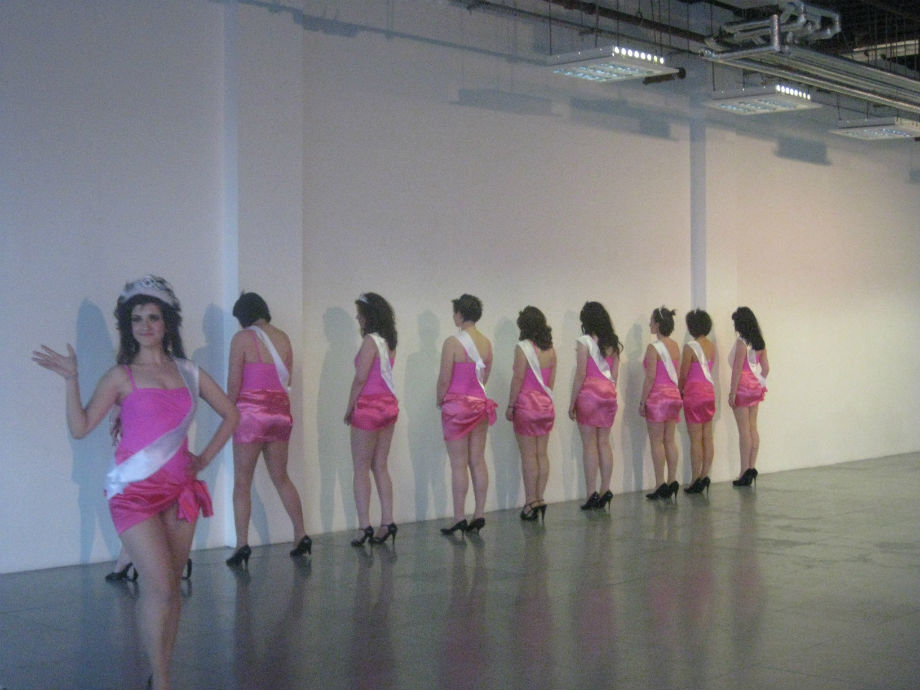
    It turns out that despite ourselves, even the most urbane and politically correct audience can still love a beauty pageant.  The sequence of young women in swimsuits could not be more easy on the eye

    It is obvious what heterosexual men might get from this. But women too were enjoying it. There were no shortage of volunteers to strip off, while their fully clothed sisters looked on with vicarious pleasure.

    But context is everything. Each of us knew this was a performance by a feminist artist, Sarah Maple, and a feminist curator, Beverley Knowles. So that was okay.

    Also, the swimsuit, sashes, and tiaras were balanced up by the fate of each Miss America. After parading past the extensive glass windows of La Scatola, they went to stand facing a wall.

    Here they reminded the viewer of children in disgrace. It was as if they had blown their moment in the limelight by using their platform to make an off beam comment about the recession or the war.

    About 20 women took part, only coming to life every five minutes when a burst of Sinatra or maybe Bert Parks cut through the silence and then cut out with just as much abruptness.

    When the music played and the girls were up, it was all eyes in their direction. The rest of the time they were to be seen and not heard. The choreography was impersonal and brutal.

    As the title of the piece and a corresponding handout suggests, to be crowned Miss America or Miss World entails a year of hard work. Just like artists, their levels of dilligence might surprise the public.

    Gallery director Valentina Fois is not sure how this glass box of a space was used before. But last night it was not hard to imagine a car showroom, with bonnets for the girls to drape themselves over.

    Clearly we have come a certain distance since the time men crooned about beauty queens and no car ad was complete without a dolly bird. But not so far we could not recognise our role in this piece.

    It’s just like any other job really took place at La Scatola gallery on 30/03/12. For more on the players visit the websites of La Scatola, Sarah Maple and Beverley Knowles.

    aggregation, contemporary art

    Found Objects 26/03/12

    March 26, 2012

    Almost too many links to choose from this week, but here are the best all the same:

    • Government ministers sack head of Arts Council England. Could it be they want someone who will cosy up to big business instead? (via @MutualArt)
    • Here’s a reality check for London and New York. The world’s most visited exhibition last year was in Brazil.
    • This was the week Artist Taxi Driver cropped up on my Twitter feed. Imagine a rabid leftwing cabbie venting his spleen and you’re still only halfway there.
    • The laughs come at unexpected points in this low key spoof: Christopher Walken reads Where the Wild Things Are (via @adam_orbit).
    • Also very funny is this Bedwyr Williams piece from Frieze, which chronicles the life and sad death of a fictional intern (via @LizzieHom).
    • To get a little more serious…photos for those who may still not yet have had enough of Soviet brutalist architecture (@caravia158)
    • Damien Hirst has just rigged up his studio with a pair of web cams, which is oddly compelling (via @BevieKnowles)
    • New York Times reviews Keith Haring at Brooklyn Museum and there was more to the prodigious young artist than t-shirt designs.
    • Daily Serving look at a playful and pleasing Chicago show by identical twins Alan and Michael Fleming.
    • The final link comes from Art Fag City and features a rap by CalArts student Yung Jake. Be warned you may have to tidy your screen a bit when it’s all done.

    Figurative painting, modern art, photography, portraiture

    David Dawson, Mirror in Studio (2004)

    March 21, 2012

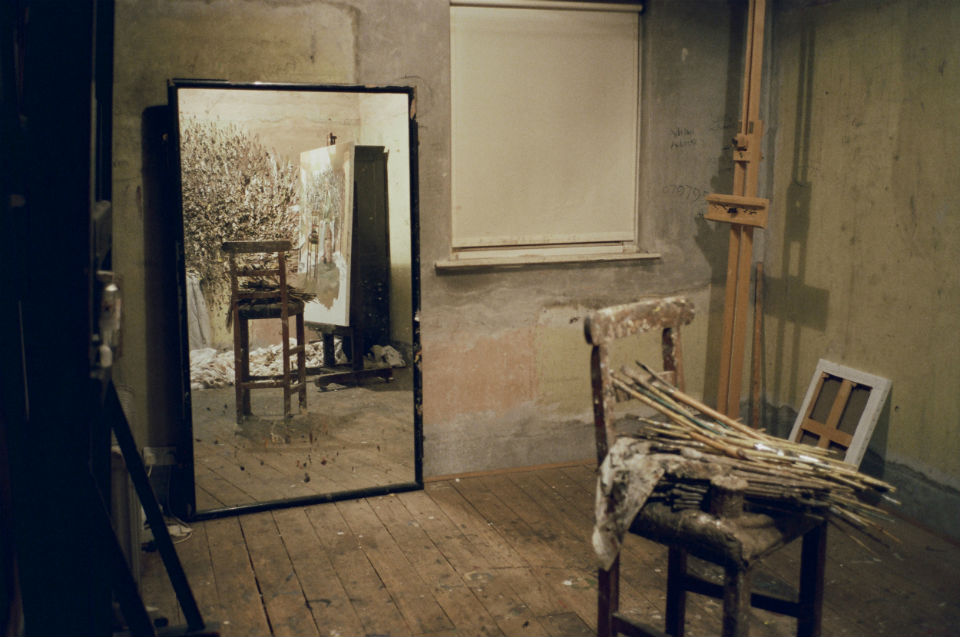
    Like many a good artist’s studio, that of Lucian Freud required a mirror. And when David Dawson was in the studio it would have become a rich metaphor.

    Freud‘s longterm assistant was also a painter. The master would also paint Dawson. And Dawson in turn made portraits of his employer – photographic, like the one here.

    But in this shot, Freud is conspicuous by his absence in the room, then conspicuous again by his absence in the mirror. The brushes and the marks on his wall stand in.

    It almost goes without saying that Freud is all the more present for being invisible. Just as he seems ubiquitous ever since he passed away last Summer.

    Dawson is also absent, bur only up to a point. This is no baroque conceit like Las Meninas in which the artist includes his own mirror image in the composition.

    Instead he gives the impression of this being an objective view of both ends of an empty studio. And in its way, that too is a bit of trickery.

    It is a trick which captures the sad reality of this space on a top floor in Holland Park  Freud can no longer be here. Dawson, after 20 years service, has no reason to return.

    David Dawson: Working with Lucian Freud can be seen at Pallant House Gallery until 20 May 2012. See gallery website for times, etc. Click here to watch a video interview with Dawson

    aggregation, contemporary art

    Found Objects 19/03/12

    March 19, 2012
    • The Art Newspaper reports on a ‘major systemic shift’ as sales go to the world’s many art fairs, rather than through traditional galleries.
    • No less than 56 rhino horns have been stolen from museums since 2011. Der Spiegel reports on this worldwide crime trend.
    • The Smithsonian website looks back at the trailbrazing career of guitarist Carol Kaye, a rare female member of the so-called Wrecking Crew of session musicians in the 60s
    • More Damien Hirst. Since the artist has said he makes art about money, Hari Kunzru offers a quotable analysis of his market in the Guardian.
    • Philip Hoare writes in The Independent about Britain’s current fixation with the comforts of television, theatre and art which look to the past.
    • The Guardian also covers the arty new PlayStation game Journey. It really is out there.
    • Paris Review carries an interview with Martin Kippenberger’s sister Susanne. Covers alcoholism, art critics, and Jeff Koons.
    • Olafur Eliasson has built a kaleidoscopic doughnut on the roof of a museum in Aarhus, Denmark. Beautiful Decay has pictures and video.
    • There’s something amusing about a vagrant voyeur making his own camera  – although of course there shouldn’t be.
    • Art Info have posted some good hip hop links this week, and none better than this track by Nas.

    contemporary art, galleries, gentrification, modern art

    Opposition to the Jerwood Gallery in Hastings

    March 17, 2012

    Pictured above is a view from upstairs at the brand new Jerwood Gallery in Hastings. If those fishing boats weren’t already picturesque enough, now they are framed.

    At the foot of the shot is a yellow poster. And as you might know, there are several of these nearby, all voicing opposition to the new £4m gallery.

    Fishermen, at least those in this town, do not want to share the beach with a first rate collection of modern and contemporary British art.

    What they would prefer is a coach park, so that daytrippers can arrive by the busload and visit the old town for fish and chips. This is the town they want to see.

    It cannot be denied that the new gallery changes the complexion of this part of the beach. So perhaps the neighbours are right to resist the gentrification.

    They have the largest beach-launch fishing fleet in Europe and now their daily toil will become the charming and quaint view from this window.

    As an art blogger from just down the road, clearly my vote goes to the gallery. We do not have a comparable space in Brighton, so Hastings is lucky.

    But we don’t have a fishing fleet either. All that remains of that industry on our stretch of the coast is a beachfront museum. No, I haven’t been.

    In a perfect world, thousands of art lovers would descend here every day and buy fish. Fishermen would pop round the gallery for some 20th century abstraction.

    Is it really such a crazy dream? Many gallery visitors will cheerfully feast at the local chippies. But a “not for the likes of us” mentality may prevent reciprocal footfall.

    But since lives are being risked daily to bring fish back from the English Channel, the maritime neighbours have the moral, if not the cultural, high ground. What’s to be done?

    For more info about opposition to Jerwood on this stretch of beach, The Stade, visit the campaign website (features a 50 verse poem!). Read my review of the gallery on Culture24 here.

    aggregation, contemporary art

    Found Objects 12/03/12

    March 12, 2012

    Stories you may or may not have seen from the last seven days:

    • Succumbing to the fact we may need rolling new coverage of Damien Hirst in 2012, here’s a fine analysis of his spots from The Point + here’s a revealing interview in the Guardian (via @artnet)
    • Gilbert and George now also have a worldwide show in their London Pictures. I hope this is not a new trend to cater for 1%ers. But here are the inimitable duo on film in The Telegraph.
    • You’ve got to like a man with enough talent to carve out his own name, throwing it away for a life of more-or-less victimless crime. Story on the German ‘hippie forger’ in The Independent.
    • Daily Serving celebrates the tactile art of Mark Bradfield, while lamenting the failure of jpegs to do him justice.
    • Some important questions raised in a report from Puerto Rico; Pedro Vélez takes in the confessional show Vividos/Vividos.
    • The Modern Art Notes podcast hosts the legendary Richard Serra, who furnishes some anecdotes about his formative artistic experiences.
    • Catch up with the progress of a boulder, which has travelled halfway across California to LACMA, with a short/sweet interview with gallery director Michael Govan.
    • Just love the look of these tele-waves and tele-breezes. All is explained on Hyperallergic.
    • Pending the death of the printed word, an artist performs open heart surgery on a number of antiquated books (via/ @TheSimonEvans).

    contemporary art, curating, fan art

    Jeremy Deller, The Uses of Literacy (1997)

    March 9, 2012

    You may not think much of this picture and I should point out quickly it is not by the artist Jeremy Deller. It is by an anonymous young person and fan of therein mentioned band.

    But the onetime inclusion of this work and many like it, in a show given over in its entirety to art by fans of the Manic Street Preachers, is a really wonderful thing.

    The Uses of Literacy (1997) demonstrated the ways in which a rock group has served as an “alternative educational resource” for those who consumed their music and press appearances.

    It is hard to take lyrics as seriously as the syllabus for A level English, but perhaps we should. Which of us has not been led from an album sleeve into a bookshop?

    But this was, to be fair, a more common phenomenon in the 80s, when NME journalists regularly dropped references to Kafka, Camus, Dostoyevsky, et al.

    By the time the Manics broke through in the 90s, intellectual pop music was as defunct as the Soviet Union. And it has never really made a comeback.

    Yet fandom, as expressed by a show like The Uses of Literacy, can be expression of more than idolatrous desire. Here it was also once a commitment to bettering oneself.

    And besides, idolatry never did that much harm. One can quite easily see the history of art as a catalogue of fandom: Jesus-worship, Mary-worship, nude model-worship, etc.

    Deller himself is clearly a big music fan. His oft mentioned lack of artistic training means that in some ways he makes work as a fan, rather than an artist.

    This gives his new show at the Hayward an impulsive simplicity, like that in the picture above. “I am a simple man, making simple art for simple people,” he said in a recent BBC documentary.

    If simple art can sometimes be naive art, as this picture shows, then it is also an innocent form of engagement with the world. Bad technique is even a sign of good intentions.

    And only an innocent would tow the remains of a Baghdad car bomb across the United States, as Deller has done for his project It Is What It Is. Who else would have got away with it?

    For that reason I’ll happily go on record as a Jeremy Deller fan. I defy anyone who’s ever had a record collection to see his new show at the Hayward and not be converted.

    Jeremy Deller: Joy in People is at Hayward Gallery until May 13. See gallery website for more details.

    aggregation, contemporary art

    Found Objects 04/03/12

    March 4, 2012

    Some links from the week that was:

    • China Miéville offers a dystopian portrait of London which most will recognise. Can he do some more cities, please? (via @AnnaMinton)
    • Martin Creed, artist behind a redesign of part of Sketch restaurant, tells The Independent he prefers to eat at home.
    • On art-Corpus, there’s an in depth review of the Boetti show at Tate. Sounds like a must see.
    • Rare photo of Andy Warhol having fun on Animal NY.
    • What connects anal sex to space probes? Well, this Geoff Dyer piece for starters. Thomas Ruff also features.
    • Nothing says controversy like a local news report. Take this footage of Sarah Maple and Beverley Knowles, for instance.
    • The gamefication of your 80s angst is here at last with the hilarious Super Morrissey Bros on Sound Cloud (thanks @thebenstreet)
    • The gamefication of neoplasticism can be found on Beautiufl/Decay. Who could have seen this one coming?
    • Nice photo essay about a Paris trip in Pipe magazine. I’m always up for a second hand boat trip on the Seine.
    • Witty interview with a binman from Georgiasam (via @jod45) but I’m not sure who is the real target.

    contemporary art, film art

    Interview: Asheq Akhtar

    February 29, 2012
    Akhtar on location (c) Jo Irvine

    When Asheq Akhtar answered a small ad calling for non-professionals to take part in a film, he could not have predicted the results. After three week’s training in method acting he was out on the streets before a full feature film crew. And no one who saw the movie Self Made will forget his barely scripted attack on a pregnant woman.

    “It was a really hard day in Newcastle,” recalls Akhtar. “It was cold. It was bitter. It was in the same place I grew up in where my mum was abused by this ex boyfriend of hers. So I had all these memories, all this stuff to contend with.”

    And for anyone who needs reminding, he adds “I’d never seen a film crew in action like that. It’s a very challenging environment to work in if you’ve never shot a film before.”

    Plaudits and brickbats for this striking piece of reality cinema have since fallen the way of artist and director Gillian Wearing. And many said that her cast of novices, who all played out challenging psychodramas, were victims of an exploitation flick.

    “When I watched it I thought people are going to read this the wrong way and it was a real worry for me,” says Akhtar, who sounds nothing like a psychopath when we talk on the phone. “I was thinking what have I done. What have I actually done? What are people going to take away from it?”

    But as the DVD release approaches, he advises me the film “takes repeat viewing” to get a better sense of why he might want to play out such a brutal denouement. And a year and a half on from the premiere, he can laugh about the controversy it caused.

    “It’s been a mixed reaction,” he says in a tone of understatement. “It’s very difficult for my family to watch and they were the people I was most concerned about. I had a lot of talks with them about it”.

    Turner Prize-winning artists are just the latest thing his family has had to contend with. “[They] have been through so much: from the days of the partition in India, to the Bangladesh civil war, from migrating over to the UK and there’s been so much history.”

    Some of this may explain the anger in Akhtar’s performance, yet the mild mannered Londoner explains that the final cut of Self Made makes his experience look harsher than it really was. “I found it very liberating,” he says cheerfully, “very enlightening and very interesting”.

    If anything, the worst part were those accusations of cast exploitation. “It’s strange how people never gave us the credit to know what we were doing and know what we were getting ourselves involved in. And I think that’s been the most painful thing.”

    “We just wanted to do something to express ourselves,” he continues. “So someone provided us with an option, with a choice…They asked do you wanna take part in it? Absolutely! We could have pulled out at any time.”

    In fact, the closest art lover Akhtar came to dropping out was when he heard about the involvement of YBA Wearing. “And all of a sudden I was absolutely terrified,” he admits. “I thought why am I even going to go to this audition.”

    But his controversial debut may be the making of a new career. For the next two years he continued classes with the film’s drama coach, Sam Rumbelow. He says now he is a “wannabe, struggling actor”, albeit one who has recently landed an agent.

    “So that was my training,” he says of the chain of events kicked off by the film, “I’d definitely like to be an actor, but it’s not where I envisaged ever ending up at all.”

    Along with his own astonishing performance, the coming DVD offers the chance to watch two of his group’s end scenes, which didn’t make the 90 minute edit, plus a workshop in which all the group reflect on their experience.

    “I look back on those times so fondly,” says Akhtar who is still in close touch with the film’s other stars. “I think we were such different people back then, two or three years ago. It will be interesting to see that stuff now and say, ‘Isn’t it amazing how far we’ve come?’”

    Self Made is out on DVD on March 26. It is available from www.cornerhouse.org and from The Whitechapel Gallery shop to coincide with Gillian Wearing’s upcoming show.