<h1>Archives</h1>
    aggregation, contemporary art

    Found Objects 04/09/11

    September 4, 2011

    How was your week? Mine was all the better for finding these 10 links:

    • Christopher Hawthorne in the LA Times reports on boom time for skyscrapers. To quote from movie Life Stinks: “Gentlemen, you’ll never know how much this project excites me.”
    • And as we approach 9/11/2011, at least one bit of reportage now looks like a clever piece of photoconceptualism. Jonathan Jones discusses Thomas Hoepker in the Guardian.
    • This guy’s got an interesting ‘practice’. The BBC interviews Lee Hadwin, who makes art in his sleep (hat tip to @artcoholic).
    • It’s now a book, a play and an exhibition. But the patricidal life of Richard Dadd still wouldn’t make a good game of family charades. Arifa Akbar writes about him in The Independent.
    • What happens when you auction cash as art? Find out in this Art Info story about Australian artist Denis Beaubois.
    • Charlotte Higgins interviews painter and writer Alasdair Gray, and the Guardian plays it for comedic charm in the resulting video.
    • Speaking of comedy, here’s a story about the German man who’s rerecorded every single Beatles album auf Deutsch.
    • Flavorwire carried a popular list of 30 artist-on-artist put downs from the renaissance right up to the very present day. As they say, harsh.
    • David Bowie’s Space Oddity has been turned into a saddening children’s story by Andrew Kolb. Read it and weep at Comics Alliance. Thanks to Alexis Somerville.
    • Lastly, here’s an IRL Facebook like button. So you can like the act of liking in a real world sort of context. LIke the buttons below, but more nihilistic.

    art fairs, art market, contemporary art

    Interview: Karl England and Ben Street (Sluice Art Fair)

    September 1, 2011

    For artists who don’t perhaps make millions, Frieze art week may be a date to hate. But this year, two man team Karl England and Ben Street are presenting a bold alternative. The brand new Sluice Art Fair will be 15 minutes down the road.

    “We have had some hostile reactions when we invited people to take part in an art fair,” says artist England, who in fact hails from New Zealand.

    “That’s an important point,” agrees writer and curator Street. “We’ve been saying to people we’re doing an art fair and it’s just by Bond Street. People think ‘Oh it’s like an equestrian art fair!’”

    In fact, despite its West End location, Sluice will show work from emerging artists, artist-run spaces and other less commercial galleries.

    “They’ve allowed frieze and their ilk to define what an art fair is and that’s what their vision of an art fair is, it’s quite sad really,” England continues.

    “Exactly, and if your vision of an art fair looks like the ideal homes exhibition and is loads of little booths then Sluice is going to subvert that hopefully,” says Street before adding: “Definitely, actually.”

    The scale of Frieze Art Fair is well known. Their blue chip marquee in Regents Park has space for 170 galleries and draws some 60,000 visitors a year. Sluice is making do with less than 200 sq on South Molton Lane. They are not even sure whether to hire a credit card reader.

    “It’s spaces that wouldn’t normally have thought of going to an art fair before,” says England, looking quite at ease with the paradox. “They don’t have the budget. They’re not looking at being a selling gallery.”

    Street, meanwhile, has a considered line on why this should be. Sluice is “partly an investigation into what an art fair is. It’s quite self reflexive and a lot of the work that’s going to be shown, which we know about, is pretty self reflexive stuff.”

    His co-director chips in: “The thing with Frieze is they charge so much money per sq foot, that can’t help but affect the sort of art these galleries submit, because they need to be showing art to be commercially viable, whereas that doesn’t really happen with us.”

    Sluice has got its space for free from a sponsor. The cost of taking part is relatively low. This, according to Street, gives them a chance to ask: “How [art fairs] affect the way art is seen and understood by the general public, and by the art world at large, And how they affect or if they affect the practice of artists themselves.”

    But then again you might expect awkward questions from a partnership which formed thanks to a notoriously democratic social networking site. After the Arab Spring, is it possible that Twitter is helping bring about an Art World Autumn?

    “I would love to think that it was,” says Street with caution. “You’re right though in the way that we were able to very speedily and quickly being able to create a sort of network.”

    England also thinks Twitter can play the art system: “I think it does break it down,” he says, “because traditionally you get shows because you know people through all the colleges. Studios tend to be like that. Art galleries tend to be like that.”

    But he is more than happy to work outside that. As followers on Twitter will know, the antipodean artist has staged exhibitions on a 14cm plinth and set up an artist’s residency in his own home.

    “I’ve done these little self-initiated artist projects,” he explains. “So I thought it would be great to get projects of that scale and up and group them together and present them in a kind of, like unified…”

    This appears to be the point where an artist needs a writer: “What’s that union thing where you get all the workers together and then present them as a block?” he asks.

    It is a “Union,” points out Street

    Both laugh. Organised labour during art fair week sure does sound crazy, but since when did art fairs make a whole lot of sense. Roll on October.

    conceptual art, contemporary art, photography

    Mocksim, Contra-Invention (2010)

    August 30, 2011

    To those who say, I could have done that when faced with contemporary art, here is a project that you really could have done. The catalogue provides instructions.

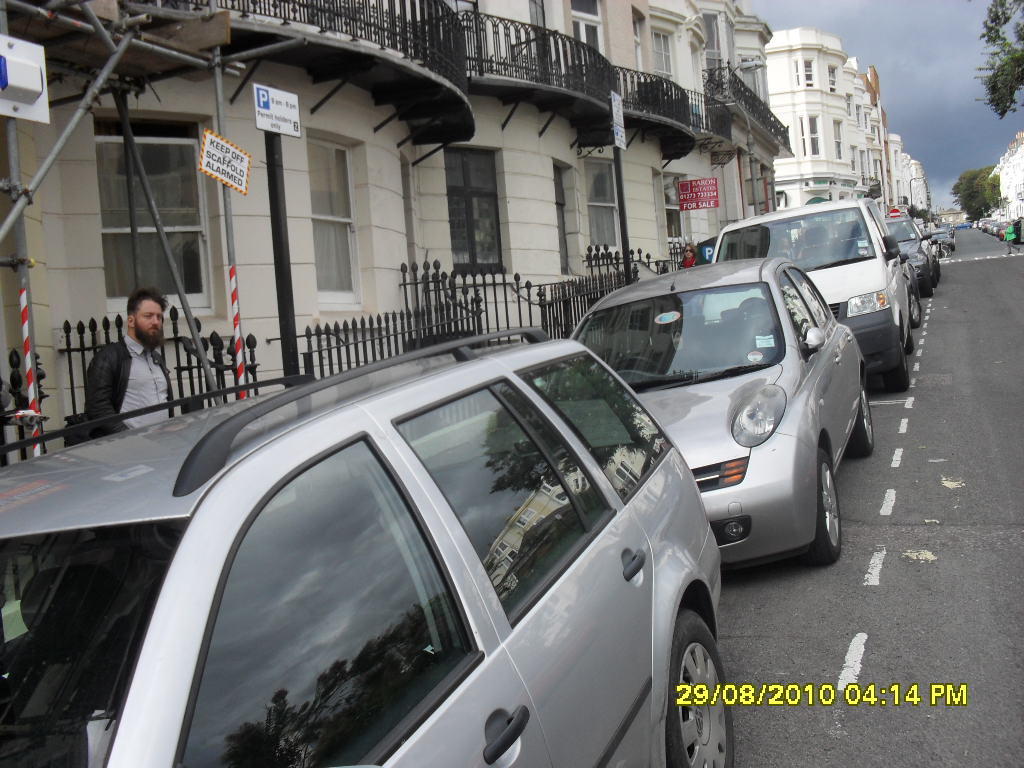
    Mocksim’s show comprised some 200 photos of illegally parked cars. 1) check the parking ticket; 2) visit the Penalty Charging Notice website; 3) enter a code; and 4) retrieve your artwork.

    The artist notes that data is also available about the make and model of the camera used by each traffic warden, along with shutter speed, aperture, focal length. The mind boggles.

    But the final exhibition still represents a lot of work, as much pounding of pavements as a so-called civil enforcement officer. You would have needed some time to emulate it.

    As social minded art, Contra-invention seems very honest. We do not have many wars, famines or plagues in Brighton. But we do have zealous parking restrictions.

    Part Two of the project presents photos of wardens at work. Using another cheap camera (a cameraphone, in fact), Mocksim now appears to be working in tandem with his subjects.

    So there does not appear to be all that much difference between the artist as flaneur and the traffic warden. He snaps them. At times they snap him (see picture above).

    No one much wants their portrait taken at work. But the shots reveal a tolerance and resignation which redeems this hated job. If you too could do that, then great. Go make some art.

    Contra-Invention appeared as part of Brighton Photo Fringe in 2010. Thanks to the artist for sharing documentation with me in the form of catalogues. See Mocksim’s website for details of other projects.

    aggregation, Uncategorized

    Found Objects 27/08/11

    August 27, 2011

    Some links from the last seven days. The internet has been busy again:

    • Once you start building a bunker, it hardly ever ends well. As Gaddafi hunkers down in Tripoli (presumably), Jonathan Glancey looks at his architecture.
    • Does art change nothing? This galvanising piece on The Daily Serving finds street art in the thick of the recent battles for control of Libya.
    • Here’s an some heartening street art news from Der Spiegel. Graffiti is taking over from gardening as retirement activity of choice.
    • Surely this is Tracey Emin at her least good. She now exhorts the prime minister to have ‘more passion‘ not more compassion.
    • The Telegraph also run a good interview with photographer Martin Parr. Here’s why you might not like certain photos of yourself.
    • Art Info looks back at Steve Jobs reign as CEO at Apple. They will miss almost everything except the black polo neck.
    • Did David Foster Wallace invent the language of blogging. Well, lawyer turned blogger Maud Newton seems to think so. Sort of.
    • If you’re given to schadenfreude you may enjoy these photos from Chloe Nelkins’ most recent gallery trip. She was not having much luck.
    • The old adage that two are better than one does not, in my book, apply to guitar necks. So what to make of these creations on Beautiful/Decay blog.
    • It worries me I like looking at bad art. If you do too, here are 15 slides from the Museum of Bad Art in New England.
    • Director John Waters has just said liking contemporary art is like being in a biker gang. Get your boots on and check out this video.
    • Meanwhile there’s a very infotaining film on Animal NY, which demands you watch it. Oh, it’s about copyright law.
    • Love him, hate him or merely never heard of him, arty musician Momus has always got something to say. Check out his geo-psychology podcast.

    Arab Spring, Cairo, contemporary art, film installation, installation art, photography

    Hala Elkoussy, Al-Khawaga and Johnny Stories (2011)

    August 23, 2011

    A film in the back room tells the story of Sein, who seems to be in perpetual flight around the city of Cairo. In piecing together her story, the artist may also be piecing together ours.

    Like Sein, we find ourselves lost in the city or at least the shop at 87 Sandgate Road, in which the memories pile up on the wall. In places the postcards, adverts and photos are ten deep.

    The colonial past is everywhere: in adverts for stationers and soap, in baroque architectural flourishes, in notices for travel agencies selling us the pyramids.

    Egypt has just had a revolution, but this was not its first. It was not even its second. But with each convulsion of revolt, the country tries to move away from British or Western influence.

    The 1,000 killed in Tahrir Square might not have even been there were it not to mark so-called Black Saturday, and the 1952 murder of 50 Egyptian police by our occupying forces.

    Given the amount of blood shed during the Arab Spring so far, it is embarrassing to look from the walls to the collection of books which Elkoussy has laid out on a central table.

    Thrillers and travel yarns tracked down on Ebay and via the British Library catalogue remind us that Egypt has long been considered a playground by the West, albeit a mysterious one.

    So her installation implicates. If you’ve ever enjoyed a film about mummies or a visit to the British Museum, there are mirrors on the wall in which you see yourself.

    The surrounding ephemera points to at least 1,001 stories in this Arabic city. And it may come as a surprise to find how many of them involve Johnny, in other words you or me.

    This work can be seen at Folkestone Triennial until September 25 2011. See organisers’ website for more details. And read my interview with Hala Elkoussy here.

    aggregation, contemporary art

    Found Objects 19/08/11

    August 19, 2011

    Allow me to pilfer some more of your time for this week’s selection of links. Theft has emerged as a bit of a theme:

    • Der Spiegel carries an interesting long read about a time when tourism and archaeology went hand in hand. Berlin’s famous bust of Nefertiti is just one item Egypt wants back.
    • Then there was the straightforward theft of a Rembrandt from an LA hotel. Here’s the story in the Telegraph.
    • Meanwhile, a shrine to digital piracy has been created, ‘worth’ $5m. Animal NY has the details.
    • And here is a brilliant analysis of last week’s riots. Rather than the ‘pure criminality’, Justin McGuirk in the Guardian appears to suggest they were closer to pure gullibility.
    • Finally, you can find a 2007 essay about plagiarism by novelist Jonathan Lethem here. It’s great, so thanks to @maudnewton for tweeting the link this week.
    • Also this week, Hyperallergic ran a top ten art T-shirts. Not acceptable gallery-wear apparently.
    • After The End blogger Lizzie Homersham traced back some Folkestone roots and brought back this optimistic review of the Triennial.
    • Art Observed linked through to a trailer for Sophie Fiennes documentary about Anselm Kiefer’s bunker/studios in the South of France.
    • And happy 20th anniversary to Frieze magazine. They celebrate with this history of philosophy since the 1990s.

    19th century, painting, post-impressionism

    Henri de Toulouse-Lautrec, At the Moulin Rouge, 1892-93

    August 17, 2011
    Henri de Toulouse-Lautrec, At the Moulin Rouge, 1892-93. The Art Institute of Chicago, Helen Birch Bartlett Memorial Collection

    By elevating the point of view and catching performer May Milton as she surges past, Toulouse-Lautrec captures the unsteady excitement of a late night at the Moulin Rouge.

    And unlike the paparazzi shots which litter today’s gossip pages, looking at this work leads to a feeling of inclusion. Perhaps that’s also thanks to the intoxicating shades of green.

    When an art scene becomes synoymous with a nightclub, it generally reminds you just how exclusive both worlds can be. But this painting is like slipping through a post and rope barrier.

    The short figure right opposite is the artist himself. Maybe that’s the price of admission, to recognise that the post-impressionist is at the centre of this work, and the centre of the world.

    Never mind his achievement in painting. Just consider the disabled artist’s achievement in gaining acceptance with the beautiful people of Paris 1892, despite his ailments and appearance.

    But even an artist in the right place at the right time and in the right clothes must remain something of an outsider. Hence the painting’s newly arrived viewpoint.

    His depiction at the centre of a world famous club is also self-conscious. Toulouse-Lautrec is watching himself on a night out: a modern malaise he might just have invented.

    This work can be seen in the UK until September 18 2011 at the Courtauld Institute, London. See gallery website for more info on their fantastic show about Toulouse-Lautrec and Jane Avril.

    Thanks for @FisunGuner for recommending this show. Her brilliant review on the arts desk will tell you more, and my own review of the entire show can be found on Culture24.

    aggregation, contemporary art

    Found Objects 12/08/11

    August 12, 2011

    After an unplanned hiatus, this blog returns with another selection of links: items from the last seven days in descending order of topicality…

    • Nevermind the stock cupboards of Footlocker, etc. Lucy Inglis in the Guardian laments the Victorian architecture which suffered at the hands of rioters in Tottenham.
    • Tattooist Louis Molloy is another victim of the last week’s disorder. Among other questions raised by the Independent is why mass murderer Harold Shipman had no body art.
    • Ai Weiwei speaks out, again. Artinfo dissects an interview which the recently imprisoned Chinese artist gave to the country’s Global Times.
    • Queues have been forming for Alexander McQueen’s show at the Metropolitan Museum of Art. The New York Times offers this sketch of the fashion designer’s fans.
    • And here’s another fashion story which went viral. Der Spiegel reports that Neo Nazis were this week tricked into taking home anti-fascist t-shirts.
    • It’s 100 years since the Mona Lisa was stolen and 50 years since the theft of Goya’s Duke of Wellington. The latter event makes for an amazing tale by Sandy Nairne in the Guardian.
    • Harold Shipman crops up again in this well-argued piece by Tom Jeffreys in Spoonfed. Which just demonstrates that tricky questions face those condemning corporate sponsorship of the arts.
    • Artists reading might be inspired by this story in Art Fag City. Nate Hill reveals how his trips to NY’s Chinatown fish market came to hook the art world media.
    • Hyperallergic sets a playful example for anyone faced with a dauntingly large art museum.
    • If you haven’t yet been to the De La Warr Pavilion, here’s the next best thing.
    • Finally, I’ve been enjoying this Spotify playlist based on the novel Inherent Vice by Thomas Pynchon.

    aggregation, contemporary art

    Found Objects 23/07/11

    July 23, 2011

    Posting early links this week, due to weekend commitments. So, erm, click while you’re ahead:

    • Lucian Freud appears not to have liked social conventions, but I hope he would not mind the odd tribute or two. Martyn Gayford’s close, measured and warm recollections in the Telegraph are well worth a read.
    • An Xiao’s piece in Hyperallergic makes recent debates in social media about social media art seem much less fuzzy. It’s a more serious business than the self-referential mise en abyme might suggest.
    • A Google software engineer conveys the excitement of turning a Calder sculpture into the day’s much-liked animated doodle. But try to imagine explaining it to an artist who died in 1976 and the mind boggles.
    • Author Mark Fisher is cropping up two weeks in a row, but he has written a very involving piece on philosopher Nick Lands (also via @frieze_magazine).
    • A Kick Up The Arts has been busy this week. Check out their incisive review of The Shape of Things to Come at The Saatchi Gallery.
    • After reading Calvin Tomkin’s excellent book Lives of the Artists, I’m hooked on the long-read artist profile. This fine example on Miranda July by Katrina Onstad delivers on all six pages of its NY Times slot.
    • A slide show of psychedelic artwork from 60s design team Hapshash and the Coloured Coat from Kathy Kavan at Another Design Blog.
    • This 15-minute documentary on Street Photography is a real must. Takes you to a dark and paranoid place and then, well, I won’t spoil it.

    abstract expressionism, contemporary art, hackgate, media art, textiles

    The art of Hackgate

    July 19, 2011

    At about 12.30 last night a widely-published cartoonist had his email and password broadcast on Twitter. Mark Wood’s only connection to #hackgate is that he has also worked for The Sun.

    If his characters are anything to go by, Wood is a likeable sort. His client list suggests he’s hard-working. And indeed a web listing makes clear he “will draw anything for anybody”.

    Someone must have pointed out his innocence, because the offending tweet has been removed. But sadly a few journalists and techies still have mobile numbers, etc, in the public domain.

    Disclosure of these details was the fairly shabby denouement to an otherwise spectacular assault on the servers of News International by a crew of hackers known as Lulzsec.

    Lulz boast repeatedly about providing “high-quality entertainment”. But the fake death notice they posted on Sun online was not in and of itself all that funny or entertaining.

    But what was gripping was the hacking procedural drama in which they played central characters and the metaphorical panache with which they suggest they operate from an incorporeal longship.

    So when @Lulzsec tweeted about sailing over to NI and wrecking it, the image of vikings at Wapping coupled with that of geeks tapping away at laptops was a potent mix.

    Elsewhere you can see what they’ve done with code. In their exaggerated reports of Rupert Murdoch’s demise, the group reported a body found in the mogul’s “famous topiary garden”.

    Topiary, as has been mentioned in the Guardian, is also the handle of a prominent member of the group. Monocles also feature in both fake news stories and Twitter avatars.

    With these in-jokes, Lulzsec hint at vast depths. It’s an informational chiaroscuro. If Stockhausen got in hot water for comparing 9/11 to a work of art, he might have waited for something like this.

    Art has played a further role in the story this afternoon when Murdoch and his son took their seats before the Select Committee of ten MPs asking interesting questions on behalf of the DCMS.

    This was, up to a point, a more polite drama. And behind the action on the far wall of the Wilson Room was a no less polite painting. I was told this was an Untitled work by Kate Blee.

    The epic scale and red/brown colour scheme brought to mind certain Rothkos. Although the macho excesses of abstract expressionism were here trimmed by the employment of, I think, painted linen.

    But when it was Murdoch’s turn to be attacked in person, we cut to this contemplative work. At that point art came across like the wilful blindness of which James Murdoch was indirectly accused.

    As for that incident with the custard pie, it certainly wasn’t a very good performance piece. There’s a time and a place for that sort of thing and it ain’t on the “most humble day” of anyone’s life.

    If you haven’t already, check out this post by Jonathan Jones in the Guardian in which he talks up the art factor in a widely circulated photo of Rebekah Brooks.